'%3E%3C/path%3E%3Cpath d='M76.4782 25.7185L71.982 9.04089H74.6936L78 22.8409L81.8045 9.04089H84.5853L88.2722 22.8409L91.5787 9.04089H94.2902L89.7248 25.6977H86.7781L83.1396 12.6379L79.3835 25.6977L76.4782 25.7185Z' fill='rgba(247, 43, 0)'%3E%3C/path%3E%3Cpath d='M96.6075 9.04089H102.439C103.739 9.04089 104.818 9.26224 105.676 9.69803C106.534 10.1338 107.17 10.7287 107.592 11.4827C108.014 12.2367 108.222 13.0875 108.222 14.0421C108.222 14.9483 108.021 15.7783 107.613 16.5254C107.212 17.2794 106.575 17.8812 105.725 18.3239C104.867 18.7666 103.774 18.9879 102.439 18.9879H99.1323V25.6977H96.6075V9.04089ZM99.1323 16.9128H102.321C103.511 16.9128 104.362 16.6568 104.881 16.138C105.399 15.6192 105.655 14.9206 105.655 14.0352C105.655 13.1152 105.399 12.3958 104.881 11.8839C104.362 11.372 103.511 11.1092 102.321 11.1092H99.1323V16.9128Z' fill='rgba(247, 43, 0)'%3E%3C/path%3E%3Cpath d='M124.138 25.9744C122.492 25.9744 121.067 25.6147 119.87 24.8953C118.674 24.1759 117.747 23.166 117.097 21.8725C116.446 20.5789 116.121 19.0848 116.121 17.3901C116.121 15.6746 116.446 14.1735 117.097 12.88C117.747 11.5864 118.674 10.5765 119.87 9.84329C121.067 9.11698 122.492 8.75036 124.138 8.75036C126.089 8.75036 127.68 9.22766 128.918 10.1753C130.156 11.1299 130.938 12.458 131.277 14.1735H128.469C128.247 13.2051 127.77 12.4373 127.044 11.8631C126.317 11.289 125.342 11.0054 124.118 11.0054C122.45 11.0054 121.136 11.5726 120.168 12.707C119.199 13.8415 118.715 15.3979 118.715 17.3831C118.715 19.3476 119.199 20.8971 120.168 22.0246C121.136 23.1521 122.45 23.7124 124.118 23.7124C125.342 23.7124 126.317 23.4427 127.044 22.9031C127.77 22.3636 128.247 21.6234 128.469 20.6896H131.277C130.945 22.3428 130.156 23.6294 128.918 24.5702C127.68 25.5109 126.089 25.9744 124.138 25.9744Z' fill='rgba(247, 43, 0)'%3E%3C/path%3E%3Cpath d='M133.961 25.6908V8.5636H136.486V25.6908H133.961Z' fill='rgba(247, 43, 0)'%3E%3C/path%3E%3Cpath d='M145.195 25.9744C144.067 25.9744 143.057 25.7185 142.158 25.1997C141.259 24.6809 140.553 23.9615 140.027 23.0346C139.502 22.1076 139.246 21.0216 139.246 19.7903C139.246 18.5591 139.509 17.4731 140.041 16.5392C140.574 15.6123 141.293 14.8929 142.192 14.3741C143.099 13.8622 144.102 13.5994 145.215 13.5994C146.343 13.5994 147.353 13.8553 148.252 14.3741C149.144 14.8929 149.864 15.6123 150.396 16.5392C150.929 17.4661 151.192 18.5522 151.192 19.7903C151.192 21.0285 150.929 22.1076 150.396 23.0346C149.864 23.9615 149.144 24.6809 148.245 25.1997C147.332 25.7185 146.315 25.9744 145.195 25.9744ZM145.195 23.8093C145.796 23.8093 146.357 23.6571 146.869 23.3597C147.387 23.0553 147.802 22.6126 148.121 22.0177C148.439 21.4228 148.598 20.6827 148.598 19.7903C148.598 18.898 148.446 18.1579 148.134 17.563C147.823 16.9681 147.415 16.5185 146.896 16.221C146.377 15.9167 145.824 15.7714 145.222 15.7714C144.62 15.7714 144.06 15.9236 143.548 16.221C143.029 16.5254 142.614 16.9681 142.296 17.563C141.978 18.1579 141.819 18.898 141.819 19.7903C141.819 20.6827 141.978 21.4228 142.296 22.0177C142.614 22.6126 143.023 23.0622 143.534 23.3597C144.032 23.664 144.586 23.8093 145.195 23.8093Z' fill='rgba(247, 43, 0)'%3E%3C/path%3E%3Cpath d='M158.275 25.9744C156.85 25.9744 155.723 25.5317 154.906 24.6394C154.09 23.747 153.682 22.4258 153.682 20.6688V13.8899H156.207V20.406C156.207 22.6887 157.141 23.83 159.015 23.83C159.949 23.83 160.717 23.498 161.326 22.834C161.927 22.1699 162.232 21.2153 162.232 19.9771V13.883H164.757V25.6908H162.522L162.336 23.6225C161.969 24.3488 161.436 24.9299 160.731 25.3449C160.011 25.7669 159.195 25.9744 158.275 25.9744Z' fill='rgba(247, 43, 0)'%3E%3C/path%3E%3Cpath d='M173.341 25.9744C172.2 25.9744 171.19 25.7046 170.318 25.1651C169.447 24.6255 168.762 23.8854 168.271 22.9515C167.779 22.0177 167.53 20.9525 167.53 19.7627C167.53 18.5729 167.779 17.5146 168.271 16.5876C168.762 15.6607 169.447 14.9275 170.325 14.4018C171.204 13.8692 172.213 13.6063 173.362 13.6063C174.296 13.6063 175.119 13.7861 175.824 14.1528C176.53 14.5194 177.083 15.0313 177.478 15.7022V8.5636H180.002V25.6908H177.74L177.478 23.8577C177.097 24.4111 176.571 24.9022 175.907 25.3311C175.243 25.76 174.385 25.9744 173.341 25.9744ZM173.791 23.7885C174.87 23.7885 175.755 23.415 176.44 22.6679C177.132 21.9209 177.478 20.9663 177.478 19.7903C177.478 18.6006 177.132 17.6391 176.44 16.8989C175.748 16.1588 174.863 15.7922 173.791 15.7922C172.712 15.7922 171.826 16.1588 171.127 16.8989C170.429 17.6391 170.083 18.6006 170.083 19.7903C170.083 20.5651 170.242 21.2568 170.56 21.8586C170.878 22.4604 171.314 22.9308 171.881 23.2767C172.435 23.6156 173.078 23.7885 173.791 23.7885Z' fill='rgba(247, 43, 0)'%3E%3C/path%3E%3C/svg%3E)
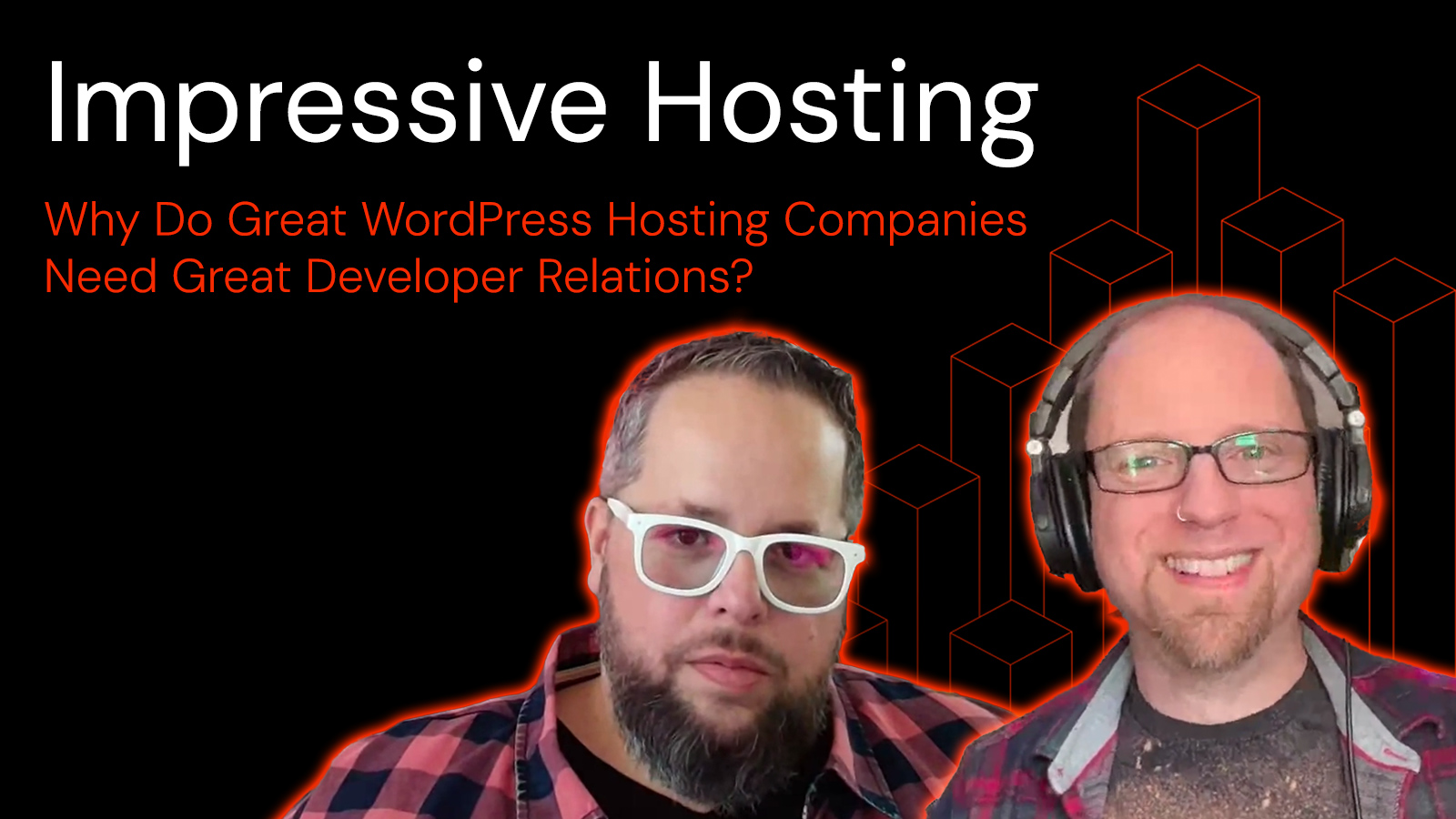
In part two of our conversation with Chris Reynolds, Pantheon’s Developer Advocate, Jesse Friedman and Chris dive deep into the organizational dynamics and strategic importance of developer relations in WordPress hosting companies.
Chris reveals how DevRel teams often struggle to find their proper home within organizations, whether under marketing, sales, or product teams, and why each placement creates different tensions and opportunities. He shares his perspective on the ideal positioning for developer relations as an independent function that can effectively bridge different departments while maintaining focus on user experience.
The discussion explores practical examples of how developer advocacy translates customer insights into product features, including Pantheon’s recent roadmap tool and the long-awaited GitHub integration that customers have been requesting for years. Chris demonstrates how developer relations can identify blockers that prevent potential customers from signing up, creating a valuable feedback loop for both product development and sales teams.
Jess and Chris examine the broader question of hosting companies’ responsibility to the WordPress community, moving beyond the traditional “maker vs. taker” paradigm. Chris argues that hosts contribute to the ecosystem in ways that extend beyond code commits, including scaling WordPress to handle thousands of sites, providing infrastructure insights, and maintaining community connections.
Their conversation touches on the importance of community giving back, referencing companies like 10up and agencies like Linchpin that consistently contribute tools and resources to the WordPress ecosystem. Chris shares his own journey from community involvement to core contributions, including how Chris’ advocacy led to improvements in WordPress’s font manager feature.
Links:
Transcript
Teaser
Jesse Friedman: Welcome to Impressive Hosting, where we seek to uncover core tenets of great WordPress hosting. I’m your host Jesse Friedman and with me today as part of part two is Chris Reynolds from Pantheon.
Introduction
Jesse Friedman: Chris, one thing I didn’t mention to you in the last episode is that growing up in high school I had a very close friend named Chris Reynolds. So every time I go to say that out loud, I have to remember that you and I didn’t go to high school together in Cape Cod.
Chris Reynolds: It’s a weirdly common name, and I don’t like, yeah I accidentally met someone online who is also named Chris Reynolds, who was also a web developer. And it was really weird for a couple years, like sort of following him, and following his web development process as well, because it was at the time that I was freelancing. So that there were two Chris Reynolds web developers and I think we were both using WordPress. It was a really weird time.
Jesse Friedman: Crazy doppelganger. I actually have two doppelgangers name-wise. One is, I actually have an article on my personal blog explaining how I’m not in any way related to this actual criminal named Jesse Friedman. But there’s actually another Jesse Friedman that I ran into just by chance spelled exactly the same way. And he used to work at Google on the Google Maps team. So not quite as exact as WordPress, but still in the technical world.
And actually the way in which I met him was that he started getting emails from me because my email address is my name with initial in it and his was the same exact one just without the middle initial. And so he gets emails from folks who were trying to get ahold of me because they just happened to leave out the middle initial. And so he is like, I think this is yours. I don’t know how he put it together, but he did. And so he ended up building, working at Google, you have access to all these people. He built some filters and stuff to push some emails directly to me that are inadvertently going to him. So he created like a little auto mail responder. So when we ended up…
Chris Reynolds: Yeah I had CS Reynolds at Gmail for a long time because, you know, when Gmail was brand new I wanted to have a professional sounding kind of email address and towards the end, like I ended up shutting it down because yeah, I was getting so much stuff for other CS Reynolds’ in the world that it was no longer tenable. And it was just like, this is, this is it, just table flip, start over brand new.
Developer Relations at Different Companies
Jesse Friedman: That’s right. All right, so in the last episode, we had a great conversation about support and coming up from that kind of background, empowering you to put yourself in the shoes of your end customers and all that stuff, and you found your way to Pantheon and they, you’re a developer advocate there. You’re beta testing these products and software, putting yourself in the shoes of your end customers, trying to make sure that these products before they go live are ready for the big show and all that.
I don’t think it’s true to say that every single hosting company out there has a developer advocate. You know, I think that a lot of companies have QA folks who are working in QA, things like that. From my perspective, those people are much more focused on like actual bugs or making sure that you’re writing code in compliance with whatever regulations you’ve put in place and things like that, but they’re not necessarily focusing on that empathetic standpoint or trying to think about how your products are gonna be actually used by end customers.
So as you think about your role within Pantheon, how do you think that translates to the rest of the hosting industry and what a hosting company should be considering when maybe thinking about building a position like that and maybe think about some examples that you could share, like where having your role has really helped to save the day, or maybe there’s an example or a story of when Pantheon like really was able to move faster or solve a problem quicker or something like that because of the existence of your role.
Chris Reynolds: I’ll start off by saying that the way that DevRel lives at different companies is different. Like it, there’s a million different ways that developer relations can exist within an organization. Sometimes it’s very technical, sometimes you’re doing a lot of coding. Sometimes you’re doing more like content-focused blogs, live streams, videos, documentation, that sort of thing. At Pantheon, we wear a lot of different hats simultaneously. But the thread that’s always been present at least as far as I’ve known has been that we’re also really deeply involved in the developer community of people that use Pantheon and in the CMSs that we support.
So really trying to get in the weeds and being there with the people that are potentially using our software so that we have a good connection to them. That’s at least like when I joined DevRel because for a while we didn’t have a developer relations team anymore. We had some layoffs and that whole function was dissolved for about a year.
And as I said, I came to Pantheon partially because of the developer relations team, because I had met them in person. I thought they were really cool. I got to know them and got to know the product through the developer relations team. And really when I joined Pantheon, it was with this idea that like, I know that Pantheon does DevRel really well, and maybe someday, I was already in a place where like I’m done with the day-to-day engineering stuff. I kind of want to do this other thing and be able to play more really and when I learned that the team was being reformed I immediately jumped over. I think my interview process was like literally five days, not five business days, but five actual calendar days between my first interview and being offered the position.
Which was pretty fun. But I think part of that is because I was already doing that sort of job and already answering questions in the community Slack and whatever. But yeah so DevRel can have a lot of different flavors depending on where you are.
Organizational Structure of Developer Relations
Chris Reynolds: And it can be in different parts of the organization. Right now we actually just recently moved developer relations into the product organization within Pantheon. Previously we were in marketing. Marketing tends to be a fairly common place where developer relations goes, even though as marketing, like I’m not a marketer. The things that I do, maybe they’re marketing-adjacent, but it’s really like the types of stuff that I would be creating from a marketing standpoint is really like long-tail stuff, right? It’d be like, you know, a blog post that maybe somebody will read in a year from now and be like, oh, maybe I’ll consider Pantheon because they are really good at this thing. Or they have this idea or whatever. It’s not a thing that’s gonna immediately turn into inbound leads, right? Which is a lot of what marketing is about.
It makes a little bit more sense in product because that means that we’re more closely aligned with the things that our product is doing, our product engineering teams are doing, which fits with sort of what we do.
It’s also sometimes developer relations is stacked under sales, which is also a really weird fit. I know I have talked to one of my former coworkers at WebDev was Damon Cook, who works at WP Engine as a developer advocate. I remember talking to him before when I was considering moving into developer advocacy and he was telling me that WP Engine has DevRel under sales. And I always thought that was really weird. So it’s not even like the things that they’re producing. They’re done with an aim for selling the product to their customers. And maybe they’re selling it to a technical customer but that’s still like, it still has that sort of end goal.
And from what I’ve heard of other people in developer relations that sales, when it’s nested under sales, there’s always that sort of tension of like it doesn’t really fit here, but we’re gonna make it work. But there’s sales has these expectations that are just kind of unrealistic for the type of work and the function that we do. Where developer relations really excels is in being able to connect with and give value to developers who use the thing, right? Not everything. Not every software needs a developer relations team necessarily. But if you are building an ecosystem of people building with your tools, then it’s helpful to have a team of people that kind of know how it’s done, or at least know how to guide you along in your journey as you’re learning this thing.
Jesse Friedman: The idea that I could see the complexities and the tension of having a developer advocate working under a sales team. Because that you’re in that close proximity to another team, you almost take on their goals and their initiatives.
Chris Reynolds: Right.
Jesse Friedman: I would imagine your role would be very different if it was less about providing and ensuring a really great experience for that customer, but instead creating an experience that’s sellable or that…
Chris Reynolds: Revenue. Good.
Jesse Friedman: Keep the lights on. I totally understand that, but there’s, it is, it’s very different when you think about it from that perspective is like, are you building this to provide a really excellent experience, which will naturally fund sales? Or are you trying to shape the experience around something that appears to be highly sellable and will drive revenue, but maybe it doesn’t have at its core the need to create a great experience.
And so I could see how that could be pretty complicated and a little bit of tension there and maybe even make the developer’s advocate’s experience a little bit frustrating because you want to give feedback and you want to help make this product better, but maybe your advice is not gonna help it sell better. Or maybe there’s a tool out there that sells like crazy, but maybe it’s not really providing the best experience and so now you’re not in a position to really advocate for even removing it or building it from the ground up because the sales team’s afraid of touching it.
Ideal Position for Developer Relations
Chris Reynolds: When my boss asked me like, where I thought DevRel should fit within Pantheon when we were considering moving out of marketing, my initial response is well, in a perfect world, we would live independent of any stack, right? Because I see developer relations as being like a medium between different parts of the company. Both like in between the company and our users. We should float and have good working relationships with kind of everyone because we’re representing what the user experience of the product is. So ideally we don’t have anybody over us, right?
Ideally we just live in this amorphous space that kind of hovers over and connects with different people at different times. But the reality is usually it’s nested under something. And that something depends on really I think in the industry within DevRel broadly it’s usually which person in which department cares the most about the types of things that DevRel could do. And a lot of times, developer relations teams are spun up without a full understanding of what it does.
And I’m very thankful that, like I feel at Pantheon we have always understood that because foundationally our founders were basically doing DevRel when they made Pantheon. They were speaking at events. They were talking about how they built Pantheon, why you should use Pantheon, because that’s what they did. And these are the decisions that led to the architectural decisions that we made. And they were leaders in the Drupal community for doing that. And we’re just an extension of Josh and David Strauss and Zach Rosen, the people who built Pantheon from the ground up. We’re just continuing the legacy of things that they did when they first founded the company.
Platform Building and Customer Empowerment
Jesse Friedman: That’s great. It actually kind of brings me back to my role within WP Cloud and thinking about the way in which we’re going to market with what we have. We have a WordPress-first cloud platform that is only for WordPress. And the way in which we’re going and servicing hosting companies is giving them basically WordPress as a service. And the beauty of the product that we’re shipping is that we handle the security, we handle the performance, we handle all these elements underneath their infrastructure, but we’re removing the business of it.
And what I mean by that is that WP Cloud operates in an API layer below whatever way in which they go to market. So we are gonna focus on providing these experiences and making sure that sites are fast and reliable. But then they can go to market with any way they want. They can craft an experience that is catered to their end customer and give them, and it empowers them to really differentiate themselves. And it’s not us driving in any way a specific narrative around how it is that they need to shape things.
And it’s funny because we talk to different customers, like Conveo recently went live with WP Cloud and they actually went in a different way that a lot of other customers are going where they’re using WP Cloud to go up-market and to service enterprise-level customers, similar to what Pantheon does. Conveo was already doing that, but they wanted to be able to provide something at the same level of quality, but do it at scale. And so that’s how they’re leaning on WP Cloud to do that at actually moving down-market and selling lower-tier pricing plans.
When you mentioned that you really just drove it home for me, that one of the real advantageous elements here is that whether or not you’re building software for an end customer or you’re building a platform for a partner being focused on the experience that you’re providing and the way in which you’re delivering that product. But getting out of the way of the way in which they want to use it is important so that they can go and they can employ it any way they want to build their own workflows on it, build their own panel on top of it, incorporate it into their agency program, however they’re doing it. You are really focused on just providing them with an excellent experience and giving them the freedom.
It’s very much I think how it must feel at Microsoft or Mojang before it was Microsoft and working on Minecraft. My daughter is a huge fan of Minecraft and the things that she builds is absolutely amazing, and I have to think to myself ways in which they’re instituting some new piece of the puzzle in Minecraft. Some new formula thing or a new block or whatever. It’s not just about oh, I’m going to insert this into a building. You are creating a framework for someone to build endless number of things on top of it, and there’s no way in which you can actually forecast or predict how they’re going to actually use it in the future. It’s just you are giving it the components and the pieces so that someone can actually institute it and build it into their workflows, and that’s pretty magical.
It’s pretty awesome that you get to work on things like that and helping your end customers to really build out. And we talk about this a lot too. You’re helping them to build out more efficient workflows to do their jobs better. You end up putting more money in the pockets of agencies because they can do more with less or they can ship faster or whatever. They can end up hiring another employee and taking on more work because you’ve made their workflow so much easier. So that’s really cool.
Customer Success Stories
Chris Reynolds: We’ve, one of the things that is like a banner moment we’ve actually gotten this comment more than once because we just recently had, at DrupalCon we had a partner summit and another newish customer said basically the same thing that we’ve heard that’s been in slides for a couple years from somebody completely different. But basically the gist is Pantheon gave me my weekends back.
And it’s the idea that because of the tools that Pantheon has, because of the workflows and the automations and because of how it just improves the workflow, it means that this person didn’t need to be on call over the weekend for an important deploy or to monitor things. They could just trust that Pantheon does the Pantheon things and they can go back to working eight to five or whatever and not have to stress about it when they’re not at work.
And that’s honestly like, if there is, that’s the best testament that, I really think that we rely a lot on stories like that to communicate the value of the thing that we’ve built.
When I went to my first DrupalCon last month. And DrupalCon has an opportunity to basically if you have enough space and you have a PA system, you can just bring a PA system to your booth and do demos and things, which some people are doing. And we had one of the bigger sponsorships. So we did that. And in the past we’ve just been presenting DevRel doing DevRel things and presenting things that Pantheon does and whatever, and it gets some people to turn up. But what a pattern that we noticed last year that we leaned into a lot this year was we got an even better response when we just asked some of our partners, some of our customers, to talk about something that they’re doing with Pantheon and have them present and tell their story.
We were packed for pretty much every one of those booth demos, and the stories were great and the quotes that came outta them were amazing and it really just drove home the sort of value. A lot of times DevRel is just taking a step back and letting people do our job for us and just shining a light on those stories.
Jesse Friedman: That’s a great point to drive home that sometimes you’re, you said, shining a light on those stories, but sometimes it’s just a matter of connecting the dots, right? Being a conduit…
Chris Reynolds: Yeah.
Jesse Friedman: …a way to communicate what someone’s experiencing, positive or negative, and bringing that back to the people who are actually building the products to inform their decisions and help them to move things forward. And in that example you said before, like if you’re bringing that back to a sales team, that’s very different I think, than bringing it back to a team of developers or product people who are focused on building something there.
Chris Reynolds: But obviously there’s a sales overlap, right? Those are stories that are gonna help sales, right? To have those sort of use cases and testimonials and things. Those are like gold in your pocket when you’re going into sales meetings. But yeah, I mean it’s not, it’s just a different, it’s different interests and there’s different flavors of developer relations depending on where in the organization structure you happen to be.
Balancing Customer Wants vs Business Needs
Jesse Friedman: So when you’re interviewing folks or talking to them and thinking about it on behalf of your team and your product team, how do you balance what a developer wants versus maybe what the Pantheon or any hosting company wants to promote or sell or anything? How do you help to prioritize things that you are the people you’re interviewing or asking for areas where you think that a new evolution would fill a gap over something that may have an easy price tag on it or something like that.
Chris Reynolds: We’ve always had this challenge of surfacing insights that are coming from the customer base internally to become features of the product and also outwardly telling people what we are doing to solve those problems or alternately not solve those problems. Right. And so we recently launched a roadmap tool. We use this product board. It’s at I believe roadmap.pantheon.io where you can go and you can see all the things that we’re working on, and you can vote on upvote things that you’re interested in. You can submit new ideas, and those go directly to product managers. Product managers can assign it to a particular, connect it to another idea that’s already been surfaced.
Each idea that comes in from a customer or each upvote basically increases the value internally that, okay, we’re gonna be looking at this thing more because there’s more people that have asked for this or a similar feature. And that’s a really valuable tool that we’re starting to lean into more to really drive some of the product decisions that are happening.
GitHub Integration – A Long-Requested Feature
Chris Reynolds: One thing that I think that has come out of that or two things, that thing that has been perhaps lacking in the platform forever is that as people started building their sites and really leaning into using things like GitHub for hosting the code for their site Pantheon comes with its own Git repository, which is really great. It’s one of the things that I loved as a developer about Pantheon. But we also don’t have pull requests and code reviews, built-in processes, things that you are now used to seeing and issue queues and whatever that you’re used to seeing on GitHub and that people use teams use GitHub for.
So having an interaction between a GitHub repository and a Pantheon site has been a place where a lot of people have built their own integrations. For a while we had a thing called Build tools where it would create a sort of layer through, I mean, this is pre-GitHub actions even, a set of workflows that would connect the dots. But now we’re building a native integration first with GitHub and then with other version control systems like GitLab and Bitbucket and whatever. Where it doesn’t like, basically wherever your code lives, if it lives in GitHub, if it lives in Bitbucket, that is now the code server. We don’t, we were not going to manage the Git repository anymore will just let you do the Git repository and use whatever tool you want.
And that’s obviously like that’s a thing that people have been wanting for years, for possibly a decade. And that’s a thing that’s being acted and that’s one of the things that I’m, I’ve been playing with a lot myself as well recently.
Jesse Friedman: Before you move on there, you know, it’s the idea that’s been around for a long time that people have wanted for a really long time. I think that’s where your role can really feed into that sales position, right? Because then you can say, Hey, this has been something that people have been wanting. It’s a blocker. Maybe a lot of people who didn’t sign up. And then there’s probably a correlation there that’s, you know, if you are working in a sales team at a hosting company, something to think about might be like keeping track of the customers who would’ve signed up if it weren’t for this thing and then…
Chris Reynolds: Yes. A thousand percent.
Jesse Friedman: And then using that to fund the products. And then when that gets released and all of a sudden you have now a book of business that you could be calling, reaching out and saying, Hey, we have that thing now. Come on over.
Chris Reynolds: Yeah. Yeah. And it’s funny because as I said, people have been implementing their own versions of this for years. If you go to the GitHub actions marketplace and do a search for Deploy to Pantheon, there are three different actions called Deploy to Pantheon, or that deploy to Pantheon as GitHub actions, none of which are maintained by us. We’re going to fix that problem. We’re working on a native one ourselves that’s gonna do those things. One of ’em is by Alley, one of ’em is by 10up. One of ’em is by a former Pantheon. It’s just really funny that going there myself as somebody who works there, I’m like, yeah, that we should definitely have something in this list, right?
It shouldn’t just be, but it’s also notable that like I said, 10up and Alley. Those are companies that I recognize and I trust that have built solutions for this in different ways. And seeing them sort of building that.
Community Giving Back
Jesse Friedman: 10up there. I feel like, you know, going back just to the last episode where we talked about you coming up in the community and myself coming up in the same way. Jake Goldman from 10up actually used to live here in Rhode Island where I’m located, and he was one of the earliest people who I worked with and he always exemplified this idea of giving back in terms of open source and everything.
And I just feel like you see that all over the place with 10up, there’s always 10up just seems to be everywhere where they just we built this for ourselves and actually just coincidentally out of Rhode Island, Aaron Ware, who was on this podcast from Linchpin, has basically done the same thing. His agency has all these intricate little tools and little helpers and everything else that they use all the time, and then they just release them for free.
And I think it just goes to show very much that the WordPress community, a lot of the people who have seen a lot of success within WordPress have come up on the backs of benevolent people who have helped them get there themselves. And so that instills in them this need to give back to the community. And you see that through all these different products peppered around. I didn’t mean to interrupt you there, but I just, when you mentioned 10up, having one of those things out there, like it just, I was like, that is exactly the way in which they operate. If they’re gonna build a thing, they’re just gonna give it away. They’re just gonna help people be more successful.
Chris Reynolds: Yeah. Well, and going back to that conversation too, one of the things that was fundamental for my growth within WordPress and my reason for sticking around was the, so the blogging system that I used before WordPress was called Slog. And when Matt tells the story of b2/cafelog, the story of you developer goes missing, we don’t know what’s going on. There’s no development for a period of time. It was very similar with this slog and I found it on some website called HotScripts which is hilarious now that I think about it. It’s like it had a slower development cycle. The developer went missing for a while. I’m like, okay, there’s problems. There’s things that I need fixed. I’ll try WordPress out.
And the thing that kept me around in WordPress was realizing that whenever I had a question or a problem, I could do a search on the internet and I would either find a piece of documentation on that thing or I’d find a blog post about that thing. And it just, like you said, the community just putting that time in. And so that’s what led me to both get involved in the documentation team for core for getting involved in WordCamps in the local WordPress community and becoming a speaker and teaching doing Pluralsight courses.
All of that stuff was because of, my growth in WordPress was foundationally because WordPress has been so good at just maintaining such a high level of documentation and just an ecosystem around it. And that was my way of giving back is being able to feed back into that sort of cycle.
Core Contributions
Jesse Friedman: Yeah, that’s really cool. Have you officially, you obviously contributed back through documentation, but are you a core contributor as well?
Chris Reynolds: I have a couple core commits to my name. I think that my first actual core commit was just like a doc block that I fixed something for.
Jesse Friedman: Do you remember the day you got your wings right? Like the day that you were actually mentioned in a core release. Because I remember mine and it was another thing, it was rather small, but the thing that I was fixing was just this little thing that bugged the crap outta me. It was in the header when you started a new site. It was just providing a poor experience to an end user trying to figure out how to get started with WordPress. And so I just, it was like, I don’t know, six lines of code to just clarify a statement.
But it was just one of those moments where you feel like you are one, you are writing code that is going to be implemented on millions of websites and a large percentage of the entire internet, which is this huge, monumental thing, but also just like, it’s like this moment of recognition for giving back to a community that’s helped you so much. So that’s why I wanted to ask, because I was like, I bet you remember the first commit you had because I think everybody does.
Chris Reynolds: Yeah more recently one of my colleagues, Phil Tyler likes to say that I single-handedly punted the font manager out of 6.4. Because when that was being discussed in the GitHub repository, I tried it out on Pantheon. And because our system is a read-only file system for the live sites. There was no way of managing fonts in the implementation that was built originally. And so we would need to like there, and there was no way of changing where fonts were stored or whatever. So people would not be able to use the font manager from day one unless there was a filter or a constant or something to at least customize that.
And because I was loud enough about that in the right channels they got punted. It got punted outta that release, and it was put into 6.5 or 6.6. And at which point there was, it was a whole conversation about what the, where, the best place to put those things are, why it should be in a different place. Pros, cons, whatever. And also I think a filter in place to modify it. And really all I needed was a filter. Give me a filter and I’m happy because then we can just put it into our mu-plugin and just move along. But it did lead to more conversation, which I was happy to see because not just us, I mean, we’re not the only ones that have a read-only file system, but we are. We host a lot of sites and we do have a read-only file system. And yeah, that was, so I have props for that as well because I was just in the GitHub being a problem.
Host Responsibility to WordPress Community
Jesse Friedman: You know, It’s funny, I think that a pessimistic person might look at that and say oh so you’re pushing the change because it’s just gonna mean more work for your customers on Pantheon. But the real reason that you’re doing it is because you’re extending your role beyond advocating for Pantheon customers, and you’re giving back to the community and advocating for the entire ecosystem.
Which kind of goes back to a common theme that we see within this podcast every single time I’m interviewing somebody. We circle back to this concept that a host has a responsibility to the WordPress community. And the reason that I say that is because when you look at the Pantheon website right, you talk very heavily about the WordPress hosting that you’re providing and the speed and the performance that you get and the other things and everything else. And so if you are convincing someone to come to Pantheon to have a good WordPress experience and you don’t provide a great WordPress experience. you are doing a disservice to the WordPress community because now people may lose faith in what WordPress actually means and what the core value that you get out of WordPress.
And so I love seeing that you are, you know, you’re extending your role beyond just the parameters of solving for Pantheon. But you’re giving back to the WordPress community. But let me ask you this, and this will probably be our final question because we’re already at time. I can’t believe another half an hour has gone by so quickly where do you see. A developer advocate having more formal responsibility back to the WordPress community. Is this something that you would expect a developer advocate at any hosting company to be doing and feeding feedback back to the community? Or is this something that you just, you want to do outta the goodness of your heart and it’s less of a responsibility to the role and more just how you came up and where you came from?
The Maker-Taker Relationship
Chris Reynolds: I definitely gravitate toward community-based things because that is, that was my entry point, and I definitely that’s just part of who I am, and that’s, it just coincides with the work that I do because the work that I do happens to be really good, that I happen to be already invested in the community and talk passionately about the community, but I fundamentally believe that, so Dries Buytaert the founder of Drupal wrote a very well-known blog post about the maker-taker relationship. That there are people who make the thing, and then there’s people that just take and profit off the thing.
And a lot of the characterization around hosting is in this idea that hosts are takers that we don’t have a million hours of contribution back into the source code, Drupal, WordPress whatever it is. Then we’re just profiting off of the software that we’re building, that we’re using. And I think that is a misrepresentation of the impact that a provider has on the overall ecosystem.
Because like you said, we’re doing things like we’re involved in the community, and we’re helping the ecosystem grow and thrive. And maybe it doesn’t have a tangible number of commits associated with it, but it is still helping the health of the community and the software by being able to scale to thousands of websites or like a single multi-site with 5,000 subsites on it or whatever. You wouldn’t know that was possible unless you had teams and people in the spaces and making sure that it can run on a hosting platform at that scale.
So I think that it’s…
Jesse Friedman: That’s right? We talked earlier about how you’re someone who’s connecting dots and conveying ideas and helping to shape the things that people are building, whether at Pantheon or WordPress core, by highlighting your experience and those of the people who are using it. So I think you’re absolutely right. I think that there’s more than just core commits as a way to contribute back. And there’s so much more. I mean, You mentioned documentation and other things, but it sounds like what you’re saying is that at the end of the day, whether it is core commits or not, there is a need for institutions that’s selling WordPress to give back in some way to the community to preserve it, to make sure that it’s gonna live another hundred years and be there for us in the future.
Yeah. Very cool. All right, great. This was another fantastic conversation. I really loved having you on, Chris. I would love to have you back and yeah, if there’s anything else you wanna say before we go. Otherwise thanks so much for a great episode.
Conclusion
Chris Reynolds: I’m on the socials at least occasionally. I’m jazzsequence in most places. You can find me online. I’m happy to talk about Pantheon or WordPress or other things. And yeah I’m thank for having me on.
Jesse Friedman: Great. Yeah. Thank you very much.
Subscribe to Impressive Hosting:


Leave a Reply