'%3E%3C/path%3E%3Cpath d='M76.4782 25.7185L71.982 9.04089H74.6936L78 22.8409L81.8045 9.04089H84.5853L88.2722 22.8409L91.5787 9.04089H94.2902L89.7248 25.6977H86.7781L83.1396 12.6379L79.3835 25.6977L76.4782 25.7185Z' fill='rgba(247, 43, 0)'%3E%3C/path%3E%3Cpath d='M96.6075 9.04089H102.439C103.739 9.04089 104.818 9.26224 105.676 9.69803C106.534 10.1338 107.17 10.7287 107.592 11.4827C108.014 12.2367 108.222 13.0875 108.222 14.0421C108.222 14.9483 108.021 15.7783 107.613 16.5254C107.212 17.2794 106.575 17.8812 105.725 18.3239C104.867 18.7666 103.774 18.9879 102.439 18.9879H99.1323V25.6977H96.6075V9.04089ZM99.1323 16.9128H102.321C103.511 16.9128 104.362 16.6568 104.881 16.138C105.399 15.6192 105.655 14.9206 105.655 14.0352C105.655 13.1152 105.399 12.3958 104.881 11.8839C104.362 11.372 103.511 11.1092 102.321 11.1092H99.1323V16.9128Z' fill='rgba(247, 43, 0)'%3E%3C/path%3E%3Cpath d='M124.138 25.9744C122.492 25.9744 121.067 25.6147 119.87 24.8953C118.674 24.1759 117.747 23.166 117.097 21.8725C116.446 20.5789 116.121 19.0848 116.121 17.3901C116.121 15.6746 116.446 14.1735 117.097 12.88C117.747 11.5864 118.674 10.5765 119.87 9.84329C121.067 9.11698 122.492 8.75036 124.138 8.75036C126.089 8.75036 127.68 9.22766 128.918 10.1753C130.156 11.1299 130.938 12.458 131.277 14.1735H128.469C128.247 13.2051 127.77 12.4373 127.044 11.8631C126.317 11.289 125.342 11.0054 124.118 11.0054C122.45 11.0054 121.136 11.5726 120.168 12.707C119.199 13.8415 118.715 15.3979 118.715 17.3831C118.715 19.3476 119.199 20.8971 120.168 22.0246C121.136 23.1521 122.45 23.7124 124.118 23.7124C125.342 23.7124 126.317 23.4427 127.044 22.9031C127.77 22.3636 128.247 21.6234 128.469 20.6896H131.277C130.945 22.3428 130.156 23.6294 128.918 24.5702C127.68 25.5109 126.089 25.9744 124.138 25.9744Z' fill='rgba(247, 43, 0)'%3E%3C/path%3E%3Cpath d='M133.961 25.6908V8.5636H136.486V25.6908H133.961Z' fill='rgba(247, 43, 0)'%3E%3C/path%3E%3Cpath d='M145.195 25.9744C144.067 25.9744 143.057 25.7185 142.158 25.1997C141.259 24.6809 140.553 23.9615 140.027 23.0346C139.502 22.1076 139.246 21.0216 139.246 19.7903C139.246 18.5591 139.509 17.4731 140.041 16.5392C140.574 15.6123 141.293 14.8929 142.192 14.3741C143.099 13.8622 144.102 13.5994 145.215 13.5994C146.343 13.5994 147.353 13.8553 148.252 14.3741C149.144 14.8929 149.864 15.6123 150.396 16.5392C150.929 17.4661 151.192 18.5522 151.192 19.7903C151.192 21.0285 150.929 22.1076 150.396 23.0346C149.864 23.9615 149.144 24.6809 148.245 25.1997C147.332 25.7185 146.315 25.9744 145.195 25.9744ZM145.195 23.8093C145.796 23.8093 146.357 23.6571 146.869 23.3597C147.387 23.0553 147.802 22.6126 148.121 22.0177C148.439 21.4228 148.598 20.6827 148.598 19.7903C148.598 18.898 148.446 18.1579 148.134 17.563C147.823 16.9681 147.415 16.5185 146.896 16.221C146.377 15.9167 145.824 15.7714 145.222 15.7714C144.62 15.7714 144.06 15.9236 143.548 16.221C143.029 16.5254 142.614 16.9681 142.296 17.563C141.978 18.1579 141.819 18.898 141.819 19.7903C141.819 20.6827 141.978 21.4228 142.296 22.0177C142.614 22.6126 143.023 23.0622 143.534 23.3597C144.032 23.664 144.586 23.8093 145.195 23.8093Z' fill='rgba(247, 43, 0)'%3E%3C/path%3E%3Cpath d='M158.275 25.9744C156.85 25.9744 155.723 25.5317 154.906 24.6394C154.09 23.747 153.682 22.4258 153.682 20.6688V13.8899H156.207V20.406C156.207 22.6887 157.141 23.83 159.015 23.83C159.949 23.83 160.717 23.498 161.326 22.834C161.927 22.1699 162.232 21.2153 162.232 19.9771V13.883H164.757V25.6908H162.522L162.336 23.6225C161.969 24.3488 161.436 24.9299 160.731 25.3449C160.011 25.7669 159.195 25.9744 158.275 25.9744Z' fill='rgba(247, 43, 0)'%3E%3C/path%3E%3Cpath d='M173.341 25.9744C172.2 25.9744 171.19 25.7046 170.318 25.1651C169.447 24.6255 168.762 23.8854 168.271 22.9515C167.779 22.0177 167.53 20.9525 167.53 19.7627C167.53 18.5729 167.779 17.5146 168.271 16.5876C168.762 15.6607 169.447 14.9275 170.325 14.4018C171.204 13.8692 172.213 13.6063 173.362 13.6063C174.296 13.6063 175.119 13.7861 175.824 14.1528C176.53 14.5194 177.083 15.0313 177.478 15.7022V8.5636H180.002V25.6908H177.74L177.478 23.8577C177.097 24.4111 176.571 24.9022 175.907 25.3311C175.243 25.76 174.385 25.9744 173.341 25.9744ZM173.791 23.7885C174.87 23.7885 175.755 23.415 176.44 22.6679C177.132 21.9209 177.478 20.9663 177.478 19.7903C177.478 18.6006 177.132 17.6391 176.44 16.8989C175.748 16.1588 174.863 15.7922 173.791 15.7922C172.712 15.7922 171.826 16.1588 171.127 16.8989C170.429 17.6391 170.083 18.6006 170.083 19.7903C170.083 20.5651 170.242 21.2568 170.56 21.8586C170.878 22.4604 171.314 22.9308 171.881 23.2767C172.435 23.6156 173.078 23.7885 173.791 23.7885Z' fill='rgba(247, 43, 0)'%3E%3C/path%3E%3C/svg%3E)
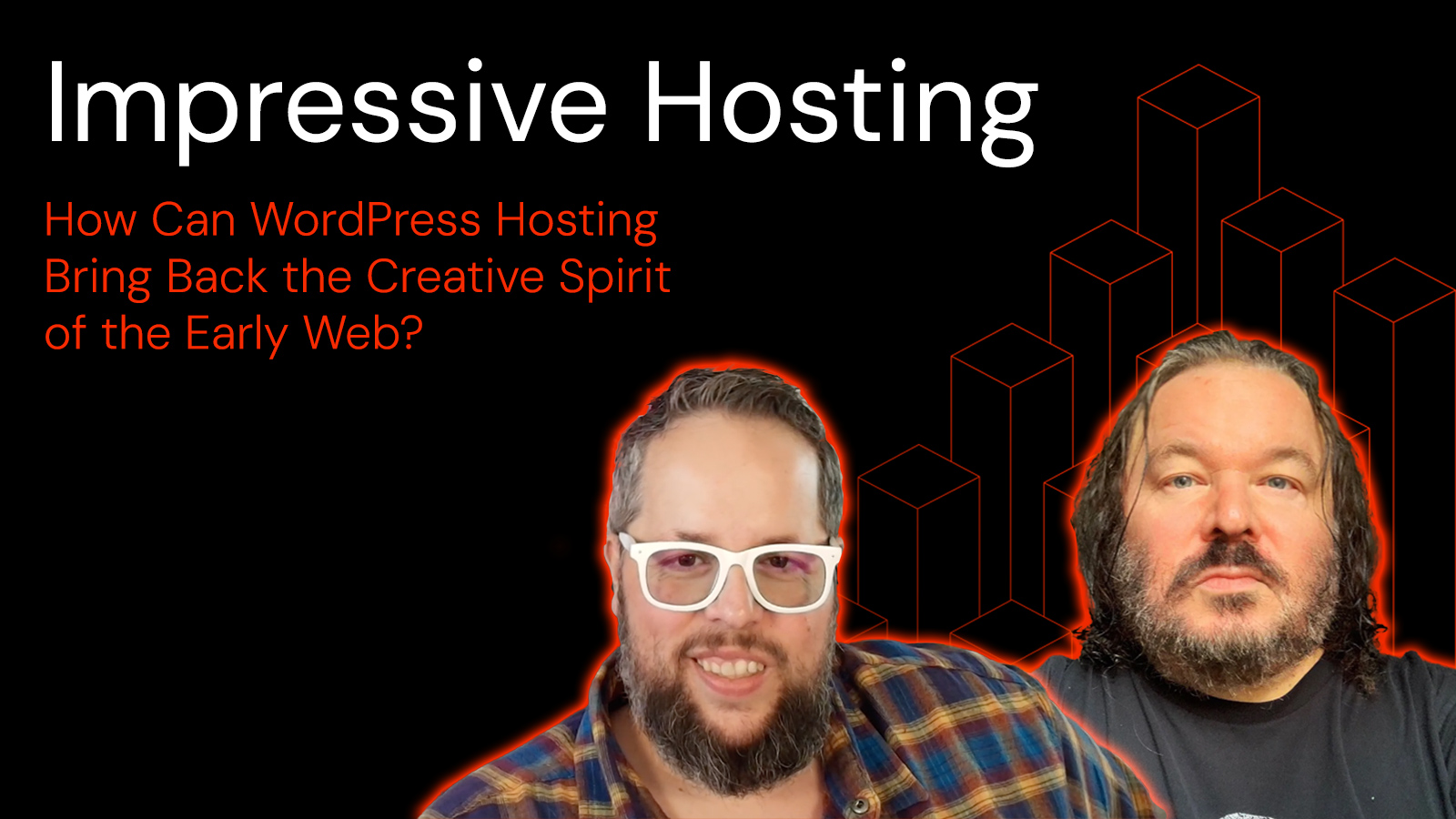
Host Jesse Friedman sits down with Jeffrey Zeldman, the web standards advocate, designer, and current Automattic colleague who helped shape the modern internet through his work ending the browser wars.
Jeffrey shares stories from the early web when designers had to choose between Netscape and Internet Explorer, often creating separate sites for each browser. He explains how the Web Standards Project translated complex technical specifications into compelling benefits that browser companies could understand, ultimately creating the foundation that made everything from the iPhone to modern responsive design possible.
The conversation explores how the web has evolved from a place of creative expression and individual artistry to today’s conversion-focused, sterile landscape dominated by social media algorithms. Jeffrey and Jesse discuss the contrast between early web experimentation with transparent PNGs and CSS techniques versus today’s form-heavy, data-extraction focused approach.
For hosting companies, Jeffrey offers crucial insights about designing with empathy rather than extraction. Instead of rushing customers to “pull their credit card out,” he advocates for understanding customer goals and creating personalized experiences that genuinely help people succeed online.
Key topics include Jeffrey’s current work at Automattic on AOS (Automattic Operating System) and employer brand, lessons from 30 years of freelancing including when and how to fire difficult clients, and why “fair trade marketing” beats data harvesting for building lasting customer relationships.
The episode also touches on concerns about AI site builders potentially recreating the semantic structure problems that plagued early web development, and how WordPress represents an opportunity to maintain the open web’s creative potential against the algorithmic control of closed platforms.
Jeffrey’s perspective as someone who lived through the browser wars and now works at one of the web’s most influential companies offers unique insights for hosting providers looking to serve customers with genuine empathy and long-term success in mind.
Links:
Transcript
Introduction
Jesse Friedman: Welcome to Impressive Hosting, where we uncover the core tenets of great WordPress hosting. I am your host, Jesse Friedman. Before we dive in, remember to check out impressivehost.net. It’s where you can comment on episodes, ask follow-up questions, and submit questions for upcoming guests.
You’ll also find all our links to follow, like, and subscribe wherever you listen. And today I’m very excited to say that with me is the godfather of web standards, the peacemaker of the great browser wars, the creator of A List Apart and An Event Apart, author, educator, and evangelist of the Open Web, Jeffrey Zeldman. I think it goes without saying as to why I wanted to have you on the show today, but thank you so much for joining. A real pleasure for me. I’ve been following your career for a very long time. I’ve been influenced heavily by the work that you’ve done. And so having you on is a great honor.
But thank you. Thank you so much for coming.
Jeffrey Zeldman: Shucks, I’m very honored to be here. I really look forward to doing this with you. I’m happy that we’re doing it now.
Jesse Friedman: That’s great. So I actually have the pleasure of working with you as a colleague here at Automattic. You know, you had a very storied past with the web, but let’s kind of start with the present. What are you doing at Automattic? What are you working on?
What is it like working at Automattic?
Jeffrey Zeldman: So at Automattic, basically, I do a lot of writing. I work on two things. AOS, which is the Automattic Operating System, which is kind of how we think of what we make for people, how it works for them, are they happy? So it sort of overlaps product a little bit, but it’s also how do we interview people when we’re hiring?
Are we prompt at giving them an answer? Everything, it’s like nothing and everything. It’s a very zen area. And that’s no offense to actual Zen, which I just summarized in a very dumb American way. Never mind that. It’s somewhat intangible, so coming to grips with that is interesting.
The other thing that I work on a lot is employer brand. I got this job, I hadn’t worked for anyone for like nearly 30 years. I’ve worked for myself for my own companies. You mentioned An Event Apart, and that was with Eric Meyer. Basically I hooked up with smarter, more talented people and started companies that way. A Book Apart with Jason Santa Maria, Mandy Brown, and so on. But I contacted Matt, who I knew from the conference scene and we’d had dinner a couple times and I said, you have an amazing company, but your website isn’t telling that story. And he said, I’ll hire you but don’t change the website.
So I’m finally changing the website, but I’ve been here six years and I’m changing it with other people and it would’ve been wrong to do it when I first arrived. And I gotta say, I can’t imagine working anywhere else in tech right now. Even the worst day at Automattic is better than 99% of tech jobs from my friends who are still employed, and of course, better than my friends who are unemployed and struggling. Like, you know, you get a few gray hairs and you’re just like, you can’t code anymore, or no one wants to see your designs, old man or whatever.
That’s not the case at Automattic. We hire a lot of not only actual veterans of like wars, but veterans of browser wars. That sounds like I’m comparing Desert Storm to the browser wars. I’m not.
Jesse Friedman: Yeah, but I think it’s okay to say that we had lived through that time period where it was a very tumultuous time for web designers. It was a very hard time period. The web was evolving and growing and changing so much, and there was so much beauty coming out of it.
But behind the scenes, what a lot of people didn’t realize is there were so many struggles trying to make everything work between each browser. And so for those of you who aren’t in my generation, or Jeffrey’s generation, like knowing where the web kind of came from and how all this stuff came about.
The browser wars were really about these browsers choosing to go in different directions, to serve different things, in different ways and without a set of standards. Yeah, they were competing and trying to go for it.
Now you jump in, please.
How did the browser wars shape early web development?
Jeffrey Zeldman: Okay. So the first website that I made with two partners was optimized for Netscape 1.1 because we could make a repeating background tile and do things like, we made the Gotham Library where these repeating brick patterns and then we stuck a table cell with like a white background behind it so that we could mask part of it and then we put a little roof on the top.
We didn’t know what we were doing, but before Netscape, the web was something I’ve looked at a little bit and I remember having—you know, it’s like you hear people who hate each other. Like in sitcoms, people meet and they don’t like each other, and then they end up married, you know, for 50 years with like grandchildren.
It was sort of like that. I looked at the web and went, oh man, this is not gonna replace AOL. America Online is so nice looking. And the Apple’s thing, I forget what it was called, like those have graphic design and the web was really, really ugly and primitive.
Jesse Friedman: I mean, at that time it was mostly just like gray backgrounds and blue text. Just very, very simple.
Jeffrey Zeldman: But that became its own aesthetic and things like nobody had bandwidth. It would take overnight to download a 400 by 300 QuickTime video or RealVideo that was—nobody had this, like, we’re using 14.4 modems. So could you make something that created an impression but was very, you know, used very few resources and Netscape made up these tags and it was the only browser where you could do this, so you’d basically go Netscape or nothing.
And we were ignorant. We didn’t go like, oh, people on Lynx are gonna be screwed. Oh, people who use screen readers. I didn’t even know they existed for a while. So it was this interesting thing where there was a lot of artistry, there wasn’t a lot of usability. There was almost no thought to accessibility and inclusion.
The W3C, the people who made some of our standards were thinking about those things, but they were communicating it like eggheads to each other. So it took someone less intelligent than them—me. And I’d been in advertising before this to go, what’s the benefit? Like imagine you work for an ad agency for Detroit and someone hands you a brief and it’s like, here’s how many cubic centimeters this engine has and everything.
You gotta translate that to whisper quiet ignition or zero to 60. And you know, pulse, you’ve gotta translate it to something that makes people actually care about. And that’s all I really did. I talk to people smarter than me. Todd Fahrner, Eric Meyer, lots of people who I’m gonna blank on.
And it was like, these early standards exist, but they’re not called standards. And we called ourselves the Web Standards Project and we were just a bunch of goofballs. But we could see that it was—what’s the reason they were browser wars. Man, I sound like I’m high. I’m not high by the way. I’m just happy to be talking to you.
Jesse Friedman: The reason I’m sitting here quietly is ’cause I’m just enjoying the conversation. So like you go down as many tangents as you want. But you said how did we get here? And it was very—
Right. How did we get here? People made software and software companies compete. So, you know, one visual tool supports SVG and another doesn’t. Oh darn. We should support SVG. Yeah. But you know what you can do with ours? You can make a timeline and animate things with ours.
Jeffrey Zeldman: So then, you know, so like Photoshop versus—I forget what their competitors were back then. ‘Cause there was a time when Photoshop wasn’t the be-all, you know, and again, these days, it’s not necessarily the first tool a lot of web designers turn to.
Jesse Friedman: I actually opened Figma for the first time and started working in that.
Jeffrey Zeldman: Are you enjoying it?
Jesse Friedman: I actually am, yeah, from a web building perspective, it is quite nice.
Jeffrey Zeldman: How are you onboarded?
Jesse Friedman: You know what’s funny is that everybody at Automattic uses Figma. So every single time that somebody sends me a comp, I get dropped into Figma. And so I’ve had some kind of interactions with it at some level for quite a while. And then I’m thinking about the new framework for the way in which the WP Cloud website’s gonna work. And so I started actually wireframing it in Balsamiq and then I tried Miro, and then I was like, you know what? Let me just try Figma as a way to kind of—and all of a sudden I found myself designing instead of wireframing, because it’s very intuitive. It’s very easy to use. And so I didn’t really have much of an onboarding actually. It just kind of works the way you’d expect it. Which is kind of the beauty of it.
Jeffrey Zeldman: Like Sketch and like, my understanding is it’s pretty similar to Sketch and it’s pretty similar to XD, which was sort of like a poor person’s version of Sketch. I started by coding. I did my designing in code. I did my designing in HTML in plain text for a long time because it was very—what you could actually do was very primitive, but you could make incredibly beautiful things by saying, this area is gonna have this background color.
I’ll put a wall there. Oh, I know. I’ll put a little ping at the bottom. That sort of creates a gradient like before. But anyway, what happened was Netscape browser existed. This was the nineties, mid-nineties. You’d go to computer store or Radio Shack or something. You’d buy this $40 CD-ROM.
You’d sit there, you know, it would have to be optimized for your platform. Then you’d plug it into the—you know, all that. And so Microsoft went, hmm, I’ll tell you exactly what happened. Netscape piled up with Sun Microsystems and said Windows is over. We’re gonna have this combination of the web browser and these open standards and everything’s gonna be great.
And that’s what Bill Gates woke up from his nap and went, oh, are you? All right? Let’s make a browser too and let’s make it different with better features. Not necessarily, but that’s what he would’ve hoped.
Jesse Friedman: So that was the birth of the blue E on the desktop.
What made the browser wars so challenging for developers?
Jeffrey Zeldman: The browser wars, and not only were they incompatible with each other, they were incompatible with themselves. So the way CSS wasn’t supported at all in Netscape three, it was in Netscape four, but differently than how it worked in IE. IE three supported CSS. That was the first time people went, oh, okay, maybe Microsoft has something here.
Like to some degree, Microsoft won the browser wars because they had a monopoly on the operating system and they used that—the European court found that they abused it. Clinton also prosecuted them for anti-competitive monopoly, but nothing really happened in America.
‘Cause we always kinda liked the capitalists. They’re probably—ah, as Europeans let them have their free medicine and their, you know, beautiful clean parks for children. We have the power to someday be a billionaire if we work real hard. In the meantime we pay for everything. And so anyway, not to get political, but so I think when I saw IE three, they did early support of CSS and it was so much better than what you could do with tables and font tags. And I just went, okay, this is the future. And my couple of friends, just some other—I would say not the most popular kids in high school, some of—like we were the people who cared about this, and we found a way to translate.
And the browser companies listened. At first what seemed crazy, like no one was gonna listen to us, but they did. Browsers started supporting standards. We said, support them better, please. Thank you. And we wouldn’t have anything that we have, we wouldn’t have the iPhone. Steve Jobs wouldn’t have been able—would, you know, wouldn’t have been able to say.
‘Cause before there were apps, it was just, we have this internet device, right? But—
Jesse Friedman: Prior to that, like you—the way in which you described it and it’s funny ’cause I have to keep reminding myself. My daughter is 17 years old and I have to remember that her vision for the internet, her view of it is very different from what I’ve experienced growing up. And so for anyone at home who’s not maybe getting it, the browser wars, it was a competitive state in which these browsers were trying to take market share of the people using their browsers by releasing these new cool features and things like that.
And what that ended up meaning is that the web designer would design something and if they didn’t take the care to evaluate the way it looked in every one of these different browsers, it was very much like taking the time to design—and, you know, just for a second, the web at that time and still does, took its page from publishing, right?
Like magazine layouts highly influenced the way in which websites were designed back then.
Jeffrey Zeldman: Roger Black, who designed Time and Newsweek, was one of the first big web designers and founded a multimillion dollar company for the web, you know, dedicated to it. His principles were good. You know, like type hierarchy, all the stuff that people who sort of blundered into it—
Jesse Friedman: Not to mention the stuff that we take for granted today. Yeah, I mean, even just the term below the fold, people may not recognize this, but below the fold is referencing the fold in the newspaper that everything above that was what you would see when it was sitting on the rack at the store and below the fold is what you’d have to do to actually flip it over.
In this case, in the web you’d scroll.
Jeffrey Zeldman: It was based on your client’s screen. So whatever the dimensions of your client’s laptop, you go, I want that above the fold. It’d be like, okay, it’s above the fold for you, but for someone at a different resolution, it won’t be. It’s like, no, I want—you know?
Jesse Friedman: Right, and then the idea that that even makes sense to them is so hard. But this would be very much like designing a magazine layout, expecting to have it printed on a very specific size of paper and then all of a sudden everyone is consuming your magazine in different views, in different formats.
Sometimes text wouldn’t even be visible, images would be missing. Things would—it was just a mess. And so your work and others who contributed to it to standardize these things, had such a major impact on the internet as a whole. I don’t think people necessarily recognize that, who haven’t lived in it themselves.
‘Cause you know, you end up taking these things for granted. You kind of grow up in it and you don’t even understand how you got to where you are today. But, you know, I built my first website in ’98, coding first, as you said. Not designing first, but coding first because it actually closed the gap.
It helped you to not get excited about designing something that was not even possible to be built into a browser. I can’t tell you how many times, you know, a designer would hand me something and I’d be like, that’s not—we’re not gonna be able to do that. We’re gonna have to do it a little bit differently.
But in like the early 2000s and in like, you know, we got to like 2010, you know, we still had this lagging behind old browsers kind of issue where you remember IE5 and IE6 were like the last ones to cause us the most amount of pain.
And I keep going back to this anecdote where there was this website, it was so smart. They had this e-commerce platform and they would detect that you were in IE6 and they would charge you a tax. So if you bought a product off their website, it would cost you an extra dollar because you were on IE6, and they would say to you, if you would like to avoid this charge, go use a modern browser like Firefox and they would actually link to Firefox, and it was a way for them to justify the extra work that was involved in making that website actually function on IE6.
How did web standards advocacy overcome browser compatibility issues?
Jeffrey Zeldman: I get where they’re coming from. But like one of the things when we’d say, well get a modern browser, some people would say, I can’t. I live in a poor country. I can’t, I’m borrowing my grandfather’s laptop. At the beginning, what people don’t know about the browser wars, unless you were around, we would make websites.
Let’s say click here if you’re using Netscape, this, click here. If you’re using Netscape, that, and so on and so forth. And then the advance of like using JavaScript to basically read the metadata at the beginning and it would say who, what it was optimized for or, okay. That was terrible. And then it was a big deal to get people to stop and they’re still some sites being built where they test for browsers instead of capabilities.
And the reason that didn’t work is that like Opera was perfectly capable of displaying a site, but the site had code in it that said, oh, if this isn’t IE6, you can’t come in. So Opera would—I forget the word that we used to use, but it would basically, it was like a cloaking agent or—
Jesse Friedman: It would mask the headers right to kind of like ghost itself as Internet Explorer.
Jeffrey Zeldman: It announced itself as Internet Explorer and then the server would go, oh, I can serve this now. And then maybe it didn’t work, maybe it did, and if it didn’t work, you know, so all this complexity and at the beginning of my design career, I kept going for super simple.
And I would tell—like when clients really wanted that stuff, I would go, you can’t really do that on the web yet. You can’t rely, and this is like 2003. So I was the kind of designer like, why would you hire me? I don’t know. But I was the kind of designer who would say, we can’t do that on the web, or it’s gonna look different.
Is that okay with you?
Jesse Friedman: Well, simplicity’s hard.
Jeffrey Zeldman: Simplicity is hard and incompatibility is hard. Imagine making a film, but projectors aren’t standardized. And so in one thing they’re moving a little too slowly and you can see stuttering. And in another one they’re speaking with high voices and moving too fast.
It was all stuff like that. And then of course people would go, I use the only browser that matters, and then for a long time it’s Chrome, it doesn’t—well switch to Chrome and I still see stuff like that. And the government used to be really bad about that until, I would say the last five to 10 years when a lot of really great UX people went into government work specifically, so that the government could actually serve the people.
And if you wanted to pay your ticket online or register for, you know, to get your new passport online, it would actually work and it wouldn’t go, sorry. You’re using Windows 11. This only works in Windows 3.1 or whatever. I mean, because the other thing is people run outta money and they stop updating. So all of that was terrible.
Web standards was the answer. It’s still the answer. And I struggle now, not at work ’cause I don’t—we don’t do this and ’cause I struggle now because I see so many platforms that being touted as the next, you know, and now AI site builder and it’s amazing. And we even have one ourselves, but I worry like.
Yes, it’s building, but is it doing it the way FrontPage would’ve done it? Treating everything as sort of like just putting everything inside a span and putting that span inside a div and having a million class names and there’s no coherent underlying semantic structure. So selling people on the coherent underlying—that became my job once the browser companies were on board with standards.
It took another five years for us to persuade designers. And everybody loved Flash. I used to hate—I used to hate my life. I would go, my friends are designing such beautiful stuff and I just got a two-column layout to work in CSS on four browsers.
Jesse Friedman: I cut my teeth on Flash websites. Actually, I started a freelance business in high school. All my other friends were serving ice cream at a local shop, making money on the side. I was building websites in a small town on Cape Cod. I moved there after I grew up in New York, so you and I actually have a little bit of overlap there.
But it was an antiquated old town where, you know, everyone was behind the times. So even now they still don’t have as many websites as you think, like businesses just aren’t online as much. So it was a green field for me. I was able to build so many websites for so many local businesses in that area.
And but then my first real job was at a company that built websites for car dealers. And we used Flash for everything. It was an interesting thing.
Jeffrey Zeldman: It wasn’t a commerce site, right? It was more of a look at our great new models, or were you actually buying the car online?
Jesse Friedman: No, you weren’t buying the car. But what you were doing is we had so much content that was actually highly valued. It was great to have in Flash. So for example, people may not know this, but like back in those days, the manufacturers didn’t provide you with the 360 spins of vehicles. So every single make and model, I actually built those for a company that we were later acquired by ADP, which then distributed them.
So if you ever shop for a car between the years of like 2005 and 2007, and you spun the vehicle, I probably made that spin. And so it was stuff like that for Flash. It was so helpful because those types of animations and interactions that users could have—it was beyond JavaScript at that time.
It was not something that you could do, but it required an installation. You had to—
Jeffrey Zeldman: Yes. You had to download and install software in order to use the web.
Jesse Friedman: Exactly.
Jeffrey Zeldman: You remember Jason Kottke before he was kottke the blogger? Initially I met him on a mailing list of like web designers, and he made this great satirical site where you could change the color of a Volkswagen Beetle by clicking. And the colors were based on the first iMacs, the—like, you know, first there was just one color of iMac, Bondi Blue, and then there were like five colors that Steve Jobs picked out, and so he—Kottke made like you could change the color and it was just using JavaScript and I guess PNGs, maybe, you know, colored PNGs or—
Jesse Friedman: Yeah, maybe some. I remember we used to do—we cut out transparent PNGs and then changed the color of the div in the background so that it appeared like a mask over it. Crazy stuff like that because it was funny because each time the browser unlocks something new, like transparent PNGs were huge.
Then you could do like shading and things like that. So you could add depth and feel, but then you were just changing the color behind the scenes. Like it was stuff like that that you used to be so excited back then with the web because there’s always something new to try and test and play with, and it allowed for such strong individual expression.
Why does the modern web feel more sterile than the early web?
And it’s funny because we talk about this on this podcast a lot—the fact that the web is becoming so much more sterile. It seems like, you know, the internet as a whole is so much more focused on getting you to fill out a form, getting you to sign up for a newsletter, getting you to buy something or click on an ad, that it’s almost like everything kind of looks the same, feels the same.
It doesn’t have that weird old web feel as much anymore. And I think a lot of that has to do with social media. I actually shared a video internally at Automattic, I don’t know if you saw it, but it was the perception of the web through the youngest generation, my daughter’s generation.
And the thing that was most intriguing to me was that the way in which this person was describing the internet was by reminding people that Facebook and Twitter and TikTok and Instagram is not the web. Those are closed source, you know, walled gardens that are algorithmic driven, but they are not an expression of the web.
The web is so much more. And the way in which it described is like there’s this whole other internet with websites that you can go and you can see the way in which people describe things differently and talk about things and express themselves. So I think that I personally am on this path of like, getting us back to that.
I want us so badly to return to a place where we’re not relying on Facebook and that WordPress can be that foundational layer underneath of it because it gives you the ability to express yourself any way you want to.
Jeffrey Zeldman: Absolutely. And that was the other thing that appealed to me when—first of all, I was flattered when I was offered a job at Automattic. Also I’d been chasing clients to get paid for 30 years and I’m not getting any younger. And I was like, you know, a steady paycheck might be a good thing. And when you freelance, it’s feast or famine, so you get a whole bunch of money and you think, oh, I’m rich. And then you spend it and then your colleague goes, hey, it wasn’t half of that mine? And you’re like, oh, of course it was. You’re right. Anyway, I was not good at that. I was really good at starting things. I was really good at ideas. I can make a book. I’ve made books. I’ve made websites.
Making a business—that impresses me and people who are good at that impress me and I’m not good at that.
Jesse Friedman: Well, you know, freelancing, I think it helped me to gain somewhat of an entrepreneurial spirit. Like you had to hustle, you had to learn, but you just made me remember something and I can remember exactly where I was. You wrote something online. I don’t remember if it was on zeldman.com or if it was on Twitter or something else.
You gave me permission. You didn’t even know me to fire a client. And it was this idea that had—it blew my mind that, you know, ’cause you mentioned that freelancing was feast or famine. You had to bring in these clients, you had to bring in the work or you weren’t gonna get paid. But at some point, somewhere, I read something that you wrote and you basically said, it’s okay to fire a client if they’re not working, if the relationship isn’t right.
If you’re not helping each other, you’re not serving each other’s needs, you know, whatever it might be. And that actually changed for me, a huge thing. So complete tangent, but I just wanted to thank you because I do specifically remember.
Jeffrey Zeldman: How did you change?
Jesse Friedman: It gave me peace of mind, honestly because it allowed me to shed the weight of some of the more frustrating clients I ever had, and it helped me to grow my business, honestly, because I wasn’t realizing it at the time.
Because, you know, sometimes it’s easier to deal with the devil that you know, and you end up having these prolonged relationships that can be super frustrating and the time sucks and you don’t want to bill them for every minute because it just creates more frustration and more headaches, but at the same time, you’re not creating a mutually beneficial solution, you know, partnership there.
And so feeling better about being able to say, hey, you know, this isn’t working out. I’m gonna fire you. It changed everything because it was always me working so hard not to get fired by the client. And when I was able to switch the paradigm, it was huge. It was an enormous thing for me.
How should freelancers handle difficult client relationships?
Jeffrey Zeldman: Like if someone stays in an abusive relationship ’cause they don’t feel they’re worthy of love or ’cause they’re used to it or ’cause they think it’s all they deserve. Whatever we—and we all have stuff like this. And then realizing it’s okay to be without a partner.
It might be better to be without a partner than to be with the wrong person. Better for you, better for them if there’s kids, better for the kids, like, but that’s hard. There’s a way to fire clients though, too. There’s like a couple things. One is you do it respectfully. You do it as a service. You say, I think your vision is very compelling, but it doesn’t—I’m not sure it aligns with what I’m best at. I feel like my particular skillset is X and you need Y. So and so who I’ve worked with and I believe you can trust might be a good person to talk to, shall I effect an introduction? And that way you’re basically saying, I know you’re not happy, I’ll be brave about this rather than take your money and have you be unhappy and have me eat my heart out.
I will find you someone who will work for you better, the kind of thing you wish for. If you’re ever in a relationship you wanna get out of and you’re like, man, why can’t they just fall in love with Joe over there? And you know, I’ll go, oh honey, that’s okay. Like, I would have fantasies like that when I was in a relationship that wasn’t working for me, that somehow miraculously, ’cause I didn’t wanna hurt anybody.
That’s another thing too, you can feel like, I don’t know. I think there’s people who treat business like business and they’re very cold, and my hat’s off to them, but I always had to fall in love with my clients and have a real relationship or a friendship at least. I don’t mean like make love to them and fly off to Acapulco, I just mean respect what they did, understand their business.
Jesse Friedman: I was gonna say, I think you’re an incredibly compassionate person and it shows in the way in which we converse here. But you are not gonna remember this, but you and I met in 2008 at An Event Apart, and at the time I had the blue beanie on in November for web standards day.
I had your book, idealized you as someone I never cared about. Real celebrities. I literally ran into, bumped into Bruce Willis one day. Didn’t care, but getting to meet you, getting to meet Eric Meyer at that same conference, those were huge moments for me. They were very, very influential. And I followed up and I sent you an email afterwards telling you about some ideas that I had going on, and I shared a web design that I had.
And it was zero expectation to ever hear back from you, but you wrote me this email back and you explained to me about like, you had not only critiqued my work, which I think a lot of people might have been like, oh, he doesn’t like my work, but I saw it as, oh my God, he took the time to tell me where I can improve and that’s gotta cost X amount of dollars per hour if I were to hire him.
And he is just doing this out of, you know, the kindness of his heart. But you also just started a conversation with me and we had bounced around ideas and shared emails over the years and stuff like that. And so like, it’s just always been so amazing to see that from you. But I think it kind of comes from a place deep inside of you that has been expressed through your work as well.
So, you know, it leads us into this conversation about something that I’ve been thinking about a lot lately, which is like, you know, we talked about in the past, designing with the intent to delight, right? And how the web was meant to like, really you have these opportunities to really make people feel special or heard or listened to or whatever.
And I think that the reason you’ve probably seen a lot of success with your work is because you’ve always thought about that end customer and the ability to delight them. And that doesn’t come from a place of capitalistic interest. It comes from a place of wanting to give a great experience to a customer and to give them back something.
How can we design with empathy instead of extraction?
And so now, you know, we talked a little bit about the web becoming sterile. I think we need to be shifting towards a place where we’re more empathetic in our design and that we are thinking and putting ourselves in the shoes of our end customers and getting away from trying to force fit them into a signup flow and do whatever we can to get them to sign up.
Like, I can’t tell you how much it drives me absolutely nuts when people want my personal information before they give me any information in return. You know, one of the things that I’ve been saying for a long time now is this idea of fair trade marketing. If I’m gonna give you something, I want something in return.
If I’m gonna give you personal information, you need to personalize my experience. If I’m gonna give you the business industry that I’m in, do something with it. Don’t use it as a metric just to sell me later. Do something to actually improve my experience so that, you know, when I say I am an electrician trying to build a website, stop trying to show me ice cream shop websites.
Show me something about electricians.
Jeffrey Zeldman: And stop selling. Hey, this electrician, blah, blah, blah. Like, stop selling your sucker list. There are companies that make more money from that than from providing any service, and that can be very seductive.
The dark side is real, right? You mean I can make 20,000 bucks in the blink of an eye? Yeah. Okay. Screw him. I don’t care where he—why he came here. The people, and now with some private equity and just what’s been happening in business the last 10 years and how it’s set up the current political scene where actual working people have almost no chance of surviving.
Like, you know, like everything’s for the benefit of the very few and it just keeps getting worse and worse.
Jesse Friedman: I mean, it’s that desire to extract rather than to give back. And, you know, I mean this whole podcast is about hosting, so I guess we should try to turn this towards it for a little bit, but I think hosting companies, you know, are in a unique place where people are trying to build an experience and they’re trying to launch something, which gives them the opportunity to share so much information about their goals, who they are, what they’re trying to do.
Hosting companies, I think in general, could be doing a much better job of understanding that and then giving back to that customer an experience that helps them to be successful, that’s tailored to them, that’s more personalized to them. And stop focusing so heavily on how fast can I get you to pull your credit card out.
But much more focused on how do I help you to get something going or get something live, be successful. And you mentioned before a little bit of concern with AI. And I have a response to that, but my producer John, he’s gonna kick my butt because we’re almost at 40 minutes.
And these episodes we try to keep them at 30. So is it all right, Jeffrey, if I ask you that we take a break here and we come back and continue this awesome conversation and talk a little bit about AI and empathetic design?
Jeffrey Zeldman: Yeah, that sounds perfect.
Jesse Friedman: Awesome. Thank you so much for joining everybody. You’ll see more of Jeffrey Zeldman and myself in a bit.
Conclusion
Jesse Friedman: Thanks for joining us on another episode of Impressive Hosting, where we uncover the core tenets of great WordPress hosting. Do you have a follow-up question for today’s guest, thought or comment on anything we talked about, a future guest suggestion, a hosting horror story? What do you think makes great WordPress hosting? All your comments shape the show. Drop them on impressivehost.net. We also appreciate you following us on social media and subscribing to the podcast on your favorite platform. Finally, do check out our list of open source projects that need support at impressivehost.net. Whether it’s code, community, or cash, you can make a difference.
See you next time.
Subscribe to Impressive Hosting:


Leave a Reply