'%3E%3C/path%3E%3Cpath d='M76.4782 25.7185L71.982 9.04089H74.6936L78 22.8409L81.8045 9.04089H84.5853L88.2722 22.8409L91.5787 9.04089H94.2902L89.7248 25.6977H86.7781L83.1396 12.6379L79.3835 25.6977L76.4782 25.7185Z' fill='rgba(247, 43, 0)'%3E%3C/path%3E%3Cpath d='M96.6075 9.04089H102.439C103.739 9.04089 104.818 9.26224 105.676 9.69803C106.534 10.1338 107.17 10.7287 107.592 11.4827C108.014 12.2367 108.222 13.0875 108.222 14.0421C108.222 14.9483 108.021 15.7783 107.613 16.5254C107.212 17.2794 106.575 17.8812 105.725 18.3239C104.867 18.7666 103.774 18.9879 102.439 18.9879H99.1323V25.6977H96.6075V9.04089ZM99.1323 16.9128H102.321C103.511 16.9128 104.362 16.6568 104.881 16.138C105.399 15.6192 105.655 14.9206 105.655 14.0352C105.655 13.1152 105.399 12.3958 104.881 11.8839C104.362 11.372 103.511 11.1092 102.321 11.1092H99.1323V16.9128Z' fill='rgba(247, 43, 0)'%3E%3C/path%3E%3Cpath d='M124.138 25.9744C122.492 25.9744 121.067 25.6147 119.87 24.8953C118.674 24.1759 117.747 23.166 117.097 21.8725C116.446 20.5789 116.121 19.0848 116.121 17.3901C116.121 15.6746 116.446 14.1735 117.097 12.88C117.747 11.5864 118.674 10.5765 119.87 9.84329C121.067 9.11698 122.492 8.75036 124.138 8.75036C126.089 8.75036 127.68 9.22766 128.918 10.1753C130.156 11.1299 130.938 12.458 131.277 14.1735H128.469C128.247 13.2051 127.77 12.4373 127.044 11.8631C126.317 11.289 125.342 11.0054 124.118 11.0054C122.45 11.0054 121.136 11.5726 120.168 12.707C119.199 13.8415 118.715 15.3979 118.715 17.3831C118.715 19.3476 119.199 20.8971 120.168 22.0246C121.136 23.1521 122.45 23.7124 124.118 23.7124C125.342 23.7124 126.317 23.4427 127.044 22.9031C127.77 22.3636 128.247 21.6234 128.469 20.6896H131.277C130.945 22.3428 130.156 23.6294 128.918 24.5702C127.68 25.5109 126.089 25.9744 124.138 25.9744Z' fill='rgba(247, 43, 0)'%3E%3C/path%3E%3Cpath d='M133.961 25.6908V8.5636H136.486V25.6908H133.961Z' fill='rgba(247, 43, 0)'%3E%3C/path%3E%3Cpath d='M145.195 25.9744C144.067 25.9744 143.057 25.7185 142.158 25.1997C141.259 24.6809 140.553 23.9615 140.027 23.0346C139.502 22.1076 139.246 21.0216 139.246 19.7903C139.246 18.5591 139.509 17.4731 140.041 16.5392C140.574 15.6123 141.293 14.8929 142.192 14.3741C143.099 13.8622 144.102 13.5994 145.215 13.5994C146.343 13.5994 147.353 13.8553 148.252 14.3741C149.144 14.8929 149.864 15.6123 150.396 16.5392C150.929 17.4661 151.192 18.5522 151.192 19.7903C151.192 21.0285 150.929 22.1076 150.396 23.0346C149.864 23.9615 149.144 24.6809 148.245 25.1997C147.332 25.7185 146.315 25.9744 145.195 25.9744ZM145.195 23.8093C145.796 23.8093 146.357 23.6571 146.869 23.3597C147.387 23.0553 147.802 22.6126 148.121 22.0177C148.439 21.4228 148.598 20.6827 148.598 19.7903C148.598 18.898 148.446 18.1579 148.134 17.563C147.823 16.9681 147.415 16.5185 146.896 16.221C146.377 15.9167 145.824 15.7714 145.222 15.7714C144.62 15.7714 144.06 15.9236 143.548 16.221C143.029 16.5254 142.614 16.9681 142.296 17.563C141.978 18.1579 141.819 18.898 141.819 19.7903C141.819 20.6827 141.978 21.4228 142.296 22.0177C142.614 22.6126 143.023 23.0622 143.534 23.3597C144.032 23.664 144.586 23.8093 145.195 23.8093Z' fill='rgba(247, 43, 0)'%3E%3C/path%3E%3Cpath d='M158.275 25.9744C156.85 25.9744 155.723 25.5317 154.906 24.6394C154.09 23.747 153.682 22.4258 153.682 20.6688V13.8899H156.207V20.406C156.207 22.6887 157.141 23.83 159.015 23.83C159.949 23.83 160.717 23.498 161.326 22.834C161.927 22.1699 162.232 21.2153 162.232 19.9771V13.883H164.757V25.6908H162.522L162.336 23.6225C161.969 24.3488 161.436 24.9299 160.731 25.3449C160.011 25.7669 159.195 25.9744 158.275 25.9744Z' fill='rgba(247, 43, 0)'%3E%3C/path%3E%3Cpath d='M173.341 25.9744C172.2 25.9744 171.19 25.7046 170.318 25.1651C169.447 24.6255 168.762 23.8854 168.271 22.9515C167.779 22.0177 167.53 20.9525 167.53 19.7627C167.53 18.5729 167.779 17.5146 168.271 16.5876C168.762 15.6607 169.447 14.9275 170.325 14.4018C171.204 13.8692 172.213 13.6063 173.362 13.6063C174.296 13.6063 175.119 13.7861 175.824 14.1528C176.53 14.5194 177.083 15.0313 177.478 15.7022V8.5636H180.002V25.6908H177.74L177.478 23.8577C177.097 24.4111 176.571 24.9022 175.907 25.3311C175.243 25.76 174.385 25.9744 173.341 25.9744ZM173.791 23.7885C174.87 23.7885 175.755 23.415 176.44 22.6679C177.132 21.9209 177.478 20.9663 177.478 19.7903C177.478 18.6006 177.132 17.6391 176.44 16.8989C175.748 16.1588 174.863 15.7922 173.791 15.7922C172.712 15.7922 171.826 16.1588 171.127 16.8989C170.429 17.6391 170.083 18.6006 170.083 19.7903C170.083 20.5651 170.242 21.2568 170.56 21.8586C170.878 22.4604 171.314 22.9308 171.881 23.2767C172.435 23.6156 173.078 23.7885 173.791 23.7885Z' fill='rgba(247, 43, 0)'%3E%3C/path%3E%3C/svg%3E)
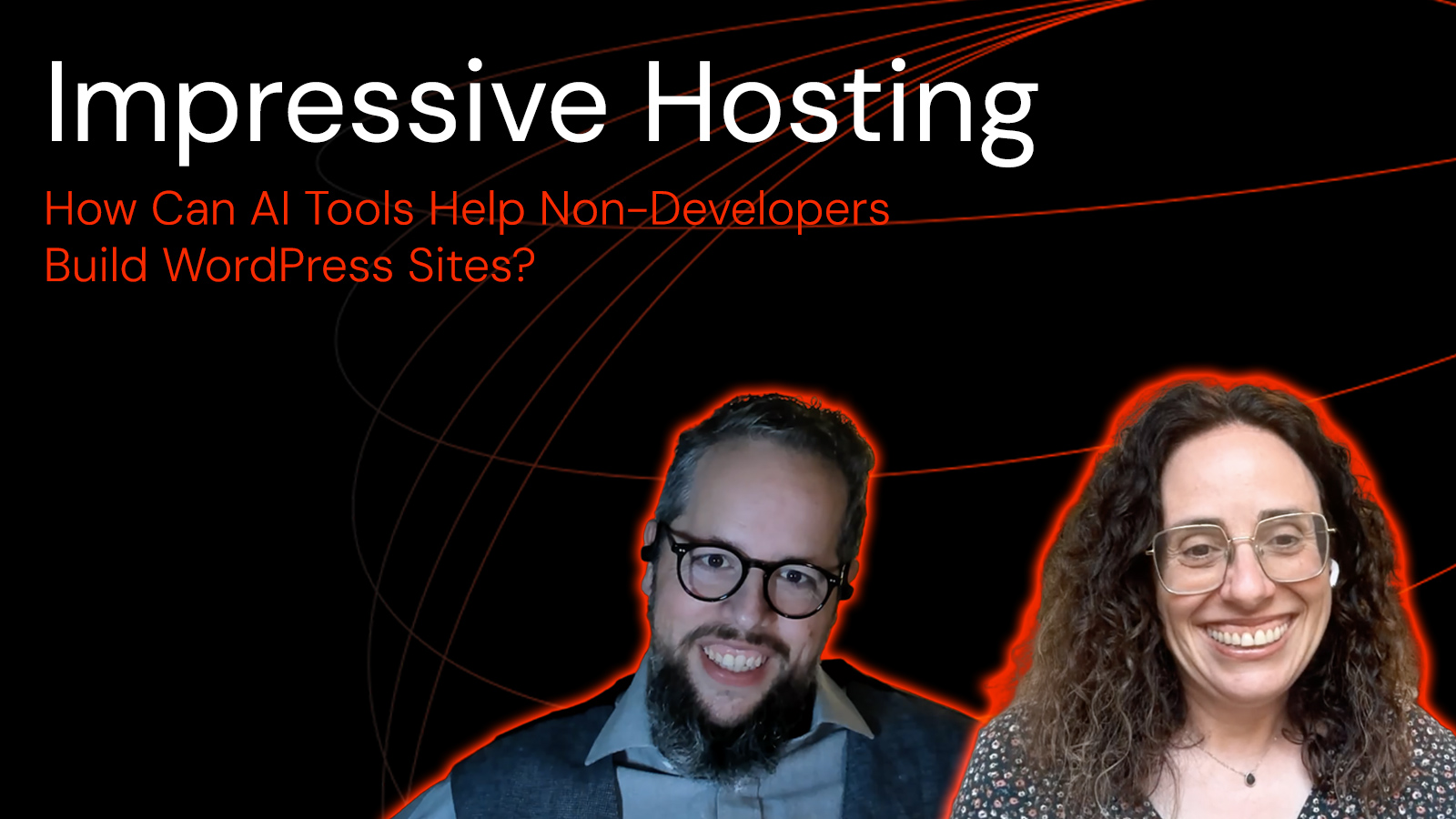
A company’s AI agent recently deleted its production database and all its backups in a single action, despite having explicit rules in place telling it not to. Jesse Friedman and Miriam Schwab use this cautionary tale as a jumping-off point for a wide-ranging conversation about AI safety, backup strategy, and the evolving role of WordPress site builders in an AI-driven world.
Miriam shares how Elementor’s AI plugin Angie addresses production safety through a sandbox artifact system. Users can build Elementor widgets, Gutenberg blocks, and custom WordPress functionality using natural language, but nothing goes live until they explicitly publish it. She also talks about the decision to demo Angie in live webinars rather than polished marketing videos, accepting the risk that AI might fail on camera because showing real usage matters more than looking perfect.
The conversation broadens into how Elementor grew from a page builder into a full platform with over 20 million sites. Miriam describes how theme designers organically adopted Elementor as their power tool, building niche products for specific audiences like book authors without any formal partnership. Jesse connects this to a recurring theme on the podcast: hosting companies that solve specific problems for specific audiences tend to build stronger businesses. For anyone in the hosting or WordPress ecosystem weighing AI integration, this episode offers a grounded look at what is working, what is breaking, and what still needs solving.
Links:
Transcript
## #### Welcome and Introductions
Jesse Friedman: Welcome to Impressive Hosting, a podcast about the role hosting plays in shaping the open web. I’m your host, Jesse Friedman. On the show we go deeper than uptime and dashboards. We talk about hosting, its infrastructure, about ownership, independence, and what it takes to build ethical, high-end WordPress hosting that actually serves creators, businesses, and the internet itself. Before we dive in, head to impressive.host. That’s where you can comment on episodes, ask follow-up questions, and help shape future conversations. You’ll also find links to follow and subscribe wherever you listen. Today I’m very happy to have Miriam Schwab, head of WordPress at Elementor, with us. Miriam’s a friend and someone I get to see all the time at WordPress events all over the world. Thank you, Miriam, for joining. Tell us a little about yourself, where you are, and what you’re working on.
Miriam Schwab: Hi, thanks for having me. Like you said, I’m head of WordPress at Elementor. I’ve been in the WordPress space for over 20 years, which is a very long time. Makes me quite old, I think. But I started off discovering it and building sites. I found it very interesting and then started offering it as a service. I built that out into an agency and did that for many years. Then I sold the agency and founded a startup in the space called Strati, which was a different approach to hosting websites. It deployed sites in a static architecture to give our customers a higher level of security, performance, and scalability. Then almost four years ago in June, Elementor acquired Strati and I’ve been with Elementor since then. I actually can’t believe it’s almost four years. I had never really been an employee before joining Elementor, so it’s a new stage in my life. I’m based in Israel and I do get to see friends like you at various WordPress events, which is really fun. I’ll be at WordCamp Europe. That’s the plan.
Jesse Friedman: Yeah, that’s the next thing on my list actually, so I’m looking forward to it. That’s going to be in Poland, in Krakow.
Miriam Schwab: Yeah.
Jesse Friedman: Very cool. Well thanks for the background. That’s really interesting that you got started and moved into Elementor through an acquisition. It’s very much like how I joined Automattic actually. But you’re hitting four years. I’m actually coming up on 12.
Miriam Schwab: Whoa.
Jesse Friedman: Yeah, and I actually gave an interview this morning and one of the things I had to say was that I’ve been working in WordPress for over 20 years. Same thing, right? It’s just a reminder of how old I’m getting.
Miriam Schwab: Yeah. I mean, when we started out 20 years ago, what was the web like? First of all, it was an incredible concept. I remember being so excited that we could access information so much more easily, but we could also make information more readily available and reach more people. It’s definitely through WordPress that I met people from around the world, which I loved. I don’t know if that would have been possible without the web, without WordPress and its ecosystem and community. So yeah, the web has come a long way. I do kind of miss those early days where things were so exciting and new, but the way I feel now in this era of AI reminds me of how I felt back then. It’s a game changer. There’s a lot to learn. It has many ways infinite capabilities, kind of like WordPress did and still does. So these are also fun times.
Jesse Friedman: Oh yeah. When we got started with WordPress, the internet was still weird. Everyone was trying to figure it out and people were looking at ways to commercialize it, put their business online, and solve people’s problems. WordPress was one of those things that kind of just helped accelerate everything. You felt like the tool just worked. It was reliable. But that feeling back then was novel. It was novel to have something that kind of just worked in that way. I feel like AI is a lot like that. A year or two ago it was kind of finding its footing, but now it’s this accelerant that is getting everybody moving so much faster. It has that same level of energy, that same excitement of “I can do so much with this.” One of the things I’m working on right now is having a chief-of-staff productivity assistant, someone who can take all the mundane, repetitive tasks out of my life and give me a little more freedom. I don’t necessarily want to apply all that time savings to work. I don’t know if Matt’s listening, but maybe I can get a little bit of my personal life back too. Ground myself in being with my family and other things. I’m interested in AI from that perspective. How are you using AI these days? We usually save AI for the end of the conversation because it’s what everybody wants to hear, but we might as well dive in.
Miriam Schwab: Can’t help it. Every topic of conversation just immediately goes to AI.
Jesse Friedman: Right?
Miriam Schwab: So I’m always thinking about it because like I said, it’s so fun. I think I’ve actually created more work for myself. I’m going in the opposite direction. At Elementor, I’m an individual contributor type of person. I don’t have a team. I haven’t had a team since I practically joined Elementor. I work sideways in the organization and collaborate with different teams depending on what I’m working on. But everything is me, and I want to do a lot. My capabilities and my time are limited. So what I’ve done with AI is let it help me do more. On one hand it’s really cool. I’m like, oh my goodness, I can do so many more things. On the other hand, it’s definitely filling up more of my time. It’s streamlined a lot for me and it gives me capabilities that I just didn’t have. They often say when you’re hiring, hire people who are smarter than you. I feel like AI is the team I’ve hired that’s smarter than me, which is great, but I spend a lot of time managing AI now. Documenting, making sure things are running smoothly, all the i’s are dotted and t’s are crossed. That ends up taking more time. At one point I actually started to feel a little burned out.
Jesse Friedman: No kidding.
Miriam Schwab: Yeah, a few weeks ago, because I was pushing myself too much with AI and spending too much time on it. So I’ve scaled that down a bit because it was getting to me. Basically I’m doing more, not less. But now that I’ve calmed down with the AI thing, I’m not necessarily working more, which is good because that was too much.
Jesse Friedman: Yeah.
Miriam Schwab: But it’s cool and fun. I’m having a great time with it.
Jesse Friedman: It is interesting. I think in a previous episode I said something along the lines of AI helping me become the developer I always wanted to be back in the day, before I really had the ability to unlock that. And now all of a sudden I can write code. Now I’m a developer again. It’s a whole other subset of responsibilities I didn’t have ten minutes ago. All of a sudden I can write code. Now I have a responsibility to actually maybe do that. Am I just adding more to my life? Maybe it is adding more work.
Miriam Schwab: Yeah, I think in some ways it does. Same with me. I started off doing some development but then moved away from that and managed developers. I never liked coding. I think it’s like knowing or learning a language. I know two languages, English and Hebrew, but I’ve never had the brain capability for picking up other languages. I feel like coding is the same. Now that the programming language is just writing in English, or really any language, and I’ve always been a communicator, I feel like now I can do that. It unlocks a lot of things I’ve wanted to do and experiments I’ve wanted to try. It’s really allowed me to test a lot of AI in WordPress in ways I couldn’t before. If I don’t understand something, I’m just like, Claude, help me out. Explain it to me. Tell me what’s going on. Tell me why this isn’t working. And I can really learn a lot that way too. So yeah, we’re all developers now, which is fun.
Jesse Friedman: Right. So you’re using AI for your actual work. What about AI within Elementor? I know Angie is like the orchestrator within Elementor trying to help customers accomplish goals and get sites live faster. How’s that going? Are you talking to users about it? Are they enjoying it? Do they adopt to it quickly?
#### Angie and AI in Elementor
Miriam Schwab: So we actually just passed 20,000 installs on the repo, which is pretty exciting. I didn’t announce it yet, but depending on when this comes out it may have already passed. We reached 10,000 a few weeks ago, so that happened pretty quickly. People are very interested in trying AI in WordPress. It’s really fun to see all the different approaches. People approach it from the Claude MCP direction and from different directions. There are a lot of MCP approaches being developed, obviously the core AI one, which is great, and some others. Angie’s approach is a bit different because you just install a plugin and then you have AI in WordPress. It has its pros and cons. The pro is you’re up and running with AI without having to configure stuff and hook things together, which isn’t everyone’s cup of tea. Some people prefer to work with Claude directly, so the team is working on some kind of integration to give them that workflow. But at the moment people are testing it out a lot, and it’s fun to see. Because AI is so capable in many ways, people’s creativity is really interesting to see coming through. People are building a wide range of stuff with Angie on their sites. The strong part of Angie right now is what we’ve called Angie Code. You can build widgets, like Elementor widgets or Gutenberg blocks, or just general WordPress functionality with it. People are trying it and liking it. The feedback is positive. We also get some more critical feedback, but that’s good. It helps us improve where it’s not so strong. We actually started doing live webinars about Angie, which is super risky.
Jesse Friedman: When you say live webinars, you’re actually demoing in real time? Yes. Okay. Yeah.
Miriam Schwab: So the first one we did was with a smaller audience to test it out and it went well. People were just excited to see us using it live and not in a shiny marketing video. But we did another one yesterday. I did three examples with Angie and two worked well, and then the third did not.
Jesse Friedman: Yeah. Sounds a little bit like our panel at CloudFest last year. For people who didn’t see it, I was moderating an AI panel and Miriam was on it. What I did was I hooked up ChatGPT to talk to us through the speakers and everything.
Miriam Schwab: It introduced us and asked us questions like that.
Jesse Friedman: Yeah, and it was kind of sassy with me too. It had a bit of an attitude. I forget what happened, but it gave you a title that maybe it knew before it was official or something.
Miriam Schwab: Yeah, my title had changed by one word. It was “head of WordPress relations” and then it was decided we should just remove the “relations” part and make it “head of WordPress.” I hadn’t talked about it publicly or anything. And then your AI partner introduced me with the new title and I was like, whoa, that is a very up-to-date AI.
Jesse Friedman: Yeah. So it was cool in that sense. But then by the end of the talk it had started going nuts, hallucinating, and asking the same questions over and over again.
Miriam Schwab: Yeah, it’s true.
Jesse Friedman: “Oh, you’re right. I got that wrong. Let me try again.”
Miriam Schwab: Right? But in real life, like a live panel, it was amazing. It was such a good idea. I love that you did that. So yeah, it’s the same thing. AI is great and then sometimes it’s not great, and when you’re doing anything live with it, you’re at risk. But we decided to go with it anyway to really show what it’s like to work with AI.
Jesse Friedman: Yeah.
Miriam Schwab: When it doesn’t work, you’re just like, oh my gosh.
Jesse Friedman: It’s actually kind of nice that it fails in such an extravagant way, because then it’s not a subtle failure you’re not noticing. You’re just like, oh yeah, you screwed this up. At least I know you screwed it up.
Miriam Schwab: Yeah, it’s very clear that it didn’t do what I asked.
Jesse Friedman: Right, right. And in that panel it was nice because even though we made fun of it and had a good laugh, it also had this dose of reality that everyone in the room kind of needed at that moment. I think everybody was worried about what AI is going to be, how it’s going to work, are we all going to be replaced and jobless and AI is just going to run the world. And then all of a sudden it starts hallucinating and it’s like, okay, we’ve got a little bit of time at least. But just in that amount of time, since that was March 2025 and it’s now April 2026, 13 months, I don’t know that that would happen now. If we ran that exact same panel, I think it would have actually done quite well. I could have probably stepped out of the room and let it run the whole thing. It’s amazing how fast we’re progressing through this technology. When WordPress came out in 2003, or just any kind of web technology, we used to have a release and then know what that release was. We could take a breath, absorb it, then decide to build the next thing on top of it. But now every day AI is adapting, changing, and growing. You blink and you’re missing so much. It’s wild how fast it’s going. So with Angie, you’re talking about it from the perspective of people building new things. What about someone like my wife? She has her author website. She’s got a book coming out and she built a site on it. She loves the way it works and doesn’t want to modify the structure, but she does want to add new pages and things. Should she fear using Angie? Could it change the whole website? Or is it easy to use just for very specific tasks?
Miriam Schwab: It’s easy to use, and it also has a very interesting approach to securing the site from AI work. One of the scary things about working with AI is, and I don’t know if you saw this story, there was an app where their AI was for some reason connected to their production environment and it deleted the production database plus backups. It was a big story on Twitter.
Jesse Friedman: I did not see that one. Okay.
Miriam Schwab: So obviously working with AI, you have to be careful. And they had all the guardrails in place, by the way. They had rules that said don’t do this, don’t guess, don’t assume. And then when it did this, the AI, I think it was Claude, they asked “Why did you do this?” and Claude was like, “I know I’m not supposed to assume and guess, but I did. Sorry.” But it was done. So working on a production site with AI is scary. But the team created, as part of Angie, a test sandbox environment. Whatever it’s building for you, it’s not actually live on the site yet until you publish it. So you can create it, see how it works, and then only when you feel like it’s not breaking your site, you publish it. It’s called an artifact, and then it goes live. Until then it’s there in your site and you can go back to it and work on it, but it’s not publicly available. So your wife can try it out and see if it does what she wants. It’s good for specific things. Where it works for her, she can use it. Where it doesn’t work for her, she doesn’t have to use it. But it’s just there and it can be helpful.
#### Backups and Production Safety
Jesse Friedman: I’m going to drop a little shameless plug here for people who are just listening. I’m holding up a sign that says backups are important. It’s a bit of a shameless plug for Jetpack. But every time I hear a story like this, I can’t tell you how important it is to have third-party off-site backups. It doesn’t matter if it’s your repo, your website, whatever. Any time you have anything running in production, it should not be able to even reach your backups.
Miriam Schwab: Yeah.
Jesse Friedman: Yeah.
Miriam Schwab: One of the issues with that crazy story was that the backups were on the same server, which is obviously a big no-no. You need backups of your backups. You need that redundancy where it’s sitting somewhere else, separated, disconnected. It should be the first thing people set up in their development environment. Backups of the backups, and also making sure the backups have the integrity you need, that you can actually restore them and they work. It’s so basic. We’ve been dealing with this in WordPress forever. The importance of backups, how to do backups, making sure you have backups that aren’t on your server. And here we are in 2026 with all the amazingness of AI, and you still have a situation where a company can be taken down by not doing backups. It’s crazy.
Jesse Friedman: Oh my God, yes. This is a great divergence because one of the things I talk about with WP Cloud all the time is that we have built-in backups. We do nightly backups. We have a live sync database backup to another location, so we have automated real-time failover. But at the same time, we are encouraging our partners to also include Jetpack backups because it’s another layer of redundancy. The thing about Jetpack is it provides a user experience that people can actually use to restore things themselves. It’s not like tools that exist where you have to build from the API into your panel UI. Jetpack is designed with an activity log, so it’s almost like an undo button, and all your stuff lives off-site. The cool thing about Jetpack too is that if you have orders because you’re an e-commerce shop, it actually keeps your orders persistent so you can restore your site without overriding your orders, which a lot of people don’t even realize is something they need to think about. You talk to hosting companies and look at the way they talk about their product, they offer backups. But if you can’t restore your site in a way that’s actually usable to you as a user, if you’re given a restore point that’s just an image of your entire server and you can’t cherry-pick things and you need a technical level of expertise to do it, you’re not only hurting yourself as a user, but the hosting company itself is going to cost a ton of money as well because they have to hold your hand through that restore. All during chaos, all during a moment when you’re freaking out because your site’s down. Anyway, we’ll move on from the shameless backup plug, but that was a nice transition.
Miriam Schwab: It’s important to still talk about, apparently.
Jesse Friedman: Yeah. And now with AI it’s even more important than ever. The thing I always say about backups too is it’s not necessarily just about security, it’s also about freedom. When you have a solid backup plan, it gives you the ability to experiment and not have to worry.
Miriam Schwab: True.
Jesse Friedman: Right? You can do a lot of the things you want to do. You can change things. You can feel free to update plugins and not worry that everything’s going to collapse.
Miriam Schwab: Totally.
Jesse Friedman: But anyway, to circle back, my wife should feel comfortable using Angie knowing it’s not going to affect the production level of her site. She can go and experiment and play with it. That’s very cool. So if we didn’t really jump into exactly what Elementor is, how do you go about describing it? Is it too simple to say it’s a site builder? How do you give the elevator pitch?
#### What is Elementor?
Miriam Schwab: That’s a really good question. I almost never have to give an elevator pitch because we’re mostly in WordPress circles and people already know what it is. Elementor is used by something like over 30% of WordPress sites, and I’m assuming a lot of them are actively using it. Within the WordPress space, people tend to know what it is. But if I had to give an elevator pitch, it is much more than a page builder. At this point it’s a platform. Technically it’s a plugin you drop in, but what’s happening behind the scenes is huge. It gives people a lot of control and capability when it comes to building out their sites the way they want, to fulfill their vision and their creativity. But now we also have a lot of accompanying products to enhance the experience and fill in the gaps where we saw users needed extra tooling. We have an image optimization solution, a site mailer for SMTP to make sure the emails being sent from your site actually get delivered, and Manage, which is a way to have an overview of your sites and make sure they’re updated. We have Angie. We have an accessibility plugin, which is actually very nice. It gives you a very easy way to see your accessibility issues and remediate them with one click. Those are all now offered as a suite called Elementor One, which is a monthly subscription that gets you access to all of those. We’re going to be launching more products that will be part of that suite going forward. So yeah, it’s much more than just a page builder. It’s a website creation experience, something like that.
Jesse Friedman: You know, it’s funny because Matt always talks about WordPress as the operating system of the web. The way I think about Elementor, both as a member of the community and as a user helping my wife with her site, is like WordPress is Linux and Elementor is macOS.
Miriam Schwab: Yeah.
Jesse Friedman: A lot of people don’t necessarily know this, but macOS is actually running on Linux. Linux is an independent operating system. You can run just Linux if you want to. macOS comes in and puts a layer on top that provides a ton of extra tools, a different level of usability, a different interface. It simplifies a lot of things. It drives you nuts sometimes too. But Elementor is kind of like that. WordPress is the Linux operating system, the more vanilla core functionality, and then Elementor layers this whole feature set on top of it with a different user experience. When you use Elementor, it does take a little bit of adapting if you’re very used to WordPress core functionality. Getting used to Elementor takes a little cognitive investment. But once you get over that hurdle, it tends to make a lot of sense. Like a lot of things I had to get used to were where global styles lived and things like that. But it’s not a huge hurdle. Once you get past it, it starts to make more sense and you unlock all this stuff. Who is typically using Elementor? Is it the DIYer, agencies, or both?
Miriam Schwab: It seems like DIYers are using Elementor. I mean, there are over 20 million sites using it, so the range is everyone. It’s kind of like WordPress where it’s everyone, from simple sites to huge publishing and Fortune 500 types of sites. Elementor is similar. The people I end up talking to most are agencies. Agencies whose entire business is based on Elementor. They just build site after site on it. It’s their power tool. I really like your comparison to Linux and Mac because when I moved from Windows to Mac, there was a learning curve too. You have to rewire how you instinctively do things. But once you do, it’s fabulous. With Elementor, it becomes their power tool and they’re so used to it that they can do very amazing, beautiful things with it. So it’s definitely a lot of agencies. I actually just heard a story recently. This 23-year-old guy from India, he went to WordCamp Asia and built up a business building Elementor sites to the point where he was able to start supporting his family, which was really important to him. For the first time ever, he took his mother on a trip. She had never gone on a trip. It’s amazing that he built himself up and made a living off of Elementor like that. People that do that are very grateful to Elementor. Those are inspiring stories. People are building businesses around it and it’s great.
Jesse Friedman: Oh, that’s such a great story of empowerment. You’re giving people the tools to take their moms on trips.
Miriam Schwab: Change lives. This guy changed his life and it’s like, thank God. It’s really nice.
Jesse Friedman: Yeah, and in talking about Elementor’s parallels to WordPress, that’s a typical story you hear about WordPress in general all the time. In learning WordPress, you’re learning skills around project management, development, design, and usability. You’re giving people the tools to run a business, make a living, and do great things. That’s really cool. In that same space though, one thing I noticed is that the way my wife went about building her website was very different from the way my mind works as a former developer. When I have a new web project, I have a clear idea of what I want to build and I can start with a basic theme and I’m off and running. She did it very differently. She went online and started looking for designs she liked. Then she found a designer who was selling themes that were not in the repo, which is so foreign to me. She fell in love with this theme that was actually made for book authors and had a dependency on Elementor. So it wasn’t a situation where we decided to install Elementor and then build something. It was more like this thing had been built and it had a dependency on Elementor. To get it, you buy the theme and then install Elementor. It was a very different cycle for me to go through that way. I’m curious how that evolved. Was Elementor going out and recruiting these designers to bundle it? Or is it more of a natural adaptation where they just found it easier to use and started bundling it?
Miriam Schwab: It’s actually the latter. Theme authors, in the heyday of themes, everyone wanted to one-up the other by creating something more beautiful and with more capabilities. And I guess what happened was that Elementor was the tool that gave them that ability. People built one theme after another and it became their power tool. So they just kept building themes that depended on Elementor and bundling it with them. That was definitely one of the ways that Elementor took off, through these theme shops that were dependent on Elementor. But it wasn’t a partnership or a formal conversation. It just happened. We see less of that now, especially as themes are, well, although your wife just went that route, which is interesting. I guess they still are popular, and it is a good way to start with your site. Even if you are a website designer, sometimes you just don’t know where to start. The blank canvas is a really hard thing to get past.
Jesse Friedman: It’s a daunting thing. Yeah.
Miriam Schwab: Like, what do I even do now? Where do I start? Where do I want things to go on the page? But if you have a theme that’s done a lot of work for you, it’s just a matter of tweaking it. It lowers that barrier and gets you up and running with a site. So yeah, it just happened organically.
Jesse Friedman: I mean, one of the things we talk about on this podcast a lot is how hosting companies can do a better job of protecting the open web while doing it in a profitable way. One common thing that comes up is providing niche solutions. So instead of just selling hosting, selling very specific things that can result in greater success, like selling book hosting or whatever. This designer was not in hosting, but they were solving a very specific problem for authors. They designed a theme made for an author to express what they had written. Everything is book covers and ISBN-related, solving these very niche things. Having Elementor, I think, allowed this person to do that with very limited developer experience. Based on the website and the way she went to market with this product, I got the feeling that she was not a strong developer, but more of an implementer. She was a designer who knew how she wanted it to work, and Elementor was the glue that brought it all together so she didn’t have to write code herself. It might be interesting to explore how AI might empower someone like that to do even more. But John in the background is telling us we’re at time, so we’ve got to take a pause and break and move on to another episode. Miriam, thank you so much for joining us and we’ll be back with part two.
Miriam Schwab: Great, thank you.
Jesse Friedman: Thank you. All right. Thanks for joining us on another episode of Impressive Hosting, where we uncover the core tenets of great WordPress hosting. Do you have a follow-up question for today’s guest, a thought or comment on anything we talked about, a future guest suggestion, a hosting horror story, or what you think makes great WordPress hosting? All your comments shape the show. Drop them on impressive.host. We also appreciate you following us on social media and subscribing to the podcast on your favorite platform. Finally, do check out our list of open-source projects that need support at impressive.host. Whether it’s code, community, or cash, you can make a difference. See you next time.
Subscribe to Impressive Hosting:


Leave a Reply