'%3E%3C/path%3E%3Cpath d='M76.4782 25.7185L71.982 9.04089H74.6936L78 22.8409L81.8045 9.04089H84.5853L88.2722 22.8409L91.5787 9.04089H94.2902L89.7248 25.6977H86.7781L83.1396 12.6379L79.3835 25.6977L76.4782 25.7185Z' fill='rgba(247, 43, 0)'%3E%3C/path%3E%3Cpath d='M96.6075 9.04089H102.439C103.739 9.04089 104.818 9.26224 105.676 9.69803C106.534 10.1338 107.17 10.7287 107.592 11.4827C108.014 12.2367 108.222 13.0875 108.222 14.0421C108.222 14.9483 108.021 15.7783 107.613 16.5254C107.212 17.2794 106.575 17.8812 105.725 18.3239C104.867 18.7666 103.774 18.9879 102.439 18.9879H99.1323V25.6977H96.6075V9.04089ZM99.1323 16.9128H102.321C103.511 16.9128 104.362 16.6568 104.881 16.138C105.399 15.6192 105.655 14.9206 105.655 14.0352C105.655 13.1152 105.399 12.3958 104.881 11.8839C104.362 11.372 103.511 11.1092 102.321 11.1092H99.1323V16.9128Z' fill='rgba(247, 43, 0)'%3E%3C/path%3E%3Cpath d='M124.138 25.9744C122.492 25.9744 121.067 25.6147 119.87 24.8953C118.674 24.1759 117.747 23.166 117.097 21.8725C116.446 20.5789 116.121 19.0848 116.121 17.3901C116.121 15.6746 116.446 14.1735 117.097 12.88C117.747 11.5864 118.674 10.5765 119.87 9.84329C121.067 9.11698 122.492 8.75036 124.138 8.75036C126.089 8.75036 127.68 9.22766 128.918 10.1753C130.156 11.1299 130.938 12.458 131.277 14.1735H128.469C128.247 13.2051 127.77 12.4373 127.044 11.8631C126.317 11.289 125.342 11.0054 124.118 11.0054C122.45 11.0054 121.136 11.5726 120.168 12.707C119.199 13.8415 118.715 15.3979 118.715 17.3831C118.715 19.3476 119.199 20.8971 120.168 22.0246C121.136 23.1521 122.45 23.7124 124.118 23.7124C125.342 23.7124 126.317 23.4427 127.044 22.9031C127.77 22.3636 128.247 21.6234 128.469 20.6896H131.277C130.945 22.3428 130.156 23.6294 128.918 24.5702C127.68 25.5109 126.089 25.9744 124.138 25.9744Z' fill='rgba(247, 43, 0)'%3E%3C/path%3E%3Cpath d='M133.961 25.6908V8.5636H136.486V25.6908H133.961Z' fill='rgba(247, 43, 0)'%3E%3C/path%3E%3Cpath d='M145.195 25.9744C144.067 25.9744 143.057 25.7185 142.158 25.1997C141.259 24.6809 140.553 23.9615 140.027 23.0346C139.502 22.1076 139.246 21.0216 139.246 19.7903C139.246 18.5591 139.509 17.4731 140.041 16.5392C140.574 15.6123 141.293 14.8929 142.192 14.3741C143.099 13.8622 144.102 13.5994 145.215 13.5994C146.343 13.5994 147.353 13.8553 148.252 14.3741C149.144 14.8929 149.864 15.6123 150.396 16.5392C150.929 17.4661 151.192 18.5522 151.192 19.7903C151.192 21.0285 150.929 22.1076 150.396 23.0346C149.864 23.9615 149.144 24.6809 148.245 25.1997C147.332 25.7185 146.315 25.9744 145.195 25.9744ZM145.195 23.8093C145.796 23.8093 146.357 23.6571 146.869 23.3597C147.387 23.0553 147.802 22.6126 148.121 22.0177C148.439 21.4228 148.598 20.6827 148.598 19.7903C148.598 18.898 148.446 18.1579 148.134 17.563C147.823 16.9681 147.415 16.5185 146.896 16.221C146.377 15.9167 145.824 15.7714 145.222 15.7714C144.62 15.7714 144.06 15.9236 143.548 16.221C143.029 16.5254 142.614 16.9681 142.296 17.563C141.978 18.1579 141.819 18.898 141.819 19.7903C141.819 20.6827 141.978 21.4228 142.296 22.0177C142.614 22.6126 143.023 23.0622 143.534 23.3597C144.032 23.664 144.586 23.8093 145.195 23.8093Z' fill='rgba(247, 43, 0)'%3E%3C/path%3E%3Cpath d='M158.275 25.9744C156.85 25.9744 155.723 25.5317 154.906 24.6394C154.09 23.747 153.682 22.4258 153.682 20.6688V13.8899H156.207V20.406C156.207 22.6887 157.141 23.83 159.015 23.83C159.949 23.83 160.717 23.498 161.326 22.834C161.927 22.1699 162.232 21.2153 162.232 19.9771V13.883H164.757V25.6908H162.522L162.336 23.6225C161.969 24.3488 161.436 24.9299 160.731 25.3449C160.011 25.7669 159.195 25.9744 158.275 25.9744Z' fill='rgba(247, 43, 0)'%3E%3C/path%3E%3Cpath d='M173.341 25.9744C172.2 25.9744 171.19 25.7046 170.318 25.1651C169.447 24.6255 168.762 23.8854 168.271 22.9515C167.779 22.0177 167.53 20.9525 167.53 19.7627C167.53 18.5729 167.779 17.5146 168.271 16.5876C168.762 15.6607 169.447 14.9275 170.325 14.4018C171.204 13.8692 172.213 13.6063 173.362 13.6063C174.296 13.6063 175.119 13.7861 175.824 14.1528C176.53 14.5194 177.083 15.0313 177.478 15.7022V8.5636H180.002V25.6908H177.74L177.478 23.8577C177.097 24.4111 176.571 24.9022 175.907 25.3311C175.243 25.76 174.385 25.9744 173.341 25.9744ZM173.791 23.7885C174.87 23.7885 175.755 23.415 176.44 22.6679C177.132 21.9209 177.478 20.9663 177.478 19.7903C177.478 18.6006 177.132 17.6391 176.44 16.8989C175.748 16.1588 174.863 15.7922 173.791 15.7922C172.712 15.7922 171.826 16.1588 171.127 16.8989C170.429 17.6391 170.083 18.6006 170.083 19.7903C170.083 20.5651 170.242 21.2568 170.56 21.8586C170.878 22.4604 171.314 22.9308 171.881 23.2767C172.435 23.6156 173.078 23.7885 173.791 23.7885Z' fill='rgba(247, 43, 0)'%3E%3C/path%3E%3C/svg%3E)
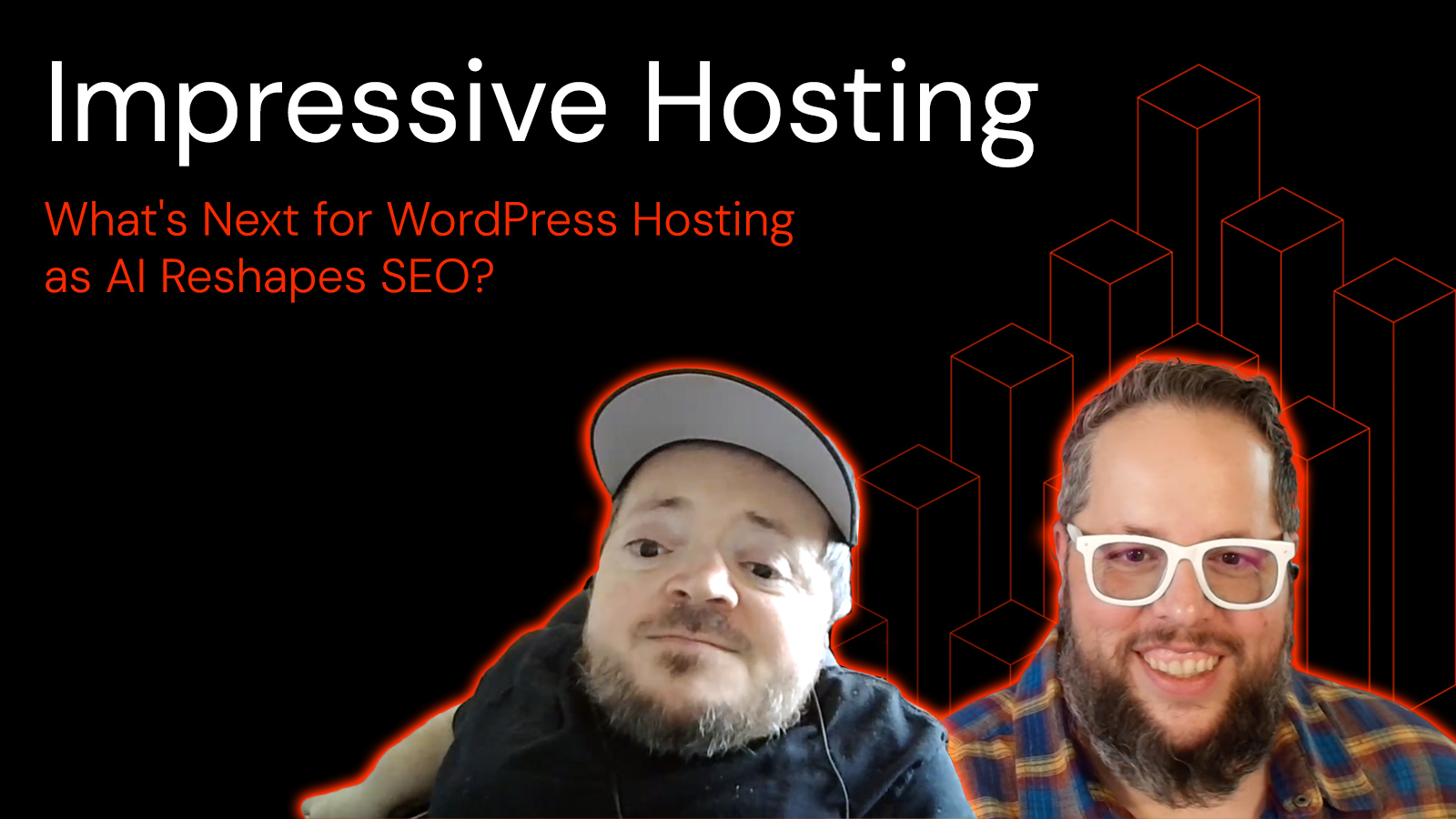
In this episode of Impressive Hosting, Jesse Friedman continues his conversation with SEO expert Joe Hall from Hall Analysis, diving deeper into what makes great WordPress hosting from an SEO perspective. They explore essential tools that hosts should consider bundling with their plans, including SEO plugins like Yoast, redirection tools, and 404 monitoring systems that help customers optimize their sites without technical expertise.
A major theme emerges around the critical importance of knowledgeable customer support. Joe shares real examples of hosting companies that go beyond basic infrastructure support to actually help customers implement SEO recommendations, choose plugins, and resolve conflicts. Jesse and Joe discuss how the best hosts align their success with customer success, providing tier-three support that can execute technical tasks rather than just pointing users to documentation.
The conversation then shifts to the future of SEO in an AI-driven world. They examine how Google’s AI Overviews are disrupting traditional SEO metrics and making traffic attribution more difficult, while exploring how large language models crawl websites differently than traditional search engines. Joe explains why server-side rendering and standards-compliant HTML are becoming crucial for AI visibility, and how brand mentions and vectorization will shape future SEO strategies. The episode wraps with insights about WordPress as both a platform for building websites and a gateway to learning programming and computer science.
Links:
- Previous episode: How Do Great Hosts Make WordPress SEO Better?
- Hall Analysis – Joe Hall’s SEO consultancy
- Yoast SEO plugin
- Screaming Frog SEO Spider
- Looker Studio
- Link Whisperer plugin
- WordPress Codex
- Pressable
- Bluehost Cloud hosting
Chapters:
00:00 Teaser
01:55 What are some essential tools for SEO in great WordPress hosting? 01:59 Why build a WordPress site?
03:51 What are some essential tools for SEO in great WordPress hosting?
07:24 What does great customer support in hosting look like?
10:33 What is the impact of AI on SEO?
20:38 What is the relationship between AI crawling and SEO for WordPress sites?
25:37 Community Questions
34:58 Conclusion
Transcript
Jesse Friedman: Because every single host should obviously provide you with enough support to help you update PHP or something because that’s interacting with their platform.
Joe Hall: If you really take the time to learn it and understand it, you can do anything you want with WordPress. You can use it as a platform for development, education, liberation, whatever, man.
Jesse Friedman: Wait, does that mean we’re gonna see a resurgence of keyword stuffing?
Joe Hall: Not to throw any shade here, but I will just say that there’s a difference between building a WordPress website and making one.
Jesse Friedman: Welcome to Impressive Hosting, where we seek to uncover the core tenets of great WordPress hosting. I’m your host Jesse Friedman, and with me today is Joe Hall. We’re continuing our great conversation from the last episode where we were talking about SEO and the importance that hosts play in making sure that their sites are performant and creating a good foundation for customers to have good SEO.
We’ve touched on a lot of different topics. We were talking about ranking in Google and what Google cares about. Core Web Vitals, which has come up a few times on this podcast. The need for hosts to provide performance solutions, and the fact that things like WP Cloud and others out there are recognizing the fact that fully integrated CDNs and caching edge networks, things like that are good foundation for customers.
Joe, when you start to think about going beyond those core foundational layers, after that, what should a host be thinking about in terms of bundling with a hosting plan? So, you know, you look at something like Bluehost Cloud, for example. It runs on WP Cloud, so it gets all that great speed underneath.
But then on top of it, they include Yoast SEO for example, which, you know, for people at home that don’t know, it’s a plugin that helps you to do things that don’t come in WordPress core by default, like changing your SEO title, adding meta descriptions, keyword analysis, adding different thumbnails and things like that. And sometimes guiding you into writing better content.
What are some essential tools for SEO in great WordPress hosting?
Jesse Friedman: But what are some of your favorite tools? What are you using and what do you suggest?
Why build a WordPress site?
Joe Hall: That’s a great question. So, I’ve used Yoast for many years. I like Yoast a lot. There are not too many WordPress-specific tools just for SEO and I like to use, because there are a lot of tools out there that can help with your SEO process that are not specifically SEO related. I use some, for example, I use some redirection plugins to help with handling redirections. That’s an important part of SEO – sometimes you have to redirect a URL to another URL, and there are some great redirection plugins out there that can do that for you through WordPress.
Jesse Friedman: One of my favorite tools that’s just connected to that is a 404 monitor system so that it tracks when you have a 404 and then you can redirect those URLs to something else.
Joe Hall: Yeah. A lot of the redirection plugins do that too, and that’s great because it can catch 404s from live traffic, you know, so when a user hits a 404, it will flag it inside WordPress and then give you the option to turn it into a 301 to redirect it to another section of the site. That can be very helpful for SEO. Then also, there are a handful of tools out there that can help you manage internal linking, which is basically adding links through your site’s content to specific pages on the website, which helps a lot with SEO. So there’s one out there called Link Whisperer, there’s also Internal Link Manager, which is a pretty good one for that. Those are things that you can use and not even really be focused on SEO, but they do help with SEO. But you know, back to what you were talking about, how Bluehost, that’s built on top of your WP Cloud and bundles Yoast and all that stuff.
What are some essential tools for SEO in great WordPress hosting?
Joe Hall: I think one of the things that comes up a lot with clients is, and this is again not an SEO-specific thing, but the level and responsiveness of support personnel for hosting. Because a lot of the clients I deal with, especially the WordPress clients, are not technically minded. They may not even have a developer in-house. They may not have a technical person in-house, and truthfully, it’s a lot more expensive to hire me out to do these technical tasks. So sometimes I will mention to them like I’ll give them a list of URLs that they need to put redirects in for, and I will say they’ll be so lost in how to do that. Even some of the plugins that are super easy to use, they’re just at a loss of how to do it. So I’ll say, well call your hosting company and see if they can help you with that. They may be able to provide some guidance on their support system for setting up these redirects instead. And in some cases that works really well. In some cases, if it’s a bad host, they just don’t really help that much at all. They just kind of point you to a plugin to use without really doing it for you. So I think that the level of responsiveness from hosting can really be beneficial for SEO too because there are some things that I’ll tell a client to do. You know, ’cause one of my big products is an SEO audit where I go through and I tell all the different technical things that the business needs to execute on, and some of these things they just are completely unaware or unable to do on their own, you know? And I do offer the service of implementing all those things for them, but if they’ve spent most of their budget already on the audit or if they’re unable to hire me for another consulting engagement, then they really are kind of out of luck when it comes to executing on a lot of those recommendations. And so having a responsive host, a host that can execute some of them, maybe not everything on there, is beneficial, you know?
Jesse Friedman: Absolutely. I think that’s another recurring theme that we see on this podcast is how hosts are handling support. You know, we talk about Pressable, who has experienced WordPress developers who know how to not only build a WordPress website but are familiar with, and they run their own WordPress website, so they have their own favorite tools. They know that they work really well on the platform. Bluehost Cloud, I mention it all the time. They have tier three phone support. You just pick up the phone and you’re immediately connected to somebody who knows what they’re doing and they’re actually gonna help you with this stuff. And I think that what you’re touching on there is an important thing for our customers when they’re choosing a host to differentiate between because they may talk about how fast they are to respond or whether they have live chat versus phone or whatever. But the bigger question I think there is, are they gonna go beyond supporting just their infrastructure? Are they actually gonna help you with things?
Joe Hall: That’s exactly right.
Jesse Friedman: Yeah. Because every single host should obviously provide you with enough support to help you update PHP or something because that’s interacting with their platform. But are they gonna help you choose a plugin? Are they gonna help you install it? Are they gonna help you when you get into a bind and you’ve got two conflicting plugins, for example? And that’s not always easy to suss out. And what we tell people is sometimes you just gotta try it out in your early days, you try managed WordPress trials or you sign up with a money-back guarantee. Come up with a reason to call support and see what they say no to.
What does great customer support in hosting look like?
Joe Hall: I’ll give you an example. One time I was working with a client, I think it was WordPress, and I think it was a WordPress hosting company. I can’t remember the name of the company, but I was working with this client and they were on a managed WordPress host, and I had to, I was doing something for them. I can’t remember what it was, but I remember that I did have a list of redirects that I needed to implement and I was gonna use a plugin for it. But I also remember hearing that this specific host had their own utility, you know, on the backend somewhere that you could upload a CSV file. And I kind of thought that was a better idea than doing it through the WordPress dashboard just because if anything with WordPress happened, if there was a plugin conflict or something, the redirects at least would still work, you know? And so I wanted to use that. And so I called their support line and I had a huge list of tasks that I had to do for this client. Calling that support line asking them like, how do I access the redirect utility, the tech that I spoke to was like, well, we have two options. You can, you know, log in, click here, go through the user management portal and then access it there. Or you can just email me the CSV sheet. And I was like, for real? And he was like, yeah, just email me the redirects and I’ll input them for you. And I was like, bro, you are so awesome. You know, I was like, I have so much to do for this client. That is awesome. You know, so you can deliver that level of support, I feel like that goes a long way for a client. And, you know, even if that client I was working with, they didn’t really understand the value of that because they were having me do the work, but I feel like if I would’ve known ahead of time that they could have done that, instead of asking me to do it, then I would not have put forth the effort and time into exploring that, and would’ve saved them a little bit of money because of it. And so I think working with a company like that, that really kind of has customers’ backs, so to speak, from a support perspective, I think can be incredibly helpful for SEO, for implementing things that you just are not at your depth on, and anyone would love that support.
Jesse Friedman: Right. I didn’t mean to cut you off there, Joe, but I think it leads into one thing that’s super important, which is when a hosting company aligns their success with the customer success, that they’re not just trying to get you in as a paying customer and just be one more notch on their belt. They’re actually trying to make sure that they’re successful through your success. And that’s a really great anecdote.
Joe Hall: Yeah, exactly.
Jesse Friedman: And I’m sure it didn’t stop there for that client. Like obviously they didn’t interact with that customer service rep, but I’m sure they had something that came up in the future and they got that level of support that was really phenomenal for them.
Joe Hall: Absolutely.
What is the impact of AI on SEO?
Jesse Friedman: That’s great. So, you know, we’ve been talking about SEO from the perspective of obviously search engines. Google’s probably still the dominant one out there, although I don’t have my finger on the pulse of this stuff anymore. Give me an overview of the landscape. Is Microsoft still a big player? Are there other ones out there that are coming in? And then I want to transition because everybody wants to talk about it, but I want to talk a little bit about AI too before we depart on this episode.
Joe Hall: Yeah. So, you’re right, Google is still the dominant player. This year they had a brief dip in market share for search, but they went right back up again. Bing has seen a slight increase in search market share. I think that that’s probably because of the popularity of ChatGPT. GPT is tied heavily into Bing, and then of course, they were the first ones that rolled out their integration of artificial intelligence within the search results. So they did see a little bit of an uptick there, but I think Google is back to where they used to be. They’re still very much a dominant player. AI really is kind of having an impact on SEO and search in general. I think that it’s having a bigger impact on the business of SEO than it is actual SEO itself. And I say that because, if you’re in the United States, and I guess most everywhere else now, you may see in the search results there is what’s called AI Overviews that’s positioned above the search results. And that has had a significant impact on the way that SEO is kind of done and reported on. So for 20-something years, SEOs have been focused on rankings, and that’s been one of our core metrics that we report to our clients on—are we in the first 10 links on page one? A change of where your website falls on those rankings is significant, and usually those rankings correlate with traffic that comes from the search engines, right? So if you’re ranking like position five for a specific term, and then after doing some SEO work, you go up to position two or position one, then you will see your traffic increase.
Now because of AI Overviews, that correlation is becoming more blurry. And now it’s possible to see a website rank number one or number two for a specific term, but still see a significant drop in traffic because there are many searchers who are not scrolling down below the fold to get to—
Jesse Friedman: Right. They’re getting the answer to their question at the top of the SERP.
Joe Hall: Exactly. They’re getting the answer at the top of the SERP. And then also another big problem we have is that currently, at the time of this recording, early April, there’s no way to accurately track mentions or citations within AI Overviews. Google is not providing any sort of metric or tracking data for being mentioned inside an AI Overview. And so, and even the referral traffic within Google Analytics is just showing up as organic traffic, so it looks like you’re just getting traffic from Google. You know, you still don’t know if you’re in that AI Overview or not. And so that’s what I mean by it’s changing the business of SEO in that it’s making it much more difficult for us as SEO professionals to track attribution. Traffic might look the same or visibility might look the same, or rankings might look the same. We’re still in this position where we’re not able to accurately report on what’s going on in regards to organic search and SEO.
Jesse Friedman: This isn’t the first time we’ve seen this though. Like you think about the top of that search engine results page. That’s what we meant by the SERP, and how it’s evolved over the years. You know, you think about like a simple question you might ask Google like when was Sharon Stone born, or something like that? You know, years and years and years ago, you had to scroll through the SERP and try to find a page that would, you know, you would hope have the biography information of an actress and give you that information. But Google had started pulling that information out of those pages and just displaying it at the top and giving you some bio information, and we’ve seen that evolve over the years.
How has that been something that you’ve been able to attribute to like, you know, these people out there who take the time to write this content and they craft this information for people to consume and Google’s kind of pulling it out and giving it to you and you’re never visiting that website. You’re never actually going to that page. How did we rectify that with customers back then when that started coming out?
Joe Hall: So what you’re describing is called featured snippets.
Jesse Friedman: Right.
Joe Hall: And featured snippets actually did drive more traffic. You could get traffic from featured snippets and, depending on what the information in the snippet was, for example, like what you just described, someone’s age or someone’s birth date probably did not drive much traffic onto the website because that’s like a clear, very informational query. But things like recipes for example, they used to put recipes up in featured snippets and a recipe can only really show like maybe the list of the ingredients and some of the instructions, but—
Jesse Friedman: Right.
Joe Hall: —the user would need to get more info in order to actually cook the meal. So they would have to click through to get to it. And in that situation, featured snippets used to push tons of traffic. And in situations like that, we had, I had clients that were fighting for that featured snippet position because it would get the bulk of the traffic for that query. And I actually did a whole talk once about featured snippet optimization. By the way, you can find it on hallanalysis.com under the learning section.
Jesse Friedman: Nice plug.
Joe Hall: Yeah, under the learning section, there is a link to the featured snippet video. But back then it was possible to get traffic from featured snippets, and I think it’s because there’s just less opportunity for the user to get distracted and less opportunity for the user to scroll somewhere else. It was just like this block of info with a link going to more about that topic. So I think that featured snippets were kind of a canary in the coal mine almost, where we should have seen this coming. We should have seen AI Overviews coming. But we were kind of, I think we were pleasantly surprised with featured snippets where some of us were, and we just figured, okay, well it’s just another source of traffic we can work for our clients. But it turned out to be where AI Overviews kind of took that concept, ran with it, and took it to the next level to where we’re just not seeing that same level of traffic. Google claims that traffic that comes from AI Overviews is better quality traffic. So it may be less, but it’s more likely to convert. I don’t know how they know that, because they’re not looking at the same data I’m looking at, and based on what everyone is saying, that’s not the case. So, who knows? But it is just another kind of thing that’s happening right now that changes the business of SEO, and changes search in general.
Jesse Friedman: I have to say that my, personally for me, I’ve been using AI to do more search results, and I’ve been living in Google search a lot less. I’ll tell you why. For example, you know, there are times when I’m looking for something specific and Google’s very good at telling you, trying to serve up alternatives. And I think it’s getting to a point where it’s almost a little bit frustrating. You know, you might look up something because you’re looking for a specific, like vehicle, like a, let’s say a Ford, and then all of a sudden, you know, the first results are always Chevy or someone else because they’re competing for that advertising space at the top. But the thing is, is that Google doesn’t tend to, at least for me, understand I’ve already made that decision. I’m already past the purchasing point, and now I want like an accessory or something like that. So selling me a Chevy truck is not gonna help me with the cup holder I want for my Ford truck.
Joe Hall: Yeah.
Jesse Friedman: And that type of thing continues to happen and it’s been getting frustrating, but with, at least for now, you know, like ChatGPT’s a good example. You mentioned it before. There is no advertising, there is no deception there. I don’t wanna say deception, but there is no trying to reroute you down a different path or try to correct the path that you’re on. It just serves you the answer that you’re looking for. And so in that way, AI has been very fruitful for me. And also it’s better at answering questions than Google has ever been. For example, just yesterday, my wife and I were trying to remember the name of a restaurant somebody recommended to us. And I couldn’t remember it, but I did know that it started with the letters BA, it was in Providence and they served duck. And so that’s not the type of thing that you can type into Google and get a result for. But in using ChatGPT it was able to tell us exactly the name of the restaurant. It gave us a whole bunch of information. It was so helpful. So, you know, in that sense and also now I’ve started to see that it also gives you links to those pages to actually prove like where it’s getting the information from. So maybe there is some click-through traffic there, but as someone who’s running a website, do I have to start to think about how to change the structure of my HTML? Do I have to think about AI crawling my site differently than a search engine might crawl my site? Do I have to prepare for this?
What is the relationship between AI crawling and SEO for WordPress sites?
Joe Hall: Yeah, it’s probably a good idea to start thinking that way, and I can give you a quick rundown of what I know so far. See if anyone wants to know some tips—
Jesse Friedman: That’s great.
Joe Hall: —on how to perform well in ChatGPT search. So, what we know as of now, and this is again early April, about half of the large AI models, maybe more than half of them, like ChatGPT, Perplexity, Claude, a few of the others out there are crawling the web very similar to the way that Google used to crawl the web. And so they are not parsing JavaScript, and they’re not really parsing the page at all. So it looks like what they’re doing is they’re just going in and grabbing the baseline HTML or the DOM as it were, the direct object model without any rendering, JavaScript rendering or anything like that.
So with that, in that regard, it’s important, at least now, that websites are server-side rendered, and they’re not using a lot of client-side rendering, or are not relying on—
Jesse Friedman: Wait, does that mean we’re gonna see a resurgence of keyword stuffing? Like, so for folks at home, like Joe and I, when we came up, there was so much, there was black hat SEO, and there was white hat SEO, and then there was the gray in the middle. And we always had to describe to our customers why you didn’t want to go with black hat because it might give you some short-term success, but it was never meant to give you long-term success. And one of the tricks back then was to take white text over a white background to fill the page with content that the user wouldn’t see. And so Google had to get good at actually discerning the CSS and the JavaScript to be able to see what the visitor would actually see when they get there.
Joe Hall: Yeah. We probably will not see keyword stuffing. I hope not. That’s another thing too. Regarding language, large language models do language a lot differently than a search engine. So what they do is they vectorize the content and turn each word into an individual vector, which within its neural net is assigned a series of numbers that describe the relationship to it from the other words on the page or the other words in the English language, so to speak. And so from a content perspective, if you wanna do well inside a large language model, you really need to consider the words that you own. So your brand name, for example, is gonna be critical in the future. And so the more that you can mention your brand name, not only on your own website but elsewhere out there in the world, the more that you mention it within the context of the topics and categories that you would like to do business in, that’s critical and important. So if you have a, like if Nike wants to perform better within LLMs, then it would make sure that every time it mentions the word Nike somewhere, it also surrounds that term with like tennis shoe, football shoe, whatever, different shoe-related words, because they wanna make sure that their brand name has a strong vector connection to all the words that they are associated with. And that way when a user goes into ChatGPT and types in like soccer cleats or whatever, there’s a higher probability of Nike’s brand popping up within that response. And so that’s kind of like where it’s at for language. But back to the technical part of it, you know, I do have a bias for technology. Because they are not rendering pages with JavaScript, websites are gonna wanna make sure that the HTML they use is standards compliant. It doesn’t need to validate, everybody wants to run their website through the W3C validator or whatever, it doesn’t need to do that, but it does need to use kind of the standards for HTML so that when the large language model processes that page before it turns it into a vector, it’ll turn it into markdown, and then process it as vectors, understanding that markdown, you know, so that like all the H2s are in a markdown format. We’re not sure if they vectorize the terms in individual sections differently, but we wanna make sure that they can at least interpret the page in the way it’s supposed to be interpreted. And standard HTML is kind of the best method to make sure they do that.
Jesse Friedman: So is this as simple as testing your site, going into the inspector and disabling JavaScript and making sure that you have a good experience reading it?
Joe Hall: Yeah, exactly. Disable JavaScript, and make sure that everything is still visible. That’s gonna be really helpful in that regard. Yeah.
Conclusion
Jesse Friedman: But, Joe, while this was an amazing conversation, we are a bit over, so I think I’m gonna have to pull the plug here. But can I ask you to come back and we continue this conversation? ‘Cause this has been awesome.
Joe Hall: Yes, absolutely. I would love to come back. Jesse, I’m a big fan of you and I’m always here to talk about WordPress anytime. Pleasure to be here.
Jesse Friedman: I’m always around to talk to anybody who’s a big fan of me. So—
Joe Hall: Sounds good.
Jesse Friedman: All right. So Joe, before we go, so it’s hallanalysis.com. I know you’re on socials. I don’t know if you wanna share any, and you’re always giving talks too. Is there a place where we can see you anytime soon or meet up?
Joe Hall: No, I am not gonna be anywhere this year, but I’m always on LinkedIn. I’m kind of like not really doing anything for business outside of LinkedIn anymore. My other socials are just about junk food now at this point. So LinkedIn is the best place to find me. I’m Joe Hall, I think Joe W. Hall on LinkedIn. So you can check me out there, and I post on there almost every day about SEO stuff.
Jesse Friedman: All right, Joe, well we’ll have you back on soon. Thanks so much for coming.
Joe Hall: All right, man. Thanks a lot. You have a good one.
Jesse Friedman: You too. Thanks for joining us on another episode of Impressive Hosting, where we uncover the core tenets of great WordPress hosting. Do you have a follow-up question for today’s guest, thought or comment on anything we talked about, a future guest suggestion, a hosting horror story? What do you think makes great WordPress hosting? All your comments shape the show. Drop them on impressive.host. We also appreciate you following us on social media and subscribing to the podcast on your favorite platform. Finally, do check out our list of open source projects that need support at impressive.host. Whether it’s code, community, or cash, you can make a difference. See you next time.
Subscribe to Impressive Hosting:


Leave a Reply