'%3E%3C/path%3E%3Cpath d='M76.4782 25.7185L71.982 9.04089H74.6936L78 22.8409L81.8045 9.04089H84.5853L88.2722 22.8409L91.5787 9.04089H94.2902L89.7248 25.6977H86.7781L83.1396 12.6379L79.3835 25.6977L76.4782 25.7185Z' fill='rgba(247, 43, 0)'%3E%3C/path%3E%3Cpath d='M96.6075 9.04089H102.439C103.739 9.04089 104.818 9.26224 105.676 9.69803C106.534 10.1338 107.17 10.7287 107.592 11.4827C108.014 12.2367 108.222 13.0875 108.222 14.0421C108.222 14.9483 108.021 15.7783 107.613 16.5254C107.212 17.2794 106.575 17.8812 105.725 18.3239C104.867 18.7666 103.774 18.9879 102.439 18.9879H99.1323V25.6977H96.6075V9.04089ZM99.1323 16.9128H102.321C103.511 16.9128 104.362 16.6568 104.881 16.138C105.399 15.6192 105.655 14.9206 105.655 14.0352C105.655 13.1152 105.399 12.3958 104.881 11.8839C104.362 11.372 103.511 11.1092 102.321 11.1092H99.1323V16.9128Z' fill='rgba(247, 43, 0)'%3E%3C/path%3E%3Cpath d='M124.138 25.9744C122.492 25.9744 121.067 25.6147 119.87 24.8953C118.674 24.1759 117.747 23.166 117.097 21.8725C116.446 20.5789 116.121 19.0848 116.121 17.3901C116.121 15.6746 116.446 14.1735 117.097 12.88C117.747 11.5864 118.674 10.5765 119.87 9.84329C121.067 9.11698 122.492 8.75036 124.138 8.75036C126.089 8.75036 127.68 9.22766 128.918 10.1753C130.156 11.1299 130.938 12.458 131.277 14.1735H128.469C128.247 13.2051 127.77 12.4373 127.044 11.8631C126.317 11.289 125.342 11.0054 124.118 11.0054C122.45 11.0054 121.136 11.5726 120.168 12.707C119.199 13.8415 118.715 15.3979 118.715 17.3831C118.715 19.3476 119.199 20.8971 120.168 22.0246C121.136 23.1521 122.45 23.7124 124.118 23.7124C125.342 23.7124 126.317 23.4427 127.044 22.9031C127.77 22.3636 128.247 21.6234 128.469 20.6896H131.277C130.945 22.3428 130.156 23.6294 128.918 24.5702C127.68 25.5109 126.089 25.9744 124.138 25.9744Z' fill='rgba(247, 43, 0)'%3E%3C/path%3E%3Cpath d='M133.961 25.6908V8.5636H136.486V25.6908H133.961Z' fill='rgba(247, 43, 0)'%3E%3C/path%3E%3Cpath d='M145.195 25.9744C144.067 25.9744 143.057 25.7185 142.158 25.1997C141.259 24.6809 140.553 23.9615 140.027 23.0346C139.502 22.1076 139.246 21.0216 139.246 19.7903C139.246 18.5591 139.509 17.4731 140.041 16.5392C140.574 15.6123 141.293 14.8929 142.192 14.3741C143.099 13.8622 144.102 13.5994 145.215 13.5994C146.343 13.5994 147.353 13.8553 148.252 14.3741C149.144 14.8929 149.864 15.6123 150.396 16.5392C150.929 17.4661 151.192 18.5522 151.192 19.7903C151.192 21.0285 150.929 22.1076 150.396 23.0346C149.864 23.9615 149.144 24.6809 148.245 25.1997C147.332 25.7185 146.315 25.9744 145.195 25.9744ZM145.195 23.8093C145.796 23.8093 146.357 23.6571 146.869 23.3597C147.387 23.0553 147.802 22.6126 148.121 22.0177C148.439 21.4228 148.598 20.6827 148.598 19.7903C148.598 18.898 148.446 18.1579 148.134 17.563C147.823 16.9681 147.415 16.5185 146.896 16.221C146.377 15.9167 145.824 15.7714 145.222 15.7714C144.62 15.7714 144.06 15.9236 143.548 16.221C143.029 16.5254 142.614 16.9681 142.296 17.563C141.978 18.1579 141.819 18.898 141.819 19.7903C141.819 20.6827 141.978 21.4228 142.296 22.0177C142.614 22.6126 143.023 23.0622 143.534 23.3597C144.032 23.664 144.586 23.8093 145.195 23.8093Z' fill='rgba(247, 43, 0)'%3E%3C/path%3E%3Cpath d='M158.275 25.9744C156.85 25.9744 155.723 25.5317 154.906 24.6394C154.09 23.747 153.682 22.4258 153.682 20.6688V13.8899H156.207V20.406C156.207 22.6887 157.141 23.83 159.015 23.83C159.949 23.83 160.717 23.498 161.326 22.834C161.927 22.1699 162.232 21.2153 162.232 19.9771V13.883H164.757V25.6908H162.522L162.336 23.6225C161.969 24.3488 161.436 24.9299 160.731 25.3449C160.011 25.7669 159.195 25.9744 158.275 25.9744Z' fill='rgba(247, 43, 0)'%3E%3C/path%3E%3Cpath d='M173.341 25.9744C172.2 25.9744 171.19 25.7046 170.318 25.1651C169.447 24.6255 168.762 23.8854 168.271 22.9515C167.779 22.0177 167.53 20.9525 167.53 19.7627C167.53 18.5729 167.779 17.5146 168.271 16.5876C168.762 15.6607 169.447 14.9275 170.325 14.4018C171.204 13.8692 172.213 13.6063 173.362 13.6063C174.296 13.6063 175.119 13.7861 175.824 14.1528C176.53 14.5194 177.083 15.0313 177.478 15.7022V8.5636H180.002V25.6908H177.74L177.478 23.8577C177.097 24.4111 176.571 24.9022 175.907 25.3311C175.243 25.76 174.385 25.9744 173.341 25.9744ZM173.791 23.7885C174.87 23.7885 175.755 23.415 176.44 22.6679C177.132 21.9209 177.478 20.9663 177.478 19.7903C177.478 18.6006 177.132 17.6391 176.44 16.8989C175.748 16.1588 174.863 15.7922 173.791 15.7922C172.712 15.7922 171.826 16.1588 171.127 16.8989C170.429 17.6391 170.083 18.6006 170.083 19.7903C170.083 20.5651 170.242 21.2568 170.56 21.8586C170.878 22.4604 171.314 22.9308 171.881 23.2767C172.435 23.6156 173.078 23.7885 173.791 23.7885Z' fill='rgba(247, 43, 0)'%3E%3C/path%3E%3C/svg%3E)
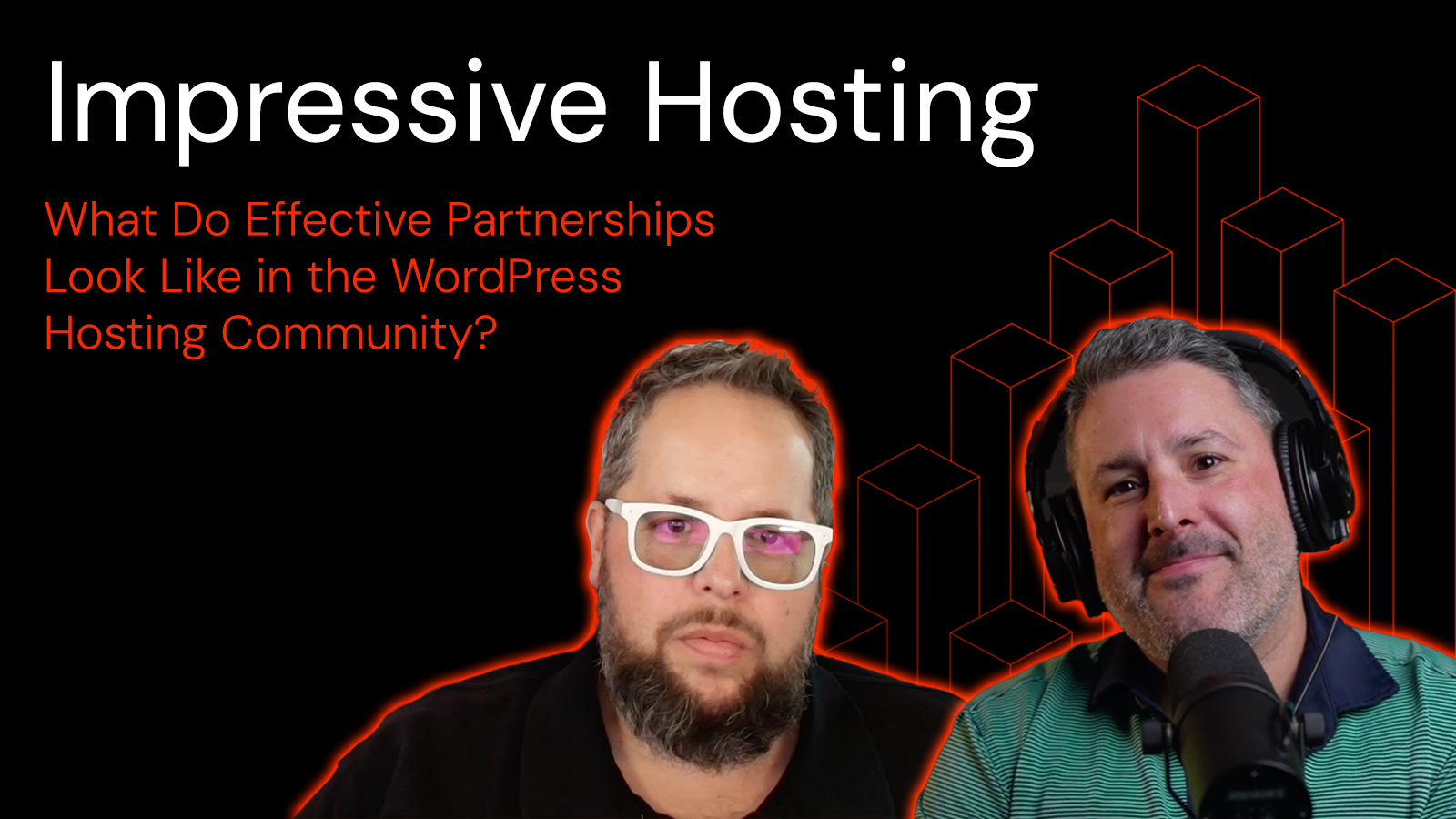
In this episode of Impressive Hosting, Jesse Friedman reconnects with longtime friend Matt Medeiros, Head of WordPress Community at Gravity Forms, to explore what effective partnerships really look like in the WordPress hosting ecosystem. Drawing on Matt’s 17+ years in the WordPress space, including his time running an agency and working at enterprise host Pagely, they dive deep into how the community should be defined and what that means for hosting companies.
The conversation examines the difference between the active WordPress community of contributors, WordCamp attendees, and passionate users versus the millions who simply use WordPress as a tool. Matt shares insights about various ways to contribute to WordPress beyond writing code, from documentation and support to education and idea generation, illustrating how he became a WordPress core contributor through a simple GitHub issue suggestion.
They discuss the fundamental shift happening in hosting sales, moving away from technical specifications toward selling promises of success, similar to platforms like Shopify and Squarespace. Matt emphasizes the critical need for hosting companies to develop genuine agency partnership programs that go beyond simple reseller relationships, advocating for transparent co-selling opportunities and high-touch support that helps agencies succeed rather than hide their hosting arrangements from clients.
Links:
Chapters:
00:00 Teaser
00:42 Introduction
03:54 What does leading WordPress community look like?
08:21 How should we define the WordPress community?
12:00 What’s the best way to contribute to WordPress?
17:09 What are some common challenges and opportunities in WordPress hosting?
25:25 Conclusion
Transcript
Teaser
Matt Medeiros: You create connections. There’s cross-marketing, collaboration, and things just happen. You keep the pulse of what’s happening in the space and you get to meet and talk to people.
Jesse Friedman: Something really magical about WordCamps when you’re able to go to those events and actually meet the people behind the products that you’re using. You get a business card or a handshake or whatever it might be, and then you run into an issue and you actually have somebody that you feel like you can reach out to.
Matt Medeiros: Contributions have been answering tickets on .org or helping somebody onboard with WordPress. This is valuable across the board. Anything that somebody’s doing for WordPress is valuable.
Jesse Friedman: These closed-source systems that have this fully integrated hosted solution don’t really sell hosting. They sell a promise of success.
Introduction
Jesse Friedman: Welcome to Impressive Hosting, where we uncover the core tenets of great WordPress hosting.
I’m your host, Jesse Friedman. Before we dive in, remember to check out impressive.host. It’s where you can comment on episodes, ask follow-up questions, and submit questions for upcoming guests. You’ll also find all the links to follow, like, and subscribe wherever you listen. With me today is Matt Medeiros from Gravity Forms. Matt is an old friend and someone that I’ve worked with on and off throughout the years and the decades that I’ve been in the WordPress industry. And he’s an awesome community member who’s got a lot to share around hosting, so that’s why I wanted to bring him on the show. Thanks for coming, Matt.
Matt Medeiros: Jesse, it’s a pleasure to see you. It’s a pleasure to see you podcasting because the fun fact is, 17 years ago you were guest number one on my podcast, so it’s nice to see you behind the microphone.
Jesse Friedman: Yeah, I was actually just thinking about that. I fumbled the ball a little bit there because I should have been a little bit more reciprocal and when I had a podcast coming up, I should have grabbed you and had you be guest number one on mine.
Matt Medeiros: That’s fine. No problem.
Jesse Friedman: Yeah. 17 years though. That’s crazy.
Matt Medeiros: Yeah, it is. It’s crazy. Time flies when you’re having WordPress fun.
Jesse Friedman: That’s true.
So what have you been up to in that time?
Matt Medeiros: Well, done a lot, right? Ran an agency for a decade. Worked at, well, speaking of hosting, of course, that’s why we’re here. Worked at a company called Pagely, which was acquired by GoDaddy for a few years. Now you’ll find me at Gravity Forms as a full-time job and WP Minutes still behind the mic.
Recording interviews with folks from around the WordPress community. Hot off the heels of PressConf. So chatted with a lot of folks there. Still loving and using WordPress, doing tutorials on YouTube, doing all the fun things to help WordPress thrive and get the word out about how great WordPress is as a CMS.
Jesse Friedman: That’s awesome. And so when did you join Gravity Forms?
Matt Medeiros: A couple years ago. So after Pagely, I worked for a few more years in the podcasting space. Worked at a podcast hosting company for a few years helping them with their product, helping their customers get off the ground with podcast hosting and getting their podcast off the ground, which was the most important part of that business.
And then transitioned over to when Gravity Forms opened up a new position for head of WordPress community. I was like, this sounds like a good fit. Gravity Forms wanted me to run their podcast, wanted me to do some YouTube content.
I was a Gravity Forms, still am a Gravity Forms customer. Since I started my agency, same thing, like 12, 13 years ago was probably my first commercial license that I ever bought for a plugin was Gravity Forms.
So I was like, yeah, this is a great fit. You know, talked to Carl and team, they had a great sort of fit for that role, and I was like, yeah, I’ll do this for sure. So I joined them two and a half years ago.
Jesse Friedman: They probably have been pretty happy finding out you applied for the job. I mean, everyone in the community knows you. You’re at every event. You have relationships with everyone from executives at hosting companies down to people in the local community building and running websites. Even the people who are blogging and stuff. I mean, you know, I think we mentioned 17 years ago I was on your podcast, but 20 years or so, we’ve been bouncing around the New England area and
Matt Medeiros: Yep.
What does leading WordPress community look like?
Jesse Friedman: Each other at events and everything. So really great. So what does a WordPress community manager, or what does the head of community mean? What does that look like?
Matt Medeiros: Yeah. So I mean, one of the great things as a testament to put a feather in that cap about podcasting. One of the great things about podcasting is that it sort of increases that surface luck area. It’s very, from a business standpoint, I’m sure with WP Cloud and stuff you’re doing, they’re like, what’s the ROI on this podcast you’re doing, Jesse?
But it’s really hard to pin that down from dollars and cents kind of thing from a business perspective. But what it does as you know, is increases that surface luck area. You meet people, you create connections. There’s cross-marketing, collaboration, and things just happen.
You keep the pulse of what’s happening in the space and you get to meet and talk to people. And that’s essentially what I’m doing at Gravity Forms, for WordPress at large, is leveraging the contacts, leveraging the community aspect of things that I’ve built over time, running the YouTube, running their podcasts, and keeping those connections going so that when we do talk to web hosts and they say, we would love to partner with Gravity Forms and maybe I know somebody in that space where I can make a connection when somebody from our team needs to reach out to somebody.
It really helps fortify those relationships. So I’m creating content, I’m talking to people, and most importantly talking to customers. Right? I have no problem. Not that we get many upset customers at Gravity Forms, but if we do and they’re like, “Hey, you know, why doesn’t this form integrate with this?” Or “I’m trying to build this form this way.” And they get a little upset, but they also are somebody who’s willing to share some constructive feedback. I have no problem hopping on a call with them and understanding how they’re using the product and how I can relate that back or relay that back to the product team.
Like, “Hey, I talked to agency owners. This is what they need from their payment forms. This is the feature, these are the features that we’re requesting. How can we get this into the product so that it makes sense for them and it’s not just the engineers building the product and not interfacing with the customer.”
So I spend a lot of time just talking to folks in this role, making those connections and hopefully dialing that feedback back to the team to improve Gravity Forms.
Jesse Friedman: Yeah, so a little bit of evangelism, a little bit of advocacy, building a conduit for people to have good feedback and the opportunity to talk to you. I think that goes a long way because something really magical about WordCamps when you’re able to go to those events and actually meet the people behind the products that you’re using. You get a business card or a handshake or whatever it might be, and then you run into an issue and you actually have somebody that you feel like you can reach out to. And even if they’re just gonna say, “Hey, I’m gonna pass you along to our customer service reps, they’re gonna let them know what your problem is and take care of you.” Having that first contact be someone that you’ve actually met and you’ve interacted with before. It could be hugely helpful and it’s great for your brand.
Matt Medeiros: Yeah.
Jesse Friedman: I remember actually using Gravity Forms for the first time. It was actually around the time that you and I did that podcast ’cause I was working on a very large multisite. And what we were working on was a way for companies to come in and start the process of building their website by filling out forms, answering questions about their business and things like that. And I love that Gravity Forms made it so easy for us to tie the front end of the form to things like custom post types in the backend, so that way you can actually pump in information into site meta or even post meta and start to craft and build a site from just some of these entries that people are building.
And then when you style it and make it really gorgeous, what we’re actually doing is creating an onboarding flow and helping them to build their website just from a simple form builder.
Matt Medeiros: Yeah, I mean, it’s still one of the most used use cases for Gravity Forms, and WordPress, and especially as WordPress has matured over the years and has a lot more plugins and themes and stuff like that, and front-end stuff. But people now looking at it as like, “Oh, I can use this Gravity Forms and WordPress to build these little mini apps.”
And maybe at some point we talk about AI, but certainly leveraging WordPress and AI to build maybe front ends where WordPress remains the backend. And there’s all kinds of things that you can do once you know the recipe, which is another thing I spend some time on doing with Gravity Forms is building out tutorials on the YouTube channel.
Like, here’s an idea, here’s something that you could implement in your business or freelance business or whatever, and show people how to build those things.
Jesse Friedman: Yeah. Yeah, yeah, exactly. So let me ask you this.
Here’s the edited version of this section:
How should we define the WordPress community?
Jesse Friedman: Since you’ve been in the community for so long and you’ve been to so many events and you know so many people, help me understand how you would define the WordPress community. Because I think this is a conversation that I end up having a lot, where a lot of times people will talk and say something on behalf of the WordPress community.
“The community wants this, the community wants that.” And then what I like to do is take a step back and think about it from a different perspective and say to myself, what does that actually mean? Who are you referring to? Are you referring to the people who show up to a WordCamp? The people who contribute, the people who write the documentation.
Is that the WordPress community or are you talking about the millions of users who use WordPress every day but maybe don’t even know anything about it? That a community exists, that WordCamps even exist and they think about it more like a different tax tool like Intuit or something like that.
There’s a lot of people there who just use WordPress because they wanna get in, they wanna write some content and get it back out of it, and it’s not something they’re super passionate about. So, I’m curious where, when we say the words “WordPress community,” where do you think that’s defined by?
Matt Medeiros: Yeah, I mean, the first pictures that pop into my head is either one big extended family or local government. I don’t know which route we wanna go with, but I totally get what you’re saying there. There are, at the end of the day, I think the community of the people who show up who want to help WordPress thrive, and that could be somebody who just writes docs on wordpress.org or answer support tickets.
Or it could be folks like yourself who work at Automattic and have a part in pushing the technology forward. Or it could be some third-party hosting company that might not be as big as a big name, but they’re out there and they’re helping distribute WordPress. I think what’s important is that everyone sees WordPress as this stable foundation that we’re all standing on, and you want it to be the best that it can be, so that you don’t lose your footing on WordPress.
Right? And it’s easy to, oftentimes in the community, what you’ll get is a lot of criticism. It’ll be criticism about the product, about the website. It’ll be about all these different points of criticism. And it’s okay to criticize and have critical thoughts and all this other stuff, but what you don’t want to do is retract from WordPress being seen as a good solution. You don’t want to talk about WordPress in a bad light from the people on the outside looking in going, “What? Should we be using, all you do is complain about this block or these blocks. Why should we be using it?” “Oh yeah, but we’re a family. We’re just having some discussions about these blocks or these patterns. But don’t worry, this is the right thing that we should be doing.”
Jesse Friedman: I love that analogy because when I was a kid, I would pick on my little brother all the time, right? I was allowed to do anything I wanted. I could beat up on him, I could call him whatever I wanted to. But if anybody else came in from the outside and started picking on my brother, then you stand up and you stand up for him. And it’s very much like that. I think the community and the group of people that we have is a family in a sense that we are very passionate about it. We’ve come to owe a lot to WordPress and the community and every one of us has come up from a place where we’ve gotten help from somebody else or somebody contributed to a project we were working on.
And so that locks us into this very passionate, emotional dedication to this product.
Matt Medeiros: Yeah.
Jesse Friedman: And then when we want to make it better, then all of a sudden there, of course this conflict is gonna rise and people are gonna get frustrated with it too. But I think you’re absolutely right that that perception needs to be stronger for the outside, for the people outside looking in.
Matt Medeiros: Yeah. You know, there’s, I would also urge the people who are in the community to understand, and especially those who have been around as long as we have.
What’s the best way to contribute to WordPress?
Matt Medeiros: ‘Cause I think it’s just human nature to be like, “Well, I’ve deployed hundreds of thousands of lines of code, so I am more important” in air quotes “in the community than the next person.”
And I think everyone would do well to understand that if you’ve been in the community for two years and your contributions have been answering tickets on .org or helping somebody onboard with WordPress, this is valuable across the board. Anything that somebody’s doing for WordPress is valuable.
So don’t belittle is not the right phrase, but don’t look down on something just because in air quotes “they only do docs.” We need those docs. Without those docs, the developer who’s coming into the system doesn’t know how to build something and because those docs were written correctly, the person learned how to code stuff and that stuff was deployed into a plugin. Therefore, your job was easier. So we all need each other on this raft that we’re on this 45% of the internet.
Jesse Friedman: Yeah. ‘Cause I can remember getting my wings when I did my first core contribution and it felt amazing. But it was, I don’t know, 20 lines of code. It was to help a little thing. When you got started, there was a banner at the top of the page and it just helps you kind of get started with WordPress a little bit easier. But I would never say I was a core contributor. I mean, technically, I am, I guess by definition, but I’m not gonna go around referring to myself that way. And the way in which I’ve contributed to the WordPress community is very different than a lot of people. I mean, I went from becoming a developer, a designer, a developer, marketing experience, all that stuff. And then I jumped into education and I taught probably thousands of students over the course of maybe close to a decade at two different universities in Rhode Island. Various topics around web design. And I always pushed WordPress, and I can’t tell you, I mean, I actually know some of my former students, and I can’t tell you how many times I run into them at a WordCamp or whatever, and they tell me that they were so greatly impacted by the introduction into WordPress that it’s impacted their career.
And in fact, there were some times when we had night classes and we would actually leave the school and we would go to the local WordPress meetup. And that’s what we did instead of having a class. And that stuck with them because it was a place where they could continue their education beyond the university, meet colleagues, network, and build up a real opportunity to grow inside of this product that is WordPress. And so yeah, I think you’re absolutely right. I think everybody has a unique way to give back and code is just one of many, many ways in which you can give back. You and your educational pieces, your podcast, everything like that. That’s been hugely helpful for the community, I’m sure.
Matt Medeiros: I love the contributor page that comes out when the new release of WordPress where it lists 600 people. I think it’s really cool. A couple versions ago, I can’t even remember, I was on that list because I had an idea. I was in the site editor. We’re all still trying to get comfortable with the site editor.
And one of the things that I love using Command K, which I could use it across all of WordPress, and one of the things I kept finding myself do, while I was doing tutorials, is like, how do I get to template parts? Why is template parts buried in a couple of three or four clicks to get to?
And I was like, I just want Command K template parts, just like you can get to templates or other aspects of the editor. So I created an issue on GitHub, and my friend Brian Coords, who now works for WooCommerce, he helped write some of that code. Somebody else on the team spot-checked it and in the next version we could go, we could do Command K template parts, right?
And because I opened up that ticket, shared my idea, collaborated with Brian, he collaborated with another developer, we were on that list of contributors to WordPress. And now every time I find myself doing Command K I was like, “Ah. I thought of this.” And that’s an amazing thing inside of WordPress, which is unfortunately sometimes just sadly overlooked, right?
These are things like, this is the essence of open source in my opinion. And again, it might be a little bit like local government where you have to corral the folks who are like, “Hey, this is all important. We should all fix this pothole on this street.” But if you can’t get enough people to get the pothole filled, then the city’s not doing it for you.
But in my case, I was like, “Hey, this is a cool idea.” Somebody else saw it was a cool idea. They joined in, wrote the code ’cause that’s not me. And it was my way of contributing to WordPress. And I love that kind of thing.
Jesse Friedman: So cool. And it’s a great example of how even if you’re not writing the code yourself, you can wrangle an idea.
Matt Medeiros: Yes.
Jesse Friedman: If you look at closed-source systems, the best you can really do there is submit a ticket, add a feature request somewhere, and just sit around and pray that someone’s listening and gonna actually implement that feature.
But you can actually, with WordPress or any open-source project, you can actually get in there and get your hands dirty. And that is so wildly different than what we use every single day. I mean, you think about all the software you use, these SaaS products, you use video streaming services, whatever. I’m sure every one of us has been frustrated about a feature at some point and user experience or whatever. And you just wished you could just fix it, or at least to have some more control over it.
So that’s really great. So you’ve had a long tenure with WordPress and you’ve done a variety of different jobs.
Matt Medeiros: Yeah.
What are some common challenges and opportunities in WordPress hosting?
Jesse Friedman: This whole podcast is about uncovering the core tenets of great WordPress hosting. Let me ask you this, everything that you know, is there anything that’s top of mind to you right now that you see that’s widespread across different hosting companies that you’re just like, I wish they did it differently. I wish they did this a different way.
Matt Medeiros: Yeah. So I go back to the early 2000s where I worked at a local internet service provider and I was managing Windows NT servers for hosting IIS where the thing crashed every 48 hours and I had to reboot it. And I helped usher in cPanel into that organization when cPanel first came out.
Then I ran 10 years at an agency that you know me from, rolled my own hosting and did a lot of that stuff where hosting was part of the sales process. Which was number one, a moneymaker for an agency. Although, because I had experience in the past working at a hosting provider, I knew how to manage servers number one at the time.
But I also knew the importance of being transparent with that. Meaning I didn’t just tell customers that hey, we were the host, end all, be all, I explained to them as transparent as possible. I made customers understand, well aware that we were sort of reselling if, for lack of a better phrase.
And what that means is what I look for in and what web hosts can do today is really find deep partnership opportunities with their agencies to help them make money. Because what happens is, and I still talk to freelancers and agencies obviously today through my podcast and of course at Gravity Forms, and people will just try to hide the fact that they’re reselling hosting, right? And that gets the young freelancer, young agency owner into hot water with their customer because they try to hide it. ‘Cause they’re afraid to say like, “Oh no, you’re paying me of course to host this website for you. We’re the ones that are doing it for you.” And then when something happens with the web host, it’s never a good thing the customer gets mad at them and say, “Hey, you’re the one that was supposed to be hosting this.” “Well then it’s not really me.” And it’s like, “Why didn’t you tell me that in the beginning?”
So you go down this terrible path, right? And I think that agencies and freelancers lean that way because there isn’t a proper mechanism from most web hosts anyway to say, “Here’s your account. Go resell this, and then let me give you the tools and the support to do that, to help your agency.”
High touch. High integration, whatever you want to call it, was something that I did a lot at Pagely. Now we were enterprise hosting different ticket, different account value and all this other stuff, but I did a lot of co-selling with my agency partners, right as the tech host tech. I would hop on a call, I would help co-sell this project with the agency, tell them why our fit is the best for this project.
I would like to see hosts do more of that. And in fact, every web host I talk to at the WP Minute or just coming off of PressConf, everyone that I know is trying to find and craft a better agency partnership program, because at the end of the day, here’s what I’m not hearing.
Here’s what I’m not hearing might be the better answer. I’m not hearing from any of my hosting friends say like, “We need to run more PHP processes or we’re rolling out the fastest database tech.” I’m not hearing anything about tech and speed anymore. I’m hearing how they’re trying to dig deeper into the relationships and the sales process with freelancers and agency owners and build either onboarding content or academies or build deeper relationships with these folks.
And it’s good to hear, but I wanna see more of it. That’s my wishlist is to have hosting that really leans into the partnership stuff, more so than not.
Jesse Friedman: I couldn’t agree with you more. So you touched on a couple different themes there. For one. talking about how you’re saying to yourself that you’re not seeing people talking about hosting as in how many workers you have, CPUs and all that stuff. And the reason I think that we’re seeing that is something that we’ve talked about on this podcast too, a bunch of times, is that the way in which end customers are thinking about buying a website has fundamentally shifted. I think the way in which we sell hosting needs to follow that too. Because you look at a Shopify or a Squarespace. A Wix or something like that. It’s these closed-source systems that have this fully integrated hosted solution don’t really sell hosting. They sell a promise of success. They sell.
You’re going to get all the tools and everything else you need, and it’s all gonna be in one place, and it’s just gonna work and it’s gonna be easy. And then all of a sudden you can launch something. And that actually was one of the reasons that I identified moving forward with WP Cloud for third parties because it was a tool that we had built internally for ourselves to power a variety of Automattic’s hosting products.
And when we said to ourselves that the, we’re seeing two shifts happening inside the hosting industry there, there’s a lot more leveraging large cloud platforms like AWS and Google Cloud and. The unfortunate thing about that is that that’s money going into huge giants and not going back into the WordPress community.
And two, it was a shift in thinking around the way in which hosting companies were going to market in that they didn’t have to be the hosting company, they didn’t have to be, it didn’t have to be their IP is their data centers in the way in which they’re going to market. What they could actually do is leverage something else.
And so WP Cloud is coming in to be this higher standard for cloud hosting that is WordPress focused, and it gives that hosting company the opportunity to really refocus their efforts on something else, providing a better user experience or whatever. Which leads me into another thing that you just mentioned, which is aligning yourself with the success of your customers is a way in which I’ve kind of interpreted what you’re saying there is that these agency programs are coming out of the woodwork. They, you know, hosts need to do a better job of understanding what it is that agencies need, the tools that they need to implement their projects, the way in which they can go and co-sell. So when a hosting company aligns themselves with the success of their customers, they’re making a promise to them that they’re going to get more than just simply the infrastructure to power a website. You’re going to help them through all that. And it could be support, it could be bundled add-ons, it could be integrated tools that help your workflow. It could save you money so that you can charge more or hire more people to run your business. So I think that that’s a really amazing way to look at it.
And I love the idea that you were going in and helping and co-selling these agencies. It’s funny because when Bluehost Cloud launched on WP Cloud, one of the things they did was invited me to come to some of their events. And I actually went to dinner with dozens of agencies to hear what it is that they wanted to see in the program and to see what they wanted to, what we could build to make it better. And I can’t overemphasize the importance of getting in there and getting your ear to the floor and just listening to what it is that they need and what’s going on in their lives right now.
Matt Medeiros: Yeah, at the end of the day, at least, I mean, it’s been seven years, eight years since I ran an agency. So I assume it’s still the same, but when I was running the agency, the client was calling us regardless, and that was from our small business customer who might be like a florist shop down the street all the way to our higher, what we would dub our enterprise types of clients, like folks that were paying us a hundred thousand dollars a year on retainer for creating custom plugins and all this other stuff for their stuff.
And they, but regardless, they would still call us like, “Something’s wrong with the server, it’s slow, it’s down, whatever.” I think it’s important that hosts recognize that the agency is the one, most of the time, 99% of the time anyway, with that relationship. And they’re gonna get called anyway. So if the agency doesn’t feel like the host wants to be a partner at that level, then at least I’m gonna do bad things.
Try to host their own, roll up their own infrastructure, and patch it together. ‘Cause they’re like, “Well, I need to make the most money because I’m gonna deal with it anyway.” Or find another host. It’s like when I tell my kids like, “Stop playing video games.”
And if I just tell them, “Stop playing video games,” they try to sneak it on the side. It’s like, no, I need to tell you why you need to stop at the one hour mark. I need you to understand what’s happening when I take this away and why. So yeah, partnerships and helping these agencies make money, I think is very important.
Jesse Friedman: Yeah, absolutely.
Conclusion
Jesse Friedman: Well, that’s great actually, believe it or not, that was essentially a half an hour already. So this was a great episode. I’d love to continue this conversation. So let’s break this up and come back into part two here.
Matt Medeiros: Sounds good to me.
Jesse Friedman: Awesome. Great. Well, we’ll be right back with Matt Medeiros.
Thank you.
Jesse Friedman: Thanks for joining us on another episode of Impressive Hosting, where we uncover the core tenets of great WordPress hosting. Do you have a follow-up question for today’s guest thought or comment on anything? We talked about a future guest suggestion, a hosting horror story. What do you think makes great WordPress hosting all your comments?
Shape the show. Drop them on impressive.host. We also appreciate you following us on social media and subscribing to the podcast on your favorite platform. Finally, do check out our list of open-source projects that need support at impressive.host. Whether it’s code, community, or cash, you can make a difference.
See you next time.
Subscribe to Impressive Hosting:


Leave a Reply