'%3E%3C/path%3E%3Cpath d='M76.4782 25.7185L71.982 9.04089H74.6936L78 22.8409L81.8045 9.04089H84.5853L88.2722 22.8409L91.5787 9.04089H94.2902L89.7248 25.6977H86.7781L83.1396 12.6379L79.3835 25.6977L76.4782 25.7185Z' fill='rgba(247, 43, 0)'%3E%3C/path%3E%3Cpath d='M96.6075 9.04089H102.439C103.739 9.04089 104.818 9.26224 105.676 9.69803C106.534 10.1338 107.17 10.7287 107.592 11.4827C108.014 12.2367 108.222 13.0875 108.222 14.0421C108.222 14.9483 108.021 15.7783 107.613 16.5254C107.212 17.2794 106.575 17.8812 105.725 18.3239C104.867 18.7666 103.774 18.9879 102.439 18.9879H99.1323V25.6977H96.6075V9.04089ZM99.1323 16.9128H102.321C103.511 16.9128 104.362 16.6568 104.881 16.138C105.399 15.6192 105.655 14.9206 105.655 14.0352C105.655 13.1152 105.399 12.3958 104.881 11.8839C104.362 11.372 103.511 11.1092 102.321 11.1092H99.1323V16.9128Z' fill='rgba(247, 43, 0)'%3E%3C/path%3E%3Cpath d='M124.138 25.9744C122.492 25.9744 121.067 25.6147 119.87 24.8953C118.674 24.1759 117.747 23.166 117.097 21.8725C116.446 20.5789 116.121 19.0848 116.121 17.3901C116.121 15.6746 116.446 14.1735 117.097 12.88C117.747 11.5864 118.674 10.5765 119.87 9.84329C121.067 9.11698 122.492 8.75036 124.138 8.75036C126.089 8.75036 127.68 9.22766 128.918 10.1753C130.156 11.1299 130.938 12.458 131.277 14.1735H128.469C128.247 13.2051 127.77 12.4373 127.044 11.8631C126.317 11.289 125.342 11.0054 124.118 11.0054C122.45 11.0054 121.136 11.5726 120.168 12.707C119.199 13.8415 118.715 15.3979 118.715 17.3831C118.715 19.3476 119.199 20.8971 120.168 22.0246C121.136 23.1521 122.45 23.7124 124.118 23.7124C125.342 23.7124 126.317 23.4427 127.044 22.9031C127.77 22.3636 128.247 21.6234 128.469 20.6896H131.277C130.945 22.3428 130.156 23.6294 128.918 24.5702C127.68 25.5109 126.089 25.9744 124.138 25.9744Z' fill='rgba(247, 43, 0)'%3E%3C/path%3E%3Cpath d='M133.961 25.6908V8.5636H136.486V25.6908H133.961Z' fill='rgba(247, 43, 0)'%3E%3C/path%3E%3Cpath d='M145.195 25.9744C144.067 25.9744 143.057 25.7185 142.158 25.1997C141.259 24.6809 140.553 23.9615 140.027 23.0346C139.502 22.1076 139.246 21.0216 139.246 19.7903C139.246 18.5591 139.509 17.4731 140.041 16.5392C140.574 15.6123 141.293 14.8929 142.192 14.3741C143.099 13.8622 144.102 13.5994 145.215 13.5994C146.343 13.5994 147.353 13.8553 148.252 14.3741C149.144 14.8929 149.864 15.6123 150.396 16.5392C150.929 17.4661 151.192 18.5522 151.192 19.7903C151.192 21.0285 150.929 22.1076 150.396 23.0346C149.864 23.9615 149.144 24.6809 148.245 25.1997C147.332 25.7185 146.315 25.9744 145.195 25.9744ZM145.195 23.8093C145.796 23.8093 146.357 23.6571 146.869 23.3597C147.387 23.0553 147.802 22.6126 148.121 22.0177C148.439 21.4228 148.598 20.6827 148.598 19.7903C148.598 18.898 148.446 18.1579 148.134 17.563C147.823 16.9681 147.415 16.5185 146.896 16.221C146.377 15.9167 145.824 15.7714 145.222 15.7714C144.62 15.7714 144.06 15.9236 143.548 16.221C143.029 16.5254 142.614 16.9681 142.296 17.563C141.978 18.1579 141.819 18.898 141.819 19.7903C141.819 20.6827 141.978 21.4228 142.296 22.0177C142.614 22.6126 143.023 23.0622 143.534 23.3597C144.032 23.664 144.586 23.8093 145.195 23.8093Z' fill='rgba(247, 43, 0)'%3E%3C/path%3E%3Cpath d='M158.275 25.9744C156.85 25.9744 155.723 25.5317 154.906 24.6394C154.09 23.747 153.682 22.4258 153.682 20.6688V13.8899H156.207V20.406C156.207 22.6887 157.141 23.83 159.015 23.83C159.949 23.83 160.717 23.498 161.326 22.834C161.927 22.1699 162.232 21.2153 162.232 19.9771V13.883H164.757V25.6908H162.522L162.336 23.6225C161.969 24.3488 161.436 24.9299 160.731 25.3449C160.011 25.7669 159.195 25.9744 158.275 25.9744Z' fill='rgba(247, 43, 0)'%3E%3C/path%3E%3Cpath d='M173.341 25.9744C172.2 25.9744 171.19 25.7046 170.318 25.1651C169.447 24.6255 168.762 23.8854 168.271 22.9515C167.779 22.0177 167.53 20.9525 167.53 19.7627C167.53 18.5729 167.779 17.5146 168.271 16.5876C168.762 15.6607 169.447 14.9275 170.325 14.4018C171.204 13.8692 172.213 13.6063 173.362 13.6063C174.296 13.6063 175.119 13.7861 175.824 14.1528C176.53 14.5194 177.083 15.0313 177.478 15.7022V8.5636H180.002V25.6908H177.74L177.478 23.8577C177.097 24.4111 176.571 24.9022 175.907 25.3311C175.243 25.76 174.385 25.9744 173.341 25.9744ZM173.791 23.7885C174.87 23.7885 175.755 23.415 176.44 22.6679C177.132 21.9209 177.478 20.9663 177.478 19.7903C177.478 18.6006 177.132 17.6391 176.44 16.8989C175.748 16.1588 174.863 15.7922 173.791 15.7922C172.712 15.7922 171.826 16.1588 171.127 16.8989C170.429 17.6391 170.083 18.6006 170.083 19.7903C170.083 20.5651 170.242 21.2568 170.56 21.8586C170.878 22.4604 171.314 22.9308 171.881 23.2767C172.435 23.6156 173.078 23.7885 173.791 23.7885Z' fill='rgba(247, 43, 0)'%3E%3C/path%3E%3C/svg%3E)
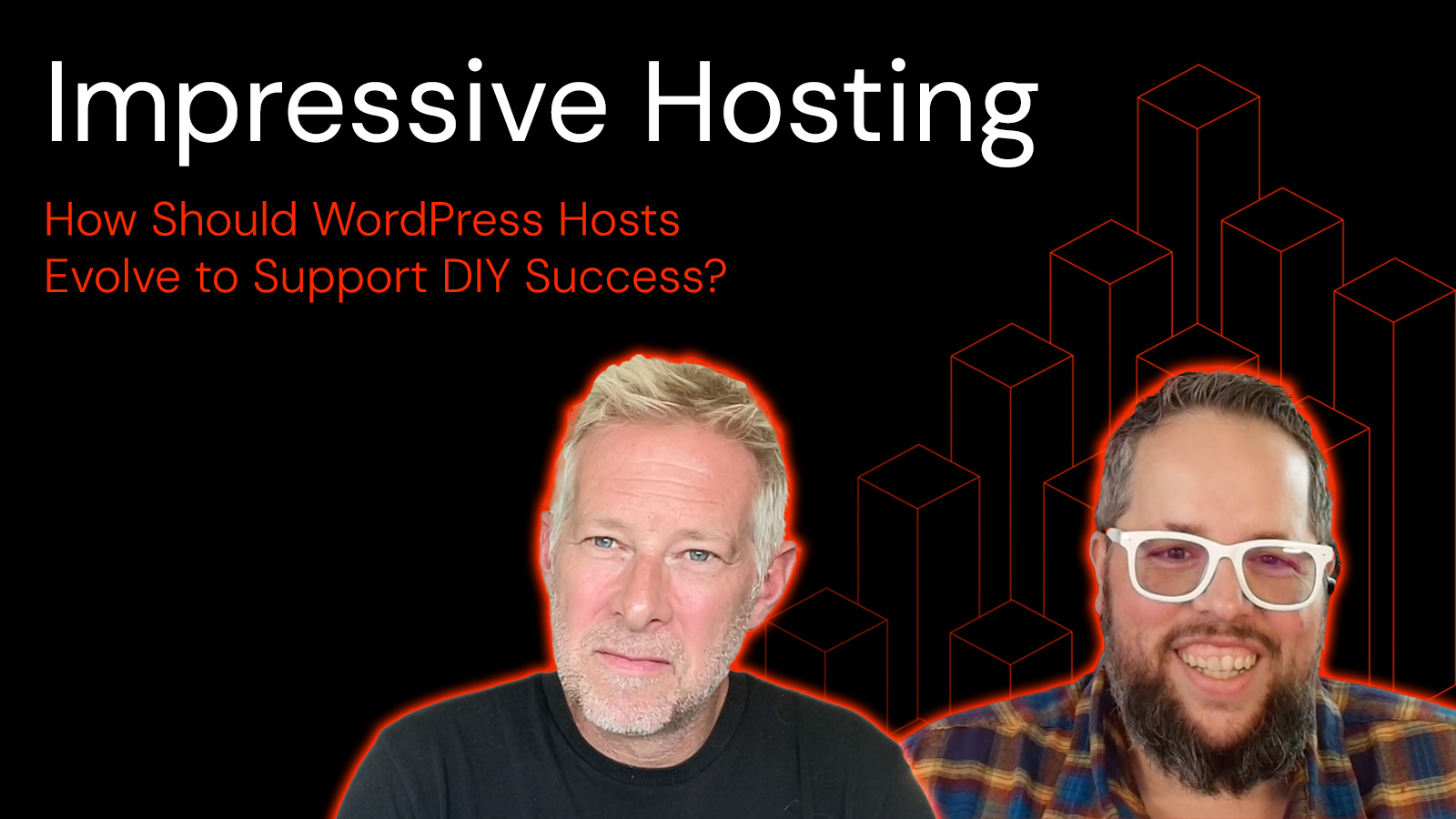
In this continuation episode with Jamie Marsland, head of WordPress YouTube at Automattic, Jesse dives deep into the WordPress hosting industry’s biggest challenge: serving the right customers effectively.
The conversation reveals striking statistics about WordPress hosting demographics – while 70% of users are DIYers building sites for themselves, hosting companies increasingly focus on the 30% who are agencies and professionals. Jesse explains why this shift happens: DIY users cost more to serve, require more support, and typically pay less per month.
But this strategy comes with significant risks. Jamie and Jesse explore how abandoning DIY users could drive them to competitors like Shopify and Squarespace, ultimately weakening the WordPress ecosystem. They discuss innovative approaches to education, including embedding YouTube content directly into WordPress admin areas to provide contextual help.
The episode tackles practical solutions for hosting companies: moving away from race-to-the-bottom pricing, using AI to reduce support costs, and recognizing that supporting DIY success benefits everyone in the WordPress community. Jamie shares insights from his experience training over 5,000 WordPress users and building a 178,000+ subscriber YouTube channel.
Key topics include customer segmentation strategies, the future of content creation in an AI-driven world, and why hosting companies should embrace open educational resources rather than creating everything from scratch.
Links:
- Jamie WP
- Jamie Marsland
- Pootlepress
- @pootlepress
- WP101
- WordPress.org AI Initiative
- WordCamp Central
- Jamie talks with James LePage
Transcript
Jesse Friedman: Welcome to Impressive Hosting, where we uncover the core tenets of great WordPress hosting. I’m your host, Jesse Friedman. Before we dive in, remember to check out impressivehost.net. It’s where you can comment on episodes, ask follow-up questions, and submit your questions for upcoming guests. You’ll also find all our links to follow, like, and subscribe wherever you listen.
With me today is Jamie Marsland, the head of WordPress YouTube. And this is part two of what was a very awesome episode that happened to go by lightning fast. And Jamie had a bunch of questions for me, which is an awesome flip of the script for this podcast. And so we’re picking up where we left off.
Jamie, you had some interesting questions when we were talking about basically industry trends around the need for WordPress or hosting companies to evolve the way in which they present WordPress. And we were talking about segmenting customers and trying to paint a much more personal picture for DIYers versus people who are interested in the technical underpinnings of hosting.
What’s the split between DIY users and agencies in WordPress hosting?
Jamie Marsland: Yeah. I’m gonna—these may be impossible questions, so forgive me for asking them. But one of the constant conversations I have in the forums I’m involved in, WordPress, is this split between DIYers and the agency professionals that are building sites. So it’d be interesting—you’re viewing that, but my question was do we have any sense of what that is in terms of—
I’ve asked a few hosting companies this and they’ve given me vague answers. But do you have in your head like, which is in my head, I have like the DIYers are 90% and the agencies are 10%.
Jesse Friedman: Mm-hmm.
Jamie Marsland: The next question follows on from that. If that’s true in terms of revenue, what does that look like in terms of the value to the host?
Jesse Friedman: It’s a great question. So this is a common theme that I talk to hosting companies, not just in this podcast, but just in my day-to-day. I’m talking to hosting companies all the time, and this is a question that I ask frequently because I want to keep my finger on the pulse of the situation.
So the number tends to be—it’s interesting how there’s so much of the same number being used when you talk to a hosting company that does not deal in only WordPress, so they have shared hosting that can be outside of WordPress, things like that. It tends to be about 70% of customers are choosing WordPress from that hosting company.
Oddly enough, the way in which they identify—it’s about 65 to 70% identify themselves as someone who’s building a website for themselves.
And so it’s about 30, 35% are building it for someone else. Now, that could mean a variety of things. That could be a freelancer, it could be a contractor, it could be an agency, it could be a variety of things.
Now. The volume of customers that you see are typically DIYers. It’s the vast majority of volume is those DIYers. However, the reason that hosting companies are taking a much larger focus on agencies is two-pronged. One is the DIYer costs more to serve, so their hosting company’s cost-to-serve increases, and they spend less.
So a DIYer who’s running a brick-and-mortar retail store may only value a website hosting plan at 15 bucks a month at max. And because they’re less educated in the technology that’s required to understand how to build a website, they’re much more likely to ask for support. And support is quite expensive to a hosting company.
Why are hosting companies focusing more on agencies than DIY users?
Jesse Friedman: Additionally, they will also make some rookie mistakes—choose bad passwords or upload malicious software inadvertently. And so that can cost the hosting company more money. So there’s this growing need for hosting companies to focus their efforts on acquiring more agencies.
And you’ll see this coming out of the woodworks. Almost every hosting company these days is either launching or working on some kind of agency program. And it’s to bring in these agencies that are lower volume, but they bring in a lot more revenue and they typically handle a lot more on their own.
So that’s the answer to your question.
Jamie Marsland: That’s a great answer. Follow on from that quickly. Do you think that’s the right strategy given where we’re going with technology and AI and the fact that—is there a risk that the agency market is gonna get smaller over the next five years because AI is making these tools much easier for folks to use?
What risks come with ignoring DIY WordPress users?
Jesse Friedman: I think the risk is in the fact that we’re leaving DIYers behind. And so when we think about the volume of these sites, it’s detrimental to the WordPress ecosystem because the DIYers are the vast majority of WordPress users across the globe. And it’s funny because when we think about the WordPress community.
People like yourself and me. We often think about the WordPress community as the people who show up on Slack or contributing plugins or go to a WordCamp, something like that. But there’s a wider audience. There’s a wider community there of people who don’t think about WordPress as a community.
They think about it as software that they use to reach their goals. And so in their minds, it’s no different than like Intuit’s tax software or Quicken or something like that. And so if we aren’t addressing their needs and helping them to be successful, they’re going to go with easier, more holistic programs like Shopify or Squarespace.
So I think the risk is greater that we end up leaving behind these customers. And one of the things that I think that we really need to do to solve for that is to get out of this race-to-the-bottom on pricing. It’s something that continues to plague the hosting industry that people will value a single website that can generate tons of money for their business at less than a cup of coffee a month. You look at unlimited hosting plans for $2.99 a month. You’re setting yourself up to be in a situation where you’re going to be acquiring customers at a loss, and then that builds up as a problem for that hosting company over time.
So if we as a hosting industry can shift out of this race-to-the-bottom and set a higher standard for pricing by providing better services and better solutions, reducing our cost-to-serve, we can actually use AI to address the needs of these DIYers and turn that larger volume of customers into a much larger profit center.
Jamie Marsland: Okay. Two final questions before we start, which are—one is, do you see this focus on agencies where—where has this manifested itself in terms of do you see this happening in terms of we’re neglecting DIYers? And the second part of that question was, do you think that hosting companies do enough around education at the moment in terms of—I mean, they should be, it should be self-interest, right? Reducing churn. But do you see that’s in a good place at the moment, or do you think that’s a big gap where we could be helping them do more?
Jesse Friedman: You know what’s funny is, one of the questions that I had set aside for you was, so you have this amazing YouTube channel. If a hosting company’s responsibility is to the success of their customer, and that comes with education, a lot of times I think in the mind of a hosting company, they’re thinking to themselves, well, now I have to generate all this unique content and I have to create our own YouTube channel and a library of things.
And I think that becomes problematic because a hosting company is afraid to reuse something or use something that any other hosting company can benefit from at the same time, which is interesting because it’s built on open source software that we’re all using anyway. So there are ways to differentiate ourselves.
So I think absolutely that a hosting company has a responsibility to the end customer to educate them because the more likely that they are successful with WordPress, the better it is for the ecosystem, the better it is for the host. But let me ask you this. This is a very specific question.
If you found out that a hosting company started embedding your YouTube videos directly into the WP Admin as a way to help create a little bit better of a connection with that end customer and teach them something in real time, how would you feel about that?
How can hosting companies better educate their users?
Jamie Marsland: I’d be 100% delighted that that happened. Yeah, if anyone wants to do that.
Jesse Friedman: The reason I ask is because years ago I worked for a company where we had these insurance agents who had no experience with the web come in and they had to write content for their website. And at the time, we bought a license for like WP 101, which for those at home, it was basically a library of videos that was constantly updated with every new release of WordPress on how to do very specific things. How do you create a blog post? How do you upload an image? Things like that. And I literally wrote a plugin to insert that video into the little helper bar that drops down from the top of WordPress so that there was actually better, more helpful content inside the WP admin.
And it got me thinking about that with a hosting company. It’s like, I bet you if I were to ask the next five hosting companies that I have on this show, if they would feel comfortable doing that, I bet you most of them would say no. That would feel uncomfortable, it would feel wrong. It would feel like I’m using Jamie’s content in a way to make profit or make money, and I don’t wanna do that.
And so what they end up doing is nothing. They don’t end up doing anything and they rely on their own support staff to help these customers. But I think there’s so much more that we could be doing to help educate.
Jamie Marsland: Yeah, this sounds like a great project for a WordPress.org project where it’s just actually at the org level and then that—I mean, you’ve triggered an idea in my head, so that’s really good. Thank you for that. Yeah. I think that.
Jesse Friedman: Yeah. I mean, I would love to—I mean, if you categorize your videos in that way, you could definitely be injecting them basically right into the WP admin and give people the ability to watch them right in there.
Jamie Marsland: Yeah, I mean that’d be kind of awesome. Yeah. Cool. Okay. That’s, that was my final question. So thank you for that. That was really interesting around the market. Because it’s a common thing I see, especially in the—I think when you go into these forums, especially the developer forums and the sort of professional agency forums, they have a—I think they think that those folks think that it’s 90% agencies and 10% DIYers, and I think the market is very, very, very, very different to that.
Jesse Friedman: Yeah. Let me ask you one last question because I know you need to go, and this is gonna end up being a shorter episode. But when you think about the fact that you are building a community on YouTube, a platform that you don’t control and that functions off of an algorithm that you don’t control.
And a connection with a community that you don’t own. Right? I’ve talked about this before, this idea that influencers need to own their influence and how WordPress can play a role in that. Leave us off with—help us understand the strategy that WordPress plays. In a world where you are building YouTube videos and content on a closed source, walled garden platform that you don’t control, but you do have the ability to embed those videos in an open source platform like WordPress.
So what role does WordPress play in helping you to build and strengthen your community on YouTube?
Can you build a community when using platforms you don’t control?
Jamie Marsland: Well, all my videos go on my website anyway. So I do have a place where I kind of control to some degree. But we are now in a world where we are building on rented land. A lot of us, in terms of our influence, we are increasingly in a world of zero clicks.
So it’s harder and harder to track where your clicks are coming from. So we’re in an interesting space. I’ve just been actually talking to James LePage, who’s just heading up the AI initiative for WordPress.org around some of the stuff we’re doing in terms of making WordPress available to AI.
So I think we’re in a really transformational space. We are the only generation that’s gonna know before AI and after AI. Every point is gonna—it’s gonna be like when they have to reset 100-meter records after they found somebody who’s taken drugs.
Right? We’re never gonna be in the period now from this point on where nothing isn’t AI. And our grandchildren are gonna know AI. We’re the only generation that’s known before and after it. So we’re in an incredibly transformational time. And I think from a content creation point of view, I don’t have the answer to your question, but I’m rambling on about something else.
I think from a content creation point of view, our customers are gonna go through this enormous period of disruption. We don’t know what that looks like. They don’t know what that looks like, but it’s gonna be crazy disruptive. Lots of people are gonna be disrupted. And I think our job as creators creating content is to reflect that honestly and more than ever to be a trusted guide through this incredible tumult that we’re all about to go through. And I think then you build trust. I spend a lot of time building my email list off my YouTube videos as well.
So I do have that community that I can directly relate to in terms of communicating.
Jesse Friedman: And that’s hugely helpful. If anything were to be disrupted on the YouTube side, you could then go communicate to those customers, those viewers via email. You could communicate to them via the website. Do you try to drive conversation to the website, like the YouTube comment section is quite powerful.
Do you try to push some of that to the WordPress website?
Jamie Marsland: Nope. I mean, I don’t—you know, to get any kind of comments on YouTube is hard, but some videos get tons and tons of engagement. And so yeah, you’re kind of just—again, you’re just having those conversations in the places, in the various places, whether it’s on X or it’s on LinkedIn or it’s on YouTube.
You’re just kind of having those conversations. Just be grateful for them. Where they are.
Jesse Friedman: Where they are.
Jamie Marsland: Where they are. Yeah.
Absolutely. So it’s not ideal in terms of we’re beholden to YouTube. One of the reasons I love YouTube though, is it’s not like—because in my old business, you were driving a lot of revenue through SEO.
What makes YouTube an effective platform for engagement?
Jamie Marsland: It’s not the same as SEO. You’re driving engagement through this human connection that you have on video. And most of the views come not through search on YouTube at all. They come because YouTube is recommending these videos to people that have watched them and are enjoying them. So for me it’s a much more—unless they make lots of changes, the algorithm is incentivized to push videos that people are actually enjoying and engaging with.
And the level of engagement you get with video completely exceeds anything else I’ve ever done. Like I used to go to WordCamps and walk around completely anonymously, and then I went to—it struck me like a bolt from the blue when I went to WordCamp Athens a few years ago, and I’d literally been walking around these WordCamps completely anonymously for years.
And then literally within about five minutes of walking through the door, I had people walking up to me wanting selfies, which was weird. Purely because they—
Jesse Friedman: You’re a celebrity now.
Jamie Marsland: My kids call me a micro-influencer, which is you’re kind of so small that if you walk down the street normally nobody’s gonna recognize you, but if you go to an event, then people come up to you and take selfies. So video has an incredible power that the written word does as well, but it’s incredible to see it in person. You probably get—
Jesse Friedman: I think that speaks to the medium of it, but I think it also speaks to the impact that you are personally making on people’s lives. Like they’re not only excited for it because it’s good video content and all that stuff, but it’s also because it’s actually helping them to be successful.
And it’s driving that for them. So they’re probably tying their feelings of pride and other things directly to seeing you in person, which is very cool.
Jamie Marsland: Very nice to say. I mean, the other thing to say is I absolutely love YouTube and I love the process of video making and I love everything about getting good at YouTube. So the learning around—which you’ve probably seen as well, going through your own journey. It’s like, I find it fascinating how you construct a video to get people to watch it.
I find that whole creative process just incredibly exciting. So if anyone wants help with YouTube, come and talk to me.
Jesse Friedman: Well, actually, you know, one of the things we didn’t get to, which I really want to talk about, so maybe you could come back on the show in the future, would be—I wanna talk about speed builds because they seem to be growing and becoming quite cool and maybe even a sport in themselves. But we didn’t have a chance to talk about that today, and that’s okay.
So in the meantime, what we did learn though is that if there is a hosting company out there that wants to leverage your videos to help educate their customers. They should absolutely feel free to do that. And if they want to do that, where do they go? What’s the website and what’s the YouTube channel name?
Jamie Marsland: The YouTube channel is JamieWP, so just YouTube, JamieWP, or just search for WordPress. And you’ll probably see my face lurking on YouTube somewhere. I’m on Twitter at Poodle Press. And I work for Automattic, so you can find me there as well. That’s probably enough places to find me.
Jesse Friedman: And we’ll put a bunch of this stuff in the show notes too. Jamie, thank you so much for joining us. It was a real pleasure. I hope to have you on again soon.
Jamie Marsland: Thank you.
Subscribe to Impressive Hosting:


Leave a Reply