'%3E%3C/path%3E%3Cpath d='M76.4782 25.7185L71.982 9.04089H74.6936L78 22.8409L81.8045 9.04089H84.5853L88.2722 22.8409L91.5787 9.04089H94.2902L89.7248 25.6977H86.7781L83.1396 12.6379L79.3835 25.6977L76.4782 25.7185Z' fill='rgba(247, 43, 0)'%3E%3C/path%3E%3Cpath d='M96.6075 9.04089H102.439C103.739 9.04089 104.818 9.26224 105.676 9.69803C106.534 10.1338 107.17 10.7287 107.592 11.4827C108.014 12.2367 108.222 13.0875 108.222 14.0421C108.222 14.9483 108.021 15.7783 107.613 16.5254C107.212 17.2794 106.575 17.8812 105.725 18.3239C104.867 18.7666 103.774 18.9879 102.439 18.9879H99.1323V25.6977H96.6075V9.04089ZM99.1323 16.9128H102.321C103.511 16.9128 104.362 16.6568 104.881 16.138C105.399 15.6192 105.655 14.9206 105.655 14.0352C105.655 13.1152 105.399 12.3958 104.881 11.8839C104.362 11.372 103.511 11.1092 102.321 11.1092H99.1323V16.9128Z' fill='rgba(247, 43, 0)'%3E%3C/path%3E%3Cpath d='M124.138 25.9744C122.492 25.9744 121.067 25.6147 119.87 24.8953C118.674 24.1759 117.747 23.166 117.097 21.8725C116.446 20.5789 116.121 19.0848 116.121 17.3901C116.121 15.6746 116.446 14.1735 117.097 12.88C117.747 11.5864 118.674 10.5765 119.87 9.84329C121.067 9.11698 122.492 8.75036 124.138 8.75036C126.089 8.75036 127.68 9.22766 128.918 10.1753C130.156 11.1299 130.938 12.458 131.277 14.1735H128.469C128.247 13.2051 127.77 12.4373 127.044 11.8631C126.317 11.289 125.342 11.0054 124.118 11.0054C122.45 11.0054 121.136 11.5726 120.168 12.707C119.199 13.8415 118.715 15.3979 118.715 17.3831C118.715 19.3476 119.199 20.8971 120.168 22.0246C121.136 23.1521 122.45 23.7124 124.118 23.7124C125.342 23.7124 126.317 23.4427 127.044 22.9031C127.77 22.3636 128.247 21.6234 128.469 20.6896H131.277C130.945 22.3428 130.156 23.6294 128.918 24.5702C127.68 25.5109 126.089 25.9744 124.138 25.9744Z' fill='rgba(247, 43, 0)'%3E%3C/path%3E%3Cpath d='M133.961 25.6908V8.5636H136.486V25.6908H133.961Z' fill='rgba(247, 43, 0)'%3E%3C/path%3E%3Cpath d='M145.195 25.9744C144.067 25.9744 143.057 25.7185 142.158 25.1997C141.259 24.6809 140.553 23.9615 140.027 23.0346C139.502 22.1076 139.246 21.0216 139.246 19.7903C139.246 18.5591 139.509 17.4731 140.041 16.5392C140.574 15.6123 141.293 14.8929 142.192 14.3741C143.099 13.8622 144.102 13.5994 145.215 13.5994C146.343 13.5994 147.353 13.8553 148.252 14.3741C149.144 14.8929 149.864 15.6123 150.396 16.5392C150.929 17.4661 151.192 18.5522 151.192 19.7903C151.192 21.0285 150.929 22.1076 150.396 23.0346C149.864 23.9615 149.144 24.6809 148.245 25.1997C147.332 25.7185 146.315 25.9744 145.195 25.9744ZM145.195 23.8093C145.796 23.8093 146.357 23.6571 146.869 23.3597C147.387 23.0553 147.802 22.6126 148.121 22.0177C148.439 21.4228 148.598 20.6827 148.598 19.7903C148.598 18.898 148.446 18.1579 148.134 17.563C147.823 16.9681 147.415 16.5185 146.896 16.221C146.377 15.9167 145.824 15.7714 145.222 15.7714C144.62 15.7714 144.06 15.9236 143.548 16.221C143.029 16.5254 142.614 16.9681 142.296 17.563C141.978 18.1579 141.819 18.898 141.819 19.7903C141.819 20.6827 141.978 21.4228 142.296 22.0177C142.614 22.6126 143.023 23.0622 143.534 23.3597C144.032 23.664 144.586 23.8093 145.195 23.8093Z' fill='rgba(247, 43, 0)'%3E%3C/path%3E%3Cpath d='M158.275 25.9744C156.85 25.9744 155.723 25.5317 154.906 24.6394C154.09 23.747 153.682 22.4258 153.682 20.6688V13.8899H156.207V20.406C156.207 22.6887 157.141 23.83 159.015 23.83C159.949 23.83 160.717 23.498 161.326 22.834C161.927 22.1699 162.232 21.2153 162.232 19.9771V13.883H164.757V25.6908H162.522L162.336 23.6225C161.969 24.3488 161.436 24.9299 160.731 25.3449C160.011 25.7669 159.195 25.9744 158.275 25.9744Z' fill='rgba(247, 43, 0)'%3E%3C/path%3E%3Cpath d='M173.341 25.9744C172.2 25.9744 171.19 25.7046 170.318 25.1651C169.447 24.6255 168.762 23.8854 168.271 22.9515C167.779 22.0177 167.53 20.9525 167.53 19.7627C167.53 18.5729 167.779 17.5146 168.271 16.5876C168.762 15.6607 169.447 14.9275 170.325 14.4018C171.204 13.8692 172.213 13.6063 173.362 13.6063C174.296 13.6063 175.119 13.7861 175.824 14.1528C176.53 14.5194 177.083 15.0313 177.478 15.7022V8.5636H180.002V25.6908H177.74L177.478 23.8577C177.097 24.4111 176.571 24.9022 175.907 25.3311C175.243 25.76 174.385 25.9744 173.341 25.9744ZM173.791 23.7885C174.87 23.7885 175.755 23.415 176.44 22.6679C177.132 21.9209 177.478 20.9663 177.478 19.7903C177.478 18.6006 177.132 17.6391 176.44 16.8989C175.748 16.1588 174.863 15.7922 173.791 15.7922C172.712 15.7922 171.826 16.1588 171.127 16.8989C170.429 17.6391 170.083 18.6006 170.083 19.7903C170.083 20.5651 170.242 21.2568 170.56 21.8586C170.878 22.4604 171.314 22.9308 171.881 23.2767C172.435 23.6156 173.078 23.7885 173.791 23.7885Z' fill='rgba(247, 43, 0)'%3E%3C/path%3E%3C/svg%3E)
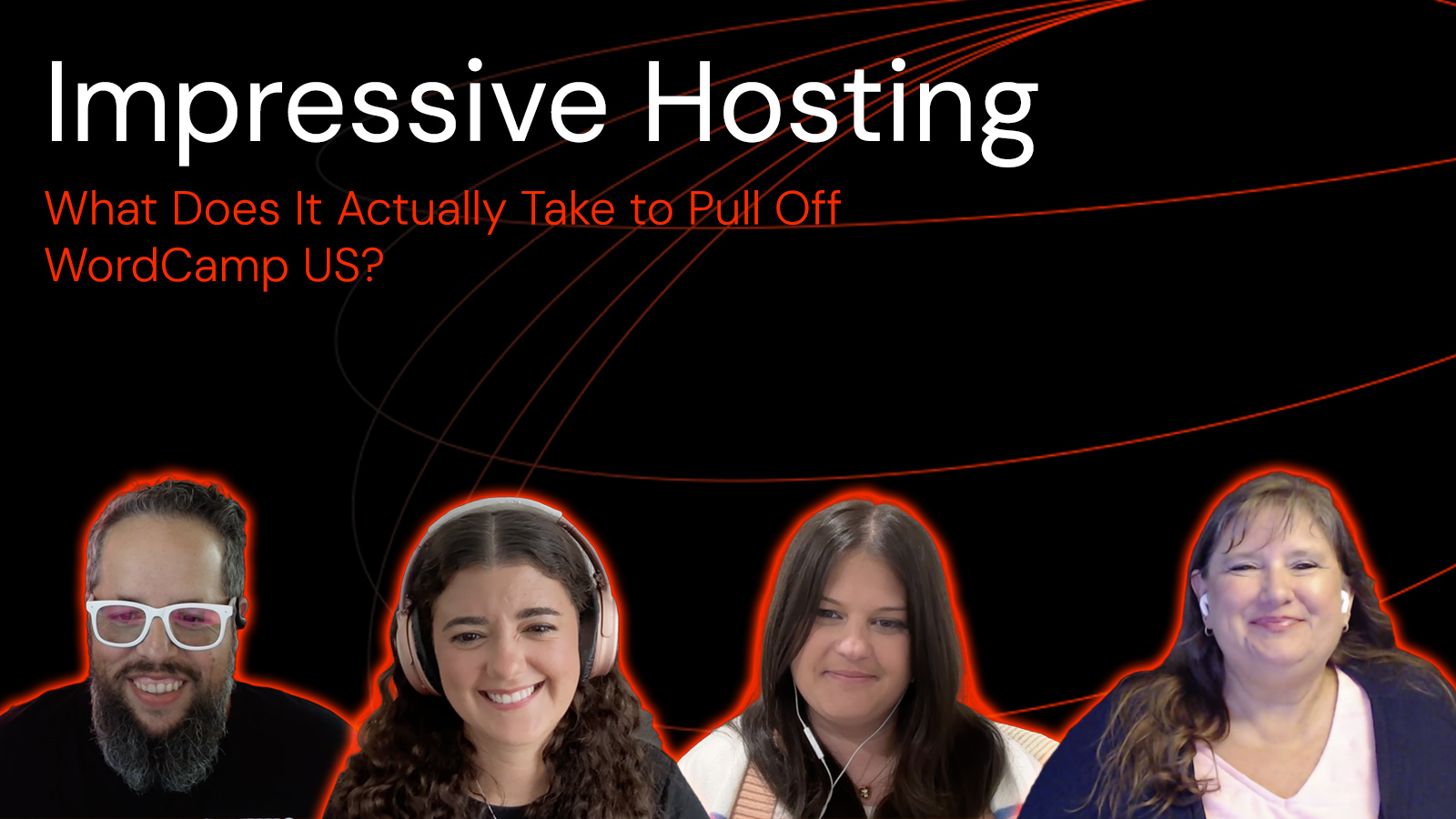
WordCamp US keeps ticket prices low on purpose, and this episode explains why. Jesse Friedman sits down with organizers Caroline Harrison, Megan Marcel, and Carol Stambaugh to talk about accessibility, community, and the work that goes into a great event.
Megan Marcel describes the sponsor support that lets the team focus on getting people in the door rather than turning a profit, along with perks like daily lunches, a happiness bar for one-on-one WordPress help, and speakers you can meet in the coffee line. Caroline Harrison talks about the volunteer experience and the friendships that form on the organizing team. Carol Stambaugh shares a story from WordCamp Phoenix about an attendee who found more value here than at a conference costing two thousand dollars.
There is also a candid section for hosting companies. Carol, an agency owner herself, explains what she looks for in a host, including watchdog tools, easy access to logs, and the freedom to move on and off a platform. She offers a smart approach to networking on the floor by asking customers about both their horror stories and their success stories. It’s a valuable episode for hosting professionals and event-goers alike.
Links:
Transcript
Jesse Friedman: Hey, welcome to Impressive Hosting. I’m your host, Jesse Friedman, and before we begin, I just want to let you know that we have a special coupon code for WordCamp US 2026. If you use the code WPCLOUD, no spaces, and sign up for WordCamp US, you get a 25% discount. I’m looking forward to seeing you there. Welcome to Impressive Hosting, a podcast about the role hosting plays in shaping the open web. I’m your host, Jesse Friedman. On this show, we go deeper than uptime and dashboards. We talk about hosting as infrastructure, about ownership, independence, and what it takes to build ethical, high-end WordPress hosting that actually serves creators, businesses, and the internet itself. Before we dive in, head to impressive.host. That’s where you can comment on episodes, ask follow-up questions, and help shape future conversations. You’ll also find links to follow, like, and subscribe wherever you listen. Today, I’m joined by three amazing people who are helping to put on WordCamp US. First, I want to introduce Caroline Harrison, the events wrangler at Automattic and a WordCamp US organizer. Megan Marcel, head of events at Automattic and a WordCamp US organizer. And Carol Stambaugh, CEO and owner of RadiateHUE, WordCamp US organizer, and lead organizer of the WordPress Arizona Meetup. Whew, that was a lot. All right, before we jump into the show, let’s give everybody a chance to say who they are, where they’re from, and all that. Caroline, let’s start with you.
Caroline Harrison: Hey, Jesse. Thank you. I’m Caroline. I have been with Automattic for about five years now, handling events during my time there. I’ve been on the organizing team for two flagship WordCamps so far. Love the community, love being on the ground, meeting all these people. I’m based in South Jersey, kind of by Atlantic City.
Jesse Friedman: Nice. Megan, you wanna jump in?
Megan Marcel: Sure. Hi, thanks for having us. I am Megan Marcel. I lead events at Automattic. I’ve been here about nine years, and about 16 years in events. I was in publishing before that. I have been on the organizing team of WordCamp US for, this is my second round, and I’m really excited to be here as well. I am in New York, Long Island.
Jesse Friedman: Nice. Carol, last but certainly not least.
Carol Stambaugh: Thanks so much for having me. I am based in Mesa, Arizona, which is a suburb of Phoenix, so I’m just about 20 minutes from downtown. I have been working with WordPress and involved in the community since 2011. I began with the WordPress meetup, and then I have served on all of the organizing teams since 2012. I’ve been speaker wrangler for all of the WordCamp Phoenix events since 2017. So I love speakers. I love doing this kind of programming. It just gets me excited.
Jesse Friedman: That’s awesome. I’m wearing my Automattic T-shirt that I got at one of the events we went to in San Francisco recently. I’m super excited about WordCamp US. Almost all WordCamps, really, but WordCamp US in particular because I think it brings in a really unique and special energy. And I think a lot of that comes around the curriculum. So Carol, real quick question. You have an education background, right? You used to be an adjunct professor, is that right?
Carol Stambaugh: I was. A social worker by trade, but I was an adjunct faculty member at ASU in their social work program. So yeah.
Jesse Friedman: Yes. I used to do that as well. I used to teach at two universities here in Rhode Island. I always found that there was a unique connection between universities and WordCamps. A lot of the time, the more local WordCamps tend to borrow location and logistical pieces and things like that from actual universities. And it’s always great to bring in the students as well. I think it’s really cool because WordCamps in general tend to have an educational kind of curriculum tied to it. There’s always this commercial aspect, there’s always industry-related news. But I think at the end of the day, there’s this core philosophy to help you get educated and learn more about WordPress. So what do we expect to be learning at WordCamp US this year?
Carol Stambaugh: So funny story, just a little side note. My mom was a teacher, and as I was growing up, she always mentioned, “You know, you would be a good teacher.” “No, no, no. I’m not gonna teach.” And so I purposefully went a different direction, and then I’ve come full circle. Now I spend so much time either teaching or designing education. So it’s kind of like mom knows best, right? But this year, one thing that we’ve done differently, and I’ve done a lot of speaker reviews and speaker selections over the years, is to really think in a very intentional way about who was going to be attending these camps. We came up with four attendee personas of people who attend our WordCamps. Now, I’m not gonna lie, AI helped me with this. But I really drilled down and did a lot of thinking about who I see at WordCamps and who benefits from WordCamps. So we designed our program and selected our sessions thinking about each one of those personas. And as we were doing our final placement of the programs into their spots, we were also thinking, “Okay, who is going to attend?” Sophia, Taylor, Jordan, those were the names of our personas. We looked line by line because we really want everyone who attends to have a place all the time and everywhere. That was a very intentional move on our part as we were both selecting sessions and placing them.
Jesse Friedman: Amazing. That’s really great. So Caroline and Megan, I think the two of you probably have some of the hardest jobs at Automattic in general. My wife would appreciate me saying this, but she has been in hospitality and event planning for a long time. So I get to see the behind-the-scenes of all the intricate pieces, all the last-minute stuff, all the things that come out of nowhere that you can’t plan for. But if anybody’s ever been to an Automattic event, they seem to go off without a hitch. There’s never a problem. They’re beautifully designed, and we just have such an amazing experience. I think back to the event we did in Chicago, the Dev AI event, and how awesome that was. That rooftop area, it looked like we owned it for a decade. You guys came in and put up WordPress logos and did all these other things. So what’s involved in planning a WordCamp, and what should people be thinking about in terms of the parts that maybe aren’t seen and that nobody really appreciates? Because there is so much that goes into planning an event like this.
Megan Marcel: Yeah, it’s a lot, and it is not without a great team behind us doing it. The organizing team this year, everyone has been very, very busy. I think one of the biggest things is the overall project management of it. Every piece of the event and every work stream really does interconnect. So it’s really about connecting those dots, looking at things, and seeing where are there gaps, where do folks need help, where do we connect the dots of, “Hey, program needs XYZ,” or, “Our room set has changed,” or, “We have a workshop and we need power at the table.” There are so many different pieces that every work stream touches, and it really does interconnect across the entire week. I think that’s probably a lot of what maybe isn’t seen. Also, how do we pull in the community and WordPress creators and all of the folks across each of the personas? How do we look at the details to make sure they feel that they belong? People feel like they have a place, whether that’s a session, a quiet room, or a speaker lounge so speakers can feel settled. And all of our incredible sponsors, how do we connect attendees to sponsors? So I think it’s a lot of connection, which actually ties back really well to the entire theme of WordCamp US this year, which is Connect. I think it’s a lot of those details. But Caroline also deals with so many of our volunteers and all of the people who are really amplifying everything on the ground. So Caroline, if you wanna speak to that a bit.
Caroline Harrison: Absolutely. Yeah, I think it’s tough. This is not an event where you can be siloed. You have to be absolutely collaborative. Our Slack channels are popping off every single day with people being like, “How can this person help me with this? I need this. Who owns this?” Having that really organized is helpful for us, and making sure that leads are aware of how we’re operating is always really important. But like Megan said, I work primarily with the volunteer team, so we have all of these folks who come in and help us on site. It’s a lot of work briefing them on everything that’s gone on thus far. But that’s also my favorite part of working on these events, because we have the most passionate volunteers coming in. We had a person last year, his name was Matt, and he came all the way from Brazil. It was his first ever WordCamp. He did not know a single soul there, and he came and was on the volunteer team, helping us stuff those bags. That’s the kind of thing that lights the fire for me, because meeting him and having those conversations with people who are so passionate about this community makes all of that behind-the-scenes stuff totally worth it. You get on site and you’re like, “Wow, this is fantastic.” And hopefully that transfers over to the attendee experience, because we don’t want anybody who’s attending to be concerned about anything going on behind the scenes. We want them to show up and network and meet sponsors and meet people. That’s my favorite bit of it.
Jesse Friedman: Yeah, that’s amazing. I think you touched on something worth calling out. These volunteers, and the organizers are volunteers too, they obviously are not necessarily coming with a decade of experience in event planning and logistics and all the other parts that go into it. These are people who are just super passionate about putting on a great event and helping other people. And I think in that way, it probably adds some complexity, because you probably have to do some training and help get their heads around event planning. But at the same time, it means that every single step of the way, we’re kind of dripping in this WordPress passion and this drive to put on such a great event. So what would you tell someone at home who was thinking about helping to volunteer with a WordCamp?
Caroline Harrison: I’d say come on down. It is such a welcoming community. Truly. We have an orientation where everybody gets to know each other. And I will say, Matt, the person I was talking about, actually reached out to me again this year. He’s bringing like three people with him, people he met and hung out with at WordCamp US last year. So this is a really great way to talk to people who are just as passionate as you, or maybe don’t know all that much about WordPress and are really curious. It really is the best vibe. And it’s interesting because even though you’re passionate about WordPress, you’re probably not like, “Oh, I know how to work registration.” But that’s something that we teach you, and it is such an important part of the event, like making sure people get their badges. So yeah, there’s that kind of collaborative task that you’re doing with other individuals, and then you can have those relationships moving into future WordCamps and your general day-to-day life too.
Jesse Friedman: I think it’s also a pretty good resume item too. Like, you gain a lot of experience, a lot of teamwork, a lot of opportunity to communicate and refine some skills there. Yeah, very cool.
Megan Marcel: And with it, you really influence what a WordCamp is. This is very much at the heart and core a community event. So if you have an idea or you’re like, “Wait, we’ve been doing it like this, we wanna try this,” you have so much of that influence when you are a part of the team to shape what WordCamp is now and going into future years. I think that’s really powerful.
Jesse Friedman: Yeah. So I have a question for the group. We can all kind of go round robin here. But if we think about other tech conferences out there, the price tag is usually quite expensive, right? We’re in the hundreds if not thousands of dollars. And that’s not the case with WordCamp. What are we charging this year for a ticket?
Megan Marcel: $100 for general admission, and for any student it’s $25. And with that you also get a free year of hosting with a domain, which is a $100 value. So the student ticket is a huge deal.
Jesse Friedman: It’s actually a net positive. So at the very least, if you’re a student thinking about building a website and hosting it, buy a WordCamp US ticket because you’ll at least get the hosting out of it.
Megan Marcel: Totally.
Jesse Friedman: You’ll get so much more value out of it, but it’s hard sometimes to convey that. I think a lot of times people look at it and might go, “Wow, that price tag is so low. Am I gonna go to an unprofessional conference? Am I gonna run into issues?” Like, maybe it’s put on in the basement of some university or something, right? But it’s not. It’s a full-blown, well-done, really professional, well-curated conference. So I’m curious, what would be your pitch to someone who has no real knowledge of the WordPress community but is looking to attend a tech conference and learn and gain skills? Carol, why don’t we start with you?
Carol Stambaugh: One of my favorite memories, and this was from WordCamp Phoenix when I was the lead organizer, someone came up to me and said, “Last month, I paid $2,000 to attend a tech conference, and WordCamp Phoenix blows that one out of the water,” as far as what she got from it, the content, and the things she took away. That statement and that testimony made all of the hard work, blood, sweat, and tears really worth it, because we deliver. And I think the pricing is so low not because it’s a low-quality conference, but because the values that the community has are that we want this community to be accessible, accessible to everyone. That’s the reason for the low cost. The value of it is far greater.
Jesse Friedman: Absolutely. Megan, you wanna jump in?
Megan Marcel: Sure. I think also it’s a huge thanks to our sponsors. We don’t look to make revenue on this conference. We look to make it accessible, get people in the door, teach people about WordPress. And for someone who’s never been, someone new coming in who’s maybe not as familiar with WordPress, you can walk away with a full website or a portfolio in a single day based on the program this year. We also have a happiness bar, which is our version of the genius bar. I’m not sure if I should say that. But it’s one-on-one support with your WordPress site, whatever that looks like. If you’re having trouble with a plugin, if you wanna talk through themes, if you’re just trying to figure out how to get online, you have that one-on-one opportunity to talk to experts in the industry. We have meals every day. You get lunch every single day and all-day coffee. And I think also the access, not just being accessible in terms of ticket cost, but our speakers are so accessible. Our speakers are also attending the conference. So they may be speaking on stage in the morning, but you might be talking to them in the coffee line. It’s a really great opportunity for almost a mentorship throughout the entire conference. There’s just so much incredible value, and the ticket cost is really offset by our sponsors. That shouldn’t shy anyone away. It’s a beautifully done conference.
Jesse Friedman: Yeah, I would definitely say that’s right. Caroline, anything to add?
Caroline Harrison: Yeah, I echo both Carol and Megan. The baseline is that this is a community event, and we also really respect the community, so we’re not gonna throw some basement-esque conference, to use your words, Jesse. But yeah, like Megan said, there’s four full days of content, and you can go and get swag. It’s in a beautiful convention center with a sponsored hotel right across the street at a really good rate. So we’re really trying to keep this super accessible to folks who are just exploring, or even for people who have been in this community for 14, 15-plus years, because they know their friends are coming. And we want them to continue to be able to do that as well. We offer, as Carol was saying, a multitude of tracks that are both for beginners, where you can walk away with that site. But we also offer a more elevated track where, you know, you know WordPress, you’ve been a part of it, and that’s something that is ever-evolving in this technological world. So we wanna make sure those people are taken care of too. It’s really just open to everybody. We want you there, and that’s hopefully reflected in the price.
Jesse Friedman: Yeah. It was a bit of a leading question when I jumped into it, but WordCamps as a whole have a reputation for being really remarkable events. The price tag is just an interesting thing that comes up when someone who may not have been a part of the community for very long doesn’t understand this aspect of it. As you said, Carol, we wanna make it accessible. We wanna make sure that everybody can benefit from it. And one of the reasons for that is because it’s one of the best ways we can grow WordPress as a community, right? Grow its market share, grow its adoption, grow its use. It’s something I’ve seen firsthand because I taught for years. My students started attending WordCamps and they felt so at home immediately. Everyone at a WordCamp seems eager to help you, solve your problems, and teach you something. The happiness bar is remarkable. It’s not at every single WordCamp, but when you have it, it’s one of those things where you can go and get help and ask any question you want about WordPress. And even if the person you get doesn’t necessarily know how to solve that problem, they’re gonna work it out with you because they wanna gain that experience too. You go to one of these WordCamps and you’ll get hooked, because you get that amazing benefit from the education, the passion, the community, all those things combined. So one of the things I keep hearing about WordCamp US 2026 is people saying, “It’s Phoenix in August. Why am I gonna go?” And we were just joking about that before the show. The fact is, if anybody knows how to do air conditioning right, it’s places like Phoenix and Vegas. Carol, you’re in Arizona right now. Are you worried about it? Do you think people are gonna be miserable the whole time?
Carol Stambaugh: I do not. I actually moved here from the Midwest, and when I go back to the Midwest, I cannot wait to come home to Phoenix because I’m so hot there with the humidity. Here in Phoenix, it’s not like that. The one thing you have to do is drink a lot of water, because you don’t realize you’re sweating since the water evaporates from your body. And it’s not that bad. Raquel and I were downtown last night walking the streets of Phoenix after dark. There were people outside. We know how to do misters well, so we’re walking by a bar that’s full of people hanging outside with the misters, just having a great time. So I honestly don’t think it’ll be a problem. And what I would tell people is bring a jacket or a sweater, because no one knows how to do AC like we do. Whenever I go to the movies in the summer, I take a sweatshirt because it’s so cold inside.
Jesse Friedman: Yeah. I actually spoke at a conference in Vegas in July once, and it was like 110, 115 outside. But inside I wished I had brought a sweatshirt. It was like 64 degrees in that room. And when you’re sitting and paying attention to a conference panel and you’re not moving, that cooler air can actually be kind of brutal.
Carol Stambaugh: Yeah.
Jesse Friedman: I would say this is probably gonna be a really cool conference. Pun intended.
Caroline Harrison: And I’ve been to the convention center when it was 100-plus degrees outside, and it was chilly. It was cold, and I was very comfortable.
Jesse Friedman: Right. So what about the logistics? Since we’re talking about the convention center, obviously when we put on these events, we’re choosing a space that’s gonna accommodate all the people and the sponsors and all the other parts. But what about other things like internet? The reason I’m asking is because I just went to the AI World’s Fair in San Francisco. We went to a workshop, the room was packed, and Anthropic was going to do a workshop on how to use an array of agents to do something, and there was no internet. The Wi-Fi went down. We had paid something like fifteen hundred dollars for a ticket, and there was no internet. So tell us a little about how it’s gonna work inside the conference. Do we have internet? You mentioned lunches. Are there water stations? What can people expect?
Megan Marcel: Yeah, there’s definitely internet. Contributor Day is our first day, so it’s most critical. Phoenix is home to the Super Bowl many years, and so the convention center is set up to support that. We are lucky enough to work with some systems folks who really know their stuff. We are in daily conversations with the internet team explaining our needs and the volume. So that is very much top of mind. And if you were at WordCamp US last year, it was working well. Fingers crossed, knock on wood, but all should be good there. We have lunches available as part of your ticket each of the four days of the conference, along with all-day coffee and tea. We’ll also have a mercantile store on site, so if you did forget your sweatshirt, the WordPress mercantile store, which is our swag shop, will be there. And we have a couple of fun collaborations that you can expect to see there as well. Lots of good stuff happening on the logistics side. Phoenix is really excited to have us there, so the convention center is working with us on all of our needs. And we know that some of our needs are unique, given how heavily people are on their computers, working on code, and how critical that is to the success of the event. So it’s very much top of mind. And to talk about the cross-collaboration, we’re working closely with Carol and team on which sessions are workshops. We need different table setups for a room like that versus a keynote or a panel. So all of that is very much underway as well.
Jesse Friedman: Very cool. Carol, before we break on this episode, I have a question that is more related to the core thesis of this show. Impressive Hosting is about providing insight to agencies and others so that hosting companies can put out the best WordPress hosting product. We’re doing a special episode about WordCamp US because it’s a really great opportunity for anyone listening at home to go to another event and get something really great out of it. More to the point of what this podcast is about, you run an agency and you’re putting on this event. What would you say to hosting companies, or any other large corporate software infrastructure company attending, about how to learn more about what agencies need and what WordPress users need? How would you tell them to really get out there at an event like this and get feedback from their potential customers?
Carol Stambaugh: I can tell you one of the most important things for me as an agency owner is the ability to easily step in, assess, and then act with my hosting company in case of emergency. So I like having watchdog tools that are keeping watch over my site and letting me know when something’s gone wrong. I like having access to logs, and then being able to quickly access everything you need to act in an emergency, and then having the backup for that. That’s really important to me in a host. Also, a host that makes it easy to move on and off of their platform, to me, shows that they’re confident in their services. They’re going to deliver not by trapping you, but by servicing you.
Jesse Friedman: Really great. So in the spirit of the actual conference, how would you talk to a hosting company about this? If a hosting company is sponsoring or attending the event and they want to convey that to the agencies around them, would you suggest, I mean obviously they can sponsor and get a booth, but if they want to network or get to know agencies in the room, what’s a good way to communicate with folks on the floor?
Carol Stambaugh: You know, I think a lot of it is asking people exactly what you asked me. That’s the biggest thing about really improving your product and your services. It’s important just to be able to talk to your customer and find out what their experiences have been. Sometimes you wanna find their horror stories, because there are horror stories we can all learn from. And then you also wanna learn the success stories. “Tell me about a time when the host really came through for you. Why did that make a difference in your business? What was it about that that made you so appreciative of what they did?” So I think talking to people about their experiences is a big way that a host can learn from agencies. And even if they’re not sponsoring, they can just find people. We all have our name tags, the attendee page is up. I would encourage people to spend some time on that attendee page before they get to the event. That’s one of the reasons why we have it there. And especially now with Claude and OpenAI tools, you can ask, “Who on this attendee list runs an agency?” Get that list and then intentionally reach out. “I see this person does this. I want to learn what’s important to them for their hosting.” So take advantage of all of those things.
Jesse Friedman: Love it. Great. All right, so we’re gonna take a break and come back with another episode. Thank you all so much for being on the show. I can’t wait to dive into more networking tips. We’re gonna go over some of the speaker sessions, some of the events happening at WordCamp US, and anything else folks at home should know. But for now, we’re gonna take a break. Thank you all.
Caroline Harrison: Thanks, Jesse.
Jesse Friedman: Thanks for joining us on another episode of Impressive Hosting, where we uncover the core tenets of great WordPress hosting. Do you have a follow-up question for today’s guest, a thought or comment on anything we talked about, a future guest suggestion, or a hosting horror story? What do you think makes great WordPress hosting? All your comments shape the show. Drop them at impressive.host. We also appreciate you following us on social media and subscribing to the podcast on your favorite platform. Finally, do check out our list of open-source projects that need support at impressive.host. Whether it’s code, community, or cash, you can make a difference. See you next time.
Subscribe to Impressive Hosting:


Leave a Reply