'%3E%3C/path%3E%3Cpath d='M76.4782 25.7185L71.982 9.04089H74.6936L78 22.8409L81.8045 9.04089H84.5853L88.2722 22.8409L91.5787 9.04089H94.2902L89.7248 25.6977H86.7781L83.1396 12.6379L79.3835 25.6977L76.4782 25.7185Z' fill='rgba(247, 43, 0)'%3E%3C/path%3E%3Cpath d='M96.6075 9.04089H102.439C103.739 9.04089 104.818 9.26224 105.676 9.69803C106.534 10.1338 107.17 10.7287 107.592 11.4827C108.014 12.2367 108.222 13.0875 108.222 14.0421C108.222 14.9483 108.021 15.7783 107.613 16.5254C107.212 17.2794 106.575 17.8812 105.725 18.3239C104.867 18.7666 103.774 18.9879 102.439 18.9879H99.1323V25.6977H96.6075V9.04089ZM99.1323 16.9128H102.321C103.511 16.9128 104.362 16.6568 104.881 16.138C105.399 15.6192 105.655 14.9206 105.655 14.0352C105.655 13.1152 105.399 12.3958 104.881 11.8839C104.362 11.372 103.511 11.1092 102.321 11.1092H99.1323V16.9128Z' fill='rgba(247, 43, 0)'%3E%3C/path%3E%3Cpath d='M124.138 25.9744C122.492 25.9744 121.067 25.6147 119.87 24.8953C118.674 24.1759 117.747 23.166 117.097 21.8725C116.446 20.5789 116.121 19.0848 116.121 17.3901C116.121 15.6746 116.446 14.1735 117.097 12.88C117.747 11.5864 118.674 10.5765 119.87 9.84329C121.067 9.11698 122.492 8.75036 124.138 8.75036C126.089 8.75036 127.68 9.22766 128.918 10.1753C130.156 11.1299 130.938 12.458 131.277 14.1735H128.469C128.247 13.2051 127.77 12.4373 127.044 11.8631C126.317 11.289 125.342 11.0054 124.118 11.0054C122.45 11.0054 121.136 11.5726 120.168 12.707C119.199 13.8415 118.715 15.3979 118.715 17.3831C118.715 19.3476 119.199 20.8971 120.168 22.0246C121.136 23.1521 122.45 23.7124 124.118 23.7124C125.342 23.7124 126.317 23.4427 127.044 22.9031C127.77 22.3636 128.247 21.6234 128.469 20.6896H131.277C130.945 22.3428 130.156 23.6294 128.918 24.5702C127.68 25.5109 126.089 25.9744 124.138 25.9744Z' fill='rgba(247, 43, 0)'%3E%3C/path%3E%3Cpath d='M133.961 25.6908V8.5636H136.486V25.6908H133.961Z' fill='rgba(247, 43, 0)'%3E%3C/path%3E%3Cpath d='M145.195 25.9744C144.067 25.9744 143.057 25.7185 142.158 25.1997C141.259 24.6809 140.553 23.9615 140.027 23.0346C139.502 22.1076 139.246 21.0216 139.246 19.7903C139.246 18.5591 139.509 17.4731 140.041 16.5392C140.574 15.6123 141.293 14.8929 142.192 14.3741C143.099 13.8622 144.102 13.5994 145.215 13.5994C146.343 13.5994 147.353 13.8553 148.252 14.3741C149.144 14.8929 149.864 15.6123 150.396 16.5392C150.929 17.4661 151.192 18.5522 151.192 19.7903C151.192 21.0285 150.929 22.1076 150.396 23.0346C149.864 23.9615 149.144 24.6809 148.245 25.1997C147.332 25.7185 146.315 25.9744 145.195 25.9744ZM145.195 23.8093C145.796 23.8093 146.357 23.6571 146.869 23.3597C147.387 23.0553 147.802 22.6126 148.121 22.0177C148.439 21.4228 148.598 20.6827 148.598 19.7903C148.598 18.898 148.446 18.1579 148.134 17.563C147.823 16.9681 147.415 16.5185 146.896 16.221C146.377 15.9167 145.824 15.7714 145.222 15.7714C144.62 15.7714 144.06 15.9236 143.548 16.221C143.029 16.5254 142.614 16.9681 142.296 17.563C141.978 18.1579 141.819 18.898 141.819 19.7903C141.819 20.6827 141.978 21.4228 142.296 22.0177C142.614 22.6126 143.023 23.0622 143.534 23.3597C144.032 23.664 144.586 23.8093 145.195 23.8093Z' fill='rgba(247, 43, 0)'%3E%3C/path%3E%3Cpath d='M158.275 25.9744C156.85 25.9744 155.723 25.5317 154.906 24.6394C154.09 23.747 153.682 22.4258 153.682 20.6688V13.8899H156.207V20.406C156.207 22.6887 157.141 23.83 159.015 23.83C159.949 23.83 160.717 23.498 161.326 22.834C161.927 22.1699 162.232 21.2153 162.232 19.9771V13.883H164.757V25.6908H162.522L162.336 23.6225C161.969 24.3488 161.436 24.9299 160.731 25.3449C160.011 25.7669 159.195 25.9744 158.275 25.9744Z' fill='rgba(247, 43, 0)'%3E%3C/path%3E%3Cpath d='M173.341 25.9744C172.2 25.9744 171.19 25.7046 170.318 25.1651C169.447 24.6255 168.762 23.8854 168.271 22.9515C167.779 22.0177 167.53 20.9525 167.53 19.7627C167.53 18.5729 167.779 17.5146 168.271 16.5876C168.762 15.6607 169.447 14.9275 170.325 14.4018C171.204 13.8692 172.213 13.6063 173.362 13.6063C174.296 13.6063 175.119 13.7861 175.824 14.1528C176.53 14.5194 177.083 15.0313 177.478 15.7022V8.5636H180.002V25.6908H177.74L177.478 23.8577C177.097 24.4111 176.571 24.9022 175.907 25.3311C175.243 25.76 174.385 25.9744 173.341 25.9744ZM173.791 23.7885C174.87 23.7885 175.755 23.415 176.44 22.6679C177.132 21.9209 177.478 20.9663 177.478 19.7903C177.478 18.6006 177.132 17.6391 176.44 16.8989C175.748 16.1588 174.863 15.7922 173.791 15.7922C172.712 15.7922 171.826 16.1588 171.127 16.8989C170.429 17.6391 170.083 18.6006 170.083 19.7903C170.083 20.5651 170.242 21.2568 170.56 21.8586C170.878 22.4604 171.314 22.9308 171.881 23.2767C172.435 23.6156 173.078 23.7885 173.791 23.7885Z' fill='rgba(247, 43, 0)'%3E%3C/path%3E%3C/svg%3E)
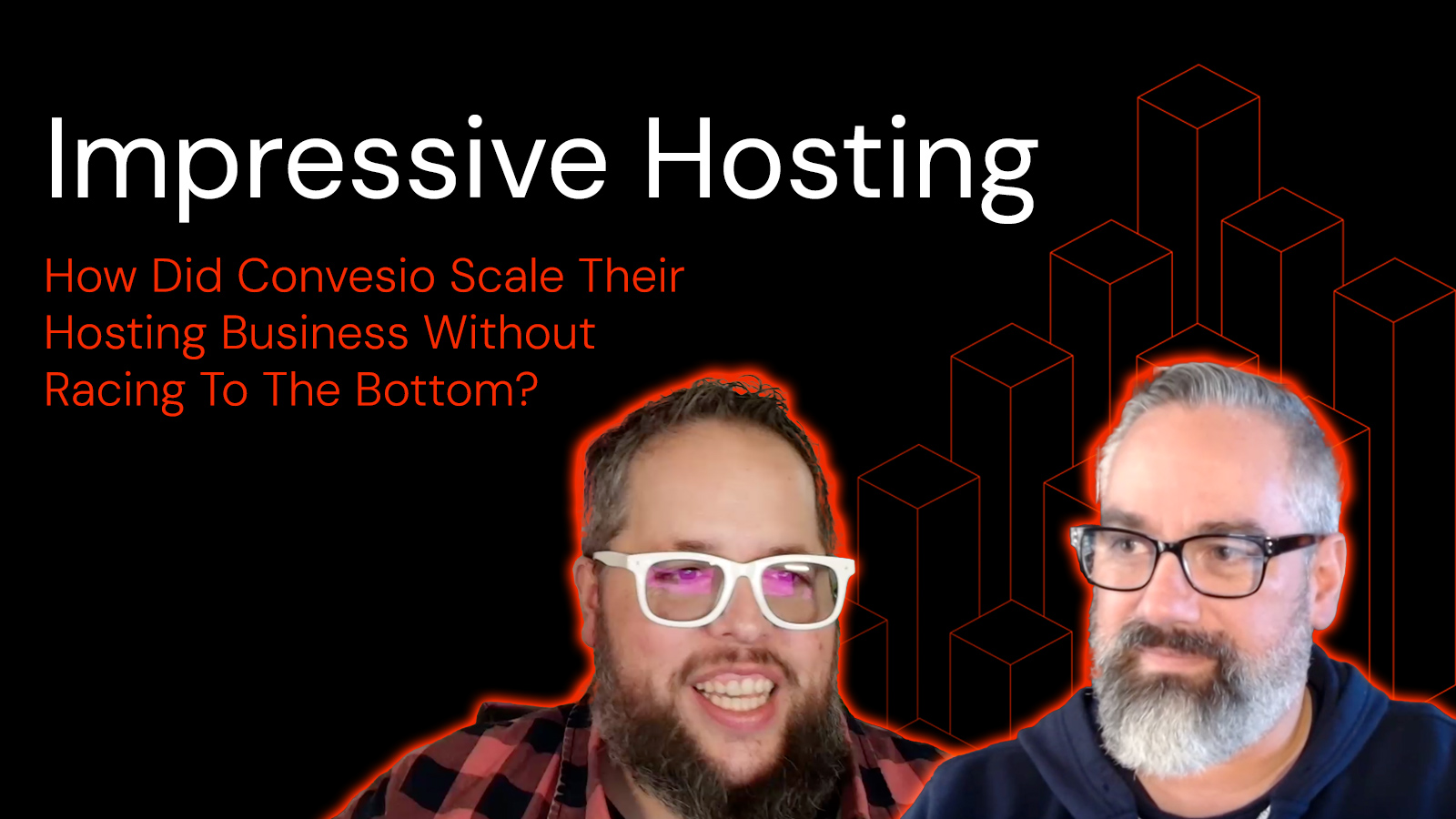
Jesse Friedman interviews Tom Fanelli, CEO of Convesio, about their unique approach to WordPress hosting. Tom explains how Convesio differentiates itself as a platform rather than just a hosting company, focusing on containerized WordPress solutions for mid-market to enterprise clients with complex needs. The conversation explores Convesio’s evolution from targeting agencies to serving mission-critical commerce sites, including online learning platforms, membership sites, and WooCommerce stores.
Chapters:
00:45 Introduction
01:44 The Origin Story of Convesio
04:46 Innovations and Pivots
10:16 The Future of Support is Human Attention in Slack, and AI
19:55 Avoiding the Race to the Bottom in Hosting
23:32 How to Level Up with Your Customers
28:38 The Importance of Plugin Compatibility
37:06 Conclusion
Show links:
Transcript
Tom Fanelli: Your companies have to be smarter than you to level you up.
Jesse Friedman: It’s very much like a gym or a fitness center where they want you to sign up, but they don’t necessarily want you to show up.
Tom Fanelli: Really great question and, by the way, this is validation for me. Slack is the future of support.
Jesse Friedman: I think a lot of hosting companies have caught some flack recently around the level of support that they’re providing.
Tom Fanelli: The reality is when you start a company if you’re trying to do anything innovative and new, you really don’t know where your end goal is going to be because you pivot and change so many times.
Introduction
Jesse Friedman: Welcome to Impressive Hosting, where we seek to uncover the core tenets of great WordPress hosting. I am Jesse Friedman, your host, and with me today is Tom Fanelli, the CEO of Convesio. Welcome Tom.
Tom Fanelli: Thanks, Jesse. It’s a pleasure to be here and congratulations on this new show and series you’re starting. Super excited to see how this all unfolds over the next few years. And really excited to be one of the early guests that you’re having on.
Jesse Friedman: It’s really great to have you here and you’re among a lot of great guests that we’ve been having on the show. So welcome and I want to start by saying thank you for all the audio help you gave me pre-show. So that was great. Out there, if anybody ever runs into Tom, he’s an audio engineer, so if you don’t ask him to set up your printer, have him set up your mic.
Tom Fanelli: That’s great. I would actually much rather help people set their mic up than their printer.
Jesse Friedman: Nice. All right, great.
The Origin Story of Convesio
Jesse Friedman: So first things first, why don’t we hear a little bit about Convesio. You started the company and I think it takes a very unique approach in managed WordPress hosting. So I’d love to hear how you got started, how it got off the ground.
Tom Fanelli: Yeah, thanks. We incorporated in 2019, I think, and I had been sort of as a side project fiddling with this idea of could I do something radically different than what most hosting providers were doing in the WordPress space? And I had always been a WordPress guy and I spent about seven years running an agency and just had a passion for the community and the space and the website creation industry. I spent, gosh, like probably two decades working at enterprise companies and in product and engineering, and I was frustrated by the lack of innovation in the WordPress hosting space. At the time the only people really doing containerized hosting was Pantheon. They were like one of the early entrance into that.
And at the time they were doing it for Drupal, so they didn’t even have a WordPress product out. And when you look around, one of the things that as a product person bothered me in this space was how many people were, I’m air quoting “me too-ing” one another where it’s like “I’ve got a cPanel stack with SSD drives in it, and we’re 200% faster than everyone else,” they’re literally in the same data centers on the same servers that 20 other hosting brands are on.
That sort of bothered me a little bit in the fact that I just had felt there was not enough innovation and new ideas and new creativity. And by the way, we look at the hosting space, it’s abundant. There’s a lot of awesome innovation going on. There’s great hosting providers out there doing really creative and interesting things.
And it’s not the case today, like it was in sort of the late 2010s, we’ll call it.
Jesse Friedman: Yeah.
Tom Fanelli: 2010s. The 2015s, 2013s. And you know, we started officially in 2019, but I had been noodling on this idea of containerized hosting for like three years prior to that. I didn’t even know when we set out if we could build something that would do this because just containerizing WordPress was difficult at the time and, we did, and that’s really the genesis of the company. And we’ve evolved a lot since then. We’re not really the company we were when we started, and that has to do more with our focus on who we work with and the products that we have.
But that was really the origin story for Convesio.
Jesse Friedman: Yeah, that’s great.
Innovations and Pivots
Jesse Friedman: So you say that you’ve obviously innovated, you’ve pivoted, you’ve changed from where you started. How did that go? Did you see like very specific moments, forks in the road where you said, I have to go and shift and move in this direction? Or was it a little bit more of a rising tide where you started feeling it change around you, but you didn’t have that one moment where you had a change?
Tom Fanelli: You know, it’s interesting. I was listening to a very famous venture capitalist the other day. He said in the startup world, history has a way of painting founders like, “they knew all along this was how their business was going to turn out. And they’re so smart and they had such insight.” The reality is when you start a company if you’re trying to do anything innovative and new, you really don’t know where your end goal is going to be because you pivot and change so many times. Because I was really passionate about the agency space, started out working with agencies and we really thought that was going to be a channel that we were going to drive into heavily.
And what I found was we really weren’t suited for all agencies. And the reason why is because we built a Ferrari. I was going to build this top of the line, we’ll call it enterprise, for lack of a better term, enterprise hosting solution. And what we found was the plumbers and doctors and lawyers and small businesses that most agencies work with, they don’t need all the superpowers of that scalability and bespoke nature and all that kind of stuff. And so what we found was it was really kind of a race for a lot of agencies to the bottom in terms of costs. So the conversation always was, well, “how much can you save me on a cost per site basis then I’m paying now?” And at the time we just couldn’t figure out a way to be really competitive in that agency space with the product that we had built. What we found was the emerging thread of people that fell in love with us were these mid-market to enterprise complex WordPress sites.
So we’re talking like, online learning sites, big membership sites, WooCommerce, e-commerce sites, custom deployments of headless solutions, all sorts of out of the box things that traditional hosting wasn’t really a good fit for. And we wound up pivoting and we went heavy into the mid-market to enterprise. We started to move away from this lower sort of entry level pricing, which we’d been trying to get lower and lower in the space. And that really happened probably a year and a half after we launched. We sort of realized we loved the agency space, but we weren’t really a fit for what they were trying to accomplish.
And so we leaned hard into this commerce focused mission critical commerce enabled sites. And that’s when we really sort of found our stride. And that evolved into us now doing things much more than hosting. We acquired a marketing automation tool for e-commerce sites and we’re sort of dipping our toe into the payments space. And so we’re now trying to become this platform for commerce sites and we broadly define that it’s not just a cart and checkout, if you will. There’s lots of ways to commerce-enable sites, subscriptions, memberships, online learning courses, payment forms, big commerce integrations. And so we’re trying to really take this broad approach to helping people in that segment. And that’s where we are today.
Jesse Friedman: Real quick before you move on, because I just want to ask a quick clarifying question. Do you consider Convesio a hosting company? Pure and simple.
Tom Fanelli: I never called us a hosting company because I started off calling us a platform, and this is the marketing thread in me, because I didn’t want to be grouped in with all the other hosting companies because in people’s minds, they have a preconceived idea of what a hosting company is, and
Jesse Friedman: Yeah.
Tom Fanelli: I can’t tell you how far we are from that. And so you either get lumped into this word of hey, we’re a hosting company, and people think GoDaddy, Bluehost, the discount, bulk hosting companies. Or you try to say, well, we’re an infrastructure company. And then they think the nameless face, faceless hyperscalers like Google and Amazon, who you’ll never talk to anyone. We really have always said, we want to be like a platform as a service for WordPress, which is this idea that, we provide infrastructure and you get hosting, but you get a lot of service and support from us that you do not get at other hosting providers.
The Future of Support is Human Attention in Slack, and AI
Tom Fanelli: And you talk about other, like revelations in the hosting space. One of the things that we discovered also early on was I mean we were one of the first hosting companies to support people in Slack. And I know it’s been adopted by other companies, and I think Slack is the way to go, especially when you’re supporting mission critical or agencies Slack.
The moment of delight people get working in Slack with a company with actual people and not a ticketing system is an exceptional experience, it’s how we should be as cutting edge hosting companies, supporting people.
Jesse Friedman: See right there. When we think about trying to uncover the core tenets of great hosting, that’s one that we can put in the checkbox right there. It’s a way to provide better superior support is to create a direct line of communication between you and your customers. But how does that scale, how does that work in a scenario where someone might be overusing those channels or asking you the most easiest questions?
Tom Fanelli: There’s a couple components to this, and this is a good thing to uncover because one of the things we do, and this is what makes us a little different from most hosting companies out there, we really are very hands on with our clients, and so we don’t really have boundaries where we say, I mean, we do, but people rarely push up against a boundary that our support team won’t handle for someone.
So for instance, a very regular thing that we do we’ll install New Relic on a site and it’ll be nothing for like a support engineer to spend an hour or two diagnosing a new relic, a problem producing sort of a one page report for customers to go, “Hey, these plugins are slowing your site down. You should consider changing them.” We are extremely hands-on with our clients. That is an area where it’s helping us land larger enterprise clients because we have a culture of accountability. We really feel like we’re accountable for your site performing well. When people have large scaling events, we have a service called Scale Ops where we’ll put an engineer to watch and monitor in real time your site’s performance. And in Slack we’ll be giving you a real time feed. It’s like this notion of a fire hose of, we’re reporting data during your event, here’s how you’re performing. Here’s your database queries per second, here’s your worker usage. That helps us understand the performance of sites so that when people come to us and they’re like, “We have a big event, how can we capacity plan for it? We have a lot of historical knowledge on the performance of the site.” So that’s the level of involvement that we’re in.
Now you asked how do you scale? This is what makes a good host, is that you’re not at the bottom of the barrel price point. So you can afford to provide very skilled people you can afford, they can have the time to be able to work on this, right? Because they’re not overloaded with 50 tickets they have to answer. So in order to keep that economy of scale, you have to have clients paying an appropriate value to get that from you. And so I think that’s part of the differentiation of this is, you have a bit of a premium price, but you have a premium experience as well now.
Jesse Friedman: Now, do you bundle in your service fees or is it a separate fee that these customers pay?
Tom Fanelli: It’s all bundled into the price of hosting with us.
Jesse Friedman: Right. Right. So it’s just the experience you get with Convesio it’s not a choice or an a la carte item.
Tom Fanelli: It’s the experience everyone gets. We support everyone on Slack. That’s where we want you, we can give you the best experience there. Those are things that are very outside the box for normal hosting companies. And so going back to this idea of why I’ve always been adverse to saying we’re a hosting company and we’re more of a platform or a suite or a commerce platform, is because we do these things that people rarely experience from other hosting companies.
You’re talking to like senior PHP developers and things that normally agencies or even brands would’ve to give to their dev teams? We will troubleshoot. So we’ve got performance experts, security experts, WordPress experts, infrastructure experts, all their database experts ready to help support you for whatever your use case is in the WordPress ecosystem.
Jesse Friedman: Now, do you do any integrations into Slack to make it a little bit more or easier to organize the actual requests? Are they considered a ticket or is it more conversational based?
Tom Fanelli: Okay, so really great question and, by the way, this is validation for me. Slack is the future of support. Have been in the last couple years a whole host of support enablement tools designed for organizations like ours. And I think even Pressable does support in Slack, right?
Jesse Friedman: Yeah, and WP Cloud as well. We support our partners in Slack as well. Yeah,
Tom Fanelli: I see you guys as more of the support for the people support, you know, it’s like
Jesse Friedman: Sure. Yeah.
Tom Fanelli: And, but, and so it makes a lot of sense, we have vendors, more vendors coming into Slack, which is really awesome because that direct line between our customers and us and the WP Cloud team, for example, is really, really important because it’s speed of execution. I have case studies on our site where we have actually had clients, and I’ll give a shout out. MemberPress is a great example. MemberPress is in our Slack clients of MemberPress. We can troubleshoot things. Everyone hates the whole hosting company, pointing at a plugin, and then they have to go file a ticket with a plugin and come back like we have all these people in our Slack org and.
We can solve things at light speed working together collaboratively for our joint customers. So we love that. Back to your question though, and my validation point, we use a tool called Unthread, we’ve been quite happy with. There’s other tools out there similar to this, but this tool is designed to come in, completely transparently in Slack, in your channels with your clients and start to organize into tickets and Kanban boards. And it’s a very like workflow automation tool where our people can actually work in Slack or in Unthread and Unthread keeps everything it manages. SLAs like this has not been responded to.
And I see the future of scaling support in Slack. Being a critical think component, being these type of tools, which allow organizations like us. Us collectively, not just Convesio you guys as well to support clients and have guardrails to make sure we’ve got KPI and analytics in Slack is not great for a support organization. This fixes that, you know, SLAs,
Jesse Friedman: Yeah.
Tom Fanelli: escalation channels, this fixes that, right? So great tools out there, and that’s just validation that this support channel of Slack is growing.
Jesse Friedman: Yeah, that’s really interesting. I know everybody at home is always thinking about AI and what’s next in AI. Are you using anything to answer some of the more simple questions or tie it into some documentation or anything just to weed out the more easy questions?
Tom Fanelli: We’ve been heavily experimenting with AI in our business on multiple fronts, and Unthread has got some really cool tools in it for doing AI in the platform and analyzing this. But one of the things we’ve been doing is we’ve actually been taking a big productivity boost for us has been this idea that we generate thousands of words of content a day, it’s all trapped in Slack in client channels. So we take those and we use those to create help desks with AI so we can sanitize, remove any sensitive information.
Jesse Friedman: Anonymize it, but then you’re giving it the, it knows that this question’s been asked before and answered.
Tom Fanelli: So
Jesse Friedman: Yeah.
Tom Fanelli: The idea of using AI to take these lengthy conversations where we’re solving things collaboratively, the context of that conversation and turning it into a help desk article has been magical. It’s an awesome use case for AI. Really good one. And we’ve been doing that for a good period of time to help boost documentation and most organizations, I tend to find a lot of organizations are writing a ton of content, but it’s in email, it’s in Slack or direct messages. It’s in these silos. And AI has been magical for helping take that and turn it into stuff that can be shared in a public format, like a knowledge base or onboarding emails, or help desk responses, all that kind of stuff.
Jesse Friedman: Yeah.
Avoiding the Race to the Bottom in Hosting
Jesse Friedman: A lot of hosting companies have caught some flack recently around the level of support that they’re providing. The hosting companies that were always considered some of the best support agents out there, are running into some issues with scale, trying to bolt on AI in a way that maybe is not providing the best support, trying to scale things down to save money. This is actually a really amazing story to hear, a really innovative way to reverse everything there and reset the expectations for what hosting companies should be providing. It’s great.
Tom Fanelli: Yeah, absolutely. For sure.
Jesse Friedman: Yeah.
Tom Fanelli: I think part of the challenge too with these legacy hosting companies is that, and this is one of the things I take pride in the decision that we had. It was a hard one because as a founder, you want to do business with everyone. And by the way, we have to talk about how we’re coming full circle with WP Cloud to the agencies, but our decision to hold our ground at this price point that we’re at and not go into the lower end is really what has enabled us to have the freedom and flexibility to provide the level of value that we provide to our customers. And I think a lot of traditional hosting companies have been chasing scale and dominance. They’re doing that at the lower end of the market. And essentially at some point, it’s hard to provide the level of personalized support when you’ve got a massive amount of customers on the platform and you’ve tried to sort of go down to the bottom tier of the market. And so that’s a dynamic of the hosting. I used to work at a company that hosted 4 million sites. Deluxe, at the time Corporation was a big aggregator. We acquired a lot of cPanel companies and it was a very more of a customer service like organization. You couldn’t get to these really knowledgeable developer type DevOps type people very easily. And I think the market’s maturing and the easy questions are sort of being self-serviced. We find that with a lot of our clients, and it’s the real hard ones that they struggle with answering. And so those are the ones where someone who’s extremely knowledgeable can solve very quickly.
Jesse Friedman: I agree. I think for better or worse, I think that the way in which we see customer service is at least for me, and I think this is a trend that we see in multiple industries, is that contacting someone is the last thing I really want to be doing. I don’t want to be interacting with someone. I just don’t have faith that I’m even going to get the help that I need. I pick on Verizon a lot because I’m a Verizon customer. Both for internet and phone, but like the last thing I want to do is get on the phone with Verizon. And half the time when I’m diagnosing something with them, it’s only because they need to perform an action that I physically can’t do. They need to reset something or do something like that. But for the most part, the internet is full of the resources I need to troubleshoot these things, if not just basic knowledge. Getting to a place where we build trust and faith in the support that you’re going to get is a key component to solving this problem because
Tom Fanelli: Yeah.
Jesse Friedman: You just don’t believe in the companies that you’re using anymore.
How to Level Up with Your Customers
Tom Fanelli: Yeah, your companies have to be smarter than you to level you up. You know, it’s like, you
Jesse Friedman: Right.
Tom Fanelli: talk about the, like you’re the combination of the people that are around you and all that. We want to level up our clients, right? We don’t want to be dragging our clients down. And so this is like, you know, another thing we do is we’re very proactive with all of our things.
We monitor all of our sites obsessively. And so when a site has a problem, like it timed out on a request or something, like our team is alerted, we want to know why and we want to communicate what’s going on to the client. And so many times, we’re proactively reaching out to customers in Slack saying, “Hey, we noticed this is happening on your site. What’s going on? Let’s help you with this.” That’s that radical kind of accountability I was talking about. We’re not trying to have less interactions with clients. I mean, if everything’s running really well, we are, but we want to have proactive conversations that are going to help the performance of the site over the long term. And it’s not just “oh, we haven’t heard from this” we don’t like it when we haven’t heard from people. We want to be hearing
Jesse Friedman: Well, yeah,
Tom Fanelli: constantly about how we can go to the next level with you? How can we get your site better? What do you have going on? Tell us what promos you have going, let us monitor it.
Jesse Friedman: That’s very different from what we see in the rest of the industry. I think a lot of times the hosting companies out there, the industry. It’s very much like a gym or a fitness center where they want you to sign up, but they don’t necessarily want you to show up.
And so there’s a lot of hosting companies out there who are hoping that you’re going to build a website, set it and forget it, and then you just continue to pay your bill. It seems very much like you’re trying to turn that around and actually remind folks that why they’re with Convesio give them the information that they need ahead of time and have the, and build that trust that we just talked about, so that they know that they have you as an arm, that it supports their business.
Tom Fanelli: It’s interesting you mention that because one of the metrics we like to look at is how much revenue have you increased since you switched to Convesio? We want to enable growth for our customers. And in the hosting space, that’s like making sure you don’t go down during your big sales.
We have this phraseology I love internally. People tend to come to us when they’ve crashed on a big event right? They look for scaling and scaling WordPress and we talk about this notion of their moment of glory turned into their worst nightmare. They went from “I have so much hope for this big event.” And then their site crashes during it. We like to think we break them free of these technical barriers of scaling their site and that’s going to lead to more revenue and it’s going to lead to growth and knocking down the barriers that they have to growing that might be technical hindrances.
Jesse Friedman: Absolutely. I think one of the things that have broken my heart in the past is when I hear a story like, “Well, we had this really great Black Friday sale, but we were a little afraid to spread it too widely because we didn’t want too many people coming and buying our product in the same moments.”
And I’m like that is just awful. That breaks my heart.
And the unfortunate thing, the blowback for us as an industry is people that don’t know any better, I’ll say, blame WordPress.
Jesse Friedman: Yeah. Right.
Tom Fanelli: Then they start looking at things like, “Well, maybe I should go to Shopify.” And we tend to find ourselves being the last line of defense before someone switches to Shopify. And it’s like WordPress and WooCommerce is so scalable. It is unbelievable. Like we’ve done, we do a lot of load testing. It is insane the amount of resources that you need or don’t need in this case to scale a bare bones WooCommerce, WordPress site. The code base is so efficient and it’s so good. It’s just the 50 or a hundred plugins and half a dozen third party APIs and services that you need to call and all of that stuff, and therein lies the problem with, somebody has to sort that out and figure out what’s going on. And that’s where we come in.
Jesse Friedman: Yeah.
Tom Fanelli: Jesse, I mean, you know this, it’s like that, those are not easy things to figure out all the time. You need tools like New Relic. You have to look and see what’s going on in every transaction on a site. There’s no easy button to that stuff. And, that’s the kind of team and the experts you need when you start scaling commerce to be able to go in and figure that stuff out for companies.
Jesse Friedman: Absolutely.
The Importance of Plugin Compatibility
Jesse Friedman: You hit on something that I like to try and remind folks every time that we’ve run one of these podcasts is that every single hosting company out there has a responsibility to WordPress when they start promoting and leveraging WordPress to make sales and in the do it yourself market.
The area where there’s a very large population of WordPress users building websites, but maybe have a lower understanding of technology. They can’t write code, they don’t understand this stuff. The extensibility of WordPress and other things have been amazing to promote the use of WordPress and to get it out there and to give people quick answers to problems.
But they also don’t have the expertise to understand whether or not those plugins that they’re bolting on are going to be performance hindrance. And I think the other thing too is that the hosting companies as a whole, if you advertise that you’re selling WordPress, if you’re bringing them in.
That may be the last time that that user ever uses WordPress if it’s not a great experience. A DIYer in particular was probably told by somebody, you should try WordPress. It’s worked great for me. And if they can’t make it work in their heads, they’re not thinking, well, I’m going to switch from this host to this host and try WordPress again.
They’re thinking, I’m going to skip WordPress now and go to Shopify or something else. And that’s a detriment to the entire ecosystem. I’m curious though, like I’ve been very focused on that from the DIY perspective the larger population of less technical people. But you mentioned it in the terms of an agency or a client.
How does that information get back to you? How do agencies consider these situations when a client is signaling that maybe they don’t think that WordPress is working for them? How does that bubble up? How do we get in front of that? How do we make sure that we’re moving them to the right host or getting them on Convesio or WP Cloud or doing something like that before the situation spirals out of control and we lose them.
Tom Fanelli: Absolutely. And this is a problem we’re very close to because we’ve had lots of experiences where this has happened, this has bubbled up. There’s the technical side of things, right? At some level of scale when a company is successful, undoubtedly because of the marketing influences out there, they have this grass is greener, like maybe Shopify’s the answer to everything that is ever a problem at WordPress for me. Right? I tend to see that people start to wonder this, right? As they are having to update their plugins regularly or deal with security issues or any of the normal things in the course of running a site. We have to be doing a better job as agencies, as hosts of getting ahead of those things and sharing the wins and the positive.
And part of that comes from the right tech stack to monitor things and be aware. That’s what we try to do proactively for our customers, right? So we try to head these things off beforehand. The other part to this though is there’s a lot of bad stuff you can put in your site out there, and this is the bigger challenge, which I’ve heard people propose, like there should be a sort of approved or sanctioned tool set that people know works together, really, really well for WordPress. And it’s just hard. There’s so many plugins and there’s so many things out there that can go wrong. Third party native plugins that just run in the site that are inefficient, that APIs, that things are hitting. And I don’t know the answer to that other than we’ve just become pretty good at seeing on a regular basis, which plugins cause problems at scale and to those plugin developers that they, these are issues.
Jesse Friedman: How do, how would you surface that publicly? Like obviously there’s a, the better way to do it is to start with the plugin company tell them that they need to fix this compatibility issue. You don’t necessarily want to just post a bulletin and say “Hey, these plugins don’t work well together.” But at some point it’s probably going to be more helpful to the community if we are a little bit more public about it.
Tom Fanelli: This is the thing, I know you know Jonathan over at Guildenberg. So Guildenberg is the essence that I was pitched by Jonathan that got me hooked was to create a guild where players in the WordPress space could communicate with one another in a preferred, I don’t want to say a backdoor, but a guild where it’s like we know this isn’t going to be like a sales thing.
It’s like we had a client come to us, they had a huge one day a year big sale, okay? And we have this case study on our website. They came to us and we migrated a proof of concept. We did a load test on their site and we’re like, this one thing is dragging your site down. It wasn’t MemberPress the core plugin, but it was something with MemberPress and Beaver Builder, but it was like a Beaver Builder add-on. And we got connected to MemberPress immediately. All in Slack. We had the agency MemberPress. The agency referred the client directly to us because it’s a larger client and it was magical. Within 48 hours, we had surfaced an entire video, transactions, New Relic diagnostics, all of this to the agency, to MemberPress. MemberPress, published a release for it, fixed it super quickly, and it was something you would never see. You wouldn’t see this on a normal site. You’d only see this if you had thousands of people trying to access the page like regularly. It just was something that was a bottleneck in the scaling of that,
Jesse Friedman: Yeah.
Tom Fanelli: we resolved that. We actually did this before these people were even clients. We did this as
Jesse Friedman: Oh, that’s great.
Tom Fanelli: concept on Convesio and
Jesse Friedman: Yeah.
Tom Fanelli: like that’s the level of engagement that we need and we need like responsive plugin companies that know if I get something from Convesio it’s legitimately sussed out. Okay. And they will make it a priority to fix it. And that is what I was hoping and still in hopes that organizations like Guildenberg can do is give us a community, and then we know these plugins and theme people in the guild can scale. That’s, I think that’s how we get ahead of it.
Jesse Friedman: It’s interesting because it’s not as simple as just saying let’s put that on the checklist of what a hosting company has to be able to provide. But at Automattic we do the same thing. When we find plugins that don’t work well with what we’re building or work well with each other. We work very closely with the plugins. And many times I’ve seen where we’ve written the code ourselves and created a patch and submitted it back to the plugin and said, “Hey, our customers are suffering from this. We want to help you make it better.” I don’t know that we can necessarily put that on a list and say that you have to be able to support other third party plugins in that way. But I think it’s a philosophical thing that you can start to look for when you start to analyze hosting companies.
Tom Fanelli: Let me go into advice mode here. I got this is what I’d love to see for this. Okay. Would love to see this stuff be included in five for the future. Okay.
Jesse Friedman: You know what? I want to pause you right there because that’s a perfect, don’t stop. I want to hear all about it.
Conclusion
Jesse Friedman: But John, our producer is saying that we do need to take a break here and we’ll have to come back. So, all right. So don’t forget five for the future and how we want to move forward there. Everyone at home this has been a great conversation with Tom. We’re not going to end here. We’re going to pick up next week where we’re leaving off. And we’ll be back next week. All right. This has been Impressive Hosting with Tom Fanelli, CEO of Convesio and I’m your host, Jesse Friedman.
Subscribe to Impressive Hosting:


Leave a Reply