'%3E%3C/path%3E%3Cpath d='M76.4782 25.7185L71.982 9.04089H74.6936L78 22.8409L81.8045 9.04089H84.5853L88.2722 22.8409L91.5787 9.04089H94.2902L89.7248 25.6977H86.7781L83.1396 12.6379L79.3835 25.6977L76.4782 25.7185Z' fill='rgba(247, 43, 0)'%3E%3C/path%3E%3Cpath d='M96.6075 9.04089H102.439C103.739 9.04089 104.818 9.26224 105.676 9.69803C106.534 10.1338 107.17 10.7287 107.592 11.4827C108.014 12.2367 108.222 13.0875 108.222 14.0421C108.222 14.9483 108.021 15.7783 107.613 16.5254C107.212 17.2794 106.575 17.8812 105.725 18.3239C104.867 18.7666 103.774 18.9879 102.439 18.9879H99.1323V25.6977H96.6075V9.04089ZM99.1323 16.9128H102.321C103.511 16.9128 104.362 16.6568 104.881 16.138C105.399 15.6192 105.655 14.9206 105.655 14.0352C105.655 13.1152 105.399 12.3958 104.881 11.8839C104.362 11.372 103.511 11.1092 102.321 11.1092H99.1323V16.9128Z' fill='rgba(247, 43, 0)'%3E%3C/path%3E%3Cpath d='M124.138 25.9744C122.492 25.9744 121.067 25.6147 119.87 24.8953C118.674 24.1759 117.747 23.166 117.097 21.8725C116.446 20.5789 116.121 19.0848 116.121 17.3901C116.121 15.6746 116.446 14.1735 117.097 12.88C117.747 11.5864 118.674 10.5765 119.87 9.84329C121.067 9.11698 122.492 8.75036 124.138 8.75036C126.089 8.75036 127.68 9.22766 128.918 10.1753C130.156 11.1299 130.938 12.458 131.277 14.1735H128.469C128.247 13.2051 127.77 12.4373 127.044 11.8631C126.317 11.289 125.342 11.0054 124.118 11.0054C122.45 11.0054 121.136 11.5726 120.168 12.707C119.199 13.8415 118.715 15.3979 118.715 17.3831C118.715 19.3476 119.199 20.8971 120.168 22.0246C121.136 23.1521 122.45 23.7124 124.118 23.7124C125.342 23.7124 126.317 23.4427 127.044 22.9031C127.77 22.3636 128.247 21.6234 128.469 20.6896H131.277C130.945 22.3428 130.156 23.6294 128.918 24.5702C127.68 25.5109 126.089 25.9744 124.138 25.9744Z' fill='rgba(247, 43, 0)'%3E%3C/path%3E%3Cpath d='M133.961 25.6908V8.5636H136.486V25.6908H133.961Z' fill='rgba(247, 43, 0)'%3E%3C/path%3E%3Cpath d='M145.195 25.9744C144.067 25.9744 143.057 25.7185 142.158 25.1997C141.259 24.6809 140.553 23.9615 140.027 23.0346C139.502 22.1076 139.246 21.0216 139.246 19.7903C139.246 18.5591 139.509 17.4731 140.041 16.5392C140.574 15.6123 141.293 14.8929 142.192 14.3741C143.099 13.8622 144.102 13.5994 145.215 13.5994C146.343 13.5994 147.353 13.8553 148.252 14.3741C149.144 14.8929 149.864 15.6123 150.396 16.5392C150.929 17.4661 151.192 18.5522 151.192 19.7903C151.192 21.0285 150.929 22.1076 150.396 23.0346C149.864 23.9615 149.144 24.6809 148.245 25.1997C147.332 25.7185 146.315 25.9744 145.195 25.9744ZM145.195 23.8093C145.796 23.8093 146.357 23.6571 146.869 23.3597C147.387 23.0553 147.802 22.6126 148.121 22.0177C148.439 21.4228 148.598 20.6827 148.598 19.7903C148.598 18.898 148.446 18.1579 148.134 17.563C147.823 16.9681 147.415 16.5185 146.896 16.221C146.377 15.9167 145.824 15.7714 145.222 15.7714C144.62 15.7714 144.06 15.9236 143.548 16.221C143.029 16.5254 142.614 16.9681 142.296 17.563C141.978 18.1579 141.819 18.898 141.819 19.7903C141.819 20.6827 141.978 21.4228 142.296 22.0177C142.614 22.6126 143.023 23.0622 143.534 23.3597C144.032 23.664 144.586 23.8093 145.195 23.8093Z' fill='rgba(247, 43, 0)'%3E%3C/path%3E%3Cpath d='M158.275 25.9744C156.85 25.9744 155.723 25.5317 154.906 24.6394C154.09 23.747 153.682 22.4258 153.682 20.6688V13.8899H156.207V20.406C156.207 22.6887 157.141 23.83 159.015 23.83C159.949 23.83 160.717 23.498 161.326 22.834C161.927 22.1699 162.232 21.2153 162.232 19.9771V13.883H164.757V25.6908H162.522L162.336 23.6225C161.969 24.3488 161.436 24.9299 160.731 25.3449C160.011 25.7669 159.195 25.9744 158.275 25.9744Z' fill='rgba(247, 43, 0)'%3E%3C/path%3E%3Cpath d='M173.341 25.9744C172.2 25.9744 171.19 25.7046 170.318 25.1651C169.447 24.6255 168.762 23.8854 168.271 22.9515C167.779 22.0177 167.53 20.9525 167.53 19.7627C167.53 18.5729 167.779 17.5146 168.271 16.5876C168.762 15.6607 169.447 14.9275 170.325 14.4018C171.204 13.8692 172.213 13.6063 173.362 13.6063C174.296 13.6063 175.119 13.7861 175.824 14.1528C176.53 14.5194 177.083 15.0313 177.478 15.7022V8.5636H180.002V25.6908H177.74L177.478 23.8577C177.097 24.4111 176.571 24.9022 175.907 25.3311C175.243 25.76 174.385 25.9744 173.341 25.9744ZM173.791 23.7885C174.87 23.7885 175.755 23.415 176.44 22.6679C177.132 21.9209 177.478 20.9663 177.478 19.7903C177.478 18.6006 177.132 17.6391 176.44 16.8989C175.748 16.1588 174.863 15.7922 173.791 15.7922C172.712 15.7922 171.826 16.1588 171.127 16.8989C170.429 17.6391 170.083 18.6006 170.083 19.7903C170.083 20.5651 170.242 21.2568 170.56 21.8586C170.878 22.4604 171.314 22.9308 171.881 23.2767C172.435 23.6156 173.078 23.7885 173.791 23.7885Z' fill='rgba(247, 43, 0)'%3E%3C/path%3E%3C/svg%3E)
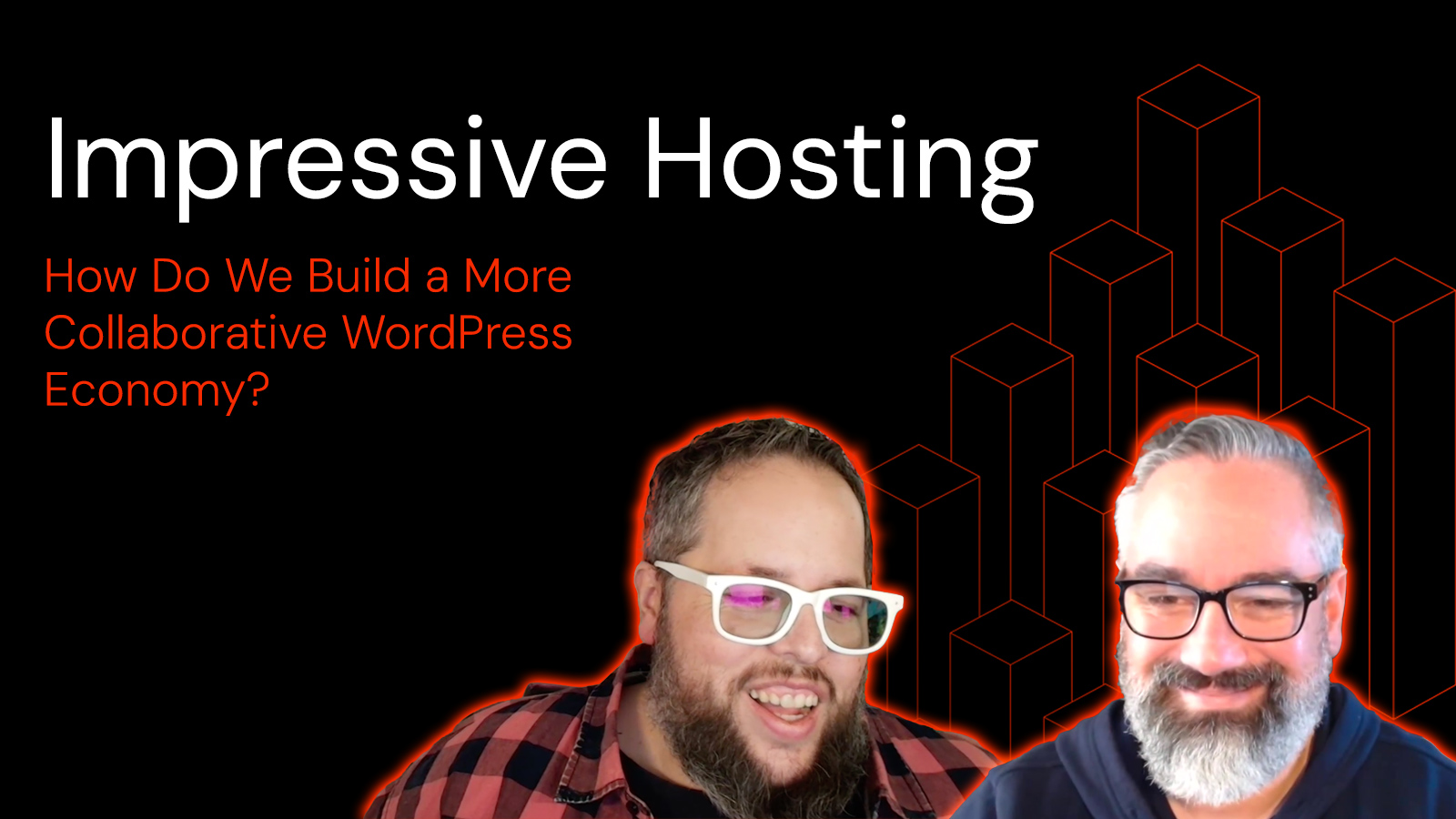
In this episode of Impressive Hosting, Jesse Friedman continues his conversation with Tom Fanelli, CEO of Convesio, exploring how the WordPress ecosystem can become more collaborative. Tom emphasizes that “we truly do sink or swim as a community.” He introduces his concept of “Guildenberg” – a professional guild enabling knowledge-sharing between hosts, agencies, and plugin developers.
The discussion examines how hosting companies can transform websites into revenue-generating tools through commerce enablement, creating value alignment where client success drives agency growth, which supports hosting providers. Tom also highlights Convesio’s partnership with WP Cloud and their vision for white-label support services that allow agencies to escape technical support burdens and focus on creative work, demonstrating how aligned incentives across the WordPress ecosystem create successful partnerships benefiting everyone involved.
Chapters:
00:38 Introduction
01:25 The Role of Hosting Companies in WordPress Community
03:46 Five for the Future and the Value Proposition of Collaborative Community
09:10 The Race to the Bottom in Hosting in Agency Pricing
15:21 The WP Cloud and Convesio Partnership
21:20 Aligning Hosting Success with Client Success
28:28 How Convesio Implemented White Label Support for Agencies
31:39 Conclusion
Show links:
Transcript
Tom Fanelli: We wanna start building smart, intelligent websites. And by the way, there is no better choice than WordPress for this.
Jesse Friedman: We don’t need to be competitive here. There’s enough WordPress hosting out there for everybody.
Tom Fanelli: We truly do sink or swim as a community. The customer’s not aware of the community. It’s us who are aware of it and how everything interplays.
Jesse Friedman: WordPress as a whole is gonna benefit from this ability to level things up. It holds everyone to a higher standard.
Introduction
Jesse Friedman: Welcome back to Impressive Hosting, where we seek to uncover the core tenets of what makes great WordPress hosting. I am your host, Jesse Friedman, and we are back with Tom Fanelli, CEO of Convesio. In our last episode, sorry everybody to leave you on a cliffhanger there. We were having such a great conversation with Tom. But we did need to take a break. And we’re coming back and we’re gonna pick up where we left off, around the philosophical conversations we were having around the needs that hosts have and the ways in which they can play in helping to make sure that the extensibility of WordPress is something that can work for all users of all skill levels. And Tom was about to go into how he thinks that this might benefit Five for the Future. So, Tom, have at it.
Tom Fanelli: Yeah. Thanks Jesse.
The Role of Hosting Companies in WordPress Community
Tom Fanelli: It’s great to be back. We were talking about this notion that the collective success of WordPress as a brand, because in the mind of the end user that runs a business, it’s WordPress. That’s the problem. It’s not x, y, z plugin that might have an issue. Scaling, performance, whatever it might be.
And what I think we need to… I’d like the powers that be to consider this is allowing us to count as a hosting company, all of the work and the energy we put into diagnosing and reporting issues in the plugins in the community. Count towards Five for the Future, because here’s why that aligns us solving problems for our customers, right?
So it’s our shared sort of responsibility. To make the experience that they have on WordPress really well, and that extends beyond core in my opinion, because honestly, rarely are the problems core WordPress and WooCommerce issues. It’s all these other plugins and we spend a bunch of time diagnosing, figuring out, understanding that this query isn’t good, this way you did this in your database structure isn’t good.
That collectively, especially for big plugins, collectively increases the experience of the community using those plugins. And I would say it increases the experience of some of the most valuable people, which are the people scaling and being super successful with WordPress. We don’t wanna lose those WooCommerce people to Shopify because they had a bad plugin and they think it’s a WooCommerce WordPress problem, and it’s not.
It’s this plugin that they installed, and I’ve seen them do all sorts of crazy things, but it would be awesome if that could tie as part of our contribution to Five for the Future. It’s not directly core, but it’s helping the community overall and helping WordPress’s reputation by making all these other plugins run better, and it aligns to the problems we’re seeing in the trenches every day.
Five for the Future and Plugin Support
Jesse: Yeah, I think that’s really great feedback and for everybody listening at home, in case you don’t know Five for the Future is a commitment that Matt has put back to the community and asked that you consider committing 5% of your workforce, your time, your money, whatever it might be, back into WordPress. As a company that hosts WordPress or builds on WordPress, whatever it might be, you are not paying for the actual software of WordPress, you get that for free. So how do you ensure that it’s gonna be around for another hundred years, that you’re positive that the contributions that you’re doing your part and your responsibility to WordPress to make sure and ensure that it has the innovative features it needs, it can grow, it can support tons of new customers, pivot if it needs to, things like that. I think that’s really interesting, Tom, because I think a lot of times people do only consider what they actually do to commit code to core or documentation.
Tom Fanelli: Right.
Jesse Friedman: And then the plugins database tends to be this arena of extensible code and it provides so many great features, but that’s typically built by third parties.
Tom Fanelli: Right.
Jesse Friedman: Anyone from a single at-home developer writing code all by themselves, all the way up to agencies like yourself or even hosting companies can build plugins, but the experience that a customer has with a plugin can vary completely. The way in which you get support for Jetpack, for example, and you have a team of happiness engineers at Automattic that are there to help you is not always the case with any other plugin. I wrote a plugin years ago, and it was just me doing it as something on the side because it was something I needed for the websites that I was building at the time. I wanted to give that code back. But then as a plugin developer, you suddenly take on the responsibility of supporting an entire network of people who are using your plugin and different ways in which they’re going to implement your plugin that you hadn’t thought of.
Tom Fanelli: Right.
Jesse Friedman: And all of a sudden they can become quite heavy. And so maybe even beyond Five for the Future. Maybe there’s a way to create a path for others to become contributors back to a plugin and support those efforts so that it can grow and expand and someone can have it more as like a, “Hey, I built this thing.” It’s something out there. And I think a lot of times maybe people are a little afraid to fork it, because they don’t want it to feel like, “Hey, I’m taking your thing and I’m running with it,” but maybe we need to normalize that a little bit more.
Tom Fanelli: Well, and I think too, you know, I’ll put my sort of pitch hat back on to the powers that be around Five for the Future. I think the challenge that we’ve got is a lot of hosting companies are on the front lines of when there’s problems like this, like we’re the first people to hear about it. The customer doesn’t know it’s a, b, c plugin causing his problem. We’re the ones that are interpreting the fatal error logs and telling people. I think that hosting companies though, just say, “Oh, you had a problem with this plugin,” and that’s the end of it. Because there’s no alignment for them to go support the other plugin.
Well, the problem is to your point. That plugin company may not be capable of diagnosing. Then they’re gonna go back and say, “Well, give us your hosting environment.” And there’s all this runaround that puts the customer in the bad spot because their site’s aren’t working. It’s busted. They’ve gotta be a project manager now to get the information from us to them.
This is where the notion of Guildenberg right? A guild for the professionals in the community to come together and where Five for the Future could be an incentive for hosting companies to level up everybody else by saying, “You know what? We’re gonna take a little bit of extra time. We’re gonna document this and we’re gonna get it to the right plugin company.” So the collective experience for the community rises. Some people need to think about how we answer that because we truly do sink or swim as a community. And you know, it’s like the customer’s not aware of the community. It’s us who are aware of it and how everything interplays.
And I think we just have to be better at sharing information with one another. I would love to see that thought about and pondered more in the larger community overall.
Jesse Friedman: I agree. We keep touching on this idea that a host has responsibility back to the WordPress community, you’re touching on something that I hadn’t really considered deeply in the past, which is that they have so much information.
Tom Fanelli: We do.
Tom Fanelli: We have tons.
Jesse Friedman: And you may not think first about giving that information back because maybe it’s not easy to compile. Maybe it’s not easy to send back, like where do you put it? How do you help people understand it? Maybe it starts with finding a way to funnel that information back to the community so that we can make these improvements and be in deeper touch with our end users, which I think is something that we can always benefit from now to the end of time. Alright. Great conversation.
The Race to the Bottom in Hosting in Agency Pricing
Jesse Friedman: But I do want to kind of move things around a little bit. We did touch on the race to the bottom. We’ve seen that in hosting companies for quite a while now. The industry has moved towards cheaper, cheaper hosting, and you have talked about how Convesio has kind of stood its ground in holding a higher price so that you can provide better services and support. And I’m interested when you, you also touched on agencies and how they have a race to the bottom. And I’m wondering a little bit about the value of a website. Like how is it that an end customer is trying to figure out how much they should really be paying for a website? I mean, we talk about a DIY solution on a shared hosting plan that can be less than a cup of a coffee a month. And that can still seem expensive to an end customer. And I’m wondering if it’s something that’s a little bit deeper inside the industry that a website is not necessarily interpreted as a business owner, as something that they should really be investing in, that they feel like because it’s a part of the internet and the rest of the internet comes free. You can watch YouTube videos. You can do all these streaming things. You can do so much on the internet, and you get to consume it for free in exchange for your data and advertising, but you’re not shelling out money, but all of a sudden you have to pay for these services. I think they have this expectation that it should be cheaper and cheaper.
Tom Fanelli: Part of the challenge, this is a big, huge question and there are a lot of people who don’t value hosting, right? As I said in our prior episode, this is one of the reasons I’ve been really hesitant to call us a hosting company just internally. I know we’re seen as that.
But people don’t value that. They think it’s a commodity, and unfortunately they’ve been trained to think it’s a low cost thing because they don’t get really great service at these other companies. And all these hyperscalers and you know, the vultures of the world and ODs and Digital Oceans are all trying to be like, you can get an instance for $2 a month or $3 a month. There’s no real value put on the hardware, the compute resources to do anything. So where do you provide value as a hosting company and how do you differentiate? That’s where we’ve tried to say, you know what? We wanna carve this path in commerce enabled sites because the magic for us is.
We want to build a platform that enables the end customer to increase their revenue and in that value stack increases the revenue to the agency and increases the revenue to Convesio and we have complete alignment in this, and this is why we’ve started to become more than a hosting company. We’ve layered in the marketing automation tools, right, so that people can interact with their group and transact more with them.
And we have got the payment solution now, and so we’re trying to be this full value stack around commerce enablement. I will tell you one thing that’s an interesting thing to me and I’m gonna not talk about what you would think of as traditional eCommerce, the WooCommerce space of the world, but I’ve been evangelizing to agencies that they should be building commerce enabled websites.
Now most agencies are scared to death of WooCommerce because they’re used to building static websites and hosting them for small businesses, local businesses, mom and pop shops. And they’re like, I can’t do e-commerce because it’s got taxes and shipping and inventory and products and all this stuff I’m not used to working in.
So it’s very scary for a lot of agencies that don’t do it to say, I’m gonna start building WooCommerce sites now. But you can build commerce enabled sites with plugins. We just did a Convesio pay integration to WS form. You can integrate Stripe to Gravity Forms, right?
You can build payment forms for businesses. That’s the way we start getting people to think of their website’s not a brochure. It’s a revenue generating tool. And now when you can say, “Hey, your revenue generates X amount of revenue for you, your website generates X amount of revenue.”
You have a lot firmer ground to stand on to say “You don’t want your site to go down, do you? Because you might lose a sale coming through or a payment or something.” And I think that we have to start to think about making websites smarter. It’s the brochure-ware days, we wanna leave those days behind.
We wanna start building smart, intelligent websites. And by the way, this aligns like there is no better choice than WordPress for this. You can do anything with WordPress easily, relatively easily. You can do anything. And this is like the evolution of leveling up the commodity hosting, sites, the commodity sites leveling those up so they become integral parts of people’s businesses and they’re like, “Man, my website is actually a revenue generator for me, even though I am a tutor.”
Because people can go pay their tutor invoice online. You know, they can go book time with me through a scheduling app. That’s, I think, how we tell the story of the evolution of sites from where they were really in yesteryear, where it’s I can go get a site at a large host for like two bucks a month.
Jesse Friedman: And that segueways really nicely into a newer product that you’re offering that is powered by WP Cloud as part of it. Tell us a little bit about how you’re moving forward with that and providing best in class hosting there.
Tom Fanelli: Yeah.
Jesse Friedman: I would love to hear a little bit more, I think the people at home would love to hear a little bit more about how you actually evaluated WP Cloud as well.
Tom Fanelli: Yes.
The WP Cloud and Convesio Partnership
Tom Fanelli: So it’s been a really interesting journey for us, and I think we have a very differentiated story than what I know about most hosts that are adopting WP Cloud. I mentioned I was at Deluxe for a while, which is a big multi-billion dollar company that isn’t in the hosting space anymore, but hosted millions of sites and a lot of cPanel stuff. And we were always like, how do we have a premium WordPress hosting offering? Right? And it was hard to figure that out during the day. There wasn’t something you could go to like WP Cloud at the time. And I think how a lot of folks use WP Cloud is they think of it as this is our premium offering.
WP Cloud is hands down, one of the best platforms, infrastructure platforms to host WordPress on. For a lot of reasons we could geek out on, but for us, we had the opposite insertion in our business. So we’ve been playing at this upper end of the market because we’ve architected this very bespoke, you can do like anything with it. It’s very, anything outside the box you wanna do like database replication and run a Grafana stack next to your site – we can do all that in our containerized platform. But we couldn’t get the economics of it to work, so we could compete with the WP Engines, the Kinstas of the world, and the Pantheons of the world.
Jesse Friedman: Right, and we talked about in the last episode about how you are providing a lot more of a white-glove-
Tom Fanelli: Right, exactly.
Jesse Friedman: -better experience. And so because you’re offering something that is bespoke and that-
Tom Fanelli: Right.
Jesse Friedman: -really fine tuning and tailoring to these customers. It is gonna come with a higher price.
Tom Fanelli: Right. We have this situation where we’d have agencies come to us and they’d be like, we have one or two difficult sites we need to host with you, and they’re worth a premium because they’re mission critical. They’re at scale, what have you.
We’re like, okay, well what about the rest of your portfolio? “Oh, well it’s on a dedicated server or it’s on a VPS at Digital Ocean. And my price per site’s really cheap.” And I was like, oh, we can’t compete with that. We didn’t have an answer for this. And what has made this interesting for us is that we didn’t have an answer for two reasons, right?
It’s like one, our native core platform just wasn’t designed to be that. And the second thing was there was no real reliable platform we could say lived up to the level of expectation to be really side by side with our core offering until WP Cloud. And this is like the perfect solution for us where it’s high uptime. It’s got bursting. It’s got a lot of the DNA of what we’ve architected, but with the scale of Automattic behind it. And so that’s enabling us to be able to go back with a competitive solution to agencies and say, “Hey, you want this white glove solution? You love us at Convesio.” We didn’t have an offering.
I just had a conversation with an agency yesterday. I was telling them about Express. They’re like, “Oh my gosh, I’m bringing everything over because the only reason I didn’t move my entire portfolio is because I have this deal at a big hosting company that was really advantageous financially for me,” and I’m like, bring it on over.
We wanna get a shot at not just providing hosting for that agency, but providing our other services that we have, our other products. We want to help them commerce enable forms with our WS forms integration for Convesio pay. The other thing that’s interesting is we’ve started to notice that I see agencies as not just a hosting thing.
I want to help them succeed. Our center of excellence is, one of them, is support. Okay. I noticed this trend when agencies get to like 75 sites or more, especially when you’re at the hundreds of sites. I feel bad for ’em.
They’re like constantly in Slack going, “I’ve got a support question, I’ve got a support question.” And I’m like, what? This is like terrible. Disincentivization to grow your portfolio. Like these people spend all day long answering support tickets for clients that the ones they can’t answer, they escalate to us and then we have to do it.
And it’s again, it’s like that plugin jockeying between parties and I’m like, can we provide white label support for these agencies? They already know and love us and trust us. They take our answers and give them to their clients. Could we just act on their behalf and get them out of the mix of doing support and having full-time team members supporting their 2, 3, 400 portfolio sites. And that’s an area where I look at it and I’m like, we want to have in the Convesio fold the entire portfolio so that they can grow with us. We can handle these problems and questions that come up. I see the value prop of agencies being way more than just hosting because I don’t think of us as just a hosting company.
I see more opportunity to do things. And to really make the hosting have a lot of value added stuff to it so we don’t have to worry about like the price per site. In fact, I would like to take hosting and give it away to agencies because there’s so much other value working with Convesio that we can win together with additional revenue streams to grow that agency.
Jesse Friedman: I love that.
Aligning Hosting Success with Client Success
Jesse Friedman: It’s amazing when any kind of company, but a hosting company in particular is aligning their success with the success of their clients.
Tom Fanelli: Yeah.
Jesse Friedman: That’s great to-
Tom Fanelli: I-
Jesse Friedman: To recap in a funny way, but I just want to touch on this one more time. You had mentioned that there was no other platform but WP Cloud out there that you felt comfortable putting the Convesio name on. Is there anything in WP Cloud that, I personally believe I’m biased, but I personally believe that WP Cloud is greater than the sum of its parts, the way in which we handle a variety of things from management, security, automated real time failover, all those things. But was there one thing that stuck out to you about WP Cloud that was really the icing on the cake or anything that got you excited?
Tom Fanelli: You have some very cool features that are real hard for hosting companies to replicate like your multi-day data center failover is really, really killer. We don’t even have that, that’s a special bespoke configuration of Convesio to get that out of the box on a site that’s like a competitively priced WordPress site is not heard of in the industry, really.
There’s some really cool features, but the benefit for us and other hosts that might be considering, it’s the fact that it’s API first, right? You really can’t go to a WP Engine and be like, as a hosting company, “Can I just use your infrastructure.” Right. So the fact that you made this in a way that is easily consumable for companies like ours to say, this is another product on our shelf. We don’t look at hosting like it’s a product for us.
It’s like, I mean, we could turn around tomorrow and be like, we’ve got a VPS product. This is another product on the shelf for a certain caliber of people. But every product that we offer that we put on our shelf has gotta be the best. It’s gotta be the best. That’s the litmus test for us.
And I think just knowing the scale of what you guys have done, the reputation of – and we know Pressable uses this – Pressable’s reputation-
Jesse Friedman: Yeah.
Tom Fanelli: -is amazing in the marketplace. So it’s like knowing the track record, the scale, and the way that you guys built this as a service we could easily consume and power something from Convesio, has just made it like.
It really has made it a no-brainer, quite honestly. Like, you guys have hit a sweet spot with this, and remember my days at Deluxe that I talked to you about this. So many legacy hosts in the shared hosting space, the consolidators who are just picking up these cPanel sites, they are looking for things like this to level up, they don’t have the expertise to build this internally and invest the tens of millions to do the stuff that you guys have done. I love the unique position we’re in where we’ve sort of said, we’ve got this uber custom thing for the if you need it, but then we’ve got this awesome thing here for everyone else and we can take a business that’s just starting out and provide the best WordPress hosting experience all the way to this enterprise scale customization.
Out of the box, you know, bespoke stuff. And we can really, truly – we like to use this terminology – we want to be a place where businesses can start, grow, and scale. And historically we have not been servicing the start market. We’ve been servicing the scale market. Okay. This with WP Cloud rounds out our product set.
So we truly can be that starter solution if people want all the way up to the scale solution at the enterprise.
Jesse Friedman: Yeah, absolutely. Yeah. I think, so for people at home who may be listening, if you’re an agency, WP Cloud is a – or if you’re a hosting company too, WP Cloud is a managed cloud platform. But it’s specific to WordPress and I think that’s where it differentiates itself in the beginning. So there’s a lot of ways that WP Cloud differentiates itself against other cloud platforms out there, but WP Cloud is the only one out there that’s offering a WordPress first focus. Anytime that you go with any other cloud platform, AWS or Google Cloud, you have to compete against the things that they are focused on outside of WordPress, a fraction of their expertise is WordPress. And so Automattic has made WP Cloud to service the highest trafficked, most robust websites that we have. But then what we ended up doing was making it available to others so that we can raise the bar and provide a higher standard of WordPress hosting. And so Tom, thank you for-
Tom Fanelli: Yeah. And you guys have been great too, by the way. I mean, the fact that we can, as a hosting partner, not be competitive, but be aligned with Automattic, I think is a really cool thing. We’ve suggested things and you turn ’em around. Like one of our features got requests, got turned around in like 48 hours I think.
And they were like, “Oh, that’s a great idea.” And then the next thing I know it’s “Oh, we just built that.” And, I mean, that’s a great way, again, we talk about the community working together, right? This is a big elevator, I think, for the community.
Jesse Friedman: I think that WordPress as a whole is gonna benefit from this ability to level things up. It holds everyone to a higher standard, but it also makes the harder things with providing better hosting more accessible-
Tom Fanelli: Right.
Jesse Friedman: -of the industry. But the other thing that you touched on is that we don’t need to be competitive here. There’s enough WordPress hosting out there for everybody. And one of the things that Automattic works really hard to do is align ourselves with other hosting companies because we see the value in diversity in hosting. This whole conversation, the previous episode, and today was about how Convesio is doing things differently. If there was only really one source for getting a WordPress instance, you would have to compete with the priorities of your customer base. But with the distribution of WordPress through many different hosting companies, you’re able to latch on to different opportunities, to embellish different features to really focus on different things. And I think that’s what you guys have done in Convesio. I mean, this conversation we’ve learned that you’re providing some really superior hosting support. You’re in touch with your customers. You want to give back, you’ve aligned your incentives and your success to the same success as your customers. I think all of that’s great.
How Convesio Implemented White Label Support for Agencies
Jesse Friedman: You mentioned that you want to be able to provide white labeled hosting to agencies because of the fact that there’s so much that they are dealing with that keeps them from being able to focus on what they care about. You know, I know a lot of people who own agencies and the things that get them excited is when they get to bring on a new client, they get to design something new, they get to do some cool new functionality they haven’t thought about before.
They get to tie it to some public event or some new thing that’s happening. Then, they get bogged down with support and they end up spending half their day answering simple questions or debugging something. So what is it that you’re trying to solve for by providing white label hosting and when did you start thinking about how you might be able to scale your own services to be able to help agencies be more efficient, take on more work, do more of what they love?
Tom Fanelli: Yeah. Well, I would say a differentiation is white label support. I suppose that that might fall into white label hosting in some way. Can we be the support agent that the customer interacts with? And we do that on behalf of the agency under the agency’s email address and under the agency’s help desk.
We’ve sort of figured out all the technology components of how we’re gonna deliver that. And really, like, the struggle I see is agencies. As they scale their portfolio, they get more and more time each month that they have to handle incoming client requests. And some of those, they’re not capable of handling themselves ’cause they’re too technical and so they have to come to us.
And so that is our area of expertise. We have to be in the support business. We’re a hosting company, right? We have to provide infrastructure, security, scaling, support, performance, and that’s an area we’re really great at training and hiring and all of that. And if you’re in some off the beaten path place, you might not have top tier talent available to you to do that.
And so you gotta go figure out how to hire a person to manage that. You’re not gonna hire 10 people for it, most likely you just, it’s a one-off. All these things plague agencies with stuff they don’t wanna deal with. Like this is not necessarily revenue additive activity to them, and it’s definitely not why they got in the agency business.
No agency owner that I know of is like “I got in the business so I could wake up every morning and have 20 emails in my inbox about why my site is having this problem or issue or my form disappeared or whatever.” When I see that problem, I go, we could solve that problem for people.
And so this notion of doing that could be a real stress reliever and a differentiator for a hosting company.
Jesse Friedman: Yeah. That’s great. That’s awesome.
Conclusion
Jesse Friedman: Well I think that’s a great place to stop. Tom, would you be willing to come back on at another time in the-
Tom Fanelli: Absolutely.
Jesse Friedman: -future to talk about what’s going on with Convesio? I’d love to hear more about how you’ve integrated WP Cloud, what your customers think of it, all that.
Tom Fanelli: Absolutely, we’d be happy to. And thanks for having us on, Jesse.
Jesse Friedman: Yeah, absolutely. All right, thank you everybody. This has been Impressive Hosting and I’m your host, Jesse Friedman. We had Tom Fanelli from Convesio on today. Don’t forget to like and subscribe as always. See you guys at the next episode.
Subscribe to Impressive Hosting:


Leave a Reply