'%3E%3C/path%3E%3Cpath d='M76.4782 25.7185L71.982 9.04089H74.6936L78 22.8409L81.8045 9.04089H84.5853L88.2722 22.8409L91.5787 9.04089H94.2902L89.7248 25.6977H86.7781L83.1396 12.6379L79.3835 25.6977L76.4782 25.7185Z' fill='rgba(247, 43, 0)'%3E%3C/path%3E%3Cpath d='M96.6075 9.04089H102.439C103.739 9.04089 104.818 9.26224 105.676 9.69803C106.534 10.1338 107.17 10.7287 107.592 11.4827C108.014 12.2367 108.222 13.0875 108.222 14.0421C108.222 14.9483 108.021 15.7783 107.613 16.5254C107.212 17.2794 106.575 17.8812 105.725 18.3239C104.867 18.7666 103.774 18.9879 102.439 18.9879H99.1323V25.6977H96.6075V9.04089ZM99.1323 16.9128H102.321C103.511 16.9128 104.362 16.6568 104.881 16.138C105.399 15.6192 105.655 14.9206 105.655 14.0352C105.655 13.1152 105.399 12.3958 104.881 11.8839C104.362 11.372 103.511 11.1092 102.321 11.1092H99.1323V16.9128Z' fill='rgba(247, 43, 0)'%3E%3C/path%3E%3Cpath d='M124.138 25.9744C122.492 25.9744 121.067 25.6147 119.87 24.8953C118.674 24.1759 117.747 23.166 117.097 21.8725C116.446 20.5789 116.121 19.0848 116.121 17.3901C116.121 15.6746 116.446 14.1735 117.097 12.88C117.747 11.5864 118.674 10.5765 119.87 9.84329C121.067 9.11698 122.492 8.75036 124.138 8.75036C126.089 8.75036 127.68 9.22766 128.918 10.1753C130.156 11.1299 130.938 12.458 131.277 14.1735H128.469C128.247 13.2051 127.77 12.4373 127.044 11.8631C126.317 11.289 125.342 11.0054 124.118 11.0054C122.45 11.0054 121.136 11.5726 120.168 12.707C119.199 13.8415 118.715 15.3979 118.715 17.3831C118.715 19.3476 119.199 20.8971 120.168 22.0246C121.136 23.1521 122.45 23.7124 124.118 23.7124C125.342 23.7124 126.317 23.4427 127.044 22.9031C127.77 22.3636 128.247 21.6234 128.469 20.6896H131.277C130.945 22.3428 130.156 23.6294 128.918 24.5702C127.68 25.5109 126.089 25.9744 124.138 25.9744Z' fill='rgba(247, 43, 0)'%3E%3C/path%3E%3Cpath d='M133.961 25.6908V8.5636H136.486V25.6908H133.961Z' fill='rgba(247, 43, 0)'%3E%3C/path%3E%3Cpath d='M145.195 25.9744C144.067 25.9744 143.057 25.7185 142.158 25.1997C141.259 24.6809 140.553 23.9615 140.027 23.0346C139.502 22.1076 139.246 21.0216 139.246 19.7903C139.246 18.5591 139.509 17.4731 140.041 16.5392C140.574 15.6123 141.293 14.8929 142.192 14.3741C143.099 13.8622 144.102 13.5994 145.215 13.5994C146.343 13.5994 147.353 13.8553 148.252 14.3741C149.144 14.8929 149.864 15.6123 150.396 16.5392C150.929 17.4661 151.192 18.5522 151.192 19.7903C151.192 21.0285 150.929 22.1076 150.396 23.0346C149.864 23.9615 149.144 24.6809 148.245 25.1997C147.332 25.7185 146.315 25.9744 145.195 25.9744ZM145.195 23.8093C145.796 23.8093 146.357 23.6571 146.869 23.3597C147.387 23.0553 147.802 22.6126 148.121 22.0177C148.439 21.4228 148.598 20.6827 148.598 19.7903C148.598 18.898 148.446 18.1579 148.134 17.563C147.823 16.9681 147.415 16.5185 146.896 16.221C146.377 15.9167 145.824 15.7714 145.222 15.7714C144.62 15.7714 144.06 15.9236 143.548 16.221C143.029 16.5254 142.614 16.9681 142.296 17.563C141.978 18.1579 141.819 18.898 141.819 19.7903C141.819 20.6827 141.978 21.4228 142.296 22.0177C142.614 22.6126 143.023 23.0622 143.534 23.3597C144.032 23.664 144.586 23.8093 145.195 23.8093Z' fill='rgba(247, 43, 0)'%3E%3C/path%3E%3Cpath d='M158.275 25.9744C156.85 25.9744 155.723 25.5317 154.906 24.6394C154.09 23.747 153.682 22.4258 153.682 20.6688V13.8899H156.207V20.406C156.207 22.6887 157.141 23.83 159.015 23.83C159.949 23.83 160.717 23.498 161.326 22.834C161.927 22.1699 162.232 21.2153 162.232 19.9771V13.883H164.757V25.6908H162.522L162.336 23.6225C161.969 24.3488 161.436 24.9299 160.731 25.3449C160.011 25.7669 159.195 25.9744 158.275 25.9744Z' fill='rgba(247, 43, 0)'%3E%3C/path%3E%3Cpath d='M173.341 25.9744C172.2 25.9744 171.19 25.7046 170.318 25.1651C169.447 24.6255 168.762 23.8854 168.271 22.9515C167.779 22.0177 167.53 20.9525 167.53 19.7627C167.53 18.5729 167.779 17.5146 168.271 16.5876C168.762 15.6607 169.447 14.9275 170.325 14.4018C171.204 13.8692 172.213 13.6063 173.362 13.6063C174.296 13.6063 175.119 13.7861 175.824 14.1528C176.53 14.5194 177.083 15.0313 177.478 15.7022V8.5636H180.002V25.6908H177.74L177.478 23.8577C177.097 24.4111 176.571 24.9022 175.907 25.3311C175.243 25.76 174.385 25.9744 173.341 25.9744ZM173.791 23.7885C174.87 23.7885 175.755 23.415 176.44 22.6679C177.132 21.9209 177.478 20.9663 177.478 19.7903C177.478 18.6006 177.132 17.6391 176.44 16.8989C175.748 16.1588 174.863 15.7922 173.791 15.7922C172.712 15.7922 171.826 16.1588 171.127 16.8989C170.429 17.6391 170.083 18.6006 170.083 19.7903C170.083 20.5651 170.242 21.2568 170.56 21.8586C170.878 22.4604 171.314 22.9308 171.881 23.2767C172.435 23.6156 173.078 23.7885 173.791 23.7885Z' fill='rgba(247, 43, 0)'%3E%3C/path%3E%3C/svg%3E)
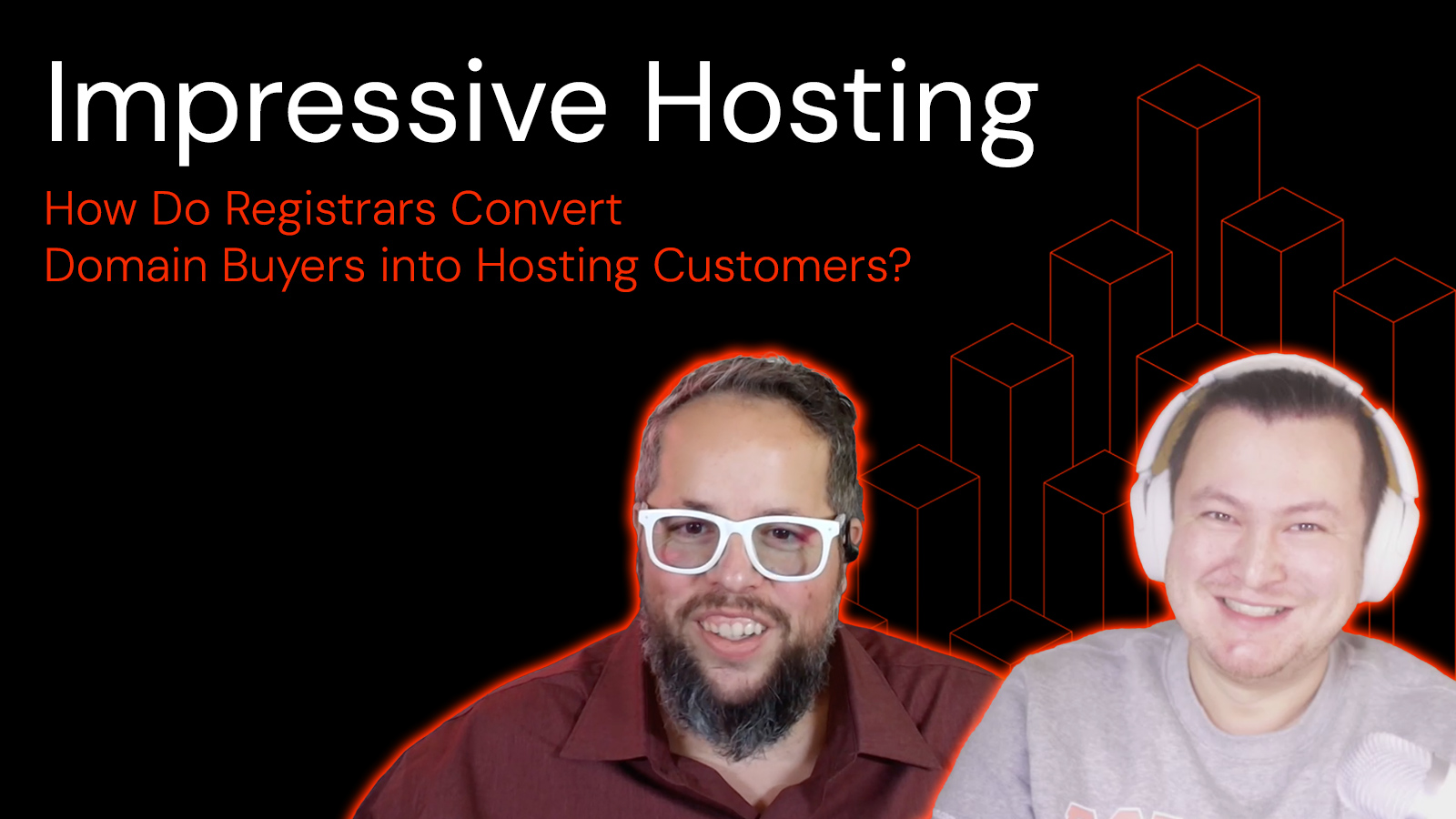
Jesse Friedman continues his conversation with Eddie Barksdale, partner manager at Porkbun, exploring the unique challenges registrars face when offering hosting services. Unlike traditional hosting companies that assume customers already have domains, registrars like Porkbun work with customers who start their journey by securing a domain name, often without clear hosting plans.
The discussion covers how registrars are adapting their support strategies to serve domain-first customers. Barksdale explains how Porkbun uses AI tools not just for site building, but for helping customers explore domain options and understand what they want to build. This conversational approach to domain discovery represents a significant shift from traditional search-based domain selection.
For hosting professionals and WordPress agencies, this episode offers valuable insights into understanding different customer mindsets. Whether you’re working with small businesses who prioritize physical locations over websites, or helping clients navigate the growing complexity of domain extensions, this conversation provides practical strategies for better serving diverse customer needs in the evolving WordPress ecosystem.
Links:
Transcript
## 125.2 – Eddie Barksdale (Porkbun)
Jesse Friedman: Welcome to Impressive Hosting, where we uncover the core tenets of great WordPress hosting. I’m your host, Jesse Friedman. Before we dive in, remember to check out impressive host. It’s where you can comment on episodes, ask follow-up questions, and submit questions for upcoming guests. You’ll also find all our links to follow, like and subscribe wherever you listen. With me today is part two of our episode with Eddie Barksdale, partner manager at Porkbun. We were having a great conversation about what it’s like to provide support for customers who are getting hosting from Porkbun, but also sometimes on a domain-first journey. And then how you go about providing them hosting and making them more aware of what it is that you’re offering. We covered a whole bunch. We were just talking about Reddit and I’m curious, you know, when we think about the fact that you guys are reaching out to customers and watching what they’re saying on Reddit, you mentioned in the last episode that you’re able to keep an eye on what it is that they’re asking for. And in some cases you’ve been able to really delight them by turning something around real quick. Do you think that customers are, like, there’s value in the fact that when they’re asking for support on Reddit, that maybe they’re a little bit more honest, maybe they’re a little bit more open. Maybe you can get a better understanding of what it is that you’re dealing with. And also do you think it’s a, like, does it actually save you any money, like maybe the community is helping to provide some answers too so you can get to things, get to the answers a little bit faster.
Eddie Barksdale: Yeah, that’s really cool. When I think about providing support where people are on Reddit and in other places. I think you end up getting that amalgamation or you get that community support mixed with you guys. I think that adds a lot of value. But I think one of the things that we’ve struggled with in this industry in particular is that because the WordPress ecosystem relies on thousands of different hosting companies to deliver WordPress, sometimes you have really amazing experiences. Sometimes you don’t, and I think the other thing that’s interesting there too is that the support that you get in the most common places where you have to ask for support can kind of erode your faith in whether or not you can get support. If it’s bad support, so like. I blame Verizon all the time because I can’t stand having to get support for them for like Verizon Fios, right? Or for internet. It’s such a painful experience. They make these assumptions that I have absolutely zero tech experience. Everything starts with instructions on how to reset your router. And because of that, I feel like, like I said before, it’s eroded my faith in whether or not I’m actually gonna get good support. So I think it’s really interesting that if you’re jumping into these other locations or other mediums where people are asking for support and just encouraging them and helping them to feel comfortable to ask support directly, that can go a long way. And I think it’s something that’s really interesting that everyone at home, you know, if you’re running a hosting company or something like that. You could benefit from that because sometimes that’s all it really takes is just to help people feel like it’s not gonna be a waste of their time. So I’m curious, like, do you feel like that’s a big burden on support as a whole right now? Like that if you don’t have the faith that you’re gonna get the help, you just don’t even bother.
#### What are the more common things that people who are buying domains are getting support for?
Jesse Friedman: What are the more common things that people who are buying domains are getting support for? Like, I’m pretty familiar, you know, what the most common support requests are around hosting, but I’m curious, when you just own a domain, what is it that people are struggling with?
Eddie Barksdale: Right. Yeah. I mean, in the first episode we talked about how folks may not necessarily understand the value of a domain, especially if they’re in a younger generation that didn’t come up with the internet as a fun, weird place. Talking about weird places, you’re from Portland. I think Portland is a really cool city and they love the idea of keeping it weird. You were at the, you mentioned that you love having the word camps in Portland, the WordCamp US. How do you feel about the WordPress ecosystem around domains? Like, do you feel like you as a company need to get in and communicate with the WordPress industry differently? Are there any messages that you want to share? Like, is there anything that you’re trying to solve for specifically within WordPress? Or is it, you know, kind of like everybody just really knows what they need to do within WordPress, but they just don’t necessarily know where to buy their next domain.
Jesse Friedman: Right. Yeah. That’s very cool. Yeah, so I mean, in the WordPress space, I mean obviously we have run the gamut right from end customers who are trying to run their own business and do everything else. And WordPress is like the last thing on the, I mean, a website is the last thing on their mind. And so they have to scramble to kind of build it. They don’t want to learn all this stuff all the way to the other side, right? Enterprise level agencies and folks who have been doing this for a long time for a better part of their professional careers. Where would you say, like the majority of Porkbun customers live in that space? Are they mostly super experienced, you know, people who are building websites or is it a lot of, you know, small businesses and DIYers trying to do it themselves?
#### What would you want hosting companies to know about domain customers?
Jesse Friedman: Nice. When you think about those customers that are doing it themselves. What are the things that, from a domain perspective, what are the things that you know, you would want hosting companies or agencies or folks working in the WordPress space to know? The things that I’m, I’ll give you an example of something that’s top of mind for me. I went to a small business conference in the UK a few years ago, and from our perspective, when we think about the web, we often think that the first thing that a business owner’s gonna be purchasing or examining what they need to do to run their business is a website. And maybe purchasing a domain is first on their list. But what I learned at this conference was that it was actually, I was completely wrong, that a lot of times what these small business owners are thinking about first is a physical location. Where’s their brick and mortar store gonna be? What is it that they need to rent, what things do they need to do legally, locally, you know, to build a business? Things like that. And then the website becomes, you know, further down the prioritization list there. So I’m curious, like any insights or interesting facts that you know might be worth sharing with folks who work in the WordPress industry to help them understand these types of customers better?
Eddie Barksdale: That’s, yeah. Yeah. I love that. Eddie. In the last, in the last episode, you said that, and correct me if I’m not getting this exactly right, but that you see support as marketing, right? That it’s a way for you to do word of mouth. Now you’re coming in with this awesome, insightful thing that it’s the parking lot test. Can you shout your brand? I like that. It reminds me of back in the day when I was working in design, and you would create a logo and you would shrink it down to a very tiny size and could you still recognize it? These days I need to wear glasses to even make that happen, but I think that’s cool when you distill something down to a simple rule or a fact like that. That’s really helpful when you think about agencies who are working with small businesses. Obviously, you know, if you’re a VIP, like AWPVIP type, enterprise level agency, or facilitator, and you’re working with someone like Time Magazine or Pepsi or UPS, right? They’re gonna have unlimited funds for buying as many domains as they need to buy. But when you’re talking to a small business owner, maybe somebody who owns like, you know, a clothing store or a restaurant or something like that. What do you think the agency needs to be informing them around the purchasing of domains? Do they need to buy every possible TLD with their brand name? Do they need to be a little bit more focused? How do they balance that with, you know, how much money they have to spend around domains? What advice would you give there? And I’ll add one other thing there too. What responsibility do you think the agency has to help explain these things to those small businesses?
#### Do people understand non-.com domains?
Jesse Friedman: Right. Right. Yeah. Yeah, I think that makes a lot of sense. Yeah. One of the things I’m curious about is when dot-com domains started becoming like household, I guess terminology, it wasn’t long before anything that ended in .com, you understood that it meant going to a website and typing that in. Now, of course, when people are linking to things online, it doesn’t really matter much because you’re clicking a link and you’re just being forwarded directly to it. But when we think about putting domains on like physical media, whether it’s a business card or a billboard or whatever it might be, do you think that the general population see a .agency or a .horse or whatever, and think website, or does it add a little confusion if they’re not super familiar with the TLD?
Eddie Barksdale: Yeah. That helps because I think that for a while actually, when I’ve been having to deal with unique TLDs, I often feel like I need to put the HTTPS in front of it just to make sure people feel like it’s a website, you know, and we have a really great domain for WP Cloud. It’s WP.cloud. It’s a two-letter domain. It’s really nice. But it kind of adds a little bit of hesitation in my mind is to like. Is the two-letter so short, you know, that like if I have a little period there, does it sound like I’m saying that it’s more of a brand than an actual domain? You know, so it leaves me thinking every once in a while, but that helps to make me feel a little bit better about the state of things that the general population sees a period as a path to a website. It seems like that’s the case, right? Like dot anything. You’re gonna be comfortable enough with it.
#### What drove Porkbun to evaluate AI?
Jesse Friedman: Now, in the last episode you mentioned that your offering for Porkbun on WP Cloud has AI, has an AI site builder. I’m curious, what made you think, what made, you know, Porkbun start to evaluate AI and, you know, was it something that you guys felt like you needed to do because you needed to keep up with what was happening out there, or were your customers specifically asking for it, you know, what drove you in that direction?
Eddie Barksdale: Yeah, right. Yeah. You know, you’re touching on something. It’s like a creed at Automattic, which is like decisions, not options. Like give, give people that polka dot or that stripe shirt choice. Don’t give them all the configurations ahead of them to do that. And I think that’s really interesting that AI, you know, can come in and I think every company that’s working with AI right now, especially around site building, is approaching it in different ways and trying to solve for different things. But I think at the end of the day, the most important thing is time to live. And I’m curious because a hosting company. You know, when you are hosting-first domains tend to be the thing that you add on when you’re buying hosting. So you go through a typical hosting flow. A lot of times hosting companies don’t even make the assumption that you need a domain. Sometimes they just assume that you’ve purchased one somewhere else or you’re gonna solve for that. So they really drive you down the hosting funnel first. But for Porkbun, it’s typically the other way around. You’re coming to Porkbun to buy a domain. You have an idea, you want to secure something. So I would imagine that you guys actually have a little bit more responsibility to the time-to-live than others. Because with a hosting company, if you’re hosting-first, you probably have a little bit extra motivation and a little bit extra intent. You may have made that decision to solve for something very specific. But when you’re buying domain-first, you may be thinking to yourself like, I have this idea. I don’t even know if I have time for it, but I just don’t want to lose the domain or see somebody else buy it. So I’m gonna buy it now. And now all of a sudden you’re being presented with hosting. I’m curious, like how do you think about that from that perspective? Are you focused on those types of metrics? Are you thinking about it from that perspective, or are you just more trying to be available to customers and provide a good experience.
#### How’s the AI site building going?
Jesse Friedman: Right. Yeah. So you’re strategically using the propagation time to help give them a little bit of an opportunity to learn about what services you have and what you can solve for, but not forcing them down a certain path. And so how has, how’s it been going with the AI site building? Do you feel like customers are finding it to be a lot easier, a lot faster. The reason I ask is because a lot of times, you know, we early adopters, folks like myself who tend to just try and grab onto the newest technology and utilize it as fast as possible. You see all these promises that things are gonna be faster, easier, you know, all that, but then, you know, it ends up being a lot more configuration, or you have to do a lot more things, or you have to reset things. I’ll give you an example. Like I fell in love with Google Homes when they first started coming out. And I had actually visited Google and they gave us a Google Home as a gift to take home. And so all of a sudden I had the ability to turn on my lights with my voice or ask questions or schedule appointments or whatever. But then over the years, and if Google’s listening, I hope they’re gonna fix this stuff. But over the years, it’s actually become more work for me than actually flipping on and off a light switch because. You know, the light bulbs become unsynced and they’re no longer programmatically connected or an update happens and you end up creating layers of burden for yourself that just end up adding more and more work in spite of the fact that it’s promising less. And I think AI site building is really interesting right now because it’s on the cusp of being absolutely revolutionary. But I’m curious, like, how are your customers, like, do you feel like they’re really getting something amazing out of it just yet, or is it just kind of on the cusp of being great?
#### Using AI for domain exploration
Jesse Friedman: Yeah. Right. That’s really cool. So actually, dive into that a little bit because, you know, the whole search engine around how domains are explored is very interesting to me. So, you know, for folks at home when you go to search for a new domain. It’s pretty simple when you have a very specific brand, you know, if you’re Pepsi, you’re typing in Pepsi. But if you’re not, if you’re trying to run a clothing store or you’re trying to run a hair salon or something like that, and you don’t know what the name’s gonna be, these types of displaying and uncovering the available domains can actually help you to understand what it is that you want to build your brand around. And you’re, so you’re saying that you’re actually using AI to help the exploration there. Is that becoming more helpful in helping customers to describe what it is that they’re doing? Because I think that’s one of the areas where WordPress is gonna see the most success from AI, is that you can have these conversational-based descriptions of what it is that you need help with. And instead of trying to force fit, you know, configurations and choose options, you’re able to say like, I’m gonna run a business and it’s gonna do X, Y, and Z, and I need your help choosing a name. I would imagine that would be actually a lot of fun working through that with an AI to try and help you in that way.
#### Parting advice about domains
Jesse Friedman: Yeah. Right. That’s really cool. All right, well, we’re just about at the end of this second episode. This is really great having this conversation with you. I’d love to have you back on and we can talk more about the AI site building when you have more customers using it. I would love to get some more insights around domains. What would you say, it’s like a parting gift, like do you have any advice or anything that you’d want to share in terms of helping anybody in the WordPress ecosystem agencies, folks at home like. Any advice around domains?
Eddie Barksdale: Yeah, I was hoping you were gonna say that ’cause that’s exactly the advice I’d give too. I think people don’t understand the value of domains right now as much as they should. And I think that there’s a lot of fun to be had. So if you’re doing anything online. Maybe you don’t control it, like we’d said before, like maybe you have an Instagram profile and you’re telling people how to, there’s always this awkward moment like, can I get you on Instagram? Okay, well here’s my username and I don’t know how to type it exactly. Right. And it has a weird zero because I can’t get, go buy a domain, you know, go buy, you know, Jesse, you know, Jesse’s instagram.com or something like that. And that way when anybody wants to find you on there, you can just point it directly to that. I think it’s a really interesting way to carve out a section of the internet for yourself and be able to point it to whatever you want. Even if it’s an article that you wrote, you know, like an editorial for the New York Times or something. And you don’t want to have to tell people that long domain every single time. Just buy a domain and point it at it. You can own these domains and point them at anything you want. So it’s a lot of fun to be had out there.
Jesse Friedman: Very cool. All right. Thanks so much, Eddie. It was great having you on.
Jesse Friedman: Thanks for joining us on another episode of Impressive Hosting, where we uncover the core tenets of great WordPress hosting. Do you have a follow-up question for today’s guest thought or comment on anything? We talked about a future guest suggestion, a hosting horror story. What do you think makes great WordPress hosting all your comments? Shape the show. Drop them on impressive.host. We also appreciate you following us on social media and subscribing to the podcast on your favorite platform. Finally, do check out our list of open source projects that need support at impressive.host. Whether it’s code, community, or cash, you can make a difference. See you next time.
Subscribe to Impressive Hosting:


Leave a Reply