'%3E%3C/path%3E%3Cpath d='M76.4782 25.7185L71.982 9.04089H74.6936L78 22.8409L81.8045 9.04089H84.5853L88.2722 22.8409L91.5787 9.04089H94.2902L89.7248 25.6977H86.7781L83.1396 12.6379L79.3835 25.6977L76.4782 25.7185Z' fill='rgba(247, 43, 0)'%3E%3C/path%3E%3Cpath d='M96.6075 9.04089H102.439C103.739 9.04089 104.818 9.26224 105.676 9.69803C106.534 10.1338 107.17 10.7287 107.592 11.4827C108.014 12.2367 108.222 13.0875 108.222 14.0421C108.222 14.9483 108.021 15.7783 107.613 16.5254C107.212 17.2794 106.575 17.8812 105.725 18.3239C104.867 18.7666 103.774 18.9879 102.439 18.9879H99.1323V25.6977H96.6075V9.04089ZM99.1323 16.9128H102.321C103.511 16.9128 104.362 16.6568 104.881 16.138C105.399 15.6192 105.655 14.9206 105.655 14.0352C105.655 13.1152 105.399 12.3958 104.881 11.8839C104.362 11.372 103.511 11.1092 102.321 11.1092H99.1323V16.9128Z' fill='rgba(247, 43, 0)'%3E%3C/path%3E%3Cpath d='M124.138 25.9744C122.492 25.9744 121.067 25.6147 119.87 24.8953C118.674 24.1759 117.747 23.166 117.097 21.8725C116.446 20.5789 116.121 19.0848 116.121 17.3901C116.121 15.6746 116.446 14.1735 117.097 12.88C117.747 11.5864 118.674 10.5765 119.87 9.84329C121.067 9.11698 122.492 8.75036 124.138 8.75036C126.089 8.75036 127.68 9.22766 128.918 10.1753C130.156 11.1299 130.938 12.458 131.277 14.1735H128.469C128.247 13.2051 127.77 12.4373 127.044 11.8631C126.317 11.289 125.342 11.0054 124.118 11.0054C122.45 11.0054 121.136 11.5726 120.168 12.707C119.199 13.8415 118.715 15.3979 118.715 17.3831C118.715 19.3476 119.199 20.8971 120.168 22.0246C121.136 23.1521 122.45 23.7124 124.118 23.7124C125.342 23.7124 126.317 23.4427 127.044 22.9031C127.77 22.3636 128.247 21.6234 128.469 20.6896H131.277C130.945 22.3428 130.156 23.6294 128.918 24.5702C127.68 25.5109 126.089 25.9744 124.138 25.9744Z' fill='rgba(247, 43, 0)'%3E%3C/path%3E%3Cpath d='M133.961 25.6908V8.5636H136.486V25.6908H133.961Z' fill='rgba(247, 43, 0)'%3E%3C/path%3E%3Cpath d='M145.195 25.9744C144.067 25.9744 143.057 25.7185 142.158 25.1997C141.259 24.6809 140.553 23.9615 140.027 23.0346C139.502 22.1076 139.246 21.0216 139.246 19.7903C139.246 18.5591 139.509 17.4731 140.041 16.5392C140.574 15.6123 141.293 14.8929 142.192 14.3741C143.099 13.8622 144.102 13.5994 145.215 13.5994C146.343 13.5994 147.353 13.8553 148.252 14.3741C149.144 14.8929 149.864 15.6123 150.396 16.5392C150.929 17.4661 151.192 18.5522 151.192 19.7903C151.192 21.0285 150.929 22.1076 150.396 23.0346C149.864 23.9615 149.144 24.6809 148.245 25.1997C147.332 25.7185 146.315 25.9744 145.195 25.9744ZM145.195 23.8093C145.796 23.8093 146.357 23.6571 146.869 23.3597C147.387 23.0553 147.802 22.6126 148.121 22.0177C148.439 21.4228 148.598 20.6827 148.598 19.7903C148.598 18.898 148.446 18.1579 148.134 17.563C147.823 16.9681 147.415 16.5185 146.896 16.221C146.377 15.9167 145.824 15.7714 145.222 15.7714C144.62 15.7714 144.06 15.9236 143.548 16.221C143.029 16.5254 142.614 16.9681 142.296 17.563C141.978 18.1579 141.819 18.898 141.819 19.7903C141.819 20.6827 141.978 21.4228 142.296 22.0177C142.614 22.6126 143.023 23.0622 143.534 23.3597C144.032 23.664 144.586 23.8093 145.195 23.8093Z' fill='rgba(247, 43, 0)'%3E%3C/path%3E%3Cpath d='M158.275 25.9744C156.85 25.9744 155.723 25.5317 154.906 24.6394C154.09 23.747 153.682 22.4258 153.682 20.6688V13.8899H156.207V20.406C156.207 22.6887 157.141 23.83 159.015 23.83C159.949 23.83 160.717 23.498 161.326 22.834C161.927 22.1699 162.232 21.2153 162.232 19.9771V13.883H164.757V25.6908H162.522L162.336 23.6225C161.969 24.3488 161.436 24.9299 160.731 25.3449C160.011 25.7669 159.195 25.9744 158.275 25.9744Z' fill='rgba(247, 43, 0)'%3E%3C/path%3E%3Cpath d='M173.341 25.9744C172.2 25.9744 171.19 25.7046 170.318 25.1651C169.447 24.6255 168.762 23.8854 168.271 22.9515C167.779 22.0177 167.53 20.9525 167.53 19.7627C167.53 18.5729 167.779 17.5146 168.271 16.5876C168.762 15.6607 169.447 14.9275 170.325 14.4018C171.204 13.8692 172.213 13.6063 173.362 13.6063C174.296 13.6063 175.119 13.7861 175.824 14.1528C176.53 14.5194 177.083 15.0313 177.478 15.7022V8.5636H180.002V25.6908H177.74L177.478 23.8577C177.097 24.4111 176.571 24.9022 175.907 25.3311C175.243 25.76 174.385 25.9744 173.341 25.9744ZM173.791 23.7885C174.87 23.7885 175.755 23.415 176.44 22.6679C177.132 21.9209 177.478 20.9663 177.478 19.7903C177.478 18.6006 177.132 17.6391 176.44 16.8989C175.748 16.1588 174.863 15.7922 173.791 15.7922C172.712 15.7922 171.826 16.1588 171.127 16.8989C170.429 17.6391 170.083 18.6006 170.083 19.7903C170.083 20.5651 170.242 21.2568 170.56 21.8586C170.878 22.4604 171.314 22.9308 171.881 23.2767C172.435 23.6156 173.078 23.7885 173.791 23.7885Z' fill='rgba(247, 43, 0)'%3E%3C/path%3E%3C/svg%3E)
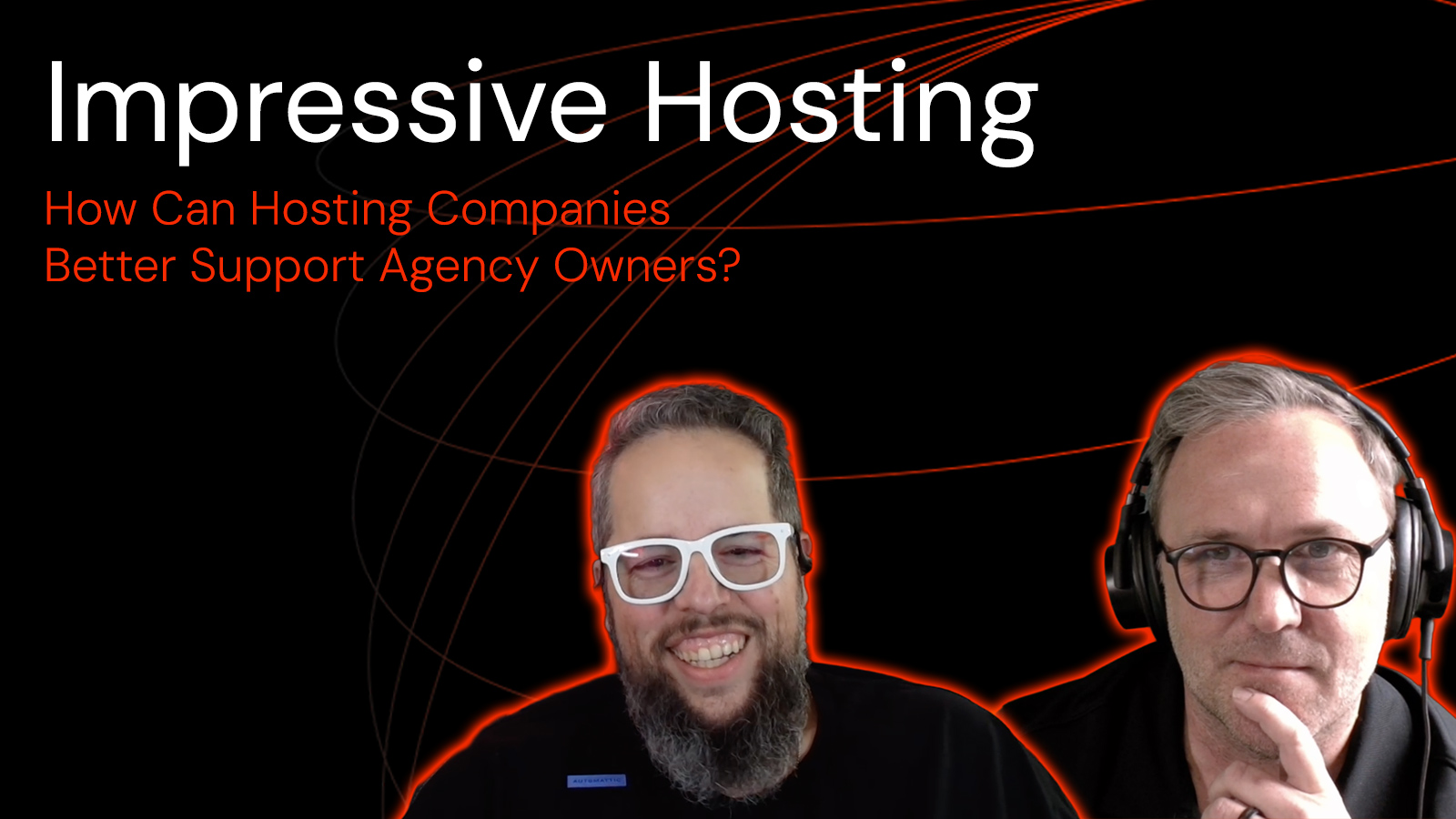
When a hosting company loses a WordPress customer, they may also be losing a WordPress user permanently. That observation, raised by Jesse Friedman and echoed by Cory Miller of hosting.com, frames a larger conversation about responsibility. Hosting companies spend heavily to acquire WordPress users, but many fail to support those users once the initial setup is done.
Jesse and Cory discuss how almost every new WordPress user today gets started through a hosting company’s auto-installer rather than downloading the software from wordpress.org. That means hosting companies control a user’s first WordPress experience. If that experience is frustrating or unsupported, the user may abandon WordPress entirely, not just the hosting provider. The stakes are higher than a single churn metric.
The conversation also explores what hosting companies can do beyond transactional support. Cory shares how hosting.com built Agency Success, a free community program that helps agency owners with business strategy, AI adoption, and long-term thinking. Building on top of that, Jesse argues that hosting companies should align their own success metrics with their customers’ success. Both agree that WordPress has thrived because of community, and hosting companies that ignore that engine are leaving value on the table.
Links:
- Hosting.com
- iThemes
- Liquid Web
- Post Status
- My Agency Success
- WP Vibe
- Five for the Future
- WordPress Boston Meetup
- Microsoft NERD Center
- WordCamp Asia
Transcript
Jesse Friedman: Welcome to Impressive Hosting, a podcast about the role hosting plays in shaping the open web. I’m your host, Jesse Friedman. On this show, we go deeper than uptime and dashboards. We talk about hosting as infrastructure, about ownership, independence, and what it takes to build ethical, high-end WordPress hosting that actually serves creators, businesses, and the internet itself. Before we dive in, head to impressive.host. That’s where you can comment on episodes, ask follow-up questions, and help shape future conversations. You’ll also find links to follow, like, and subscribe wherever you listen. Today I’m very happy to say that we have Cory Miller, chief evangelist of hosting.com, with us today. Cory is an old friend and, we’ll get into this, but one of the reasons this podcast exists. Cory, thanks so much for joining. Tell us a little about what you’re doing and where you are and all the things going on with you.
Cory Miller: Jesse, thanks so much for having me on. But first I want to say I’m just glad this podcast exists with your voice and you’re bringing in these conversations. We’ve talked over the years and this conversation has to exist. It’s essential for WordPress going forward. I’m glad to be on. So as Jesse said, my name is Cory Miller. How I got here is I started back in 2006 with a WordPress blog, and that developed into a company initially called iThemes. I ran that company for 10, 11 years. One of the first product companies in WordPress. We were acquired in 2018 by Liquid Web. Then I did my time and came out of that and thought, what’s next for me? I partnered with a great entrepreneur, Brian Carighead, at Post Status and ran that for a couple years. Then I finally said, it’s time to take that entrepreneur hat off. I’m tired of carrying all the responsibility, and I joined hosting.com as chief evangelist, where I get to do community. And that’s really my heart in all this. WordPress is an incredible community. So that’s a little bit of background on why I’m here, Jesse.
Jesse Friedman: Cory, that’s awesome. What a great resume. iThemes, man. That’s going back, huh? What was that like starting that in the early days of WordPress?
Cory Miller: Oh, I’ve been reflecting on this because in a couple days I turn 50. So you said old friend. Part of that is really, really true. I feel older. It was like stepping onto an amazing rollercoaster. 2008 is when we started, and WordPress at that time was at this incredible, explosive inflection point in its history. I rode that wave and got to live my dream of being an entrepreneur, build a team, and it was just exciting. All of us were younger then, looking around going, this is crazy awesome, isn’t it? And we just kept going. Then eventually the weight of that responsibility set in. We had about 25 team members when we were acquired, and that was heavy. So it was really fun and exciting riding that wave, and then it got serious. Kids came into my own personal situation. At some point we had more kids represented by the team than team members, and you’re like, okay, this is real. We gotta make this go. And really getting serious about what we’re doing and what we’re building in the WordPress ecosystem. That’s part of why the premise of this podcast is so essential. Hosting is the floor to all of that. To have a WordPress website, you need WordPress, you need a domain name, and you need hosting. That’s part of why my career blew up because of WordPress and why I love WordPress and am so appreciative of what it’s done in my life personally and professionally.
Jesse Friedman: That’s awesome. 2008. WordPress was established for a few years at that point, half a decade, and probably doing quite well in growth. You identified the need for a themes company, built iThemes, then sold it to Liquid Web, which has gone through a couple of rebrands since then. So what are you thinking about nowadays as someone who built a theme company? You see Gutenberg, you see the way site editing works, and now we’ve got AI site building. What do you think about themes as a business right now?
Cory Miller: So back in the day I would’ve maybe called myself a front-end developer, but let’s use those terms very loosely for me. Just this week I’ll tell you, it was so cool being able to put together themes that did stuff I wanted to do as a theme developer. That was the first iteration of our business. Then we quickly got into plugins, backup, security, maintenance for WordPress websites. So the more functional stuff.
Jesse Friedman: Right.
Cory Miller: But this week I’ll tell you, it’s been almost 20 years now and I was using Claude with AI and WordPress through the WP Vibe connection. I know the Abilities APIs are coming out. I can’t wait for that in 7.0. But it was fun because I could actually do that magical thing of clicking publish. I was helping one of our customers who happens to be my coach, and putting in some things with Claude and then seeing it in the amazing tool that WordPress is, making it live on the internet. That was pretty fantastic. I think that’s the magic of WordPress going back. That’s what caught me, what hooked me. And now in this new day, I think we’re holding both fear and excitement about the AI era at the same time.
Jesse Friedman: Yep.
Cory Miller: But I saw the beauty of WordPress again, being able to just publish my thoughts, opinions, ideas, products, onto the web for the world to potentially find, discover, and buy from. And seeing this AI tool where my skills are pretty rough, like I wouldn’t edit CSS today. I’d Google it and figure it out first. But just being able to say, I don’t want that color, I want this color. Change it. Upload my theme files back to the site and have it be there. That was rekindling some of that initial magic of what WordPress was and is today.
Jesse Friedman: Oh yeah. I feel the same exact way about how AI is enabling folks like us, people who had developer experience who were able to code things on the back end and front end. I was pretty heavy in JavaScript, HTML, CSS, ActionScript and Flash, PHP. Then I got into business and the skills kind of waned. But now all of a sudden I still remember a lot of my core education and what I taught myself and what I was able to build, but it’s not as fluid, not as natural to write code these days. Then AI comes out and it’s like I have a jetpack on. I feel like I have superpowers. I feel very much like the engineer I always wanted to be, but I was always so distracted by doing other things, working on user experience, helping customers, doing all these things, that I never really focused only on one thing and became that elite-level engineer. But I kind of feel like I’m almost there right now. And what’s interesting is that you mentioned you were helping a client. One of the things I keep going back to is WP Cloud. The way it works and operates is it’s an API-based infrastructure. A hosting company can come in, use WP Cloud, and we take care of everything in the stack from top to bottom. What we’ve also noticed is that when you deploy WP Cloud, there are almost no infrastructural tickets anymore. No support around rate limiting or issues or update problems or whatever. So we ask our hosting partners, we say, if you know now that you’re using WP Cloud and you’ve eliminated X percentage of your support tickets, what can you do with your support now? What can you apply them to to be more successful? If you were to get 20% of your support staff’s time back, could you help your customers be more successful? This narrative was common for us over the last few years. But now AI exists, and the way in which it exists, maybe we could be doing a lot more where support people are not just necessarily answering questions, but proactively helping to build with their customers and help them actually launch things. If you can do that because you have extra support time, if you can do that because you’re empowering these agents to use Claude or some other AI, I think it becomes really interesting. I’m thinking we can get to a place where the gaps we see in WordPress’s functionality, the friction we see with users not being able to get something live, maybe that can be solved with human and AI power together. What do you think about that?
Cory Miller: Yeah, when I started to really get into WordPress, the mission was what really rang my bell. Publishing. I thought of that as reaching every country, giving them this incredible CMS, this tool to build, to launch, to go live with. Now, as you were saying all that, I thought to myself that mission still resonates in a
Jesse Friedman: Yeah.
Cory Miller: because as you and I know, one of the biggest barriers, even as WordPress has worked tirelessly with different extensions and all that to get easier and easier for someone to get live what’s in their head and their heart. AI takes that big huge part out where I don’t have to learn what PHP is. I don’t have to know how to edit CSS for my site. I can say, here are my thoughts, and here they are. That’s just lowering the bar. And I think one thing that really resonated with me, and what I’ve tried to do with every company and team I’ve been a part of, comes down to community. How do we help people, as guides, get those people that have an idea, have something they want to share with the world, out there? That’s what everything we do at hosting.com is about. Being those guides for them. What’s your idea? What’s the thing you’re trying to get out? How do you think about it? How do you get your messaging out? Marketing, SEO, social, all those things. How do you get attention for the thing you’re really passionate about? And guiding those people. So I love that, the way you say that, if more and more of us on these teams from hosting.com to other companies can spend more of their time just helping people launch and birth their idea out there. That’s a win for me. That’s lifting all of us together. And that’s why it’s exciting, why that kernel of a premise of what WordPress is really about never really was about the code. It’s about helping get the idea out from inside you, out there where other people that need it can hear it, engage with it, all those things. That’s what energizes me today, what energized me 20 years ago when I first started my first professional blog.
Jesse Friedman: Yeah, and I’ve been pushing really hard on this podcast and in other places to see a resurgence of the internet that we loved. So much of social media and closed platforms have monopolized not only the traffic but the real estate of the web. People who are getting started today are often choosing services over websites. An example of this is link-in-bio. I have an article going live, it will probably be live by the time this is up, so if you want, head over to WP Cloud’s blog and check it out. But one of the things I talk about in the article is the fact that there are these services replacing the need for websites. Ten years ago, if you needed a quick little homepage to put all your social links on, you would’ve built a WordPress website or something quick, even just HTML. Now it’s on a service. You fill out a form and boom, it’s live. I’m not necessarily picking on Linktree or other link-in-bio solutions, but I think we’re starting to see this happen in a variety of places. You’re a musician, you choose a band website solution. Instagram has even made their business profiles searchable by Google. So it’s only a matter of time before that becomes a replacement for a website under Google Business listings. Instead of sending them to a website, you send them to Instagram. People see this as a convenience and a shortcut. It gets you an audience a little bit faster. But they fail to recognize that they don’t own their influence. They don’t own that connection with their audience. These platforms run on algorithms that make decisions about what can be seen and when. All of a sudden the rug can be ripped out right from under them and they can lose everything because they built it on a fragile foundation. Part of me is so adamant that the open web is the answer. I keep pushing that as a mission and a platform. But the problem we face is that it’s still an uphill battle to choose to build a WordPress website over a link-in-bio. The link-in-bio is super fast, you get exactly what you set out to do, there isn’t this blank canvas problem where you can build literally anything you want. It’s very specific with guardrails, so you’re put down a very specific path. So it makes me wonder what hosting companies can be doing to solve this. One of the things I proposed in that article is that hosting companies should be more focused on selling niche solutions. If someone wants a link-in-bio, maybe it would’ve been really great if hosting companies had gone back and started using the same infrastructure they have, the open web tools and WordPress, but just sold link-in-bios and put up those guardrails so it was super fast with instant results. I think we can do the same thing with musician websites, restaurant websites, lawyer websites. But the hosting company needs to pivot from selling hosting to selling websites. I feel strongly that it’s the right path, but I don’t know if all hosting companies are ready for that yet. What do you think?
Cory Miller: I think our customers are coming for a solution to do something. Let’s take the creators you talked about. When I started, what you’d now call content marketing was just publishing a blog post. That’s where the traffic was, and you could start to move people down a funnel or whatever. With creators today, you go, okay, you start on Instagram. Now how do you monetize? And you gotta do that through services so often. But I have the same premise. I don’t like it.
Jesse Friedman: Yeah.
Cory Miller: I don’t like more of my business owned by somebody else according to somebody else’s rules. That’s why I love the open web, just like you. So I think you’re onto something. I know you’re onto something. That’s the way we do things too, is to say, okay, what are you really trying to get done, what’s the best path for it, and help you with that path. That’s what I think community does within a business. Help you find the path and then help you get there. Help you think better about it, think long term about it. And the other part you mentioned is the tools. How do I make it as easy as possible to get on that path and keep going down it? So I think you’re right on. For our agency owners at hosting.com, we have Agency Success. It’s a community just to think about what agency owners are really trying to do. They deliver websites for clients for sure, but above that they’re trying to live a life. They’re trying to do something with their life. They might like working from home. I do too. They like to call their own shots. So we try to do that. That’s the path they want to go on. That’s a dream, a goal for them. And then there are obstacles in the way, and that’s what we do several times a month. You’re on this path. Here are the obstacles, the frustrations in your way. We have an expert trainer who is also a boutique agency owner. He’s lived it, he lives it every day, providing his insights back to our community and growing that conversation. Because for entrepreneurs, in this particular case, it’s a lonely job. There’s not a lot of people that understand what you do because most people choose to work for someone else, but you’re carrying the whole load. So we really put ourselves in that experience and say, we’re your cheerleaders, but also your guides. If there’s a problem they’re running into, we want to go research it, figure it out, talk to a lot of people, and share back so they can make the best decision possible. I think at its essence, Jesse, not just hosting companies but any business should think in that transformational mindset. We gotta do the transactional stuff, buy buttons, cart links, invoices, all those things. But when business is truly a human-centered endeavor, we’re also thinking transformationally. What are you really trying to do? And how can we help you get there faster, better, easier, cheaper? Just get there better. The premise of community embedded in business is a mindset of how do we make people’s lives better?
Jesse Friedman: That’s a really great point. You mentioned Agency Success. That’s a community and program you have running under hosting.com.
Cory Miller: Yeah, a community. We have office hours every week live with Nathan where you can just ask
Jesse Friedman: Oh, nice.
Cory Miller: and there are some technical questions and some more business questions. Then we have at least two live streams a month talking about an issue. Obviously AI is a big one. How do you use AI in your business for your clients? How do you think about potentially selling consulting offerings to those businesses for how they could leverage AI? Because it’s still technology and that’s what we do as agency owners at its core. And then there’s a Slack community for in between that we offer as well.
Jesse Friedman: That’s great. And is it free? Do you have to be a customer, or is this open to the public?
Cory Miller: It’s open to the public. If you’re an agency owner and you just want to go far together, join myagencysuccess.com. That’s where you can go join. You’ll get access to the Slack link and you’ll get emails with the next upcoming live streams. It’s really similar to what I did at iThemes.
Jesse Friedman: Very cool.
Cory Miller: Our customers were buying a tool from us to do something, and we just started asking what they were really doing. Well, they’re obviously in the business of selling client services. So what are the problems they have? The bigger-level problems are where we try to say, we’re walking with you long term. I think that’s the best expression of business. It’s a win-win and everybody can win together. There’s an exchange. You’re exchanging money for a solution. But we’re also saying we can do this together. And that’s where you get raving fans, loyalty, engagement, all those things. Those are the business terms. But I think it’s just being a good human and saying, agency owners as entrepreneurs probably feel lonely, like no one truly understands, even on my team, because they’re not the owner. So we have a lot in common together, shared interests. This is a microcosm of WordPress. The WordPress community has been the engine that has driven WordPress ongoing. Sure, the code’s awesome, but the community and the ecosystem around it, that’s the bigger community we’re
Jesse Friedman: Everything.
Cory Miller: inside of, hosting.com as an agency owner using WordPress as a tool. And it’s just better. That’s what WordPress has proven over, what, 27 years now.
Jesse Friedman: Like that. Yeah.
Cory Miller: As a software and then a community, that’s the power of it. No actual marketing has happened. It’s because people like me and you, when someone asks us, we go, WordPress might be the tool for you, and we’re evangelizing the platform. That’s the incredible true marketing engine WordPress is. People passionate like you and I and others listening to this saying, here’s a tool. I don’t get paid to go tell my neighbor who needs a WordPress website about WordPress. I want to, because I know it’s the best tool for them. I’ve gotten a long way from the start, but the emphasis there, the ground zero for me, is always community. People together, doing something together. That’s the beauty of WordPress that I hope always carries forward.
Jesse Friedman: Absolutely.
Cory Miller: Those of you listening who have contributed code or whatever it is to WordPress, you’re doing something for someone else you’ll likely never know about. And that’s tremendously powerful. That’s something bigger that we’re doing in the world and why I think WordPress has grown so much. But back down to the base level, the human-centered elements. I think more and more, even in this age of AI, we’re talking about authenticity. Sometimes you just want a human across the screen from you, sharing their experiences. That’s something only another human can give me, and I want to do that with other humans. It’s how our species has survived.
Jesse Friedman: Yeah, it’s so funny that you bring up community. That’s basically how I got my start, in Rhode Island. I was hanging out with folks and the WordPress Boston Meetup was thriving and I used to go up there. It’s a short trip on the train. Actually, I’m going on Monday. They’re gonna have a great talk. This is a fun thing because it’s a local WordPress meetup. It’s completely free, the space is donated by Microsoft’s NERD Center, and there’s usually a host or somebody who buys pizza for everybody. So it’s just put together by people who care about the community, who care about giving back, who care about WordPress. And they’re bringing in Ethan Marcotte and Josepha Haden Chomphosy to come talk to this local WordPress group. Ethan Marcotte is well known as the guy who coined responsive web design and wrote the first book on it. Josepha is obviously the executive director of WordPress. Two big names, two great names, coming to a local WordPress meetup. And you get to see a keynote-level talk for nothing, for just the cost of getting yourself to a location, and you get free pizza. That’s pretty much what got me excited too. I just felt so naturally right being there. It wasn’t awkward where everybody was sitting in a corner talking to each other with their backs to you. It was like, come join us. We’re having a great conversation. Come sit with us, tell us what you’re doing, what are you working on? And you started to become familiar with the people. Then I ended up building a local WordPress community here in Rhode Island with people like Jay Tripp, Jacob Goldman, and Mason came up for a while and helped with it. We built such a great local community. Then I started taking my students to it. I was teaching night classes at a university in Rhode Island, teaching web design, and I said, you guys gotta come to this community. So many of my students just fell deeply in love with WordPress from that local meetup. One of the most rewarding things I experience now is when I go to a WordCamp, especially a flagship, because it seems to have a gravity that brings people toward it from all over. I see an old student, they run up and they tell me about what they’ve been working on, how deeply involved they are in the WordPress community. And it all comes back to just being in a local area where human beings who are passionate about something are welcoming and bringing you into the fold. It’s an awesome thing. I felt the same exact way, kind of in reverse, at WordCamp Asia just a week or two ago. In reverse because I’m not the new kid on the block anymore. I’ve been around for a while. But you can see it on other people’s faces. They’re showing up a little nervous, they don’t know what to expect, they’re excited. Then they just start having conversations and jumping in, and all of a sudden they feel like they’re part of a community that’s been around for 20-plus years. It’s an amazing feeling. I think every one of those people who come on board WordPress in that way feel like they need to give something back. And that can be anything. It can be contributing to core, or it could be telling your neighbor to use WordPress when they’re thinking about using a link-in-bio. It can be any of those things.
Cory Miller: WordPress is so much about this. You might come for the code, the software, but you stay for the people.
Jesse Friedman: Yeah.
Cory Miller: You and I have had, and thousands of others through this, an incredible experience. It is a case study of how community can be done very, very well. My 20 years in it, I just go, there’s so much I want to carry forward that I’ve learned and grown through being in WordPress and the WordPress industry community. Someone being willing to help someone else just because they’re passionate about it and want to help somebody else. That’s a pure, awesome human principle. All those people over the years at WordPress meetups in Boston and WordCamps across the world were volunteers. They gave their time, often their own money and energy, to do something bigger than themselves. That’s powerful in human life. There are things that WordPress has demonstrated over the years, like diversity, equity, and inclusion, that should continue by the way, that I’ve brought back to my own local community. So many of us don’t see each other every day. Your state’s hundreds or thousands of miles apart from me today, but we’re connected. Whatever I learn and grow through this community, I bring back to my own life. It’s helped me grow through it, become even a better human through it.
Jesse Friedman: Oh yeah, absolutely. So your Agency Success program, is that WordPress focused or is it kind of just anything agency related?
Cory Miller: WordPress is our default tool. It’s the number one CMS on the planet and we still love it and want to help others doing that. So you don’t have to be a WordPress agency to come be a part of that. There’s gonna be plenty of things for you, but our default tool is WordPress.
Jesse Friedman: Yeah, I like that a lot.
Cory Miller: And you know, it makes me think because a lot of hosting companies, and we talk about this on this podcast a lot, the idea that as a hosting company making money and selling WordPress… I want to clarify this because it’s come up on this podcast a lot and I don’t want to give the wrong information. When I say you’re making money off of WordPress, you owe something back to WordPress. I believe that. But what I think is more important to realize, especially with hosting companies, is that hosting companies typically have a large marketing budget, a large advertising budget. They’re reaching out into the world saying, we offer WordPress, and competing against other hosting companies saying the exact same things. If you’re gonna step into that field and work hard to acquire that customer, who may have otherwise gone to a different hosting company and had a different experience, that’s the moment where I feel like you have a responsibility to that first WordPress experience. That first WordPress experience can be the last WordPress experience for that user if they don’t really enjoy using WordPress. Vanilla WordPress, where you go download it from wordpress.org and use FTP to upload it, doesn’t really even exist anymore in that way. Almost everyone gets started with WordPress through a hosting company that auto-installs it. So you’re taking an experience and saying, you don’t need deep technical experience, you don’t need to know how to FTP, you don’t need to know how to do all these things to get it up and running. But if you’re not applying an additional level of hand-holding for those new users who don’t really know what they’re doing, you’re kind of setting them up and saying, look how easy it is to get started, you can get going instantaneously, all I need is your credit card and boom, you’re off and running. But then things get hard, and it’s like, where did we go? That’s why I love this idea of your program, because I feel like it’s a really tangible way for a hosting company to give back to the community and say, we’re here to help you. Obviously this is a differentiation for hosting.com, to say that we offer this. But you’re not saying you have to be a hosting.com customer. I’m curious, what do you think other hosting companies have as a responsibility to that community? Especially when we think about new users. WordPress to them is probably no different than us using Quicken for tax software. It’s a means to an end. They need to get a website live, but they don’t want to be a web designer. They just want to get something up and running. So what do you think a hosting company has as a responsibility to the community in that way?
Cory Miller: I think we all do. That’s why you and I have talked about this in depth in private for a long time, and why I love that this podcast exists. Because you mentioned to me one time, if a hosting company churns a WordPress customer, they’re likely churning a WordPress user. And I’m like,
Jesse Friedman: Yeah.
Cory Miller: hold on. So I think there is a responsibility. But I’ll put it in business terms that hopefully resonate with leadership and hosting companies, mine and others. And we subscribe to this at hosting.com. It’s not just a responsibility to think about. This is your market. The easiest way to say this to a business person, an owner, or a shareholder is: have someone at your company run a review of your stack and see what percentage runs WordPress.
Jesse Friedman: Yeah.
Cory Miller: It’s a market. That’s obviously what hosting companies started doing the same exercise
Jesse Friedman: Yeah.
Cory Miller: years ago. How many people is this WordPress thing running on our infrastructure? Oh, it’s running 60, 70% of our infrastructure. Well, that’s a market. Now I think hosting companies, it’s even beyond obligation. Are you in business to do hosting? Then you better pay attention to WordPress. You better do something with WordPress. So I think it should come out of gratitude for sure, but it’s also essential and necessary.
Jesse Friedman: Yeah.
Cory Miller: If you want that thing to continue growing, it’s a huge part of your base. So to me it should be easy. Now maybe I’m simplifying this too much, but just look at your customer base. They’re likely 60, 70% running on your infrastructure using this tool. Fan the flame a bit. Introduce your own community program. Think about agencies, think about the do-it-yourselfers. We see Squarespace, Wix, Weebly running Super Bowl ads, doing a lot of marketing out there. What happens to your base when they go over to those platforms? You’d want to defend and protect that. And the way to do that, in my opinion, is to grow and foster and support WordPress as an ecosystem, as a software to contribute back to. You shouldn’t have to be told. You should just look at your own P&L, your own stats, and go, this thing called WordPress, we should probably do something with it. That means you foster that ecosystem, that community. We can all grow together, and there’s plenty of market and space to go around if we just look at that transformational mindset of what we’re doing for our customers. So I think it should be obvious, Jesse. I know you and I have talked about this over and over. There’s so many of these things that should just be a
Jesse Friedman: Yeah.
Cory Miller: duh. Like, come on.
Jesse Friedman: I love that.
Cory Miller: For us, we’re part of Five for the Future because our leadership understands, our shareholders understand. As WordPress grows, we grow. That’s a
Jesse Friedman: Yeah.
Cory Miller: reciprocal relationship. So we invest time from our team to contribute back to the program. We help sponsor, we attend. We’re doing a lot of things that aren’t just monetary. And I think that’s just par for the course if you understand what we have here and want to keep that fire alive. These should be easy decisions. But as you know, as the wind blows, people fall out of favor. I go, let’s anchor down. Until that is not the case, we lean in. We shouldn’t have to be asked. We shouldn’t have
Jesse Friedman: Yeah.
Cory Miller: to be told to do those things. I think we should willingly show up. We all have finite resources, budget, and all those things. Like you said, hosting companies have the marketing budget. Hosting companies are the ones that have profited from this space deeply for years.
Jesse Friedman: Yeah.
Cory Miller: Product companies come and go, but at the root, I’ve told agency owners this over and over, Jesse. Do you realize you are the customer, and there are a lot of you? And every hosting company likely has an agency program. That tells you something. A big part of their revenue comes from you. If you just talk to other agency owners and express your opinion, you are the customer to the company. You should get a vote in this. You should let your voice be heard, because you’re the heroes. I think beyond the contributors to WordPress in the ecosystem, the real heroes are those agency owners helping that nonprofit, helping that government organization, whatever it is, go, WordPress is the best tool for you. We’re experts at that and we’re gonna help you do that. Agency owners should be the hero to all our hosting companies.
Jesse Friedman: I love that. Yeah. It goes back to something we talk about on this podcast a lot too, which is that hosting companies have a responsibility to the WordPress user. But the other thing they can do, to really make a great experience and help the community indirectly, is to align their success with their customer success. In this case it’s almost always agencies. If you’re able to make sure that your agency is profitable and that you’re making money because they’re profitable, because they’re doing things and accomplishing their goals, and you align your success together, then you have a truly great opportunity to do something fantastic. Listen, we gotta take a break. John’s pointing out that we’ve surpassed our 30-minute limit here. We’re always trying to keep these shows a little shorter, but the conversations are so great that they end up bleeding over a little bit. We’ll be back with another episode with Cory. Thanks for joining us on another episode of Impressive Hosting, where we uncover the core tenets of great WordPress hosting. Do you have a follow-up question for today’s guest, a thought or comment on anything we talked about, a future guest suggestion, a hosting horror story, or what you think makes great WordPress hosting? All your comments shape the show. Drop them on impressive.host. We also appreciate you following us on social media and subscribing to the podcast on your favorite platform. Finally, do check out our list of open source projects that need support at impressive.host. Whether it’s code, community, or cash, you can make a difference. See you next time.
Subscribe to Impressive Hosting:


Leave a Reply