'%3E%3C/path%3E%3Cpath d='M76.4782 25.7185L71.982 9.04089H74.6936L78 22.8409L81.8045 9.04089H84.5853L88.2722 22.8409L91.5787 9.04089H94.2902L89.7248 25.6977H86.7781L83.1396 12.6379L79.3835 25.6977L76.4782 25.7185Z' fill='rgba(247, 43, 0)'%3E%3C/path%3E%3Cpath d='M96.6075 9.04089H102.439C103.739 9.04089 104.818 9.26224 105.676 9.69803C106.534 10.1338 107.17 10.7287 107.592 11.4827C108.014 12.2367 108.222 13.0875 108.222 14.0421C108.222 14.9483 108.021 15.7783 107.613 16.5254C107.212 17.2794 106.575 17.8812 105.725 18.3239C104.867 18.7666 103.774 18.9879 102.439 18.9879H99.1323V25.6977H96.6075V9.04089ZM99.1323 16.9128H102.321C103.511 16.9128 104.362 16.6568 104.881 16.138C105.399 15.6192 105.655 14.9206 105.655 14.0352C105.655 13.1152 105.399 12.3958 104.881 11.8839C104.362 11.372 103.511 11.1092 102.321 11.1092H99.1323V16.9128Z' fill='rgba(247, 43, 0)'%3E%3C/path%3E%3Cpath d='M124.138 25.9744C122.492 25.9744 121.067 25.6147 119.87 24.8953C118.674 24.1759 117.747 23.166 117.097 21.8725C116.446 20.5789 116.121 19.0848 116.121 17.3901C116.121 15.6746 116.446 14.1735 117.097 12.88C117.747 11.5864 118.674 10.5765 119.87 9.84329C121.067 9.11698 122.492 8.75036 124.138 8.75036C126.089 8.75036 127.68 9.22766 128.918 10.1753C130.156 11.1299 130.938 12.458 131.277 14.1735H128.469C128.247 13.2051 127.77 12.4373 127.044 11.8631C126.317 11.289 125.342 11.0054 124.118 11.0054C122.45 11.0054 121.136 11.5726 120.168 12.707C119.199 13.8415 118.715 15.3979 118.715 17.3831C118.715 19.3476 119.199 20.8971 120.168 22.0246C121.136 23.1521 122.45 23.7124 124.118 23.7124C125.342 23.7124 126.317 23.4427 127.044 22.9031C127.77 22.3636 128.247 21.6234 128.469 20.6896H131.277C130.945 22.3428 130.156 23.6294 128.918 24.5702C127.68 25.5109 126.089 25.9744 124.138 25.9744Z' fill='rgba(247, 43, 0)'%3E%3C/path%3E%3Cpath d='M133.961 25.6908V8.5636H136.486V25.6908H133.961Z' fill='rgba(247, 43, 0)'%3E%3C/path%3E%3Cpath d='M145.195 25.9744C144.067 25.9744 143.057 25.7185 142.158 25.1997C141.259 24.6809 140.553 23.9615 140.027 23.0346C139.502 22.1076 139.246 21.0216 139.246 19.7903C139.246 18.5591 139.509 17.4731 140.041 16.5392C140.574 15.6123 141.293 14.8929 142.192 14.3741C143.099 13.8622 144.102 13.5994 145.215 13.5994C146.343 13.5994 147.353 13.8553 148.252 14.3741C149.144 14.8929 149.864 15.6123 150.396 16.5392C150.929 17.4661 151.192 18.5522 151.192 19.7903C151.192 21.0285 150.929 22.1076 150.396 23.0346C149.864 23.9615 149.144 24.6809 148.245 25.1997C147.332 25.7185 146.315 25.9744 145.195 25.9744ZM145.195 23.8093C145.796 23.8093 146.357 23.6571 146.869 23.3597C147.387 23.0553 147.802 22.6126 148.121 22.0177C148.439 21.4228 148.598 20.6827 148.598 19.7903C148.598 18.898 148.446 18.1579 148.134 17.563C147.823 16.9681 147.415 16.5185 146.896 16.221C146.377 15.9167 145.824 15.7714 145.222 15.7714C144.62 15.7714 144.06 15.9236 143.548 16.221C143.029 16.5254 142.614 16.9681 142.296 17.563C141.978 18.1579 141.819 18.898 141.819 19.7903C141.819 20.6827 141.978 21.4228 142.296 22.0177C142.614 22.6126 143.023 23.0622 143.534 23.3597C144.032 23.664 144.586 23.8093 145.195 23.8093Z' fill='rgba(247, 43, 0)'%3E%3C/path%3E%3Cpath d='M158.275 25.9744C156.85 25.9744 155.723 25.5317 154.906 24.6394C154.09 23.747 153.682 22.4258 153.682 20.6688V13.8899H156.207V20.406C156.207 22.6887 157.141 23.83 159.015 23.83C159.949 23.83 160.717 23.498 161.326 22.834C161.927 22.1699 162.232 21.2153 162.232 19.9771V13.883H164.757V25.6908H162.522L162.336 23.6225C161.969 24.3488 161.436 24.9299 160.731 25.3449C160.011 25.7669 159.195 25.9744 158.275 25.9744Z' fill='rgba(247, 43, 0)'%3E%3C/path%3E%3Cpath d='M173.341 25.9744C172.2 25.9744 171.19 25.7046 170.318 25.1651C169.447 24.6255 168.762 23.8854 168.271 22.9515C167.779 22.0177 167.53 20.9525 167.53 19.7627C167.53 18.5729 167.779 17.5146 168.271 16.5876C168.762 15.6607 169.447 14.9275 170.325 14.4018C171.204 13.8692 172.213 13.6063 173.362 13.6063C174.296 13.6063 175.119 13.7861 175.824 14.1528C176.53 14.5194 177.083 15.0313 177.478 15.7022V8.5636H180.002V25.6908H177.74L177.478 23.8577C177.097 24.4111 176.571 24.9022 175.907 25.3311C175.243 25.76 174.385 25.9744 173.341 25.9744ZM173.791 23.7885C174.87 23.7885 175.755 23.415 176.44 22.6679C177.132 21.9209 177.478 20.9663 177.478 19.7903C177.478 18.6006 177.132 17.6391 176.44 16.8989C175.748 16.1588 174.863 15.7922 173.791 15.7922C172.712 15.7922 171.826 16.1588 171.127 16.8989C170.429 17.6391 170.083 18.6006 170.083 19.7903C170.083 20.5651 170.242 21.2568 170.56 21.8586C170.878 22.4604 171.314 22.9308 171.881 23.2767C172.435 23.6156 173.078 23.7885 173.791 23.7885Z' fill='rgba(247, 43, 0)'%3E%3C/path%3E%3C/svg%3E)
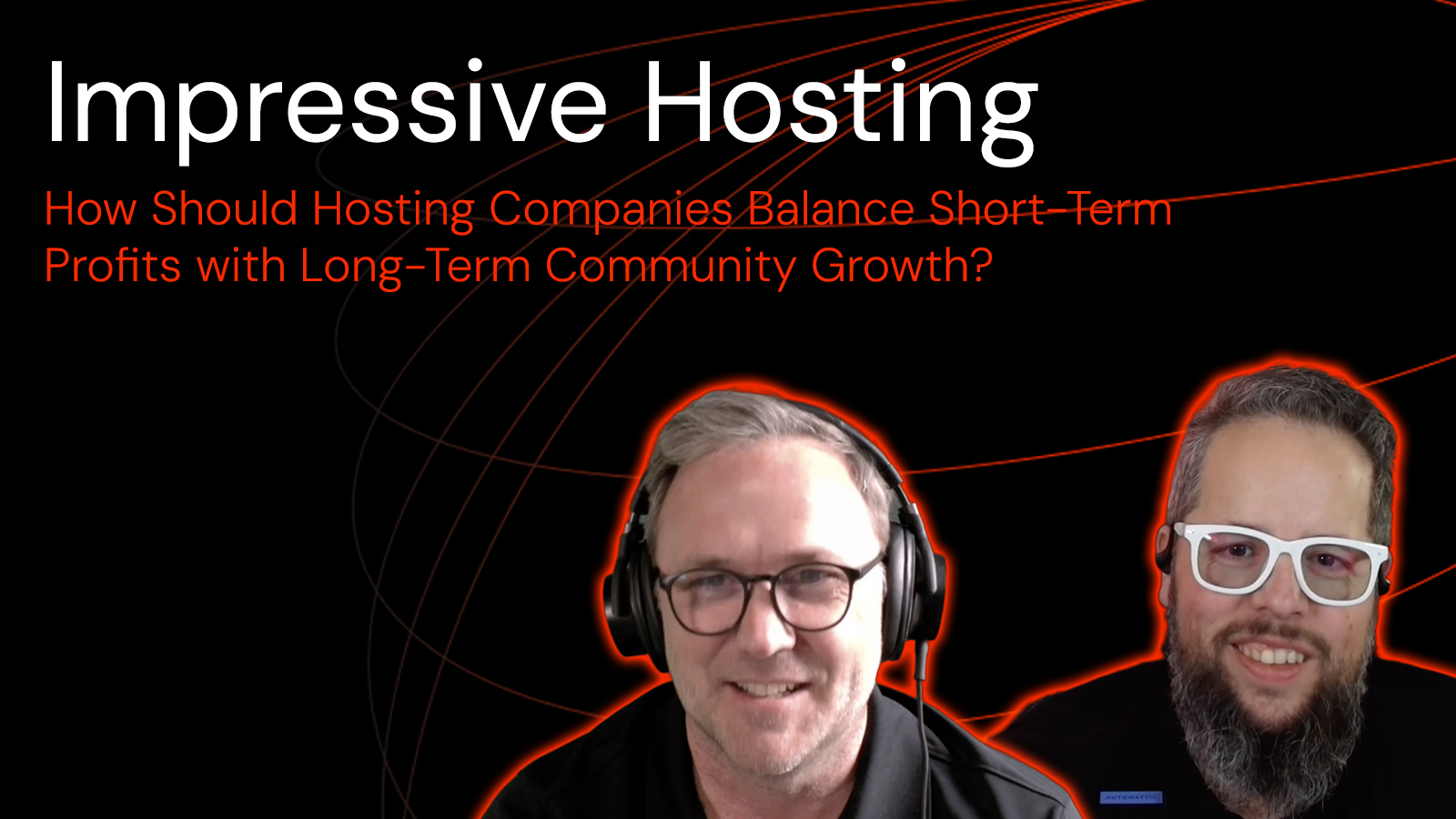
Short-term thinking is quietly sabotaging the WordPress hosting industry. That is the central theme from Jesse Friedman’s second conversation with Cory Miller, chief evangelist at Hosting.com. Together they name a problem that many in the industry feel but rarely say out loud: the pressure to hit monthly and quarterly targets is pulling hosting companies away from the long-term strategies that actually drive sustainable growth.
The conversation picks up where their first episode with Cory left off, digging into who hosting customers really are and what they are trying to accomplish. Cory breaks them into two groups: do-it-yourself business owners who need simple, guided experiences, and agency builders who need powerful tools and reliable infrastructure. He argues that hosting companies should start by better understanding the customers they already have, rather than chasing new ones with broad, unfocused products. Jesse adds that selling on customer intent rather than server specs is a missed opportunity for differentiation.
The episode also tackles the twin disruptions facing WordPress right now: the community upheaval of recent years and the rapid rise of AI. Both Jesse and Cory acknowledge the uncertainty but push back against paralysis. They talk about Automattic’s Radical Speed Month, where the usual organizational structure was cleared so teams could pair up and build freely. They make the case that the WordPress community’s greatest strength has always been building together, failing openly, and sparking new ideas from those experiments. For hosting professionals feeling stuck between short-term pressure and long-term ambition, this conversation offers a clear challenge: pick the long game.
Links:
Transcript
Jesse Friedman: Welcome to Impressive Hosting, a podcast about the role hosting plays in shaping the open web. I’m your host, Jesse Friedman. On the show we go deeper than uptime and dashboards. We talk about hosting as infrastructure, about ownership, independence, and what it takes to build ethical, high-end WordPress hosting that actually serves creators, businesses, and the internet itself. Before we dive in, head to impressive.host. That’s where you can comment on episodes, ask follow-up questions, and help shape future conversations. You’ll also find links to follow, like, and subscribe wherever you listen.
On this episode, we’re doing round two with Cory Miller, the chief evangelist of Hosting.com. We had such a great conversation in the first episode but ran out of time, so we’re continuing again. Cory, we talked about a lot. We talked about hosting companies’ responsibilities to the WordPress user and the WordPress community. We talked about agencies and end customers, and the opportunity for hosting companies to align their success with theirs. We talked about support, and a whole bunch of other things.
One thing I want to note here is that Cory and I go way back. We’ve been chatting offline and online for years. We’ve run into each other at conferences, and this one time you and I sat down to breakfast at a hotel. I think it was CloudFest US, though we’ve seen each other all over the country and all over the world. We got to talking about the exact thing we left off on in the last episode. This idea that hosting companies have a responsibility to that first WordPress experience. You quoted me back in a really nice way, which is that if you churn a WordPress customer, you might be churning a WordPress community member. That was a conversation we were having, and then we said, wait, we need to be talking about this more. We need to be expressing this in a way that hosting companies can actually hear. So we had this idea to kick off a podcast.
At the time you were running Post Status, so we planned on doing it through there. Then you had a fork in the road and ended up heading off to A2 Hosting, which has since been rebranded as Hosting.com. Something I think is really worth mentioning is that it was a beautiful representation of your spirit toward the community. You knew it maybe wasn’t the right time to do this podcast together, but you didn’t want to hold anything back. You didn’t want to anchor me down or make me wait. You said just go do it. So we did, and we ended up bringing it under the Automattic house. It’s been a really nice season and a half. I think we’re actually getting the message out about hosting. I feel like you were one of the first people to really encourage me to do something with this, and as a result it’s been quite impactful. So I want to say thank you publicly. I appreciate it.
Cory Miller: You’re so welcome. When you said that churning a hosting customer means churning a WordPress user, it rang my bell. All of this comes from a deep gratitude for WordPress, the community, and the people I’ve met over the years. I’ve had a ridiculous life because of it, so that’s my way of paying it forward. But this conversation needs to exist in the community for hosting companies, because there’s a lot of different things that play into that. It’s essential for WordPress now and into the future that we think long term.
The way I want to frame it is, as WordPress has matured and grown, it started out grassroots. We talk about community so much and I think that needs to stay. The industry needs to professionalize things, and it has over the years and continues to grow that way. What I worry about now is that we’re tipping too far into the industry side. The industry has more weight and it becomes about money exclusively. Don’t get me wrong, we need profit. Businesses have to have profit. Our agencies, Automattic, my company, all the people in and around WordPress need to make money. That’s oxygen.
Jesse Friedman: Yeah, we’ve got to keep the lights on.
Cory Miller: But I think we’re losing this part where it’s always been about people. The growth of it will always be about people. I worry about that balance tipping. That’s why this podcast needs to exist. At the root, for me, it’s saying let’s keep this incredible thing we call WordPress going. You and I both have kids, we’ve talked about this. I want this around for my children and the next generation. Whatever the code evolves to be, whatever the use case, the spirit of human-centered endeavors is the real gift of WordPress.
#### The hosting company’s responsibility to the WordPress experience
Jesse Friedman: Yeah, absolutely. When we talk about the hosting company’s responsibility back to WordPress, one of the things we touched on in the last episode was this idea that hosting companies need to provide a better experience for customers who don’t really know how to get started. WordPress core, the community-driven software, is really great at solving problems for people who are already somewhat familiar with it. But when you’re showing it to somebody with no experience at all, someone with basic web browser experience, the rest of the web is getting simpler and the guardrails are getting narrower. Publishing to Instagram is unbelievably easy. That’s where they put a lot of their effort, making it as simple as possible to get started and launch your first bit of content. You can replicate that across all the social media platforms, excluding maybe Facebook, which doesn’t seem to have changed much in 20 years.
I think it falls to the host to layer an experience on top of core WordPress to solve for their market needs. WordPress has always maintained this 80/20 rule, where the tools in WordPress should work for 80% of the customer base. We see this in the WordPress community when WordPress, or even Matt, suggests building things meant to solve super-novice problems. We get a lot of pushback because developers, agencies, and people who use WordPress every day to build a business want WordPress to be as vanilla as possible. They want to layer in their own functionality and not be forced down a certain path. But customers who aren’t technically proficient are expecting a far more white-glove experience where everything just makes sense for them.
I think hosting companies in particular don’t take advantage of the fact that a curated list of features and configurations that short-circuits the time it takes to get something live is actually a market differentiator. There’s definitely still a huge market for hosting companies selling on infrastructure, uptime, and things like that. But when you talk to a local merchant, a mom-and-pop, a small business owner looking at Shopify as an example, Shopify doesn’t sell hosting. How hard is it to find on Shopify’s website the type of CPU they’re using or how much RAM you get? It does exist, but you’re not going to find it, because Shopify’s focus is helping you be a successful merchant. They’ll give you whatever power you need to run your store, operating on the assumption that if you’re getting a lot of traffic, you’re probably profitable. That’s where Shopify seems to make a lot of its money, from the fees they collect from customers.
Which is why, and this is important for hosting companies to know, we see this plateau with Shopify. People get started there and find success, but then they reach a certain level and suddenly realize, wait, I could save $10,000, $20,000, $50,000 a month if I move to WordPress because it doesn’t inflate costs as I grow.
I think hosting companies could do a great job of differentiating themselves by reshaping the way they package WordPress. Instead of selling a universal hosted solution, they could sell solutions-based offerings. And here’s something I want everyone to hear. If you sell something very specific and niche on a landing page, if you get into a place where you’re selling a certain type of website or a certain type of e-commerce configuration, you can transfer that intent from the customer paying for that thing directly into your onboarding. Your onboarding doesn’t have to start with “what is your goal?” or “what are you trying to build?” If you’re selling on the intent the user already has, those questions become unnecessary.
I’m curious, I haven’t looked at Hosting.com’s onboarding in the last few months. Are you diving into more niche solutions or are you still running a more universal onboarding experience? And it’s not me picking on Hosting.com. I’m just curious where you sit, because I think it’s a common thing across the industry right now. If we can shift that paradigm, it can have really positive effects across the WordPress community.
Cory Miller: Can I answer this question and then kind of reverse it in a second? I think the buzzword to get any hosting company’s attention is churn.
Jesse Friedman: Yeah.
Cory Miller: Churn gets everybody’s attention. Customer acquisition, CAC, whatever you want to call it. That’s the second lever. But I always start with the customers you already have. When I started here two and a half years ago when it was A2 Hosting, my first question was, who are our customers? Not trying to put my own template on it, just going organically. Who are the people that naturally buy from us? That matters because getting a customer is the hardest part of business. Keeping customers is what keeps you profitable long term. So I always start there.
Generally speaking, from my observations being in the community and the industry for a long time, you’ve got two types of customers. You’ve got people who do it themselves but who major in something that is not web design. They’re doing something else, running a retail shop, whatever it is. That’s your Shopify-type customer. They want to sell their goods and services but they don’t have a background in web design. That’s your do-it-yourself owner. Then you have builders. That’s what we’ve been talking about: agency owners, freelancers, all the way up to enterprise agencies like 10up and WebDevStudios and Crowd Favorite that build for big companies. Their clients are people who say, I don’t major in this, I want you to do it for me. Those are the two customers.
Most hosting companies have a mix of both. Some specialize. But I say, okay, who are our customers first? What are they trying to do? Do they fit in these two buckets? Are they running an e-commerce store for their retail shop, or are they an agency building sites for clients? Then you ask, what are their problems? What are they really trying to do? Features like staging, backups, and security all flow from that. They go back to the initial job the customer is trying to get done, and you curate the experience around that. That’s the formula to me. Start with who your customers are today.
Now, if you see an adjacent customer group you think you can serve, great. Go do that. But that’s how I think about it. Ben Gaber, our chief product officer and the founder of Rocket, has a five-year case study of doing exactly that. Customer success: what do they need, give it to them. What aren’t they thinking about yet? Help them with that. It’s a very simple recipe and a successful one.
I say all this because you and I have talked to so many hosting companies, and I have a lot of friends across the industry who do great work. But they often struggle because they’re only focused on churn and new customer growth. How do we increase spend per customer? And I think it comes back down to the same thing. What do they need? What are they trying to get done? How do we get as far ahead of that as we can? At Hosting.com we’re always in that process, trying to build a better product, but really starting from the question of what do they need?
Rocket is an incredible case study of doing just that for agency owners. Now we have Rocket built into all of our WordPress plans. The magic they do so well, fast and secure websites. We’ve got that. And then we’re trying to get our other products answering those same questions. What are they trying to get done? What do they need next? Instead of just trying to grow by some arbitrary percentage.
Jesse Friedman: Right.
Cory Miller: If we stay there, that’s an organic long-term path. In the short term it’s tough because we need to make money and we need to grow. But where we’re aiming, and I know Ben, who leads our products and has been here at least six months now, is doing that real work. Back to the customers we have. Serve them well, and more are going to come because they’ll talk. I think we overcomplicate that in the hosting industry. We look at the big picture and forget there’s a simple recipe as old as humans. Do something people like and they’ll tell people about it and more will come. But it takes time.
Jesse Friedman: No, I think you’re absolutely right.
Cory Miller: And we’re in that process of just continuing to move forward and help our customers.
#### Short-term thinking vs. long-term growth
Jesse Friedman: Yeah, for sure. You run into an issue when your goals are purely around acquisition numbers and reducing cost of acquisition. At a very high level, a CEO might have positively ethical reasons for doing things and think to themselves that this isn’t counterintuitive to supporting the WordPress community. But when you hand those types of goals to salespeople and product teams, it becomes stress that pushes down on them. How do we hit these numbers? And sometimes it becomes about reaching those goals without thinking about how to also support the community, or how to think long term and make sure WordPress is around for another decade.
You get that misalignment, and it’s really detrimental to the WordPress community. But I love what you’re saying. Your focus is much more about what we talked about in the last episode: aligning your success with the success of your customers. And you answered that brilliantly, because it’s not necessarily about the tactical way you deploy onboarding. It’s much more about making sure you’re looking at and understanding the needs of the customers who are already here, raising their hands and saying they want to look at your products. Looking at them and saying, we’re going to understand you. That’s a big step in the right direction that a lot of hosting companies don’t take.
Here at Automattic it’s a common thread. Make sure you understand your customers. The way we do that is through annual support rotations where everyone talks to customers regularly. We test with our customers. We show them our roadmaps and what we’re building, and we get in front of them so they feel like they’re part of the team rather than just receiving something and having to read a changelog.
Cory Miller: Let’s just name what you and I already know, because we’ve been around long enough to have seen it all. The problem, and nobody in the hosting industry is exempt, is we have too much focus on short-term profit.
Jesse Friedman: Yeah.
Cory Miller: Short-term revenue. The scale is skewed. Long-term thinking doesn’t get much weight. It’s month-to-month, quarter-by-quarter. And I think that’s a microcosm of what happens at a bigger level. Publicly traded companies are always thinking about Q1, Q2, Q3, Q4. But you and I see what we’re missing on the long term. We can’t invest more than a month or a quarter into something before the wind shifts and we’re back to something else. Urgency and emergency thinking gets us into this, and the whole industry starts to go down a bad path.
That’s why, again, back to Impressive Hosting and why you put this podcast together. If we think about it as an ecosystem, and we support the things that will grow market share, maybe not just ours but others too, and we’re thinking a year or two years ahead, which is about as far as you can go in technology anyway, we suffer from short-term thinking as a hosting industry. No one is exempt. And there are people inside these companies, friends of ours who will listen to this, who are going to say, oh God, somebody finally said it. We all know it. We all do it.
Jesse Friedman: Yeah.
Cory Miller: I want this out there for investors and shareholders to understand that we’re sacrificing long-term growth. That’s why you anchor back to the customers-first strategy. When A2 Hosting became Hosting.com, I said we’ve got to be in that camp. I don’t know where it’s going in five years, but I know the people building and growing things. Our best customers are our agency customers. They know the difference. They’ve seen it up and down, up and down. They are not an oblivious customer. They are savvy, and they should be. They’ve been jerked around so many times by the ups and downs that they’ll say, let’s just wait a quarter before we really commit. Let’s name it. It’s because the scale is so heavily weighted on short-term thinking that we’ve missed all these long-term things. Who do we want to be in three years for those customers as they grow? You’ve said the word alignment a bunch of times.
Jesse Friedman: Yeah.
Cory Miller: Get in line with where they’re going. Be there when they need you. They’re the customer. They’re going to keep us in business, keep us profitable, and keep all our acquisition targets growing if we stay with that. But we’ve got such an emphasis on short-term thinking that it’s sabotaging us.
#### AI, change, and the path forward
Jesse Friedman: Yeah, for sure. Everyone is feeling the pressure right now across the industry, not just around acquiring customers but around whether AI is going to have a role in your job. Is it going to take over? Is it going to support you? Is it going to help you accelerate? It’s a weird place to be. That kind of pressure makes it very hard to think long term and to consider how the paths we’re taking now are going to unfold in the future.
But I think if we go back to our roots a little and think about the ways we’ve contributed to WordPress in the past, the things that got us excited about it, and the reason it became 40% of the internet, it’s because at its core WordPress was a hugely valuable set of tools that made people successful online. There are a lot of distractions out there right now taking people away from the open web in general. But hosting companies in particular have the ability to reposition and use WordPress to draw customers back from those closed platforms. Help them understand the value of it.
It goes back to what we were saying earlier. Align yourselves with what they want to accomplish. Instead of just making the path frictionless, ask how you carry them to the next step. And I love what you’re doing with your agency program because it feels very much like you’re making yourself available to agencies to support them in those efforts, and having those philosophical conversations through your open webinars and all that.
Cory Miller: It’s simply showing up over and over for the people we care about and want to go far with. But the thing I wanted to mention is, we’ve had kind of an earthquake happen a couple of years ago. No details, no commentary, but what felt like an earthquake was followed by what feels like a tsunami coming in. Everyone’s going, what is this big thing? And it’s AI. Two major events that shook us and scared us. I think we’re all in a place right now going, I don’t know what’s going to happen.
When I talk to agency owners, I think there’s confidence that WordPress as a software platform is going to continue to be there. When everything settled, people went, no, it’s still going to be here and it’s good. But then we’ve got this tsunami coming with AI and we go, I don’t know. And at the base of that, regardless of what anybody feels about either of these two things, change is happening. It’s here. We’ve got to accept it and move with it.
What I’m curious about, because of your commentary on it, is that state of going, I’ve had 20 good years of just seeing this thing grow and snowball and build and build. These are the first times in my history with WordPress where I think everybody is at the same place going, let’s just stay here for a second. We’re frozen because we don’t know what’s going to happen next. That’s where I think we need to center the conversation. At PressConf a couple of weeks ago it started. I think we need to put it out in the open. We’ve got to start talking about it. I don’t know what’s going to happen with AI. It keeps exponentially growing. Every time there’s a new update, more and more and more. But you know it’s coming.
Jesse Friedman: Right.
Cory Miller: We need to have that conversation. Why we try to have it with our agency owners is that if you really boil down what you do for your clients, it’s that they don’t understand some of the technology and you’re the expert. Let’s set WordPress and hosting aside for a second. AI is a technology platform. Your clients need to know what it is. We’re at the very early phase of that. When I got into WordPress, it was just kind of starting. There’s an opportunity we need to frame for agency owners and people in and around WordPress. What is the opportunity? It’s scary. But we’re all sitting there going, change is happening. How do we continue to evolve with it? I’m curious your thoughts.
Jesse Friedman: Yeah, it’s a great question. It feels like a tsunami in the sense that there’s this giant wave coming at you and you need to position yourself to either ride it or get hit by it. That’s so true of AI. If you’re not figuring out how to let AI operate as a superpower mechanism in your work, it’s going to have a major impact on your future. It’s unfortunate that we’re seeing large tech companies with tens of thousands of employees making the decision to lay people off and pointing at AI as the reason. I think it’s a lot more nuanced than that. It’s a lot harder to simply say AI exists and now all these jobs are gone. These are companies who can pivot based on what they see coming years in advance. They’re saying to themselves, even if AI isn’t ready today to replace people in certain roles, it might be in five years. So let’s get ahead of that, shape our corporate structure to reflect that we’re moving in that direction, which is what shareholders always want to hear. And the humans tend to take a backseat to the growth opportunity.
When we look at how AI is shaping WordPress, and the agencies working on it, and the hosting companies building on it, it’s a lot harder to get your hands around all of it right now. When WordPress first came out, or even just five years ago, the community would come together around a release. We’d all build something, contribute code, test it, and then we’d have a release and we could all take a breath, have a coffee or a shot of whiskey, and say we did it. Let’s marvel at it. Let’s start using it. Then in a couple of weeks we’d start working on the next release. That’s not how it operates anymore with AI.
I went on sabbatical last year, roughly from August through November, three months where I took advantage of this benefit Automattic offers to unplug and do whatever makes you happy. I personally chose to unplug from the entire technical world and ground myself. I did a lot of camping, a lot of fishing, a lot of reading and writing. It felt like the early 2000s. My daughter actually bought me a DVD player. I have an iPod now too, actually. It’s a WP Cloud swag item, an old iPod so you can take your music with you and feel a bit less connected to everything.
Anyway, when I returned from those three months, it felt like I had taken five years off. So much had happened that it took a decent amount of time to catch up. And I thought, you know what, I’m not even going to bother catching up. I’m just going to skip to the present and move forward from here. AI is making it possible to move so quickly that a question I have is, are we moving fast on a path together, or are we running in place? AI has done an amazing job of enabling us to build things we weren’t able to do before. We talked in the first episode about how I feel like the engineer I always wanted to be because of AI. But if I’m not using that skillset to contribute back to something bigger, to the community or to a project, am I just building things that everyone else is building somewhere else? What happens to that work?
We’re becoming almost siloed because we can do so much on our own. I want to see how we can actually work stronger together. One of the things I’ve noticed Matt doing is pushing for people working on plugin reviews and WordPress core to start using AI. I know he started covering the cost of some AI tools for contributors, which is absolutely amazing. I think his way of saying, let’s come together around a tool set and feel comfortable using it. We don’t have to do it in dark corners and feel ashamed for using AI to build something. We should be coming together and doing it in a way that makes us stronger and faster than we’ve ever been.
Cory Miller: Technology has always fascinated me. When I first saw the blinking cursor as a kid, technology, you think it’s all innovation. But underneath, and it’s both at once, is disruption.
Jesse Friedman: Yeah.
Cory Miller: The iPhone was version one when I started iThemes. That disrupted and innovated the entire world. Now we’ve got a huge one coming. I love your scenario of going offline, opting out, getting away for a second, recharging, and coming back. But what I do know is that if we just stand still and stick with what we’ve always done, we’re going to get washed over by that tsunami, whatever version of it actually comes. I don’t have a crystal ball.
The conversations that were happening at PressConf and other places need to continue. If we just stay still, we’re going to get washed over. But if you’re there doing cool stuff, I’m sure when you came back from your sabbatical you might have felt behind, but maybe there was some magic in rekindling the excitement you first felt when you started with technology and WordPress. You step out for a bit, get some air, recharge, come back and ask, where did I begin with all this, and where do I want it to go next?
That’s the conversation we’ve got to have as a community. That’s why I’m also excited about 7.0 and these APIs. I don’t know what all it’s going to do, but I want to see it happening because I know there are smart people thinking and working on those things to enable tools that others can pick up and do something crazy with that nobody ever thought of. That’s where we need to be. Where is our strength as a community, as a software? We have 40-plus percent of the internet. What can we do with that, not against AI, but with the power of AI, as the platform we are and the people we are?
#### Radical Speed Month and building together
Jesse Friedman: That’s brilliant, Cory. One of the things we’re doing here at Automattic this month is something called Radical Speed Month, where Matt basically wiped out the organizational structure for a month and told everyone to pair up with one other person and build something our customers need. He’s done it in a way that gives us all permission to do it however we feel is right. We want to maintain our ethical integrity and operate in the open and in open source, but the bureaucracy, the logistics, the reporting, the constraints on which tools to use, all of that has been wiped away. It’s a clean board and we can do whatever we want.
I was just saying how much it feels like 10 years ago when I was running a startup and could build basically whatever I felt the customers needed at that moment. It’s only been a few days of Radical Speed Month, but I already feel an energy I haven’t had in quite a while. And I think that’s a really great place to… go ahead.
Cory Miller: That is awesome. That is freeing the human spirit to just innovate. There’s going to be 90% flops.
Jesse Friedman: There’s going to be a lot of, yeah.
Cory Miller: That was a bottle rocket that went up, fizzled out. And then there are going to be moments where someone goes, wait, what about that? And whatever happens after that is going to be brilliant. That’s what we need to do as a community, as business owners, as developers. Get out there and break stuff. What makes this cool is we’re breaking stuff and failing, but we know it leads to something better. I’m not necessarily the person to do that, but we have so many talented people who made this community, who made the software, who made everything great. If we just get out there and break stuff and lead by failure, there are going to be flops, mistakes, and none of us really know. But together we can figure it out. That’s what I wanted to leave people with.
Jesse Friedman: Yeah. It always brings me back to this idea of radical openness. Jason Silva talked about this once a long time ago. You mentioned the bottle rocket that goes up and might fail. That’s okay. But everybody who watched it take off also has their own ideas. It’s not just about that one specific thing that didn’t work. It’s about the fact that they built something, and now it’s going to spark something in somebody else’s mind. Oh wait, if I just tweak that a little bit, or apply it differently to this customer need, all of a sudden I’m solving a brand new problem. That level of ingenuity in openness is what brings people together, gets them excited, and solves problems a lot faster.
All right, we are already over 30 minutes again, and John’s telling us we’ve got to wrap it up. Cory, I feel like we could do a third and a fourth episode together. I would love to have you back on real soon. Let’s make that happen, and thank you so much for joining. It was really great talking to you.
Cory Miller: Thanks, Jesse.
Jesse Friedman: Thanks for joining us on another episode of Impressive Hosting, where we uncover the core tenets of great WordPress hosting. Do you have a follow-up question for today’s guest, a thought or comment on anything we talked about, a future guest suggestion, or a hosting horror story? What do you think makes great WordPress hosting? All your comments shape the show. Drop them at impressive.host. We also appreciate you following us on social media and subscribing to the podcast on your favorite platform. Finally, check out our list of open source projects that need support at impressive.host. Whether it’s code, community, or cash, you can make a difference. See you next time.
Subscribe to Impressive Hosting:


Leave a Reply