'%3E%3C/path%3E%3Cpath d='M76.4782 25.7185L71.982 9.04089H74.6936L78 22.8409L81.8045 9.04089H84.5853L88.2722 22.8409L91.5787 9.04089H94.2902L89.7248 25.6977H86.7781L83.1396 12.6379L79.3835 25.6977L76.4782 25.7185Z' fill='rgba(247, 43, 0)'%3E%3C/path%3E%3Cpath d='M96.6075 9.04089H102.439C103.739 9.04089 104.818 9.26224 105.676 9.69803C106.534 10.1338 107.17 10.7287 107.592 11.4827C108.014 12.2367 108.222 13.0875 108.222 14.0421C108.222 14.9483 108.021 15.7783 107.613 16.5254C107.212 17.2794 106.575 17.8812 105.725 18.3239C104.867 18.7666 103.774 18.9879 102.439 18.9879H99.1323V25.6977H96.6075V9.04089ZM99.1323 16.9128H102.321C103.511 16.9128 104.362 16.6568 104.881 16.138C105.399 15.6192 105.655 14.9206 105.655 14.0352C105.655 13.1152 105.399 12.3958 104.881 11.8839C104.362 11.372 103.511 11.1092 102.321 11.1092H99.1323V16.9128Z' fill='rgba(247, 43, 0)'%3E%3C/path%3E%3Cpath d='M124.138 25.9744C122.492 25.9744 121.067 25.6147 119.87 24.8953C118.674 24.1759 117.747 23.166 117.097 21.8725C116.446 20.5789 116.121 19.0848 116.121 17.3901C116.121 15.6746 116.446 14.1735 117.097 12.88C117.747 11.5864 118.674 10.5765 119.87 9.84329C121.067 9.11698 122.492 8.75036 124.138 8.75036C126.089 8.75036 127.68 9.22766 128.918 10.1753C130.156 11.1299 130.938 12.458 131.277 14.1735H128.469C128.247 13.2051 127.77 12.4373 127.044 11.8631C126.317 11.289 125.342 11.0054 124.118 11.0054C122.45 11.0054 121.136 11.5726 120.168 12.707C119.199 13.8415 118.715 15.3979 118.715 17.3831C118.715 19.3476 119.199 20.8971 120.168 22.0246C121.136 23.1521 122.45 23.7124 124.118 23.7124C125.342 23.7124 126.317 23.4427 127.044 22.9031C127.77 22.3636 128.247 21.6234 128.469 20.6896H131.277C130.945 22.3428 130.156 23.6294 128.918 24.5702C127.68 25.5109 126.089 25.9744 124.138 25.9744Z' fill='rgba(247, 43, 0)'%3E%3C/path%3E%3Cpath d='M133.961 25.6908V8.5636H136.486V25.6908H133.961Z' fill='rgba(247, 43, 0)'%3E%3C/path%3E%3Cpath d='M145.195 25.9744C144.067 25.9744 143.057 25.7185 142.158 25.1997C141.259 24.6809 140.553 23.9615 140.027 23.0346C139.502 22.1076 139.246 21.0216 139.246 19.7903C139.246 18.5591 139.509 17.4731 140.041 16.5392C140.574 15.6123 141.293 14.8929 142.192 14.3741C143.099 13.8622 144.102 13.5994 145.215 13.5994C146.343 13.5994 147.353 13.8553 148.252 14.3741C149.144 14.8929 149.864 15.6123 150.396 16.5392C150.929 17.4661 151.192 18.5522 151.192 19.7903C151.192 21.0285 150.929 22.1076 150.396 23.0346C149.864 23.9615 149.144 24.6809 148.245 25.1997C147.332 25.7185 146.315 25.9744 145.195 25.9744ZM145.195 23.8093C145.796 23.8093 146.357 23.6571 146.869 23.3597C147.387 23.0553 147.802 22.6126 148.121 22.0177C148.439 21.4228 148.598 20.6827 148.598 19.7903C148.598 18.898 148.446 18.1579 148.134 17.563C147.823 16.9681 147.415 16.5185 146.896 16.221C146.377 15.9167 145.824 15.7714 145.222 15.7714C144.62 15.7714 144.06 15.9236 143.548 16.221C143.029 16.5254 142.614 16.9681 142.296 17.563C141.978 18.1579 141.819 18.898 141.819 19.7903C141.819 20.6827 141.978 21.4228 142.296 22.0177C142.614 22.6126 143.023 23.0622 143.534 23.3597C144.032 23.664 144.586 23.8093 145.195 23.8093Z' fill='rgba(247, 43, 0)'%3E%3C/path%3E%3Cpath d='M158.275 25.9744C156.85 25.9744 155.723 25.5317 154.906 24.6394C154.09 23.747 153.682 22.4258 153.682 20.6688V13.8899H156.207V20.406C156.207 22.6887 157.141 23.83 159.015 23.83C159.949 23.83 160.717 23.498 161.326 22.834C161.927 22.1699 162.232 21.2153 162.232 19.9771V13.883H164.757V25.6908H162.522L162.336 23.6225C161.969 24.3488 161.436 24.9299 160.731 25.3449C160.011 25.7669 159.195 25.9744 158.275 25.9744Z' fill='rgba(247, 43, 0)'%3E%3C/path%3E%3Cpath d='M173.341 25.9744C172.2 25.9744 171.19 25.7046 170.318 25.1651C169.447 24.6255 168.762 23.8854 168.271 22.9515C167.779 22.0177 167.53 20.9525 167.53 19.7627C167.53 18.5729 167.779 17.5146 168.271 16.5876C168.762 15.6607 169.447 14.9275 170.325 14.4018C171.204 13.8692 172.213 13.6063 173.362 13.6063C174.296 13.6063 175.119 13.7861 175.824 14.1528C176.53 14.5194 177.083 15.0313 177.478 15.7022V8.5636H180.002V25.6908H177.74L177.478 23.8577C177.097 24.4111 176.571 24.9022 175.907 25.3311C175.243 25.76 174.385 25.9744 173.341 25.9744ZM173.791 23.7885C174.87 23.7885 175.755 23.415 176.44 22.6679C177.132 21.9209 177.478 20.9663 177.478 19.7903C177.478 18.6006 177.132 17.6391 176.44 16.8989C175.748 16.1588 174.863 15.7922 173.791 15.7922C172.712 15.7922 171.826 16.1588 171.127 16.8989C170.429 17.6391 170.083 18.6006 170.083 19.7903C170.083 20.5651 170.242 21.2568 170.56 21.8586C170.878 22.4604 171.314 22.9308 171.881 23.2767C172.435 23.6156 173.078 23.7885 173.791 23.7885Z' fill='rgba(247, 43, 0)'%3E%3C/path%3E%3C/svg%3E)
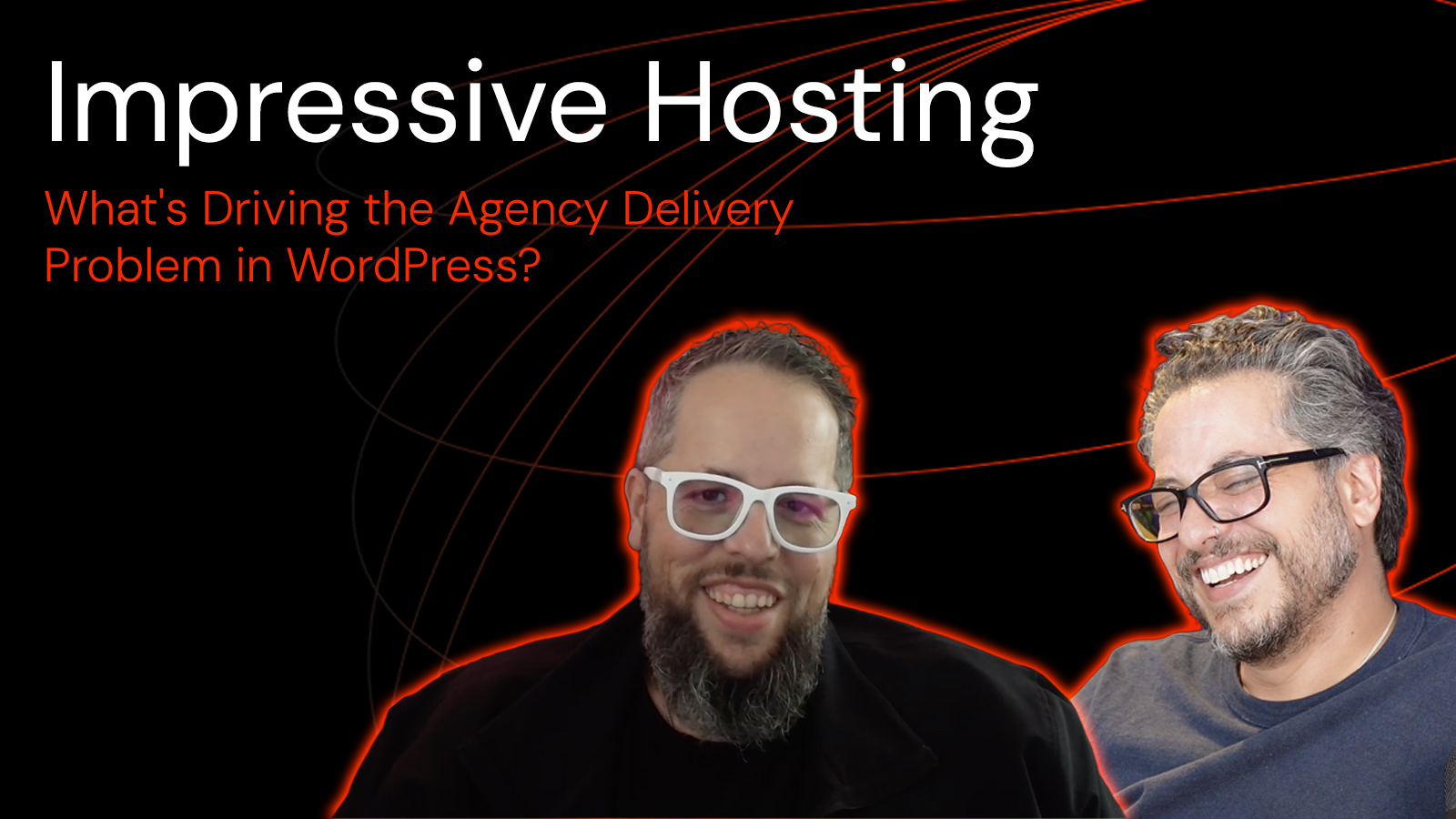
Roughly 75% of agencies say they’ve already lost work to AI, according to a recent industry survey. Jesse Friedman and Vito Peleg of Atarim use that reality as a starting point for a candid conversation about where agencies stand today and how they can respond instead of falling behind.
Vito shares his background, from building websites on GeoCities and touring Europe as a musician to founding Atarim, which now serves more than 50,000 agencies. He was one of the first people to access GPT-2 through the API and built one of the earliest AI tools for WordPress in 2020. That long view gives him a grounded perspective on what AI can and can’t do for creative teams.
Listeners will hear practical thinking on the delivery problem, automated reviews, and how to frame AI as a team you manage rather than a replacement for your talent. Jesse and Vito close on a clear point for anyone in the hosting and agency space: if work is moving to AI, the smart move is to bring it in-house and hold the work to your own standard.
Links:
Transcript
Jesse Friedman: Welcome to Impressive Hosting, a podcast about the role hosting plays in shaping the open web. I’m your host, Jesse Friedman. On this show, we go deeper than uptime and dashboards. We talk about hosting as infrastructure, about ownership, independence, and what it takes to build ethical, high-end WordPress that actually serves creators, businesses, and the internet itself. Before we dive in, head to impressive.host. That’s where you can comment on episodes, ask follow-up questions, and help shape future conversations. You’ll also find links to follow, like, and subscribe wherever you listen. Today, I’m very happy to say that I have Vito Peleg, the founder and CEO of Atarim, at our disposal here to answer questions about what agencies are dealing with, how hosts are helping to bring them on, and how he’s providing tools and services to them. We actually just got back from a great trip in Spain, which we’ll probably talk about too. But Vito, why don’t you tell us a little about yourself, where you’re at, what you’re working on? Give us the lay of the land.
Vito Peleg: First of all, it’s a pleasure to be here with you, Jesse. We’ve known each other for quite a few years, but we never got a chance to do this, so I’m excited. I’m Vito, the founder and CEO at Atarim. I actually started building websites back on GeoCities, back in the day, and went through the whole transition from there to Flash, and then discovered WordPress through that journey. At the same time, I was a musician, which maybe explains a little bit of my background here. That’s how I landed here in London, in the UK, as we got signed and started traveling all over Europe while still building websites from the back of the van. I think that gave me a nice early perspective on remote work, which was really unique back in the day. Then as I turned 30 and it wasn’t so nice to live in a smelly van with four other guys, I settled in London and started building up a web agency, WordPress One. We did hundreds and hundreds of projects, grew pretty fast. That experience led me to build a WordPress plugin called WP Feedback at the time, which was later rebranded as Atarim. We’re currently serving more than 50,000 agencies using our solution, with 1.6 million of their team members and clients. I think it might be relevant to what we’re talking about today: I was very fortunate, and in fact just lucky, to be one of the first 1,000 people that got access to GPT-2 through the API, and I proceeded to build the first implementation of AI in WordPress in 2020, which was called Bertha AI. I’ve been following this space very closely, had predictions, most of them have come true, throughout the years. I’m really bullish about this side of our ecosystem, whether it’s from the agencies or for hosting brands, as I see us all at the forefront of this. If we don’t leverage this opportunity at this point in time, I think we’re gonna regret it for the rest of our lives. I look at this like, I didn’t know much about blockchain when that was happening, or NFTs when that was happening, but this one is close to home. So I’m all in.
Jesse Friedman: That’s amazing. Six years on AI, that might as well be 50 years, as fast as things are moving. All right, so that’s a lot we wanna cover. I definitely wanna get into AI and talk about how you think it’s gonna help and hurt agencies in the way they can traverse that field. But before we do, real quick, we just got back from Spain. You and a few other companies put together this gathering in Ibiza. Unfortunately, we saw the only rain in May in the last 50 years. Our little cove escape on that boat got canceled. But other than that, it was a really amazing event. What you did was bring together leaders from across the hosting industry, agencies, infrastructure, and all that, to have conversations. When I got the invite, I was told it was exclusive, and it was an opportunity to meet other folks in the space and network. I have to admit, I fully expected some timeshare-type presentation that we were all gonna have to sit through on why we should use Atarim and the other companies that were there. But that didn’t happen. You basically just created an environment for us to enjoy ourselves, let loose a little, and talk. Now I have my own feelings about why that’s valuable and powerful, but I’m curious, what actually got you started on that, and what made you wanna do it?
Vito Peleg: You’re totally correct. That’s what people usually keep in mind because that’s what you get from events. The pitch is coming, you just don’t know when. We wanted to create exactly that kind of safe environment where we can talk not only about work, but about family, hobbies, the future, the past, and connect on a deeper level. It’s kind of the opposite of what usually happens at the big events where I know you from, Jesse, the WordCamps, the CloudFests, where you have back-to-back meetings. You can hang out and connect over a beer in the evenings, but during the day, it’s packed either with the event agenda or our own agendas going into these things and making sure our calendars are solid. So this is the exact opposite. It’s all about building relationships, getting to know each other as people. I think this is the best way of running a business. You and I are both strong advocates of communities. WordPress is our home community, but it’s not the only one. You’re part of the hosting community, and so am I. I have my founders’ space too, and we all find our people in different areas. But we rarely get to sit in Ibiza on a beautiful deck just overlooking the ocean, like that last day we had there together sitting with Andrew in the sun.
Jesse Friedman: Yeah.
Vito Peleg: And so that was the whole thing. It actually kicked off thanks to Søren. Søren is the founder of CloudFest. He’s one of our investors and advisors as well. A couple of years ago, he was starting to plan this event as his own birthday. Then
Jesse Friedman: That is such a Søren thing to do.
Vito Peleg: So he started telling people and booking things, and there’s no agenda, but there’s a rock show and a rock photographer, and small interesting things, not talking about cloud and infrastructure and that kind of stuff. But then he realized it was gonna be way more expensive than he could do on his own, and he couldn’t actually go out and ask for sponsorships, as that’s exactly what CloudFest is all about. So he rang me and said, “Vito, I already have this almost ready. Do you want it?” And I’m like, “Hell yeah, this sounds amazing.” I reached out to Patrick, our friend from Monarchs, and we did the first year last year together, which was a really nice success. About 60 people there in Ibiza for a weekend. Then this year we almost doubled it in terms of size. And yeah, except for the rain in the mornings, it was perfect. Even the boat that got canceled ended up being fine. We were all sitting in the bar upstairs, and we had that beautiful terrace where you could see the ocean. People were sitting there looking at the sunset, and I could see groups of people, and the room was buzzing. That’s how you know people have actually connected. And of course, out of relationships, you do business.
Jesse Friedman: Yeah, absolutely. It was my first year. It was your second year doing it, but the first time I had gone. You’d set up this group WhatsApp for everybody to share ideas, talk to each other, share photos of what they were experiencing and all that. And I was the guy that was like, “Hey, I’m here to talk about WP Cloud if anybody’s interested.” And a bunch of people raised their hand. It was actually great. I ended up having a lot of great meetings. It was really fruitful for us. So thank you for having that event. It was so nice to just go with no real work agenda. It was more of an opportunity to hang out with folks, get to know them, eat dinner and breakfast with people, and talk about whatever you wanted. Of course, we’re all networking. We’re all working in this industry, so we’re always gonna circle back. But you mentioned before that you were living out of a van in London. That’s very rock. Were you also touring? Because we can see the guitars in the background. And those who don’t know, Vito, are you the lead guitarist of the Lords of Uptime? Yeah, exactly. So this is a band that plays some awesome music at these events. We got to watch you live in person in Ibiza, and you had a famous musician join you as well. I’ve heard that at CloudFest last year you had the drummer from the Ramones play with you, and then this year it was Gilby Clarke from Guns N’ Roses. Yeah, that was pretty amazing. So before we dive into the rest of the tech stuff, did you give up a music career? What happened there? What made you choose tech?
Vito Peleg: It was always two sides of the same coin for me. When I was 14, I built my first website and picked up a guitar all in the same year. It always ran in parallel. Music was my main focus during my 20s. Yeah, we toured, we released four albums back in Israel, back home, and then two albums worldwide through a European label. We did 200 shows a year, Jesse, traveling across Europe. The main thing though is I’m a kind of hyper guy. When you’re actually thinking about touring life, it’s 23 hours of waiting for one hour of rocking, you know? You drive to the next venue for hours, then you need to sit and wait until the sound guy comes in. A few hours later, they show up, they do their thing. You get on stage for 15 minutes, make a few notes, and then wait again until your time comes to get on stage. Once it’s done, you wait for the next show the next day. It completely melted my brain after a while. So I was grateful to have web design and coding as an outlet at the same time. I also think about this from a perspective that we have a lot of musicians in our industry, and I think the reason for this is because in both skills you’re learning a language and making something out of nothing. Whether it’s coding or learning music, it shares those two things. You gotta learn the language properly, and then you can actually make music, or code is poetry, right? As the WordPress saying goes. But once you get to a certain point, I wouldn’t exchange those years for anything. It was a beautiful 10 years hanging out with friends I’d grown up with. Some of them I’ve known since we were five, and we moved together abroad, and we lived together, and we toured together. At some point I met my wife, and started thinking about family and the next chapter. The agency or freelancer thing I was doing at the time was working, people were coming, there were referrals, it was growing organically. So it was a natural flow from music to, all right, let’s give this thing a shot. I see it all as part of the same journey for me.
Jesse Friedman: That’s amazing. So when you were building websites at that time, were you building just band websites or doing everything?
Vito Peleg: I was doing small to medium businesses. In London I was a graphic designer for a while for H&M, doing all the brochures and things.
Jesse Friedman: Oh, no kidding.
Vito Peleg: And then at some point through the agency we niched down into nonprofits and charities in the UK. That was our main thing, and we worked with some amazing nonprofits making huge impact. That was really rewarding to not just build a section or drag rectangles, but to actually see what the impact of your work has on real people’s lives. I made it a thing to go and visit the nonprofits that we were working with. We even brought in team members to volunteer a little bit and experience this on a deeper level than just writing lines of code. I think I’m still serving people. People say when you’re on your own you don’t have a boss, but I have thousands of them. So it’s still about serving people at the end of the day. Provide value first, and then extraction of value is just an outcome.
Jesse Friedman: Right, right. Yeah, I came from a development background, but I always had a little freelance business on the side for many, many years and took on clients. Since it was always a side gig for me, I was able to be very careful about who I picked to work with. I won’t name the host, but I always remember that if a client was on a certain host, I would actually raise my hourly rate by 15 bucks an hour. At that time it was like 15 extra percent, because working with some hosts back then was so painful. It was just a horrible experience. And, you know, it makes me think of something I was actually just talking to my daughter about. She’s a bit of a perfectionist. She actually makes music and published some this week.
Vito Peleg: Oh, nice.
Jesse Friedman: Yeah, I was very proud of her. But I was telling her this story because I was trying to help her understand that when you have to make something for yourself, it’s really hard to know when it’s done. But when you’re making something for a client, you usually have a deadline. They’re breathing down your neck. Back when you were building websites in the early 2000s, did you do the whole “I’m gonna design three websites and let the client choose one” thing?
Vito Peleg: Well, it was way more time-consuming than that to do it back then. Now you can.
Jesse Friedman: Right. But the reason I bring that up is, what I told my daughter was that every single time, every designer I ever knew did the three-design thing, and they’d spend 80 to 85% of their time on one design, absolutely love it, think it was the best one. Then they’d spend 10 to 15% of their time on a second one. And then 10 minutes before the meeting, they’d churn out a third design real quick, and that was the one the client always chose. And it drove them nuts. But at that point in time when you did that, you basically designed a homepage and something else to incorporate all the different design styles and help them understand how things were gonna work, and then they would sign off on it. But now with Atarim, you have so much more ability to work in real time with your customers. It’s worth giving us a bit of an understanding of what it’s like to use Atarim. When I was first introduced to it, the way I’d explain it to people was that it was very much like real-time collaboration on a web design. The same way you might edit a document or a slide deck in Google Docs, with commenting and the ability to point at things and talk about specific elements. You could do that with Atarim. But now it’s so much more, and it’s light years beyond what I had to deal with. I’ll tell another quick story. When I got started in an actual production house building websites, it was around 2006. A client said he was experiencing something he couldn’t pinpoint exactly, whether it was the browser or whatever. I said, “Can you send me a screenshot?” We were on an actual phone. I waited for the screenshot, and days later, still nothing. I got mail. Actual snail mail, an envelope. And I’d been working at this company for a while and had never received mail there. I opened up the envelope, and inside was an actual photograph. He had gone to the store, bought a disposable camera, taken a picture of his screen, gone to the pharmacy, developed the film, waited for it, then put the picture in the mail and mailed it to me. That was how he was describing an IE6 compatibility issue. So the juxtaposition of that to what you get to do with Atarim now is absolutely amazing. Give us the lay of the land on that.
Vito Peleg: I’ll take you to a similar story that happened at the agency. One of the biggest challenges of delivering website projects is getting content from the client, at least it was pre-AI. We were following up and following up, “Please send us the content,” over and over. One day a package arrived at our agency office, and I opened it up. It was 40 pages of copy, all printed, including the logo attached as a printed picture. You know, there must be a better way. So we looked into all kinds of scenarios, from transforming things into PDFs and using old-school tools to annotate them, which was pretty cumbersome for clients to figure out. Anything from client dashboards to getting on calls regularly, which then comes the inspiration 30 minutes after you finish the call, and you get the WhatsApp messages and the emails and the whole thing piling up. But at the core, what we were coming in to solve was the delivery problem. We have an interesting survey around this that we did really at the beginning, and we recently did another one to check the current state. What we found, Jesse, is kind of shocking to most people, but it also makes sense when you actually think about it. If you build a five-to-ten-page website and you know what you’re doing, in the pre-AI stage, it would be about a three-day thing. If I do it on my own, I drag and drop it, I make it happen, and I’m done. Three days in, I’m done. The same piece of work with a client takes on average between four to six weeks. That gap from three days to six weeks is the delivery problem. In fact, it’s a 500 to 700% increase in delivery time for every creative project we do. Even if you just need to get approval on a single slide, if you know what you’re doing, five minutes in Canva and you’re done. But waiting for the client, and it’s not that it takes a full week, it’s just that by the time they get to it, look at it, give their notes, and you put it back in your queue, the whole thing spirals out of control. Now, the interesting thing we found in our recent survey is that those three days to build a website has come down to about three hours for a five-pager, but it still takes six weeks to deliver.
Jesse Friedman: Yeah.
Vito Peleg: Which actually means a 5,000 to 7,000% increase in delivery time compared to creation time. That’s insane. So we set it as a goal from the beginning to tackle this component of the build, knowing that WordPress, the builders, and everyone else in the industry would be highly focused on shortening the creation time and streamlining that process. We wanted to focus on a little more boring, but where the money actually is, where the profit actually is, which is inside the delivery process itself. Now we’re cutting delivery time by between 50 to 70%. We have hundreds of case studies and testimonials to show that. And that is a true transformation for the agencies leveraging this for their profit margins. If you can cut the time by half, it’s not that you work half a month and sit idle the other half. It means you actually take on two projects. You get more referrals because you deliver quicker, and the whole thing starts accelerating really nicely. Over time, we started with the stickers on a page, as you defined it, because feedback was the biggest drag. But then we expanded into other aspects of the workflow to figure out where else people were wasting time. That inspired Bertha as well, as the first AI solution to write copy inside WordPress for you. Back then it was mind-blowing, only a few years ago. From there we expanded to intake forms, to an email inbox designed for creative communications, like a built-in Zendesk for our use case. All the way to now, where we address the second biggest drag on projects, which is reviews. Not only client feedback, but for every single project there are between five to seven reviews that need to happen. For example, let’s say you got a design from the designer in Figma and now you need to build it. You build it, and who knows if it’s exactly right? No one knows until they look. There’s a review that happens there. Then you get the copy from the copywriter and implement it. Is it good? I don’t know. Someone needs to look. Then before you ship it to a client, just for the homepage, you don’t want missed Lorem Ipsums or a broken button. So you run a review to make sure it’s up to your standard before you ship it to a client. And then before you go live, and after you go live, so there are no rogue links leading back to staging environments and things like that. Review is a huge component of the delivery process. So we set out to look at it from a human perspective and basically created what I call the first fully automated manual review.
Jesse Friedman: Automated manual review. I like that.
Vito Peleg: We’ve had automated QA for years, but the button has to consistently be there in the same place for the script to know and check and click. That’s why it never really fit into website builds, because every page is different, every client build is a little bit different. You can’t automate the QA process unless there are huge budgets or continuous work, so you resort to manual reviews that take 45 to 90 minutes each time you do it properly. So the question was, how can we completely remove that from the equation? And I think if I’m summarizing, Jesse, there is one ethos to the product. All we do, and I’ve been saying this to the team and to myself for years, is we’re digitizing human experiences. We’re not trying to make anything up or create a scenario that we think is the right way to go about it. We just look at what humans do in the real physical world and how we can digitize that experience so that it leans into how we naturally behave. The stickers on a page are exactly that. The alternative is what you were describing. Not only giving three to five words of feedback like, “Can I change this? Can you make this bigger? Here’s the new text for this.” Those natural three-to-five-word strings we use when providing feedback to others. Instead of, “Please attach a screenshot. What browser are you on? Are you on your phone? What did you do before that? What is your desired goal?” The whole thing is completely detached from how humans behave, and that’s why it usually breaks down. The same thing you’d see across the board for every single feature. We’re just looking for the path of least resistance that people are already doing without us, but in a wonky way, and designing it so that it leans into the user’s experience.
Jesse Friedman: I love that. I think that’s the most powerful thing about AI today. Everybody’s worried about AI stealing their job and taking over the creative work they’re doing. But I see it as a multiplier, a way to work more efficiently and handle the 10 things I need to do that I don’t even like doing, things that AI can do for me very quickly. So we have a few minutes before we have to end this episode. One last question for you. If you’re talking to an agency that’s nervous, they know they probably need to start using AI because everybody else is, and if they’re not, they’re gonna fall behind. But what if they’re nervous about compromising the integrity of their designs, their workflows, or what makes them special? How do you have that conversation with them?
Vito Peleg: The way I see it, the right framing is not about AI. It’s about the work that it does. Sure, it’s not perfect, but who is, Jesse? You’ve been managing team members for years. By design, the more junior people working under you are gonna do a lesser job than you will. That’s because of their level of experience, and that’s why you are the manager. That’s why you are the authority over those relationships. I think that’s a much better analogy for what AI can do for us. People have been talking about this for a while, the concept of the orchestrator. Back in the day, it was like, you’re not the writer, you’re the editor of the magazine. I think that’s a much healthier way to look at this, and I’ll give you a story. Andy Warhol. I see you’re into pop art, just looking at the background there. Andy Warhol had the factory, right? And he’s also known as the artist who produced the most pieces ever. How did that happen? He was using AI, quote-unquote, “back in the day.” He basically had the factory where he would bring in junior artists, give them the concept, give them the first 10%, let them do the 80%, and then come back and do the last 10%. So it’s the 20/80 rule that he perfected. At the end, he comes in, moves this here to there, gives his signature at the bottom, and boom, it’s an Andy Warhol piece. That’s how creative directors actually operate, for decades. You can’t do all the work under your agency. At some point you’re gonna need to hire people who aren’t as equipped for the job as you, in most cases. We can only hire the talent we can afford. So throughout our journeys, most people we hire are not gonna be folks who work at Apple, the top of the crop. So keep that in mind. I think that’s a much healthier way of looking at it. It’s not your assistant, it’s your team. You need to manage the team, give them the right context at the right time, correct course when needed, and orchestrate the entire operation as a manager.
Jesse Friedman: Yeah, I think that’s absolutely right. When you think about a creative director’s job, they’re setting the vision for the agency. The way you approach work, the values you set. Then they set the standard, and they hold you to it. You’re right, I think they come in and apply the last 10% that takes something from 80 or 90% to where it needs to be. They’re not doing all the grunt work that leads up to it, but they are setting those guardrails and creating that vision so you know how to operate within it, get it to that 80 or 90%, and then as a team you’re accomplishing the final goal. Through that lens, that makes a lot of sense and I think it’ll really resonate with people at home. All right, we gotta take a break. I’ll have you right back for another episode. Everybody at home, the second episode will come out soon. This is such a great conversation with Vito, I don’t wanna end it here. Thank you Vito for joining.
Vito Peleg: Thanks for the episode. And while on one hand you’re the one who needs to orchestrate the work and make sure it meets your standards, most clients, SMBs, or laypeople are not part of the ecosystem we operate in. They don’t know better. So while you can do your best utilizing AI for them, 80% done is better than none. At the same time, there was a recent survey run by The Admin Bar, or I2, one of the hosting companies, that cited 75% of agencies surveyed mentioned they’ve already lost work to AI. And I think that’s a good thing to dive into and see how we face this reality now, because it’s here.
Jesse Friedman: Right. If you’re gonna lose the work, then at least bring it under your house, move it in so that you can take on that work and operate within the standard that you’ve set for yourself and your clients. I love that. All right, great. We’ll be back soon. Thanks, Vito.
—
Jesse Friedman: Thanks for joining us on another episode of Impressive Hosting, where we uncover the core tenets of great WordPress hosting. Do you have a follow-up question for today’s guest, a thought or comment on anything we talked about, a future guest suggestion, a hosting horror story, or thoughts on what makes great WordPress hosting? All your comments shape the show. Drop them at impressive.host. We also appreciate you following us on social media and subscribing to the podcast on your favorite platform. Finally, do check out our list of open-source projects that need support at impressive.host. Whether it’s code, community, or cash, you can make a difference. See you next time.
Subscribe to Impressive Hosting:


Leave a Reply