'%3E%3C/path%3E%3Cpath d='M76.4782 25.7185L71.982 9.04089H74.6936L78 22.8409L81.8045 9.04089H84.5853L88.2722 22.8409L91.5787 9.04089H94.2902L89.7248 25.6977H86.7781L83.1396 12.6379L79.3835 25.6977L76.4782 25.7185Z' fill='rgba(247, 43, 0)'%3E%3C/path%3E%3Cpath d='M96.6075 9.04089H102.439C103.739 9.04089 104.818 9.26224 105.676 9.69803C106.534 10.1338 107.17 10.7287 107.592 11.4827C108.014 12.2367 108.222 13.0875 108.222 14.0421C108.222 14.9483 108.021 15.7783 107.613 16.5254C107.212 17.2794 106.575 17.8812 105.725 18.3239C104.867 18.7666 103.774 18.9879 102.439 18.9879H99.1323V25.6977H96.6075V9.04089ZM99.1323 16.9128H102.321C103.511 16.9128 104.362 16.6568 104.881 16.138C105.399 15.6192 105.655 14.9206 105.655 14.0352C105.655 13.1152 105.399 12.3958 104.881 11.8839C104.362 11.372 103.511 11.1092 102.321 11.1092H99.1323V16.9128Z' fill='rgba(247, 43, 0)'%3E%3C/path%3E%3Cpath d='M124.138 25.9744C122.492 25.9744 121.067 25.6147 119.87 24.8953C118.674 24.1759 117.747 23.166 117.097 21.8725C116.446 20.5789 116.121 19.0848 116.121 17.3901C116.121 15.6746 116.446 14.1735 117.097 12.88C117.747 11.5864 118.674 10.5765 119.87 9.84329C121.067 9.11698 122.492 8.75036 124.138 8.75036C126.089 8.75036 127.68 9.22766 128.918 10.1753C130.156 11.1299 130.938 12.458 131.277 14.1735H128.469C128.247 13.2051 127.77 12.4373 127.044 11.8631C126.317 11.289 125.342 11.0054 124.118 11.0054C122.45 11.0054 121.136 11.5726 120.168 12.707C119.199 13.8415 118.715 15.3979 118.715 17.3831C118.715 19.3476 119.199 20.8971 120.168 22.0246C121.136 23.1521 122.45 23.7124 124.118 23.7124C125.342 23.7124 126.317 23.4427 127.044 22.9031C127.77 22.3636 128.247 21.6234 128.469 20.6896H131.277C130.945 22.3428 130.156 23.6294 128.918 24.5702C127.68 25.5109 126.089 25.9744 124.138 25.9744Z' fill='rgba(247, 43, 0)'%3E%3C/path%3E%3Cpath d='M133.961 25.6908V8.5636H136.486V25.6908H133.961Z' fill='rgba(247, 43, 0)'%3E%3C/path%3E%3Cpath d='M145.195 25.9744C144.067 25.9744 143.057 25.7185 142.158 25.1997C141.259 24.6809 140.553 23.9615 140.027 23.0346C139.502 22.1076 139.246 21.0216 139.246 19.7903C139.246 18.5591 139.509 17.4731 140.041 16.5392C140.574 15.6123 141.293 14.8929 142.192 14.3741C143.099 13.8622 144.102 13.5994 145.215 13.5994C146.343 13.5994 147.353 13.8553 148.252 14.3741C149.144 14.8929 149.864 15.6123 150.396 16.5392C150.929 17.4661 151.192 18.5522 151.192 19.7903C151.192 21.0285 150.929 22.1076 150.396 23.0346C149.864 23.9615 149.144 24.6809 148.245 25.1997C147.332 25.7185 146.315 25.9744 145.195 25.9744ZM145.195 23.8093C145.796 23.8093 146.357 23.6571 146.869 23.3597C147.387 23.0553 147.802 22.6126 148.121 22.0177C148.439 21.4228 148.598 20.6827 148.598 19.7903C148.598 18.898 148.446 18.1579 148.134 17.563C147.823 16.9681 147.415 16.5185 146.896 16.221C146.377 15.9167 145.824 15.7714 145.222 15.7714C144.62 15.7714 144.06 15.9236 143.548 16.221C143.029 16.5254 142.614 16.9681 142.296 17.563C141.978 18.1579 141.819 18.898 141.819 19.7903C141.819 20.6827 141.978 21.4228 142.296 22.0177C142.614 22.6126 143.023 23.0622 143.534 23.3597C144.032 23.664 144.586 23.8093 145.195 23.8093Z' fill='rgba(247, 43, 0)'%3E%3C/path%3E%3Cpath d='M158.275 25.9744C156.85 25.9744 155.723 25.5317 154.906 24.6394C154.09 23.747 153.682 22.4258 153.682 20.6688V13.8899H156.207V20.406C156.207 22.6887 157.141 23.83 159.015 23.83C159.949 23.83 160.717 23.498 161.326 22.834C161.927 22.1699 162.232 21.2153 162.232 19.9771V13.883H164.757V25.6908H162.522L162.336 23.6225C161.969 24.3488 161.436 24.9299 160.731 25.3449C160.011 25.7669 159.195 25.9744 158.275 25.9744Z' fill='rgba(247, 43, 0)'%3E%3C/path%3E%3Cpath d='M173.341 25.9744C172.2 25.9744 171.19 25.7046 170.318 25.1651C169.447 24.6255 168.762 23.8854 168.271 22.9515C167.779 22.0177 167.53 20.9525 167.53 19.7627C167.53 18.5729 167.779 17.5146 168.271 16.5876C168.762 15.6607 169.447 14.9275 170.325 14.4018C171.204 13.8692 172.213 13.6063 173.362 13.6063C174.296 13.6063 175.119 13.7861 175.824 14.1528C176.53 14.5194 177.083 15.0313 177.478 15.7022V8.5636H180.002V25.6908H177.74L177.478 23.8577C177.097 24.4111 176.571 24.9022 175.907 25.3311C175.243 25.76 174.385 25.9744 173.341 25.9744ZM173.791 23.7885C174.87 23.7885 175.755 23.415 176.44 22.6679C177.132 21.9209 177.478 20.9663 177.478 19.7903C177.478 18.6006 177.132 17.6391 176.44 16.8989C175.748 16.1588 174.863 15.7922 173.791 15.7922C172.712 15.7922 171.826 16.1588 171.127 16.8989C170.429 17.6391 170.083 18.6006 170.083 19.7903C170.083 20.5651 170.242 21.2568 170.56 21.8586C170.878 22.4604 171.314 22.9308 171.881 23.2767C172.435 23.6156 173.078 23.7885 173.791 23.7885Z' fill='rgba(247, 43, 0)'%3E%3C/path%3E%3C/svg%3E)
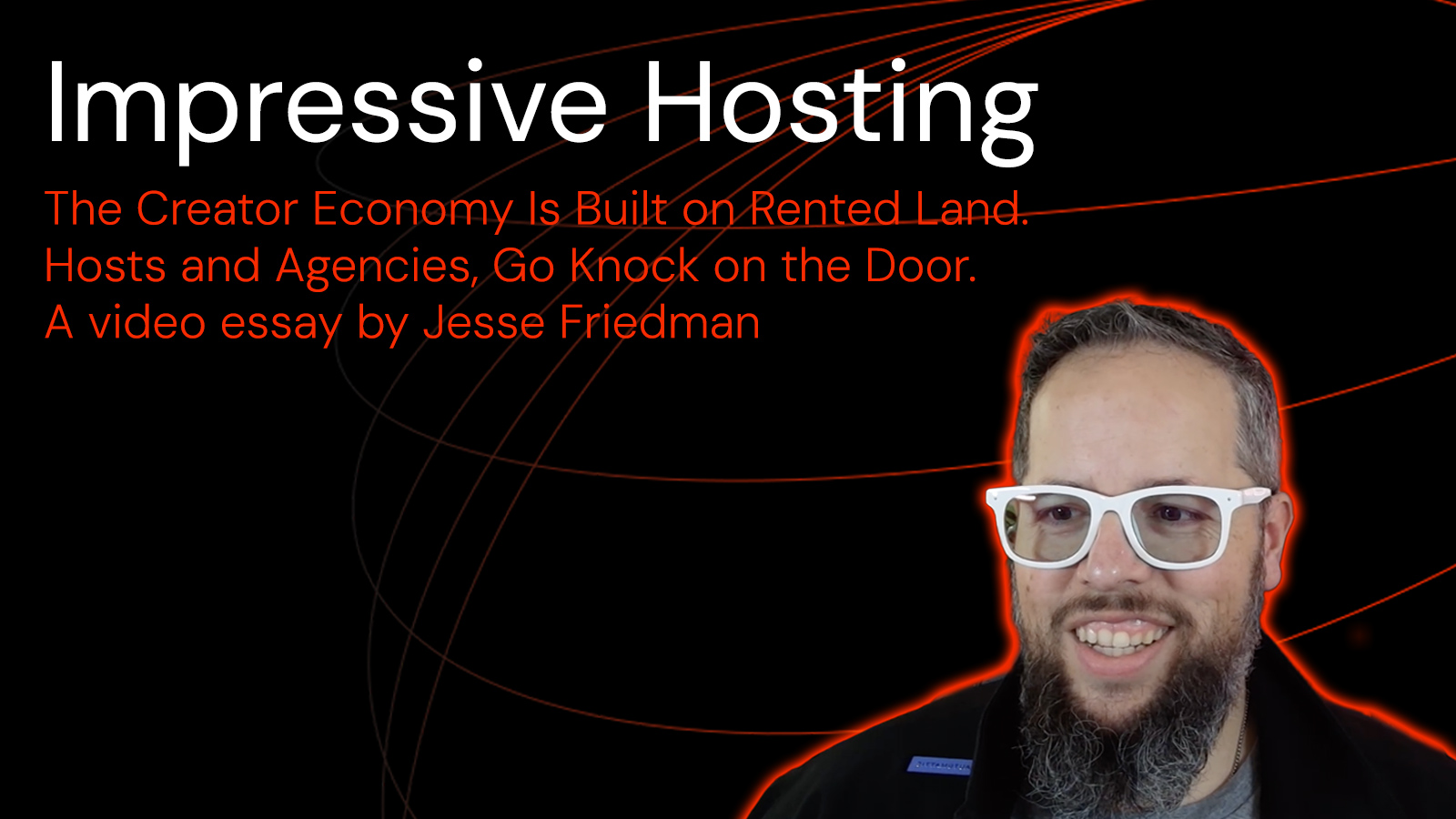
Creators do not need another pitch about CPUs and uptime. They need a straightforward way to establish a home for their content and maintain audience relationships beyond social platforms. Jesse Friedman of WP Cloud explains what that shift means for WordPress hosting companies and agencies.
His recommendations center on packaging and onboarding. Build the site before the customer arrives, offer focused templates, and include the tools needed to publish or sell without searching a plugin directory. He also describes how WP Cloud’s golden images can help hosts preconfigure sites for specific customer groups and clone them during checkout.
The marketing approach matters just as much. Friedman recommends explaining platform dependence with empathy rather than relying on fear. The episode offers a practical framework for presenting hosting as a creator-ready service, with migration support, content hubs, and simpler launches that help customers build on the open web.
Chapters:
00:00 Introduction
00:53 The Creator Economy is built on rented land.
02:48 Why they haven’t moved
03:46 Build a site before they arrive
05:44 Don’t market to fear, but education
06:48 The foundation needs to be strong
Transcript
#### The Creator Economy Is Built on Rented Land. Hosts and Agencies, Go Knock on the Door.
Jesse Friedman: There are more than 200 million creators worldwide, building a following on platforms they don’t control. They pour years into audiences they can’t export, connections they can’t control, and income streams that can vanish at the whim of a machine algorithm. And unfortunately, most don’t know how fragile it all is.
These influencers, these creators, these musicians, and craftsmen, and builders are begging for guidance and a home to call their own. No one is speaking to them outside of these closed platforms and we can do better by them and the open web.
I wrote about this recently in an essay about the Automattic documentary Code for the People:
“You are leasing a podium from them, and you get to keep it for as long as you keep the attention of those standing before it. That’s it. You’re a monkey on a box whipping yourself to perform, and if you fail, if you falter, if you make one mistake, you’re often left standing on your podium with no one to perform for.”
Creators are being shadow-banned, demonetized, and buried by a feed that cares little for them. The built-in audience of closed platforms is beckoning creators. The ease of use and shortcut access to millions of viewers creates anticipatory anxiety in the people looking to get started. The closed platforms have a gravity that draws you in but they don’t have to be the only answer. Influencers and creators need to learn of the open web in a language they speak so they can protect the audience they are building and so we can grow the open web.
## Why they haven’t moved
The creators aren’t staying on these platforms because they’re built to help them be successful. They are built to create interchangeable podiums to swap in the most attractive creator for the most attentive audiences. But the creator is a pawn in this algorithmic game and so the foundation for their business is on fragile ground. We need to address the problem by providing tools and services designed for creators on solid ground.
You see, TikTok simply asks a creator to press record. Hosting asks you to learn the skills needed to be a web designer, an information architect, and a sysadmin. That gap highlights the blank canvas problem, and it kills more migrations to the open web than pricing ever will. We need to do better, but this isn’t WordPress the software’s responsibility, it’s the responsibility of those who sell hosting and website marketing solutions. WordPress is meant to be a solution used by millions. The way we present it, market it, configure it, and ship it is how we address specific needs and verticals.
## Build the site before they arrive
I’d like to ask hosts to stop thinking in terms of selling hosting to these types of customers. Agencies, developers, and those working in IT or systems understand hosting and you should go all in on describing your infrastructure for those customers. You should double down on your performance, security and reliability and if you’re a WP Cloud customer, we can help you do that while showcasing that you’re on the best and only WordPress-as-a-Service infrastructure.
Creators, influencers, and those eking out a living on social media aren’t interested in CPUs, RAM, or uptime. They don’t want to learn about WAFs and automated real-time failover. They want to know that they are going to sign up and get something live quickly, and unfortunately the ease of setting up a social media profile is the benchmark they are measuring us against.
Ready-made link-in-bio sites. Consider building a WordPress theme that allows for a single page link-in-bio. Onboard them right into a settings page in the wp-admin that asks them to enter all their links. Give them the chance to add a photo and a color scheme and call it a day.
Creator themes that mirror their content. Give the creators the ability to pull in content from their social platforms. Embed their YouTube videos, and create simple link outs to all their platforms. Make it easy for them to create a content hub on WordPress that they can flywheel out to all social media platforms.
Pre-configured tooling, not a plugin directory. Be opinionated. Include WooCommerce out of the box for merchant solutions. Preconfigure Jetpack to offer super fast image delivery and VideoPress for ad-free video delivery. Choose your favorite SEO plugin and have it on and configured by default.
I talk to hosts all the time that don’t want to make decisions on behalf of their users because they get loud demanding vanilla WordPress. The key here is to segment your customers and send the ones that don’t know how to build a website down a flow that has all the decisions made for them. Help these customers own their connections with their audience by making them feel that WordPress was built for them. The customer list is the connection, and the connection is the whole point:
“You can’t lose your connection to an audience built on the open web. Yes, they can unsubscribe. Yes, they can move on. But the important detail to remember there is that those are individual decisions made by real people.”
## Don’t market to fear but education
Your campaigns shouldn’t instill fear in creators that platforms are risky. If they know, then your marketing is already well positioned. If they don’t know, they need to be informed and you have to address the problem with empathy. We need to raise awareness around how fast someone can have the rug pulled out from under them on a platform they don’t control. Ask them how they would get in touch with their audience to tell them about the new account they created after being shadow-banned. Lead them to the idea that they can solve for this all in advance and take control of the audience they are building on behalf of another platform.
“Own your audience connection” is a stronger headline than any feature list. Agencies, this is for you too. Put together a compelling hosting package with migration services, content mirroring, and launch-day setups. Creators will pay to avoid the blank canvas and if we do a good job of lessening the emphasis on designing a website and pivot towards configuring a profile, you’ll be speaking their language and giving them the tools they’ll need to expand their WordPress later after they have gained familiarity with it.
## The foundation needs to be strong
The entire message we need to get across is the value of the open web and the ownership you maintain with your audience. They need to be made aware that there is another option to build a foundation on top of. And in that argument we can talk — amongst ourselves — of the value of a strong infrastructural foundation. Heed this advice and you’ll be managing the site production and launch for the creators and in that same vein, WP Cloud will manage the entire stack, performance, security and uptime for you.
With WP Cloud you can pitch stability and feel comfortable knowing you can offer 100% uptime even with traffic spikes from viral posts. WP Cloud is purpose built for WordPress at scale. We define the guardrails so we can control the entire infrastructure platform top to bottom. Just as I advised above on going after creators, we do the same. We are very opinionated about the tools and services built into WP Cloud so that we can be absolutely sure we can maximize site speed, harden security and keep sites up even with unreasonably high traffic spikes and bursts of e-commerce orders. Additionally, you can take advantage of our free add-on — golden images — which allows you to preconfigure sites for specific verticals and instantly clone them during checkout so the site is up and ready to go for the creator before they even put their credit card away.
Creators are one of the fastest-growing and wildly underserved small-business segments on the net. They can not only be a strong book of business for any host, they can also bring an influx of content and traffic back to the open web, which is the best thing we can do for our industry and our freedom.
I’m Jesse Friedman — Head of WP Cloud at Automattic — and if you’re a host or agency looking to solve these problems with WP Cloud please reach out to me here. I’d love to chat.
Subscribe to Impressive Hosting:


Leave a Reply