'%3E%3C/path%3E%3Cpath d='M76.4782 25.7185L71.982 9.04089H74.6936L78 22.8409L81.8045 9.04089H84.5853L88.2722 22.8409L91.5787 9.04089H94.2902L89.7248 25.6977H86.7781L83.1396 12.6379L79.3835 25.6977L76.4782 25.7185Z' fill='rgba(247, 43, 0)'%3E%3C/path%3E%3Cpath d='M96.6075 9.04089H102.439C103.739 9.04089 104.818 9.26224 105.676 9.69803C106.534 10.1338 107.17 10.7287 107.592 11.4827C108.014 12.2367 108.222 13.0875 108.222 14.0421C108.222 14.9483 108.021 15.7783 107.613 16.5254C107.212 17.2794 106.575 17.8812 105.725 18.3239C104.867 18.7666 103.774 18.9879 102.439 18.9879H99.1323V25.6977H96.6075V9.04089ZM99.1323 16.9128H102.321C103.511 16.9128 104.362 16.6568 104.881 16.138C105.399 15.6192 105.655 14.9206 105.655 14.0352C105.655 13.1152 105.399 12.3958 104.881 11.8839C104.362 11.372 103.511 11.1092 102.321 11.1092H99.1323V16.9128Z' fill='rgba(247, 43, 0)'%3E%3C/path%3E%3Cpath d='M124.138 25.9744C122.492 25.9744 121.067 25.6147 119.87 24.8953C118.674 24.1759 117.747 23.166 117.097 21.8725C116.446 20.5789 116.121 19.0848 116.121 17.3901C116.121 15.6746 116.446 14.1735 117.097 12.88C117.747 11.5864 118.674 10.5765 119.87 9.84329C121.067 9.11698 122.492 8.75036 124.138 8.75036C126.089 8.75036 127.68 9.22766 128.918 10.1753C130.156 11.1299 130.938 12.458 131.277 14.1735H128.469C128.247 13.2051 127.77 12.4373 127.044 11.8631C126.317 11.289 125.342 11.0054 124.118 11.0054C122.45 11.0054 121.136 11.5726 120.168 12.707C119.199 13.8415 118.715 15.3979 118.715 17.3831C118.715 19.3476 119.199 20.8971 120.168 22.0246C121.136 23.1521 122.45 23.7124 124.118 23.7124C125.342 23.7124 126.317 23.4427 127.044 22.9031C127.77 22.3636 128.247 21.6234 128.469 20.6896H131.277C130.945 22.3428 130.156 23.6294 128.918 24.5702C127.68 25.5109 126.089 25.9744 124.138 25.9744Z' fill='rgba(247, 43, 0)'%3E%3C/path%3E%3Cpath d='M133.961 25.6908V8.5636H136.486V25.6908H133.961Z' fill='rgba(247, 43, 0)'%3E%3C/path%3E%3Cpath d='M145.195 25.9744C144.067 25.9744 143.057 25.7185 142.158 25.1997C141.259 24.6809 140.553 23.9615 140.027 23.0346C139.502 22.1076 139.246 21.0216 139.246 19.7903C139.246 18.5591 139.509 17.4731 140.041 16.5392C140.574 15.6123 141.293 14.8929 142.192 14.3741C143.099 13.8622 144.102 13.5994 145.215 13.5994C146.343 13.5994 147.353 13.8553 148.252 14.3741C149.144 14.8929 149.864 15.6123 150.396 16.5392C150.929 17.4661 151.192 18.5522 151.192 19.7903C151.192 21.0285 150.929 22.1076 150.396 23.0346C149.864 23.9615 149.144 24.6809 148.245 25.1997C147.332 25.7185 146.315 25.9744 145.195 25.9744ZM145.195 23.8093C145.796 23.8093 146.357 23.6571 146.869 23.3597C147.387 23.0553 147.802 22.6126 148.121 22.0177C148.439 21.4228 148.598 20.6827 148.598 19.7903C148.598 18.898 148.446 18.1579 148.134 17.563C147.823 16.9681 147.415 16.5185 146.896 16.221C146.377 15.9167 145.824 15.7714 145.222 15.7714C144.62 15.7714 144.06 15.9236 143.548 16.221C143.029 16.5254 142.614 16.9681 142.296 17.563C141.978 18.1579 141.819 18.898 141.819 19.7903C141.819 20.6827 141.978 21.4228 142.296 22.0177C142.614 22.6126 143.023 23.0622 143.534 23.3597C144.032 23.664 144.586 23.8093 145.195 23.8093Z' fill='rgba(247, 43, 0)'%3E%3C/path%3E%3Cpath d='M158.275 25.9744C156.85 25.9744 155.723 25.5317 154.906 24.6394C154.09 23.747 153.682 22.4258 153.682 20.6688V13.8899H156.207V20.406C156.207 22.6887 157.141 23.83 159.015 23.83C159.949 23.83 160.717 23.498 161.326 22.834C161.927 22.1699 162.232 21.2153 162.232 19.9771V13.883H164.757V25.6908H162.522L162.336 23.6225C161.969 24.3488 161.436 24.9299 160.731 25.3449C160.011 25.7669 159.195 25.9744 158.275 25.9744Z' fill='rgba(247, 43, 0)'%3E%3C/path%3E%3Cpath d='M173.341 25.9744C172.2 25.9744 171.19 25.7046 170.318 25.1651C169.447 24.6255 168.762 23.8854 168.271 22.9515C167.779 22.0177 167.53 20.9525 167.53 19.7627C167.53 18.5729 167.779 17.5146 168.271 16.5876C168.762 15.6607 169.447 14.9275 170.325 14.4018C171.204 13.8692 172.213 13.6063 173.362 13.6063C174.296 13.6063 175.119 13.7861 175.824 14.1528C176.53 14.5194 177.083 15.0313 177.478 15.7022V8.5636H180.002V25.6908H177.74L177.478 23.8577C177.097 24.4111 176.571 24.9022 175.907 25.3311C175.243 25.76 174.385 25.9744 173.341 25.9744ZM173.791 23.7885C174.87 23.7885 175.755 23.415 176.44 22.6679C177.132 21.9209 177.478 20.9663 177.478 19.7903C177.478 18.6006 177.132 17.6391 176.44 16.8989C175.748 16.1588 174.863 15.7922 173.791 15.7922C172.712 15.7922 171.826 16.1588 171.127 16.8989C170.429 17.6391 170.083 18.6006 170.083 19.7903C170.083 20.5651 170.242 21.2568 170.56 21.8586C170.878 22.4604 171.314 22.9308 171.881 23.2767C172.435 23.6156 173.078 23.7885 173.791 23.7885Z' fill='rgba(247, 43, 0)'%3E%3C/path%3E%3C/svg%3E)
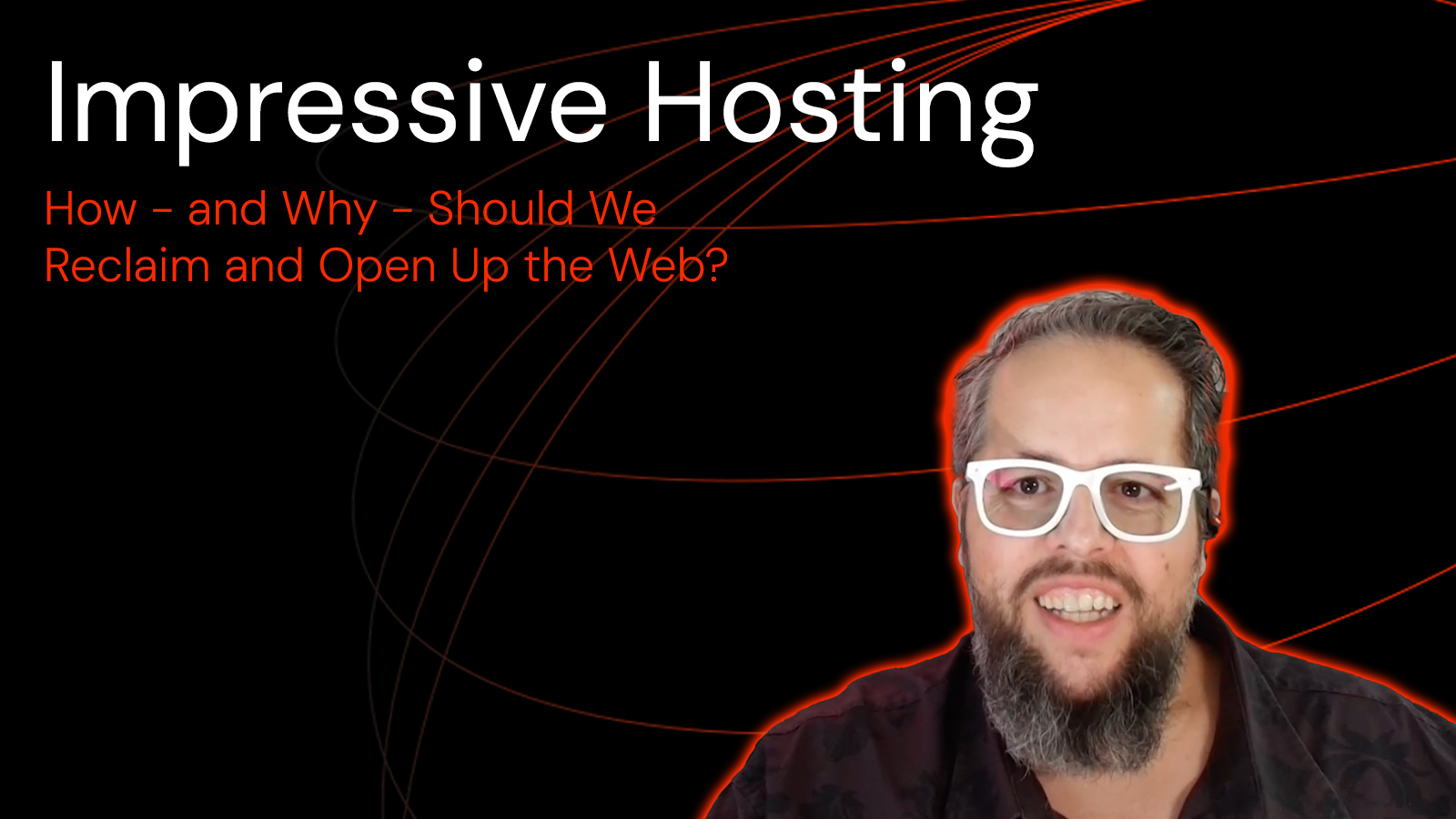
Jesse Friedman delivers a case for why the hosting industry needs to evolve beyond technical services to become advocates for the open web. This solo episode explores the intersection of profitability and responsibility, showing how hosting companies can grow their businesses while fighting against the centralization of the internet.
The discussion reveals how social media platforms have created a false sense of security for content creators and businesses, offering built-in audiences while maintaining complete control over those relationships. Jesse uses real examples to illustrate how creators can invest thousands of hours building audiences only to lose access through algorithmic changes they cannot control or appeal. This creates an opportunity for hosting companies to offer something social platforms cannot: true ownership.
Jesse envisions a future where hosting companies actively educate customers about the benefits of owned web presences, helping them understand that websites can complement social media strategies rather than compete with them. This approach positions hosting providers as partners in their customers’ success while contributing to a more diverse, independent internet. The episode concludes with a call for industry professionals to embrace this broader mission of growing the open web.
Transcript
Jesse Friedman: Welcome to Impressive Hosting, a podcast about the role hosting plays in shaping the open web. I’m your host, Jesse Friedman. On this show, we go deeper than uptime and dashboards. We talk about hosting as infrastructure, about ownership, independence, and what it takes to build ethical, high-end WordPress hosting that actually serves creators, businesses, and the internet itself. Before we dive in, head to impressivehost.com, that’s where you can comment on episodes, ask follow-up questions, and help shape future conversations. You also find links to follow, and subscribe wherever you listen.
Jesse Friedman: Thank you all for coming back to part two of Season Two’s episode one. We had a really great discussion. Well, I should say I had a really great time talking to my camera. This is a little bit weird for me because this is the first episode where I am, you know, talking without guests. So I am kind of riffing and talking about the things that I’m most passionate about.
Jesse Friedman: In the last episode, what we did was we covered a bunch of things from the first season. We talked a little bit about how season two is going to be a little bit different. We’re going to be focused on the ways in which we can help shape the open web, the responsibility that hosting companies have to do a better job of shaping the open web.
Jesse Friedman: In season one we talked about the core tenets of great managed WordPress hosting. And in that last episode we went through a whole bunch of the common themes. The things that I pulled out were things that seem to repeat themselves over and over again. Things like the responsibility that we have to the WordPress experience, because the first WordPress experience can be the last one. We talked about how it’s irresponsible for us to think that our customers want to be web designers and in fact that they have a business to run, a passionate life to live. And being a web designer may not be one of them. The importance of aligning yourselves with your customer success goes a long way. Building trust and how that can be a litmus test for everything else that you’re doing. And a variety of other things. It was a great episode. I say so myself, although I was all by myself, so you know, who knows. But I would love it if you had a chance to listen and take some time to think about ways in which you’d like to see this show grow and change.
Jesse Friedman: But what we’re going to talk about now is what is coming for the future. And so this is what I have in mind. And the focus I’m going to be taking for season two. But again, I would love to have some great feedback from the audience. Tell me what it is that you think is working and what’s not so that I can make the show better. Let me make it more about you, let me personalize it to the things that you’re thinking about. You know, ideally what would happen is that the show would be catered to hosting companies because what I want to do in season two is I want to talk about the responsibility that hosting companies have to the open web that intersects with the profitability and the ability to run a successful hosting company. And I think that the way in which we can go about that is making sure that we are talking about ways to increase customer’s awareness of the open web, to get them excited about building more websites and doing more things on the open web. And to do it in a way that is also profitable for hosting companies so that they’re making money and keeping the lights on and keeping the distribution of WordPress going and healthy.
Jesse Friedman: So this show is shifting. It’s not going to be just about good hosting and what good hosting looks like, but it’s actually going to shift into why hosting actually matters to the web itself. So we’re going to get away, I think from conversations purely about performance and uptime. And I want to start tying these shows more towards ownership, independence, creativity, cultural preservation, informing and educating audiences and their customers about what is happening around the internet. The transition that we’re seeing in the perception of the internet.
Jesse Friedman: One of the things I talked about last season was the fact that my daughter introduced me to a video that was, you know, it’s a cartoon that someone made directed at the Gen Z generation. And I thought it was cute. It was a funny little video where someone was describing the fact that there’s this misconception that people think that the internet is Facebook, Instagram, Twitter, TikTok, Amazon, Apple, and that’s the internet. And while those platforms may be incredibly huge, have large audiences and drive a lot of traffic, they make up six of, I don’t know, a hundred million different places to go on the internet to have fun, to learn things, to share passions, to meet people, to share ideas and to help further whatever it is that is your mission.
Jesse Friedman: And so, you know, that video was funny because it’s not necessarily that I learned anything new from the content of that video, but the spirit of it, the philosophy of it is what really struck home for me was that this needed to be explained to this new generation that the way in which they use the language they used is that there are all these great websites out there that have all these weird, interesting things on them, and that you don’t have to silo yourself to just social media. A little light bulb went off in my head and helped me to realize that we are not taking advantage of educating this newest generation around the power of the web. And that social media doesn’t encapsulate everything that can be done on the internet.
Jesse Friedman: And the thing is, is that the web didn’t die. It’s just moving behind these login screens. And it didn’t happen overnight. We basically kind of outsourced these efforts, one convenience at a time. Social media came about and it became this thing that was super interesting to us. You know, I remember when Facebook was releasing its audience or adoption to anyone who had a .edu domain. So that exclusivity made it seem cool and then all of a sudden you could reconnect with people. And it was funny ’cause it was for me, it was a year of being in college and feeling disconnected from my friends and my hometown. And so Facebook became this place where I could reconnect with all of those lost relationships. And then it became a place where you could share updates and talk about things going on in your lives. And of course then the algorithm was born and then it became much more about commercialization and driving content to fund advertising rather than having the, you know, in the old days advertising, for example on TV or on billboards or whatever, advertising was basically, it felt very much like it was isolated. It was, here’s my ads and it’s interrupting my content. But now it’s much more that the content itself is the advertising, and that in and of itself manipulates people, I believe. And it makes it hard to differentiate between the reasons you’re on these platforms and the reasons they want you on these platforms.
Jesse Friedman: So with that, I really want us to think about ways in which the hosting industry can play a role in improving the growth of the open web. And so, you know, we’ve seen the rise of social platforms, the app ecosystems, these closed SaaS builders taking over. And you know, it’s, I think it’s indicative of behavioral shifts where we’re seeing, you know, creation is turning into consumption. Publishing is turning into posting, ownership is turning into renting.
Jesse Friedman: And it gets me to a place where I, you know, I get super passionate about this. I talk about this all the time. This idea of owning your influence. It’s something that I’ve been playing around with for a long time. Because what I want to do is help customers, users, people who are on the internet, artists and publishers and everyone else. I want them to understand how fragile it is to build a website on social media to build an entire brand on social media. And that’s because these platforms, while they do solve real problems, and they, you know, they made things a lot easier for us to get in front of people because they have a built-in audience and they make things a lot easier sometimes. They are built on a very fragile algorithm that can disrupt your business overnight.
Jesse Friedman: They have centralized control, which you know, means that someone else is deciding whether or not you can publish, whether or not you can exist, whether or not you can even connect with your audience, which also means that creators are becoming interchangeable. You invest all this time in building an audience. You invest all this time in creating great content on social media and for whatever reason, the social media algorithm decides that you’re no longer relevant, they’re going to swap out your content for something else. Now, you know, when you think back to the metaphor I used before, TV shows and advertisements. If a TV show didn’t have the scores that it needed, if it didn’t get the traffic or the views that it needed, it would be replaced by something else, but you had a strong understanding of your control around that. The way in which the algorithm delivers content to us makes it so that your connection to creators is obscured. It’s harder to recognize necessarily who your favorites are and who you’re loyal to. And because of the fact that you’re scrolling so quickly and you’re seeing so much different content in these bite-sized little pieces, the individuals that you become fans of can slip away into the darkness and you never see them again. And think about how incredibly dangerous and frustrating that must be for that creator. Investing hundreds, thousands of hours in building content and building an audience. And then they just get disconnected from them.
Jesse Friedman: And so let me ask you this question, ’cause I think this is the one question that I can ask that really drives home the fragility of the situation. If you are a content creator and you have a million viewers and you’re creating this great content and you’re doing a great job, and all of a sudden one day you wake up and you start recognizing that you’re getting less views, what do you do about that? How do you connect with your audience? How do you tell them that something’s wrong? You are on your own to figure it out. There’s no one you can call at Instagram to get a better understanding of why you’re suddenly starting to see less and less views. There’s no one you can reach out to except maybe peers to try and sort out what’s going on. It’s incredibly hard in those moments.
Jesse Friedman: It’s what we call shadow banning. It’s this idea that you haven’t done anything flagrantly wrong. You’re not being completely banned from social media. It’s just that the algorithm has decided that you’re no longer relevant and that they’re not going to serve your content as much. And so in that moment, you might be scrambling to create new content, trying to get everything to go back to the way it was. But you don’t actually own your relationship with your audience. You can’t do anything other than use the soapbox that you’ve been using this whole time to get your message out. And so if the algorithm decides that you’re no longer relevant, and it’s no longer going to serve your content to your viewers, and then you’re just essentially left with, you know, a soapbox with nobody around you. If you don’t have an email newsletter to contact those people, you don’t have a way to send a push notification to them to let them know what’s going on, and you just slowly see all the work that you’ve done drift away.
Jesse Friedman: And this is why I think the open web plays an incredibly important role in helping people to build a business online and to grow an audience. Because if you are smart about the way in which you utilize the open web, a thing that you control, not just from the perspective of code and design and the content that you’re publishing, but you actually own the relationship that you have with these customers or viewers of your website. If you’re building an email list, if you are getting them familiar with your domain, if you are getting them to view a website that you have control over, then you don’t have to worry about the risk of losing that audience. So take advantage of the built-in audience with social media, but pair it with the open web.
Jesse Friedman: And that’s just one example of things that I want to cover in this season because what I want to do is take this time and this show, and I want to talk to hosting companies, not just from the perspective of what they have as a responsibility to WordPress in the open web, but I want to actually help them to grow. I want to help them ideate around where they can seek new customers. The ways in which we hosting companies with the tools we have and the features and the solutions that we offer can help to identify new business opportunities with customers. And to bring them back to the open web so that they’re not only reliant on social media, so they’re not only reliant on e-commerce platforms that they don’t control, and the list goes on from there. I think this show can demonstrate and illustrate for hosting companies how to live at the intersection of profitability and supporting the open web.
Jesse Friedman: And so that’s the idea for season two in just, you know, a quick nutshell is how do we go about talking about the ways in which we can grow the open web in a way that supports hosting companies to help them grow, to continue to help grow WordPress and its ecosystem.
Jesse Friedman: So, you know, some of the narratives and the themes that I think we’re going to see is that where your site lives matters. Who controls updates, matters. Who controls the relationship you have with your customers and visitors matters. When something shuts down on social media, if they shut you down, versus if a hosting company were shut down. Think about the portability there, the ability to own and control everything and to move it yourself. That matters.
Jesse Friedman: And I think that we can have a lot of fun too, because we can talk about the open web, we can talk about the weird web, we can talk about the web that I grew up in the nineties with building from day one back in ’98 when I built my first website. And what it felt like to use the web then and the fun, interesting ideas that we can bring back.
Jesse Friedman: And, you know, you might be thinking to yourself that we’re too entrenched. Social media has made their walls too high. But I think you’re wrong. And the reason I think you’re wrong is because my daughter is, on a weekly basis collecting vinyls and burning CDs. And for Christmas I got a DVD player and DVDs. And I think that we’re seeing a shift not just in my household, but across society that we are getting to a place where we recognize the importance of ownership. That physical media is going to come back because we’re tired of streaming services constantly flooding us with things that are irrelevant or unimportant or upsells or whatever. And I think we see that across the web too. And I think that’s a responsibility that hosting companies can take on and play a larger part in is that websites don’t have to be a circus of informational ads and collection mechanisms. They can be a way in which we can improve visitors’ experience.
Jesse Friedman: You know, I can’t tell you how frustrating it is now when I simply go to search for a product. I know the product name that I want and I go to Google and I type it in, and the first ad looks like the product that I’m looking for, but it’s actually a sponsored ad for something that is not the product that I’m looking for, but I can’t actually recognize that at first because once the page loads, I’m bombarded with cookie banners and subscription links and spinning dials for getting five to 25% off my first purchase. And you know, the list goes on from there. Not to mention ads built into the website that don’t load properly, so that every single time you start scrolling, the page is shifting because the media is coming in. It is just such a broken, awful experience, and I think hosting companies can play a bigger role in helping to educate people on how to build really beautiful websites and get back to a place where we are focused on delightful experiences.
Jesse Friedman: You know, there was Aaron, I’m going to forget his name, but he, you know, he introduced me to the idea of delightful experiences and he had created this little mascot that transparently told you what was going on with the website experience that you were having in a way that just made you laugh and have fun. So, you know, things were taking time. It’s not now where things load so much faster, but back in the day, you know, there were times where you had to wait. And so this little bird had this very delightful experience and made you laugh and said things “oh man, I can’t believe you’re waiting as long as this, you know, I wish I could wait for you,” or something like that. Or he fell asleep while you were waiting.
Jesse Friedman: And you know, it’s things like that where we used to really care. We used to really, really care about making people smile on the web. And now I feel the vast majority of the internet is focused on how do we get you to open your wallet? And so I think that part of the show is going to be about helping hosting companies to understand how they can educate people who are building websites for themselves on this and that they don’t have to fall into these traps of creating these terrible experiences, but they can actually do things that will make their own customers even more loyal. And while it’ll also, you know, enable their independence, enable experimentation, enable weirdness, and as an effect of that, enable longevity, you know.
Jesse Friedman: And so this kind of all deeply talks, you know, it comes back to things that I’m super passionate about. This is why I care about it because it’s been years and years of me working on the web. I mean, I built my first website, I think it was in ’98, so we’re talking 26 years of building websites. And I’ve seen it shift and change and I think that I have an opportunity here to really help and change the way in which we’re thinking about these things.
Jesse Friedman: So, you know, take a minute to think about this and think about, you know, if you’ve enjoyed this show and you want to see more of this kind of stuff, please let me know. If you want to see less of anything, please let me know that too. I really am super excited about the opportunity to kind of take the managed WordPress hosting and the core tenets of what makes that great and evolve that into, now that we know the table stakes, we know what we need to do to provide really fantastic managed WordPress hosting. How do we then transform that into how do we sell more websites? How do we get people more excited about the internet? How do we get people using it more often? Thinking outside of social media platforms and e-commerce platforms and things like that, and thinking about ways in which they can control and own their part of the internet. And I think if hosting companies take that seriously, they will see a significant increase in sales and revenue and as a result, they’ll have the ability to improve their support of the WordPress ecosystem and the WordPress community.
Jesse Friedman: So with all that, I’d really love to see if we can get some more engagement on impressivehost.com. So please head over there. Please reach out to me on LinkedIn. It’s my number one social media platform. I love having conversations out there. If you go to wp.cloud and you want to have a conversation with me, go to the contact page, my phone number’s listed there. Feel free to text me or email me. And that form goes directly to my inbox as well. So impressivehost.com, the podcast show goes back to WP Cloud and so you’ll be right there and you can get ahold of me and just please give me your feedback because the way I look at it is this, is that, you know, it drives my wife nuts, but we have a few favorite restaurants here in Rhode Island and, you know, if I have a restaurant that I absolutely love, I will go to it a lot. There’s actually this really great restaurant here in East Greenwich called the Providence Oyster Bar. And if anybody listening to this show is ever in Rhode Island and wants to get some good seafood, I can point you in the right direction.
Jesse Friedman: The reason I bring this up is because I love this restaurant. I absolutely love this restaurant. I love the experience. I love that my wife and I go there all the time. And, you know, my wife gets a little nervous with the idea of telling them when they screw something up and I’m okay. You know, they make a mistake once it’s no big deal. They make a mistake twice, three times. And I stay quiet about it. I am now responsible for the quality of their food and their experience, because I’m not speaking up. And so even though it makes my wife a little uncomfortable, I tend to have a conversation with them, not because I want to, you know, make them feel bad or because I want to vent. ‘Cause I genuinely want them to improve their experience because I know that I’m not the only one having a negative experience at that moment.
Jesse Friedman: So with that being said, you are not going to hurt my feelings if you talk about the show to me or anyone else. If there’s an opportunity for me to learn from your experience of this show to make it better, to improve on the guests that I’m having on the show, to open it to new ideas, whatever it might be. I would really love it if you could give back in that way. If you’ve gotten anything from this show and you want to say thank you, the best thing you could do is, you know, like, subscribe. And I’m saying that because John, my producer, would kick me in the butt if I didn’t. But more importantly, just tell me what you think. Tell me, you know, what you want to hear and what you want to hear less of. So that I can make the show better and I can make it work for the long term because I think that we can have a lot of fun. I think we can have a lot of great guests on. I think we can do a lot of cool things, and I think we can make a major impact on the way in which WordPress is distributed and supports the open web and helps people to be successful, but I can’t do it alone. So I’m asking you guys from the bottom of my heart to help me out.
Jesse Friedman: So with that, I just want to remind you that hosting is invisible when it’s done well, but it’s foundational. And so if we are providing a really fantastic experience to customers, we’re catering to the things that they need, we’re helping them by solving problems with WordPress rather than letting them go off and solve things with closed platforms. And we’re doing it in a way that’s invisible so that they can just accomplish their goals and we align ourselves with their success. We’re rising all ships, we’re doing things really, really well, and we’re protecting the open web for the future.
Jesse Friedman: So season two is going to be for hosts, builders, platform operators, and anyone who wants to keep the web open, strange, and owned by the people who are operating on it. So if you care about the future web and you want to help us to grow WordPress and to build profitable companies around that. Have a listen and share the show.
Jesse Friedman: Alright. Thanks for joining me on Impressive Hosting a show about why hosting matters and how it can help preserve an open, independent, and genuinely weird web. Have a follow-up question from today’s episode. A thought you want to challenge, a future topic or great suggestion or an example of hosting done exceptionally well or terribly wrong. All of that belongs at impressivehost.com. Your input shapes this show. We also appreciate you following the podcast and subscribing on your platform of choice. It helps these conversations reach the people who need to hear them. And finally, take a moment to check out the open source projects we’re highlighting at impressivehost.com. Whether you contribute code, community support, or funding, you can help keep the open web healthy. See you next time.
Subscribe to Impressive Hosting:


Leave a Reply