'%3E%3C/path%3E%3Cpath d='M76.4782 25.7185L71.982 9.04089H74.6936L78 22.8409L81.8045 9.04089H84.5853L88.2722 22.8409L91.5787 9.04089H94.2902L89.7248 25.6977H86.7781L83.1396 12.6379L79.3835 25.6977L76.4782 25.7185Z' fill='rgba(247, 43, 0)'%3E%3C/path%3E%3Cpath d='M96.6075 9.04089H102.439C103.739 9.04089 104.818 9.26224 105.676 9.69803C106.534 10.1338 107.17 10.7287 107.592 11.4827C108.014 12.2367 108.222 13.0875 108.222 14.0421C108.222 14.9483 108.021 15.7783 107.613 16.5254C107.212 17.2794 106.575 17.8812 105.725 18.3239C104.867 18.7666 103.774 18.9879 102.439 18.9879H99.1323V25.6977H96.6075V9.04089ZM99.1323 16.9128H102.321C103.511 16.9128 104.362 16.6568 104.881 16.138C105.399 15.6192 105.655 14.9206 105.655 14.0352C105.655 13.1152 105.399 12.3958 104.881 11.8839C104.362 11.372 103.511 11.1092 102.321 11.1092H99.1323V16.9128Z' fill='rgba(247, 43, 0)'%3E%3C/path%3E%3Cpath d='M124.138 25.9744C122.492 25.9744 121.067 25.6147 119.87 24.8953C118.674 24.1759 117.747 23.166 117.097 21.8725C116.446 20.5789 116.121 19.0848 116.121 17.3901C116.121 15.6746 116.446 14.1735 117.097 12.88C117.747 11.5864 118.674 10.5765 119.87 9.84329C121.067 9.11698 122.492 8.75036 124.138 8.75036C126.089 8.75036 127.68 9.22766 128.918 10.1753C130.156 11.1299 130.938 12.458 131.277 14.1735H128.469C128.247 13.2051 127.77 12.4373 127.044 11.8631C126.317 11.289 125.342 11.0054 124.118 11.0054C122.45 11.0054 121.136 11.5726 120.168 12.707C119.199 13.8415 118.715 15.3979 118.715 17.3831C118.715 19.3476 119.199 20.8971 120.168 22.0246C121.136 23.1521 122.45 23.7124 124.118 23.7124C125.342 23.7124 126.317 23.4427 127.044 22.9031C127.77 22.3636 128.247 21.6234 128.469 20.6896H131.277C130.945 22.3428 130.156 23.6294 128.918 24.5702C127.68 25.5109 126.089 25.9744 124.138 25.9744Z' fill='rgba(247, 43, 0)'%3E%3C/path%3E%3Cpath d='M133.961 25.6908V8.5636H136.486V25.6908H133.961Z' fill='rgba(247, 43, 0)'%3E%3C/path%3E%3Cpath d='M145.195 25.9744C144.067 25.9744 143.057 25.7185 142.158 25.1997C141.259 24.6809 140.553 23.9615 140.027 23.0346C139.502 22.1076 139.246 21.0216 139.246 19.7903C139.246 18.5591 139.509 17.4731 140.041 16.5392C140.574 15.6123 141.293 14.8929 142.192 14.3741C143.099 13.8622 144.102 13.5994 145.215 13.5994C146.343 13.5994 147.353 13.8553 148.252 14.3741C149.144 14.8929 149.864 15.6123 150.396 16.5392C150.929 17.4661 151.192 18.5522 151.192 19.7903C151.192 21.0285 150.929 22.1076 150.396 23.0346C149.864 23.9615 149.144 24.6809 148.245 25.1997C147.332 25.7185 146.315 25.9744 145.195 25.9744ZM145.195 23.8093C145.796 23.8093 146.357 23.6571 146.869 23.3597C147.387 23.0553 147.802 22.6126 148.121 22.0177C148.439 21.4228 148.598 20.6827 148.598 19.7903C148.598 18.898 148.446 18.1579 148.134 17.563C147.823 16.9681 147.415 16.5185 146.896 16.221C146.377 15.9167 145.824 15.7714 145.222 15.7714C144.62 15.7714 144.06 15.9236 143.548 16.221C143.029 16.5254 142.614 16.9681 142.296 17.563C141.978 18.1579 141.819 18.898 141.819 19.7903C141.819 20.6827 141.978 21.4228 142.296 22.0177C142.614 22.6126 143.023 23.0622 143.534 23.3597C144.032 23.664 144.586 23.8093 145.195 23.8093Z' fill='rgba(247, 43, 0)'%3E%3C/path%3E%3Cpath d='M158.275 25.9744C156.85 25.9744 155.723 25.5317 154.906 24.6394C154.09 23.747 153.682 22.4258 153.682 20.6688V13.8899H156.207V20.406C156.207 22.6887 157.141 23.83 159.015 23.83C159.949 23.83 160.717 23.498 161.326 22.834C161.927 22.1699 162.232 21.2153 162.232 19.9771V13.883H164.757V25.6908H162.522L162.336 23.6225C161.969 24.3488 161.436 24.9299 160.731 25.3449C160.011 25.7669 159.195 25.9744 158.275 25.9744Z' fill='rgba(247, 43, 0)'%3E%3C/path%3E%3Cpath d='M173.341 25.9744C172.2 25.9744 171.19 25.7046 170.318 25.1651C169.447 24.6255 168.762 23.8854 168.271 22.9515C167.779 22.0177 167.53 20.9525 167.53 19.7627C167.53 18.5729 167.779 17.5146 168.271 16.5876C168.762 15.6607 169.447 14.9275 170.325 14.4018C171.204 13.8692 172.213 13.6063 173.362 13.6063C174.296 13.6063 175.119 13.7861 175.824 14.1528C176.53 14.5194 177.083 15.0313 177.478 15.7022V8.5636H180.002V25.6908H177.74L177.478 23.8577C177.097 24.4111 176.571 24.9022 175.907 25.3311C175.243 25.76 174.385 25.9744 173.341 25.9744ZM173.791 23.7885C174.87 23.7885 175.755 23.415 176.44 22.6679C177.132 21.9209 177.478 20.9663 177.478 19.7903C177.478 18.6006 177.132 17.6391 176.44 16.8989C175.748 16.1588 174.863 15.7922 173.791 15.7922C172.712 15.7922 171.826 16.1588 171.127 16.8989C170.429 17.6391 170.083 18.6006 170.083 19.7903C170.083 20.5651 170.242 21.2568 170.56 21.8586C170.878 22.4604 171.314 22.9308 171.881 23.2767C172.435 23.6156 173.078 23.7885 173.791 23.7885Z' fill='rgba(247, 43, 0)'%3E%3C/path%3E%3C/svg%3E)
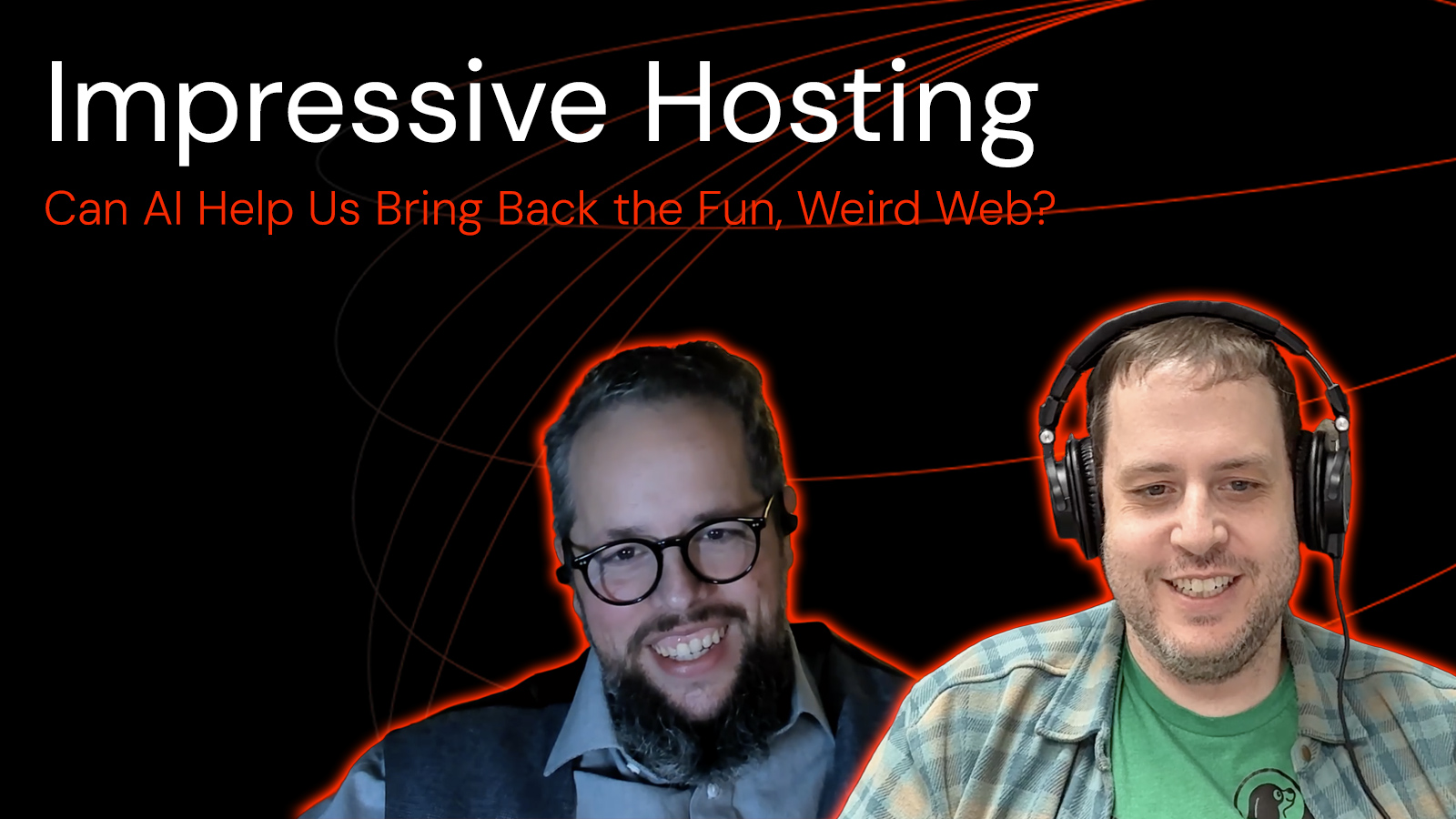
The web lost its sense of fun somewhere along the way, and Nick Hamze wants it back. In this episode of Impressive Hosting, he and Jesse Friedman trade ideas about a future where websites are an expression of both the creator and the visitor, not a sea of beige and sans-serif sameness.
They riff on RSS, semantic content, and the idea of layering your own design over any page you visit. Imagine stripping away ads, keeping the content, and viewing the entire web through a lens you built yourself. They even revisit Microsoft Bob and picture a reader that presents blog posts like cable access television.
Underneath the playfulness is a serious point about the cost of universal solutions. The same theme, the same textbook, and the same website for everyone strips away value. This is a forward-looking conversation for anyone thinking about what WordPress, hosting, and the open web could become.
Links:
- Regionally Famous
- Panel Alpha
- RTCamp
- Elementor
- Gravatar
- Jetpack
- Studio
- Archive.org
- Media Temple
- wlog.fm
Transcript
Jesse Friedman: Welcome to Impressive Hosting, a podcast about the role hosting plays in shaping the open web. I’m your host, Jesse Friedman. On this show, we go deeper than uptime and dashboards. We talk about hosting as infrastructure, about ownership, independence, and what it takes to build ethical, high-end WordPress hosting that actually serves creators, businesses, and the internet itself. Before we dive in, head to impressive.host. That’s where you can comment on episodes, ask follow-up questions, and help shape future conversations. You’ll also find links to follow, like, and subscribe wherever you listen. We’re back with Nick Hamze, the guy who’s giving us permission to use AI to be weird and have fun with it and do some really cool things. We just had an amazing first episode where we talked super fast about all the really amazing things that Nick’s doing with AI to change the way in which we see the web, building themes at a radical pace. We’re using the word radical because Automattic right now is in our Radical Speed Month, where we’re all pairing off and building whatever it is that we want that’s innovative and customer-serving. Nick, thank you and welcome back. We were just talking about regionallyfamous.com, your website, and how it’s not structured like any other website. It’s giving you permission to do some weird and cool things. We’re using the word weird, and it means so much more to me than the typical definition. It’s something that I treasure about the old web, that it was an expression of ourselves and what it is that we wanted to see. There’s so much power in the way the web is shaped, the code that we can use, the technology, the design, and yet we’re still building these sterile websites. One of the things we talked about quickly was that you’re building a theme every five minutes it seems like with AI right now. But what is the end goal with your project for Radical Speed Month? What is the actual defined goal for the project?
Nick Hamze: Well, the goal is basically to show people that… Because whenever you bring up something, it’s always about we don’t have the people, the this, this, and this. And I wanna show them that the next time you hear someone say that, say, “Are you using AI?” And if the answer is no, then that’s their answer. Because there’s probably no developers, designers, whatever, who have free time to work on themes. That’s probably why it hasn’t gotten done. But I wanna show you that you don’t need that. You just need credits.
Jesse Friedman: Yeah, yeah.
Nick Hamze: I guarantee you, while we’ve been doing this podcast, it made five themes that back in the day would take… Since I left Automattic the first time, I kept trying to hire people. I would find a couple people, and then we’d make something cool, and then they would get hired away by someone. I don’t know how many times someone that I had made something cool with got poached, mostly by hosts, to be honest. But now it’s to the point where I don’t even have to go and find anybody. I can literally just spin up another deal, and it’s done. Just absolutely fast. So the main goal is to show people who are AI naysayers that the answer to every single problem you have is not more resources, it’s more AI. But the byproduct is, the original goal was like 50 themes, but I think I could do 500. Some people on X were like, “Oh, it’s all gonna be slop,” and this and that. It’s like, no, they’re gonna be nice themes, and they’re all gonna be different. One of the gates is actually a differentiation gate where it can’t look like another theme. They’re all gonna be different aesthetics, they’re gonna be for different markets. One thing people don’t do a lot of is catalog size. Some themes are meant for like, I only have one product, or I only have three products. Like sometimes you have a shop page that shows the latest 20 products, but I only have three. There has to be a way to show products like that differently. So it’s taking all those things into account, and I guarantee you there’ll be an uptick in signups and retention. Because I feel like a lot of people want something and we’re not giving it to them, and we can. There’s nothing stopping us with AI. And as I was talking to you, I just remembered something. My first foray in trying to get back into the Automattic sphere was wanting to create my own hosting company with WP Cloud.
Jesse Friedman: Yeah.
Nick Hamze: My idea was, you know how back in the day Media Temple was like, all the creatives were on it?
Jesse Friedman: Like all the cool kids had to be on whatever.
Nick Hamze: So I was like, you know what? If it’s this easy to spin up… Back in the day I tried every VPS and whatever those cPanel things were. But now with WP Cloud, I could make a hosting service that’s only for… The idea I had was people who like Pokémon cards. I could do all this, but the problem is AI was just starting around then. So I was waiting for you guys to build, what was it called? Something Station.
Jesse Friedman: Station. Yeah.
Nick Hamze: Just Station. And so I was waiting for you guys to build Station, and I was like, now, if you guys have an API and I have AI, I could actually do that. An idea that I had given up on because the stuff wasn’t there. It’s like I could build bespoke hosting companies. All I gotta do is think up a name and just build one landing page, and then build themes that serve that community. So hey, I like Star Trek, so it’s an LCARS theme. How easy would it be to sell somebody hosting for a platform for the things they already wanna talk about in a design that already speaks to them? That’d be like shooting fish in a barrel.
Jesse Friedman: I mean, you’re nailing it, right? Because every single hosting company that you look at right now is selling a universal solution to everyone. Of course, there’s differences in how you configure the infrastructure, how much speed and bandwidth and things that you need, but that has nothing to do with the end product. It has nothing to do with the way the website looks and feels. That’s not impacting it. And you’re right, a hosting company would’ve been challenged to have created 60, 70, 80, 100 different niche solutions five years ago. But now the problem they’re gonna face is that Nick is gonna go and build 100 hosting companies with WPCloud’s turnkey hosting solution. Which, by the way, shameless plug, you were waiting for Station. We ended up pivoting Station into a… So just so everybody knows at home, Station is a WordPress-powered hosting panel that is completely white-label for WPCloud. But we ended up pivoting it. Instead of it being a production-level solution, it’s more of a reverse-engineering solution. So a hosting company who comes in and wants to put WPCloud underneath their platform can look at Station as this is how we would build it, here’s how we would interpret the API endpoints and display the user interface, so you can go and build it yourself. In the meantime, two companies went and built their own panels. Panel Alpha and RTCamp have released white-labeled panels that allow for turnkey hosting. So you can bolt that on, go with WPCloud, and launch a hosting company in like a week, maybe even less. So now you’re saying, go and build niche solutions for everything. You mentioned Star Trek, right? That’s a pretty niche niche.
Nick Hamze: Yeah.
Jesse Friedman: But like, how different would it be if you were running a Star Trek convention and you had a choice between some hosting company just offering hosting versus the Star Trek convention hosting panel?
Nick Hamze: Yeah.
Jesse Friedman: It’s a no-brainer at that point because you’ve built exactly what it is. So the underlying infrastructure, the part that they don’t see, can all be the same for everybody, that’s fine, but the layer that they’re actually interacting with on top is hyper-specific to their needs. And it’s not just about speeding up their time to live, which we talked about before, but you’re actually speaking their language. That’s the part that we’re missing right now.
Nick Hamze: 100%. And now that I’m running through it in my mind, I guarantee you I could do it in like three hours with like 40 bucks. The WordPress theme and the landing page and then hook up to one of those panels. It just blows my mind how easy things are nowadays. And why is everybody competing on the same things? Star Trek is a small niche, but how many people do you have to have to make a… You know what I mean? How many niches don’t have to have so many people? You could build a whole business around this, and then you’re not fighting the same people. If they want a hosting solution that is only for Trek, and it has customizable themes that only serve that, there’s no churn.
Jesse Friedman: Right.
Nick Hamze: Unless they all of a sudden wake up one day and like Star Wars instead. That’s not gonna happen. You got them for life.
Jesse Friedman: Yeah, no, you’re absolutely right. And you know, we’re talking about Star Trek, but you could expand that to any industry out there. Instead of every theme looking like a cafe or a reservation restaurant, you could have your Mexican food truck theme versus your barbecue food truck or whatever. You can attack these people exactly where they are and what they’re asking for. And the interesting thing is that the more people are using AI, AI itself would actually respond quite well to this. Because when you say, “I’m a food truck owner and I need a website for my food truck,” if AI is gonna go out and do the search and they have a choice between a universal hosting company that provides just regular hosting versus food truck hosting, how is the AI not gonna choose that as the solution?
Nick Hamze: Yeah.
Jesse Friedman: Right?
Nick Hamze: That’s why I’m so surprised no one’s done it. Again, I know why they haven’t done it yet, because big companies move slow.
Jesse Friedman: Big companies move slow, and frankly, I might be pissing off a lot of my audience, but let’s be real, hosting companies move slow. Hosting companies move amazingly slow. And I think the reason is that they’ve spent years fine-tuning their conversion flows and the way in which people interact with it, their advertising is so well tweaked. Anytime you talk to a hosting company about changing something on a landing page, it’s 16 layers of bureaucracy that you gotta get through and people who have fine-tuned every single thing, and it makes it impossibly hard to change things there. But I think the really cool thing about AI is that all the work involved in building an experiment is actually so much faster now. So if you own nickhosting.com, and it’s a well-established brand that’s been around forever, you don’t have to do this on that brand. You can just go build another brand. Go do it somewhere else and see if it works. So I guess the big question everybody at home is probably thinking is, okay, you’re working at a rapid pace, you’re building these things super fast. What about quality assurance? How is that being solved?
Nick Hamze: That’s one that really upsets me because it’s so easy. When I was first doing WordPress plugins, people were like, “Oh, it’s all gonna be insecure,” whatever. All the things that you have to watch out for are known. So the first thing I did when I started making plugins was take the plugin check plugin, the one that checks other plugins before you can submit to the repo. And I built an MCP and I said, “Okay, take everything this thing checks for and make me all the whatever.” I was like, just make sure that no matter what I do, it doesn’t just catch it and fix it, but don’t do it in the first place. Don’t not sanitize inputs and outputs. All the things you’re not supposed to do. And then every time it makes good stuff. I even took it one step further because people kept saying, “Oh, this is obviously AI-coded because of X, Y, and Z.” So I said, “Hey, I want you to take all the things that are like a sign that something’s AI-coded.” Like if it’s too big of classes or too verbose, and don’t do that. That’s what I understand. That’s why it makes me so upset when people say that. If you feel that’s bad code, then help people make it good code. My dream for Studio is, I like local development, I like whatever, but I want you to add that layer where if someone’s developing with it, the AI can’t do anything bad. We know all the things to watch out for. Why can’t you have an MCP cert, whatever it is, that says, “Hey, before you build this, here is everything you need to know about making good WordPress sites. Okay, have at it.” And there’ll be no bad code. When people say that AI makes bad code so you shouldn’t use AI, that’s not the answer. The answer is make it do good stuff.
Jesse Friedman: Yeah. The interesting thing is that the way in which we as human beings write code is that we use best practices. We’ve developed patterns. We know the types of things that we need to do to avert security flaws and things like that. But it requires a certain level of education and diligence. You have to be very careful with what you’re doing. But the thing about AI is that it has a full understanding of every vulnerability that’s ever existed, and we’re using AI to patch problems across the internet, not just in the WordPress space, but everywhere. So AI is fully capable of understanding any kind of security issues, and you can run your own tests to do that. The only problem we face, I think, is whether or not we are confident that the AI is actually doing it well. Because if you’re not a developer with a computer science background who has a familiarity with security, it would be hard to know whether or not the AI actually did what it said it was going to do. But there are definitely ways around that. You’re talking about MCP services, there are skills docs out there written by computer science experts who know how to build this stuff, and then you can apply those skills to your project and make sure it’s actually doing it in a way that makes sense.
Nick Hamze: Yeah. I mean, more bad code is written by junior developers that just don’t know it than by AI. I think the AI’s problem is that when you first start it up, it’s like, “I’m gonna do this the quickest way possible.” And if you don’t tell it security is a concern, it’s not gonna worry about it. You know that old joke, I told the AI to get rid of all the bugs and it deleted the whole codebase? Yeah, that is the shortest way to do it. But you just gotta tell it. And also, models are getting so much smarter. Sometimes I don’t even have to tell it because it already knows.
Jesse Friedman: Yeah.
Nick Hamze: It’s one of those things where I feel bad because people are scared. People are thinking, “Hey, I’m gonna lose my job,” or “AI’s gonna do this and that.” And I feel like if people understand that AI is actually gonna unlock your job, it’s gonna allow you to do things that you could never do before. I forget who it was, I think it was the CEO of NVIDIA, who was saying that companies that are gonna use the same people to do more are the ones that are gonna do well. That’s why I’m not concerned about it in the slightest. But I might just be saying that because when the AIs take over, I’ll make sure they know I’m on their side.
Jesse Friedman: Well, I think also you’ve always been the ideas guy, right?
Nick Hamze: Yeah.
Jesse Friedman: You’ve always had something brewing, something going on, something fun. Are you working like 3,000 hours a week? How are you doing all this stuff? Where are you learning it?
Nick Hamze: I’m just doing it. I have no… Most of the time I don’t really have to learn it. My AI has to learn it. I don’t know how any of this stuff works. Sometimes it’ll write some code in a language I’ve never heard of, but it works, so I’m like, “Okay, I’m fine with that.”
Jesse Friedman: Okay.
Nick Hamze: And people probably say I’m working too much, but I’m having so much fun. I’ve tapped into a passion.
Jesse Friedman: Yeah, you’ve tapped into a passion for yourself.
Nick Hamze: So it doesn’t really matter. I take my computer to bed with me and have it run stuff. I’m having it do stuff while I’m sitting here. It’s a lot of work, but it does a lot on its own. As long as I check in every once in a while to say, “Hey, how you doing? Can you go do this? Can you go do that?” I traded in a very nice laptop for one with 48 gigs of RAM and an M5 Pro Max because I just wanna have more parallel jobs at the same time.
Jesse Friedman: Oh, okay.
Nick Hamze: So I can just do like… It’s crazy how much stuff I can get done. Someday I’m gonna go have GitHub add up how many lines of code I’ve written. The latest one is called Odd, and it actually absorbed like the last four projects. Whatever I learned from those, it wasn’t enough to be a standalone thing, but I took everything I learned there and put it towards this other thing. Which is so fun, because in the past I hired people to make stuff and I think I spent like 20, 30, $40,000, something crazy. If I spent 5,000 bucks to develop the plugin I made last week, I would not abandon it. But it only cost me 100 bucks in credits. So it’s fine. I learned from it.
Jesse Friedman: Yeah, right.
Nick Hamze: That’s why it’s so fun. A lot of times you’re so wrapped up in how much time and effort something is that you can’t let it go even when it didn’t work. Now literally you can prove out a concept for 50 bucks. That’s cheaper than some people’s coffee budget. It’s fascinating.
Jesse Friedman: And I think when you think about what it costs, right, it’s money, but it’s also time. One of the things that AI unlocks for you is that once you start to get into it at a level where you’re actually producing stuff, you’re able to move so much faster than you’ve ever been able to move before. Your time is money, and so you’re doing so much more in such a short time. And this is something we talked about in the last episode with Miriam Schwab from Elementor. You can use AI to build a team of people to work under you. She mentioned that she was an independent contributor and didn’t have direct reports, but now she has all these AI agents working for her. She’s kind of like a team lead to these agents. The agents haven’t replaced the jobs of actual people. They’re just empowering her to do more than she’s ever been able to do before.
Nick Hamze: The only thing I’m missing from this AI world is I want someone to build a persistent way so if I build an agent, I can make sure he’s gonna be around forever. An identity layer that, no matter what model or whatever, I know that Tim’s always gonna be there with me. I think that would be a billion-dollar business. I want that to be Gravatar. That would be so cool if like that…
Jesse Friedman: You know what’s so funny, this is a good opportunity to share that Gravatar came to mind for me too. So for people who don’t know what Gravatar is, it started as a way to have a universal avatar across all WordPress websites and other things, and now it’s grown from that. It’s a link-in-bio. It’s a persistent identity on the web that kind of traverses all these other mediums. You pump in basically all your email addresses, and so when you sign into websites that use Gravatar, your face is always there, your information is always there. And that made me think about all the things that my agents have learned about me. My preferences, the way in which I like to travel, the things I like to do, the way in which I write emails or whatever. If I could have that exist across all the mediums that I’m eventually gonna be using, I could take that with me. That is huge. That’s enormous. Because right now we’re all thinking about how we’re using agents in our own little world, but soon every time you go to a website or use a product or whatever, there’s gonna be an agent there asking you questions. And if you can port your preferences and the things that it’s learned about you and have it be immediately accessible, you don’t have to teach it anything each time. It’ll just know what it is that you’re hoping to accomplish.
Nick Hamze: Yeah? So do you have an RSM project yet? Let’s do it.
Jesse Friedman: I do have an RSM project. It’s actually a little bit different. Whatever, I’ll just jump into it. Basically, instead of having the need to go hunt and peck around a website, knowing what to search for, navigation, trying to decide how the website works, all that stuff, it’s much more of a build-it-for-you in real time kind of situation. So you arrive at the website, you click a few buttons, it understands your intent and your motivations, and the website kind of unveils itself and gives you the information that you’re looking for. There are no multiple pages. It’s kind of like a live stream of content pushed to you in real time.
Nick Hamze: That’s awesome. And that is very ripe territory for fun. You could have like a scroll on whatever, like one of those… What’s that deal? Like where there’s all the different stairs. You know what I mean? It’d be fun if it did a little song and dance before it gave you what you wanted to know, like it was… Or like an old-school Tron kind of vibe. Oh, that’d be so much fun. I think that’s really fun. I mean, again, like…
Jesse Friedman: Yeah.
Nick Hamze: That’s why, when me and Rich talk about things, it always comes back to things he wants to fix in the WordPress UI. And I’m like, I don’t know if it’s worth spending a lot of time on, because someday the entire WordPress backend’s just gonna be a text box. You’re just gonna talk to it. You’re not gonna have to go and find the menu. You’re not gonna have to go and find the deal. So why wouldn’t the front end change too? The front end’s just gonna be, you just tell me what you want and I’m not gonna have to go and find the pages. It’s just gonna be there.
Jesse Friedman: Well, this is a great opportunity to ask you this question, because I get it all the time. What are websites gonna look like in a year, in five years? Are we gonna have the same-looking responsive web design reshaping as you are on a mobile device, links, and so on? Or is it gonna be something completely different? The way in which we converse with an AI kind of paints a picture of what it might be in the future. Right now, when you go into Claude and ask it a question, it responds back in text. Sometimes it uses a graphical interface. It drops an image in or something like that. But there are endless possibilities with what a website could be in the future. For me, it’s very hard to define because I don’t think there’s gonna be any one specific answer. I think the way you interpret it or traverse the web in the future is gonna be based on the creator and not necessarily a structural foundation that you have to abide by.
Nick Hamze: For me, I think it’s gonna be like, you know how there are people that still listen to records even though we have streaming? There are people that like physical books. I feel like it’s gonna be kind of like that. It’s gonna look however you want it to look. For me, I’m always gonna have it look like the old web. And there’ll be a way where agents just talk to agents and there could be no… You wouldn’t even have to go and look at something. It could all just be, I talk to an agent, it talks to your agent, and then tells me the information. I feel like it’s gonna be people like me that are gonna keep the old fun alive. It’s gonna be very similar to the way it is now, but on another level technology-wise. It’s almost like a choose-your-own-adventure novel. So when they land on it, that might be a kind of a fun thing too for your plugin. Like one of the old-school books where, okay, I’m gonna pick A, B, C, and then the website turns to page 85 and that’s the thing that you want.
Jesse Friedman: Yeah.
Nick Hamze: You know what I mean? You would think it would be more like Star Trek where it’s just a computer talking to a computer. But I feel like if we embrace the creativity of it, it’s gonna become even more like the way we want it to be. I don’t ever wanna have Reasonably Famous be nothing but a chat box where you talk to an AI. I always want it to be wacky and weird. If it’s easier to generate images, I’m gonna go and do whatever. I think it’s called wlog.fm. I made WordPress music. All the different things that you can generate, I think I’m just gonna keep doing more of that, especially if it’s easier. But for the normal stuff, like if you’re gonna go and pay your bill online, the water company’s not gonna have a website. They’re just gonna have whatever you call talking to an agent. They’re not gonna…
Jesse Friedman: Yeah.
Nick Hamze: I think the websites are gonna be whatever we want, and I hope that we wanna keep it weird and wacky and fun. I hope it’s not gonna be whatever dystopian movie is the flavor of the week. I want it to be interesting and fun and quirky. And I think everything comes back around. You think about all the trends from 30 years ago. So I’m hoping that all the things that made us invent the internet come back. We didn’t invent it to be sold products on social media. We did it because we wanted to have our own little corner of the world. My favorite thing is going on archive.org and trying to find old science…
Jesse Friedman: Old stuff, yeah.
Nick Hamze: They were objectively horrendous from a usability and design standpoint. Sometimes every item in the menu was a different font. But that was fun. I feel like we can find a happy medium where it’s not assaulting your eyes, but it’s also not killing your soul.
Jesse Friedman: Yeah. And I think you’re right. You can strike a balance there of accessibility and completely weird stuff. I remember back when I was a kid building websites in high school, there was a scholarship competition to build the university I was applying to their new news website, like for their university newspaper. The one they chose ended up looking like something more like a bank website. It was so bland and sterile. Mine was so cool, man. Like you pressed a button and the newspaper flew from one side to the other, and a dog caught it. This is back in the late ’90s, when that stuff was hard. It was not easy to make things move.
Nick Hamze: Oh, for sure.
Jesse Friedman: But it was an expression of what I wanted it to be. And I think we’ve lost that along the way. I think one thing that AI can do is not only make it an expression of the person building the website, but an expression of the visitor too. You can define for it what you like about the web, how you want it to be formatted, how you want it to look. And maybe the website can actually conform to your desires and what it is that you want to come from it.
Nick Hamze: Wouldn’t that be amazing? For me, I would never wanna visit a boring website. I wouldn’t have to. They would talk to my AI beforehand and say, “Nick’s coming to this website and he’s a little bit eccentric. Don’t show him no sans-serif fonts. Don’t show him no beige.” Like, everything has to be whatever, and then…
Jesse Friedman: Yeah, yeah.
Nick Hamze: That’d be so cool.
Jesse Friedman: Well, you know what’s funny, this is a good opportunity to share an idea. I had this recently and my initial gut feeling was, oh, keep it to yourself because somebody will steal it. But the reality is the more you share it, the more likely it’ll actually just happen.
Nick Hamze: Yeah.
Jesse Friedman: And I want this to happen. Especially with WordPress, so much of our data or the content itself is well-formatted semantic language, right? RSS still exists. We don’t use RSS nearly as much as we should, but it still exists. So you can think about a future where instead of having a typical browser like Chrome just design the website based on the way in which the person designed it, you could have your own design of a website and then use that semantic language to put everything in the same place no matter what. So if you’re tired of seeing ads popping up, this would be a way to strip all that out because you’re just looking at pure content. You could have the same calls to action in the same place. You could design the webpage yourself, make it unbelievably beautiful and weird and everything else, and then anytime you visit a webpage, the semantic data just kind of fills the content in so that it’s your experience no matter what. You’d end up experiencing the same kind of thing over and over again. But at the same time, you’re stripping away all the crap that people keep layering on top, trying to get you to click things, and you’re giving people back the ability to see the web through their own eyes, the way in which they want to. Anyway, my point is we have the data hidden in XML format or RSS, and we could layer our own designs over all of it any way we wanted to.
Nick Hamze: Yeah, no, I think that’s… I have so many ideas with that right now. It’s so much fun. So this is kind of related, but did you ever use Microsoft Bob as a kid?
Jesse Friedman: Before my time.
Nick Hamze: So it was a crazy experiment. The fun fact is that’s actually where Comic Sans came from. They created it for that piece of software.
Jesse Friedman: Yeah. Okay. Yeah, yeah.
Nick Hamze: They wanted to reimagine how the desktop works. So when you went on there, it was like a house. So instead of clicking…
Jesse Friedman: Yeah.
Nick Hamze: It was totally cool. And I almost feel like, what if we did the same thing? Like, say WordPress 7.2 has a way that not only does it package up the posts and the RSS, but all the other stuff too. The links to whatever else. And then you just ingest that into your Microsoft Bob world. You have Jesse’s world, and you say, “Anytime you see an ad, there’s a little TV over a trash can and that’s where the ads go.” And wherever you see a link, it’s on like a little Blue’s Clues-style notebook in the corner. That would be so fun.
Jesse Friedman: Right. Yeah.
Nick Hamze: Let’s…
Jesse Friedman: Yeah, that’s what I’m saying. And if you don’t like weird and you want it to look clean, that’s fine. It’s up to you. As a web designer, the only thing you have to understand is that as long as your data is formatted in a way that’s… I mean, at this point it doesn’t even matter because AI can read it in any way and pump it into anything. But I think there’s something there. I haven’t quite put my finger on exactly how it should function, but I think there’s something there in the way we can take it to a new level. Like readers, right? We have the wordpress.com reader. It pulls in blog posts from all these different places and you can subscribe to all these things in one place. But even the wordpress.com reader looks exactly the same way for every single person. It always has a featured image and the date and the title and everything. But you could have it be anything. Maybe you don’t give a crap about the date, so you throw that out and find different elements to exaggerate. And I do remember Microsoft Bob now. It literally looked like someone’s living room.
Nick Hamze: With the…
Jesse Friedman: You could do anything you wanted with it. I think we should keep pushing on this, because I think there’s something there around that that might be the way we think about it. Because if you think about the way you talk to AI today, you ask it a question, you say, “I wanna buy some product to solve some problem,” or whatever, Claude or ChatGPT is going to go reach out into the internet, find that information, and bring it back to you. But that leaves you in a situation where you’re interacting with it all through a user interface that looks exactly the same every single time. There’s no opportunity to customize it or make it weird. So you get the benefits of all that stuff, but it could go through your lens. It’s your way of viewing the internet, and you can change it any time you want to. You do holiday themes or whatever. It just gives you the ability to suck in the data and have fun with it without having to look at everything through the same…
Nick Hamze: Boring…
Jesse Friedman: I’m sold.
Nick Hamze: I, what I would do… The first step… Round two, you and me.
Jesse Friedman: Round two, you and me.
Nick Hamze: We already have RSS. I think the first step is to make a reader that displays the post in a way no one would expect. What I want it to be is like cable access television. It shows the featured image as a television, and then it uses an API to read me what’s in the blog. I think that…
Jesse Friedman: Yeah.
Nick Hamze: Especially if it’s based on like an old news anchor’s voice or like an MTV VJ or something. I think that would be hilarious. You know how easy that would be? We could have that done…
Jesse Friedman: Yeah. Yeah, yeah. Well, and the thing is too, you wouldn’t even have to have it presented as visual content. You could have something actually talk to you.
Nick Hamze: Yeah.
Jesse Friedman: You could have Alex Trebek from Jeopardy! asking you questions and reading you answers or whatever. Like, you could do whatever. There’s no limit at that point to what you can do.
Nick Hamze: Because I feel like everything lost its fun factor. I would read more news if it was presented in a fun way. There’s lots of things that I should be doing that I would do if it was fun.
Jesse Friedman: And that’s true for education too. My daughter shares these video essays where people are creating stick figures who are telling stories of history. Julius Caesar was one that we watched recently, and it’s factually true, it’s good history.
Nick Hamze: Yeah.
Jesse Friedman: But it’s told through this stick figure comic book type thing, and they’re just having so much fun with it. I remember seeing this thing where Caesar gets stabbed and he has this expression on his face that just made me laugh. But I’ll never forget that video. And the things I learned in it were reinforced by the humor and the fun and weirdness of it. That’s something we lose so quickly when we move to universal solutions. The same curriculum for everybody, the same textbook for everybody, the same website for everybody. We lose so much value in the ability to convey ideas when we do that.
Nick Hamze: Could you imagine a Jetpack plugin that, when you push publish, it sends the thing off, generates all the stick figure deals, and then sends it back to you, and you can say, “Hey, do you wanna read this or do you wanna experience this?”
Jesse Friedman: Right.
Nick Hamze: Now, without saying… Because again, I get myself in trouble a lot, but like Jetpack, we’re literally selling the same stuff everybody else does. Nobody needs a CDN, nobody needs a whatever. But what if we created something that’s gonna be niche, okay? Not everyone’s gonna want it, but they can’t get it anywhere else in the world. I guarantee you that would drive signups if you go and create interesting, fun things that AI makes. A human just has to think of the idea and everything else is automated. You could try so many things, and if you put it behind like a labs tab, if no one likes it, it goes away quietly.
Jesse Friedman: You label it with labs, right? Then it’s basically free permission to do whatever you want. Yeah.
Nick Hamze: We’ll do that for next month. I’m pretty sure Radical Speed Month’s gonna turn into Radical Speed Year.
Jesse Friedman: I hope so.
Nick Hamze: Because I think the people… The stuff I’ve already seen has blown me away. Some of these people were working in like the most boring fields in the world, and then they pull this out of their hat and I was like, “Where have they been hiding?”
Jesse Friedman: Yeah, yeah.
Nick Hamze: I wanna see more. I wanna see what the next idea is. I wanna see what happens if you get a room full of these people together.
Jesse Friedman: Right.
Nick Hamze: I think it’s gonna be wacky.
Jesse Friedman: Yeah, man. Great.
Nick Hamze: I think we’re over on time.
Jesse Friedman: We are way over on time, but this conversation’s so much fun. Let’s do it again soon. Let’s have you back on the show.
Nick Hamze: Yeah, why not? All right. Thanks, man.
Jesse Friedman: All right. Thanks, Nick.
Nick Hamze: Yep. See ya.
Subscribe to Impressive Hosting:


Leave a Reply