'%3E%3C/path%3E%3Cpath d='M76.4782 25.7185L71.982 9.04089H74.6936L78 22.8409L81.8045 9.04089H84.5853L88.2722 22.8409L91.5787 9.04089H94.2902L89.7248 25.6977H86.7781L83.1396 12.6379L79.3835 25.6977L76.4782 25.7185Z' fill='rgba(247, 43, 0)'%3E%3C/path%3E%3Cpath d='M96.6075 9.04089H102.439C103.739 9.04089 104.818 9.26224 105.676 9.69803C106.534 10.1338 107.17 10.7287 107.592 11.4827C108.014 12.2367 108.222 13.0875 108.222 14.0421C108.222 14.9483 108.021 15.7783 107.613 16.5254C107.212 17.2794 106.575 17.8812 105.725 18.3239C104.867 18.7666 103.774 18.9879 102.439 18.9879H99.1323V25.6977H96.6075V9.04089ZM99.1323 16.9128H102.321C103.511 16.9128 104.362 16.6568 104.881 16.138C105.399 15.6192 105.655 14.9206 105.655 14.0352C105.655 13.1152 105.399 12.3958 104.881 11.8839C104.362 11.372 103.511 11.1092 102.321 11.1092H99.1323V16.9128Z' fill='rgba(247, 43, 0)'%3E%3C/path%3E%3Cpath d='M124.138 25.9744C122.492 25.9744 121.067 25.6147 119.87 24.8953C118.674 24.1759 117.747 23.166 117.097 21.8725C116.446 20.5789 116.121 19.0848 116.121 17.3901C116.121 15.6746 116.446 14.1735 117.097 12.88C117.747 11.5864 118.674 10.5765 119.87 9.84329C121.067 9.11698 122.492 8.75036 124.138 8.75036C126.089 8.75036 127.68 9.22766 128.918 10.1753C130.156 11.1299 130.938 12.458 131.277 14.1735H128.469C128.247 13.2051 127.77 12.4373 127.044 11.8631C126.317 11.289 125.342 11.0054 124.118 11.0054C122.45 11.0054 121.136 11.5726 120.168 12.707C119.199 13.8415 118.715 15.3979 118.715 17.3831C118.715 19.3476 119.199 20.8971 120.168 22.0246C121.136 23.1521 122.45 23.7124 124.118 23.7124C125.342 23.7124 126.317 23.4427 127.044 22.9031C127.77 22.3636 128.247 21.6234 128.469 20.6896H131.277C130.945 22.3428 130.156 23.6294 128.918 24.5702C127.68 25.5109 126.089 25.9744 124.138 25.9744Z' fill='rgba(247, 43, 0)'%3E%3C/path%3E%3Cpath d='M133.961 25.6908V8.5636H136.486V25.6908H133.961Z' fill='rgba(247, 43, 0)'%3E%3C/path%3E%3Cpath d='M145.195 25.9744C144.067 25.9744 143.057 25.7185 142.158 25.1997C141.259 24.6809 140.553 23.9615 140.027 23.0346C139.502 22.1076 139.246 21.0216 139.246 19.7903C139.246 18.5591 139.509 17.4731 140.041 16.5392C140.574 15.6123 141.293 14.8929 142.192 14.3741C143.099 13.8622 144.102 13.5994 145.215 13.5994C146.343 13.5994 147.353 13.8553 148.252 14.3741C149.144 14.8929 149.864 15.6123 150.396 16.5392C150.929 17.4661 151.192 18.5522 151.192 19.7903C151.192 21.0285 150.929 22.1076 150.396 23.0346C149.864 23.9615 149.144 24.6809 148.245 25.1997C147.332 25.7185 146.315 25.9744 145.195 25.9744ZM145.195 23.8093C145.796 23.8093 146.357 23.6571 146.869 23.3597C147.387 23.0553 147.802 22.6126 148.121 22.0177C148.439 21.4228 148.598 20.6827 148.598 19.7903C148.598 18.898 148.446 18.1579 148.134 17.563C147.823 16.9681 147.415 16.5185 146.896 16.221C146.377 15.9167 145.824 15.7714 145.222 15.7714C144.62 15.7714 144.06 15.9236 143.548 16.221C143.029 16.5254 142.614 16.9681 142.296 17.563C141.978 18.1579 141.819 18.898 141.819 19.7903C141.819 20.6827 141.978 21.4228 142.296 22.0177C142.614 22.6126 143.023 23.0622 143.534 23.3597C144.032 23.664 144.586 23.8093 145.195 23.8093Z' fill='rgba(247, 43, 0)'%3E%3C/path%3E%3Cpath d='M158.275 25.9744C156.85 25.9744 155.723 25.5317 154.906 24.6394C154.09 23.747 153.682 22.4258 153.682 20.6688V13.8899H156.207V20.406C156.207 22.6887 157.141 23.83 159.015 23.83C159.949 23.83 160.717 23.498 161.326 22.834C161.927 22.1699 162.232 21.2153 162.232 19.9771V13.883H164.757V25.6908H162.522L162.336 23.6225C161.969 24.3488 161.436 24.9299 160.731 25.3449C160.011 25.7669 159.195 25.9744 158.275 25.9744Z' fill='rgba(247, 43, 0)'%3E%3C/path%3E%3Cpath d='M173.341 25.9744C172.2 25.9744 171.19 25.7046 170.318 25.1651C169.447 24.6255 168.762 23.8854 168.271 22.9515C167.779 22.0177 167.53 20.9525 167.53 19.7627C167.53 18.5729 167.779 17.5146 168.271 16.5876C168.762 15.6607 169.447 14.9275 170.325 14.4018C171.204 13.8692 172.213 13.6063 173.362 13.6063C174.296 13.6063 175.119 13.7861 175.824 14.1528C176.53 14.5194 177.083 15.0313 177.478 15.7022V8.5636H180.002V25.6908H177.74L177.478 23.8577C177.097 24.4111 176.571 24.9022 175.907 25.3311C175.243 25.76 174.385 25.9744 173.341 25.9744ZM173.791 23.7885C174.87 23.7885 175.755 23.415 176.44 22.6679C177.132 21.9209 177.478 20.9663 177.478 19.7903C177.478 18.6006 177.132 17.6391 176.44 16.8989C175.748 16.1588 174.863 15.7922 173.791 15.7922C172.712 15.7922 171.826 16.1588 171.127 16.8989C170.429 17.6391 170.083 18.6006 170.083 19.7903C170.083 20.5651 170.242 21.2568 170.56 21.8586C170.878 22.4604 171.314 22.9308 171.881 23.2767C172.435 23.6156 173.078 23.7885 173.791 23.7885Z' fill='rgba(247, 43, 0)'%3E%3C/path%3E%3C/svg%3E)
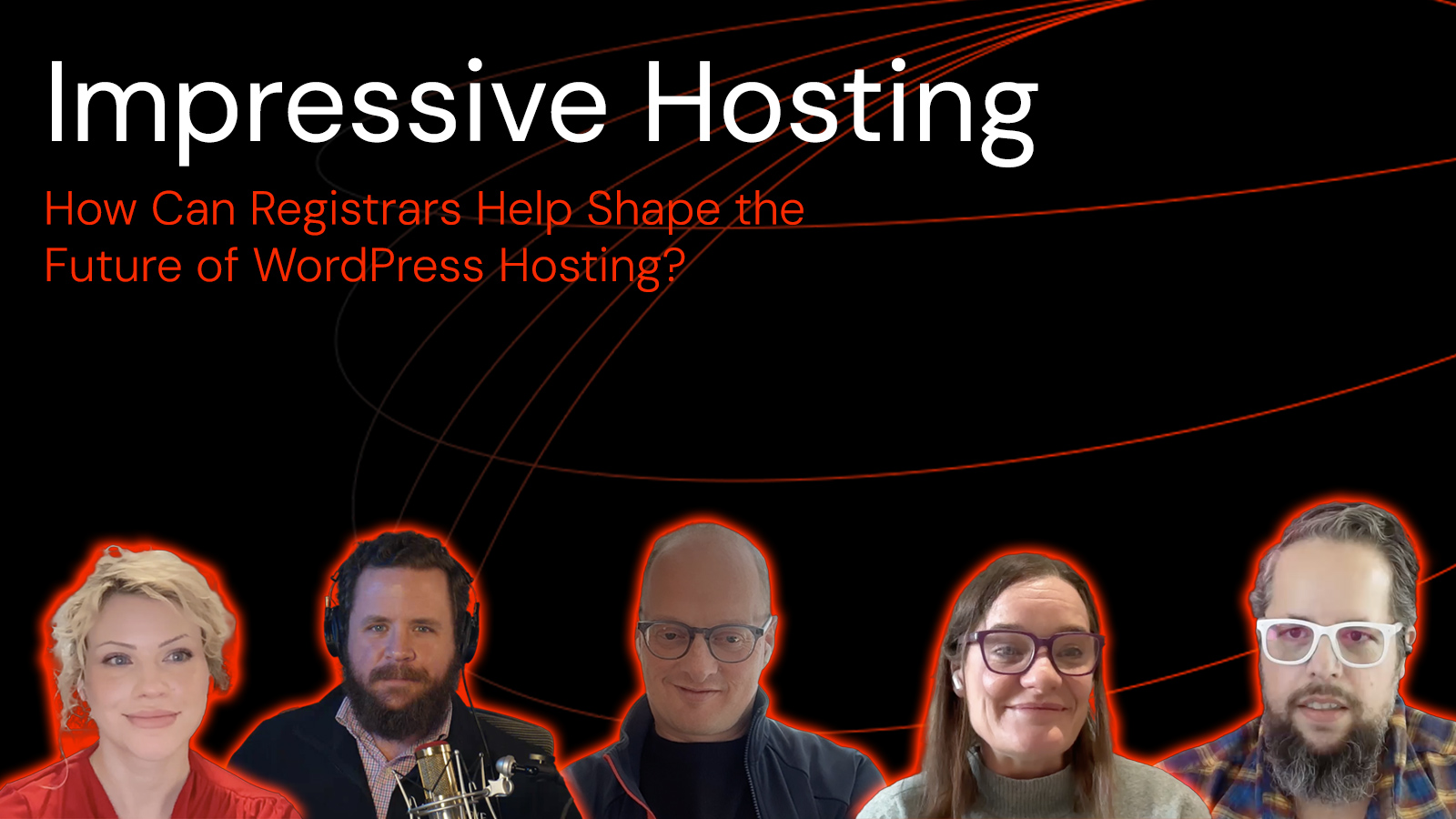
Owning your slice of the web has never mattered more. That is the through line of this roundtable episode, where Jesse Friedman, Leanne Hogben, Ronald Gijsel, Elise Prather, and Joshua Goode make the case that domains and hosting together form the foundation of brand independence. Joshua Goode goes further, arguing that in an AI-saturated world, having your own domain and your own hosting is how you control whether AI scrapes your content, pays for access, or gets blocked entirely.
The episode covers serious ground on AI without losing its practical edge. Josh outlines WP Cloud’s plans to embed optional AI tooling into performance monitoring so hosts and their support teams can quickly diagnose and fix site issues. Elise reports on a shift she is seeing in e-commerce, where AI-driven payment orchestration is quietly improving approval rates and lowering fees. Ronald highlights how AI now helps customers go from a rough idea all the way to a launched product, and how WordPress is uniquely positioned as a platform that stays alive and improvable rather than becoming a throwaway project. Leanne describes the evolution of domain search from keyword matching to conversational AI that understands the concept behind a business.
For registrar decision makers, the most actionable section may be the closing discussion on domain use cases. Jesse walks through how he uses short redirect paths to funnel social media audiences back to his own site, bypassing platform algorithms designed to keep users locked in. Ronald describes using domain portfolios for deep linking to specific business functions like directions, return policies, or booking pages. Leanne underscores that a domain is the portable layer that lets creators move between platforms without losing their audience. The takeaway for registrars is clear: domains paired with scalable WordPress hosting create a product stack that solves real problems customers face every day.
Links:
- Pressable
- Bluehost Cloud
- Convesio
- Pork Bun
- HostGator
- Yoast
- Jetpack
- jesse.blog
- leanne.blog
- .blog Registry
Transcript
## 203.2 – Video
Jesse Friedman: Welcome to Impressive Hosting, a podcast about the role hosting plays in shaping the open web. I’m your host, Jesse Friedman. On this show, we go deeper than uptime and dashboards. We talk about hosting as infrastructure, about ownership, independence, and what it takes to build ethical, high-end WordPress hosting that actually serves creators, businesses, and the internet itself. Before we dive in, head to impressive host. That’s where you can comment on episodes, ask follow-up questions, and help shape future conversations. You’ll also find links to follow, like, and subscribe wherever you listen. We are now in part two of a registrar registry roundtable with some employed experts. We have Ronald, who’s the head of registrars, Leanne, who’s the head of registry, Elise, who’s the VP of partnerships in global sales and Josh, who is our technical account manager, sales engineer, and everything else under the sun. We are all talking about the ways in which registrars can play a bigger hand in distributing WordPress and providing great WordPress experiences. So we’ve covered, in the first episode, we covered everything from what the difference is between a registry and a registrar, all the way up into how registrars could take advantage of a turnkey hosted solution like WP Cloud, the responsibility they have to WordPress if they start selling hosting, and a variety of other topics. It was a really great conversation, so I would definitely say check out episode one if you haven’t had a chance to yet. Plus we go in-depth into who everyone is on the show today and why you should listen to them. But where we left off was that Ronald had a great question for Josh. Ronald I’m gonna let you just dive in and ask that question again because we had to take a break there.
Ronald Gijsel: Yeah, so my question was, everybody who starts a site, no. Maybe 90%, not everybody, I’m sure, a vast proportion of users that start a site or maybe a blog are doing it maybe in the hope that they become quite popular and maybe go viral. So my question to Joshua was, what if I have a blog and I go viral overnight? I’ve had it in the past that I get errors, and the hosting companies simply can’t manage that. So I wonder what WP Cloud’s take is on that.
Joshua Goode: Yeah, so in the last episode, I kind of really nailed in that core table stakes for if you’re trying to provide a good experience, you should offer fast, secure, and reliable sites and pushing further on reliability from the perspective of a host. And really coming down to reliability for end user is the scalability of that as well. So WP Cloud gives registrars, or anyone who wants to be a good WordPress host, the ability to offer highly scalable WordPress sites. So if you do have one of these viral moments, one of your customers go viral, or you as a customer signed up and you’ve hit it, WP Cloud is more than capable to scale up to massive amounts of traffic, and it’s just all baked into the platform from day one as soon as someone integrates and starts offering and selling plans to people. We really focus on making sites fast and highly cacheable there. That takes care of a lot of the legwork, but we then have this entire isolated infrastructure ready to go where a site can burst up to many, many CPU cores worth of PHP workers. That offers, as a registrar, that can be very valuable of offering different types of plans and packages, but also providing users insurance if their site hits it big.
Jesse Friedman: Yeah, that’s a great answer, Josh. So if you’re at home right now and you’re listening to this, if you are someone who runs a website, you’re an agency and you’re running it on behalf of a client or you’re taking care of it yourself and you’re worried about that Oprah moment, where you get mentioned by someone, you know, big star or something like that, or maybe you have a Black Friday sale that’s coming up and you want to be ready for a massive amount of traffic to take on whatever coupon you’re offering. I would say talk to your host about bursting. So if you’re hosting through WP Cloud, you’re hosting on Pressable, WordPress.com, Bluehost Cloud, Convesio, Pork Bun, the list goes on from there. Talk to them about bursting, because WP Cloud offers this ability to scale up resources in real time to accommodate for that influx of traffic. And if you’re more interested in WP Cloud from a perspective of a host or a registrar, you know, contact Elise, contact Josh, contact myself, wp.cloud and ask us how bursting can help your customers accommodate any level of traffic. Because it’s a core tenant of WP Cloud’s feature set is to make sure that these customers can scale. It’s a very important part of the WordPress experience that we want to make sure that everyone gets to benefit from that. And it’s not just something that’s preserved or reserved for enterprise level customers. Great. All right. So with that, the next thing I want to talk about is AI. I mean, AI is, you know, it’s a term that’s been jumping around everywhere. Everyone’s interested in what’s going on with AI, how they can incorporate it, how do they can keep their job by using AI, whatever it might be, is a laundry list of things. Everywhere we turn, there’s different agents and LLMs and different things happening across the board. So I’m just curious to the general group here, what are the trends you’re seeing with AI? Like how is AI helping you and your business? How is AI helping your customers? How are people moving faster or more dynamically with AI? Josh, I’m curious to hear what your thought is on how AI might help our WP Cloud partners and maybe their end customers.
Joshua Goode: Yeah, so, you know, we want to do some pretty basic common sense integrations. Part of WP Cloud, we offer application performance monitoring. We offer performance metrics and so we want to build in optional AI tooling that goes along with that to help both hosts and support teams that handle host support their end users to be able to understand areas that they can improve while we provide a very strong baseline high performance experience. Ultimately, if you start getting into custom code or vibe coded stuff provided by an AI agent, you know, there’s always potential where it may add some things that could be improved. And so we have tooling that can tell you, Hey, your site could, this performance could be a bit better. And now we want to provide some optional AI tooling to help ingest that and understand and really make it actionable. So maybe you are using other AI tools to help modify your site. It can get that information a little bit better. But I think another thing is the fact that we’re all focused on WordPress. WordPress core itself is making some big moves into opening up its systems to make it so easy for no matter what coding platform and AI platform you’re using, whether it’s Claude Code, whether it’s what’s popular now, Claude Bot, or Open Claude. Now it’s, we want to make this open to any LLM, any AI, to where it can easily and quickly use WordPress to really make WordPress the kind of platform for any AI tool. And so we’re keeping that front in mind on WP Cloud, and we’re going to make sure that we can include those options by default in the future. And I’m very excited just whether it’s you’re hosting on WP Cloud or not. I prefer if you do, but WordPress itself is going to be a great platform for any AI tool you can find in the future.
Jesse Friedman: Anyone else want to jump in there? Anything that you’re seeing with AI?
Ronald Gijsel: It is developing so very fast. And you know, from where you have, let’s say writer’s block or you don’t know quite what domain you want to register, AI is a great little tool to help to see what’s available and maybe alternative words for that. I think it’s going faster. And so you start with an idea, and that’s sometimes just that prompt will enable you to do everything, all the way to a finished product. And what I like as well with WordPress is that you build something, but you can use AI to prompt, to improve it and to make it a living product or application. That’s, I think, is going to be a key for it to be sustainable. And so rather than, oh, here’s a cool thing that I’ve created, and now what, it dies within a few days because you’re onto the next project. And so you have this project or WordPress that lives. And that’s, I think the nice of the next iteration of how we use AI that I’m very excited about. And then also as a store owner or a site owner to query like, what, what is popular, what’s working well, you know, improve my store. It’s just mind blowing how we now start to interact with our site.
Jesse Friedman: Cool. In the last episode we had, the last episode before our roundtable, Jake Goldman and I talked about AI and the way in which WordPress is gonna enable the use of agents within WordPress. And one of the ideas that we stumbled upon was this idea that 7.0 real-time collaborations coming out if as a way to interact with agents, each agent could actually be a user in the WordPress instance, so that way you’re doing real-time collaboration around the content of your site, the site editing and all that stuff with those individual agents, and maybe those agents play a specific role. So you might have your Yoast agent, who’s an SEO specific agent, your Jetpack assistant who’s focused on content and helping you to build and craft things. You know, your WP Cloud performance AI agent who’s telling you like, Hey, you just installed this plugin and I found a memory leak. You know, I think in the future, we’re gonna be able to interact with these agents in a way that’s going to be like a team or a staff of people who are working on your website with you along the way. Elise, you were gonna jump in with something.
Elise Prather: Yeah. You know, lately I’ve been talking to quite a few e-commerce companies and payments companies. And what I’ve seen within the last, say about year, is a change in payment orchestration into a shift into using AI. I think we’re gonna see even some changes there in helping e-commerce store owners get more payments approved. Fees at that point are minimized as well. Josh, I don’t, yeah, like, I think fraud is not just an issue for the store owner, it’s also an issue for the customer too. Like, I want to be able to finish my order, but if my payment doesn’t go through, I’m probably, I’ll try twice, and then at that point I might just bounce and decide to go somewhere else completely. So I think we are seeing a change in the e-commerce industry there. I’ve also seen, just in general, I don’t know if I’ve seen it hit e-commerce yet Josh and Jesse maybe, you know, but the AI builders, a lot of those are entering the market and we’re seeing registrars use those. WordPress.com is using one, HostGator is using one, Pork Bun is using one as well. So we’re seeing it enter the market in some expected ways and then also in some unexpected ways, like in payment.
Jesse Friedman: Yeah, I think that’s interesting, especially when you think about hosting companies. And if you’re not in hosting now, but you’re thinking about it, one of the metrics that’s super important to your success is time to live. How long it takes for a customer to go from entering their credit card on your hosted, you know, marketing website to getting through your platform onboarding and actually launching a website. And AI, I think, is gonna play a fundamental role in that. Leanne, you know, one of the things that I think is super interesting in the way in which AI works is that can, you know, and Ronald mentioned this too, is like people are using AI to help you understand your branding, help you understand how to go forward with marketing and all that stuff. I also see that AI is being used in the actual search engine for domains like, so that you can have a more conversational style question around what domain you should be purchasing. And I’m curious, does that extend not just to, like, if I say I want wp cloud.com and that’s not available, does it recommend a bunch of different TLDs to me? Does it also give me alternatives, like, helps me to understand modifiers to it so that I can still get a clean and beautiful domain, but not have to worry about having it be 40 characters long.
Leanne Hogben: Yeah. Yeah. I think registrars are doing a lot of interesting things with AI and search now. You know, typical search engine, you know, we’ve always had these search engines where you’ll type in a keyword and the search engine will spit out some, you know, different TLD possibilities and some different left of the dot possibilities as well. And now you can give the AI more context about what it is. You don’t have to just type keywords, but you know, this is the concept for the website that I’m trying to build. And, you know, these are the customers I’m going after or whatever it is, and give the AI more context to get some suggestions that way. So I think that’s really interesting.
Jesse Friedman: So you just mentioned something that I haven’t heard before and I love it when I get to learn new industry jargon. You said left of the dot.
Leanne Hogben: Oh, did I say that?
Jesse Friedman: Right. So, so if I’m thinking like WP Cloud is wp cloud.com, TLD is cloud, left of the dot is wp and, and we’re actually pretty unique in that we have a two character domain, right? Like, that’s not as common as people think it might be.
Leanne Hogben: Yeah, I mean, left of the dot to me is just a simple way to say it. There’s plenty of industry jargon to describe that. I think you can, so you can say that, you know, the right of the dot is the top level domain? So dot blog is the top level domain, and I have leanne.blog. And so Leanne is the second level. And if I had shop leanne.blog, then that’s the third level. To me it’s, you know, it’s just an easy way to describe it.
Jesse Friedman: Yeah. You know, it’s interesting. A long time ago I had an STLD. It was uh, dot se.com. And the reason I had that domain, left of the dot was JES, but it was Sweden that created this SLTD. And I had bought my domain, I forget who it was, the registrar at the time, but they didn’t do a very good job of alerting me, and they had shuttered the STLD. So one day my website just didn’t work anymore and my email didn’t work and I couldn’t get ahold of my customers. And it kind of speaks to the, you know, the overall narrative that we get into around the open web and preserving your audience, right? And so I think it’s incredibly rare that my experience with that, I don’t hear very often that TLDs are shuttered or STDs are shuttered. But it does sound like, you know, a domain is a great way to kind of bind your audience to your brand in a way that goes beyond just a platform.
Leanne Hogben: Absolutely. Yeah.
Ronald Gijsel: Can I jump in? No, no, I just on the topic of AI and all these industry jargon. So when I started as the registrar in different companies, different in the industry, there are different acronyms. And I used AI to remind me on a daily basis, like, teach me all acronyms. Just test me on it so it becomes, you know, TLD SLD and those sort of things like, oh yeah. I remember that. That was a steep learning curve.
Leanne Hogben: Yeah. If there’s one thing that our industry is known for, it’s acronyms, we love an acronym.
Jesse Friedman: Oh yeah.
Ronald Gijsel: I have a question for y’all because, you know, we talked about domains, and I know everybody has a domain registered maybe for very long time and not done anything with it. But also maybe part two is like, well, if you have a domain, have you used it other than using it to publish a website. I know, Jesse, maybe because you’re the host, maybe you want to kick that off first, because I’m sure you have some in your back pocket.
Jesse Friedman: That’s great. I do have some old domains. I guess one of the ones that I have, I think is a nice thing that I did, I guess for my family, is that I bought friedman.blog so now everyone in my family can have a subdomain. So for example, my father passed away, so there’s a webpage that’s kind of dedicated to his memory and it’s ira.friedman.blog. And, so I like that because then basically anyone in my family can just ask me for a subdomain and some hosting, and that’s something I can take care of for them. And maybe it alleviates the need for me to help, like, set up printers around Christmas time and things like that if I’m helping them with something else. But, what I’ve been doing lately is using my personal website, jesse.blog, which is, you know, an awesome domain that’s been kind of gifted to us by Automattic, a lot of us get to apply for like just your name.blog. And so I got jesse.blog. And so now I’ve been putting like a slash redirect on it for various things. So I won’t say it now because it goes straight to my meeting link and I don’t want to complicate things for myself. But I use jesse.blog slash and then a word to point directly to my calendar, to schedule time with me. So it makes it a lot easier for me to share important links and not have to recall them and have to go and find them. I can actually just use it as a shortcut.
Ronald Gijsel: Yeah.
Elise Prather: Not gonna lie, I just went to your website to try to find that. I was trying to figure out what the word was.
Jesse Friedman: You just gonna start guessing?
Leanne Hogben: Meet with calendar. Yeah.
Elise Prather: Sorry. Sorry. Go ahead, Ronald.
Ronald Gijsel: No, no. It’s a really nice use case of short domains and memorizing it to do, to ask somebody to do something. Because if you’re in a conference, you don’t have it on a business card or you don’t want them just like, take a note of this or here’s my phone number. No, it is just something. Do jesse.blog as a way of asking them to connect with you.
Jesse Friedman: I want to hear from other people, but I actually, just to build on that real quick, one of the things I’ve been doing from my personal blog is that, you know, when you go to social media and you take your content from your blog and you want to distribute it on social media, if you’re creating videos around your content and things like that. It’s such a pain to be like, go to jesse.blog slash essay slash distraction free writing, right where I wrote this article on distraction free writing. So what I’ve been doing is actually, and you can do this with a variety of WordPress plugins, I just create a redirect, a short redirect for every single one of my blog posts. So now, instead of having to redirect people, I can put a watermark on every one of my videos that sends them back to my website. So it says, jesse.blog slash eight, or jesse.blog slash nine. And it kind of circumvents this social media need to hold you into their platform. Because if you notice, it’s very difficult to get people to link out. And even when you do, you know, they try to make you feel safe about it because like LinkedIn does this all the time, it’s like you’re navigating away from LinkedIn and they try to make it sound like it’s all about your safety and everything else, but the reality of the situation is they just don’t want you leaving the platform. And so anything that you can do to kind of get your audience out of that social media, don’t stop using social media. Obviously it’s a great way to get things moving faster and it’s built in audience, but anything you can do to get them back to your website to create that direct connection that you have with them to preserve that ownership of your audience and your influence is super important because that platform can rip out the rug from underneath you at any moment.
Leanne Hogben: Just to extend on what you’re saying, I think, you know, even if you’re publishing on a third party platform, we see this all the time with .blog, whether you’re on Substack or Medium or your own blog. If you’ve built an audience on one of those platforms and then you decide for whatever reason that you want to move to another one, having your domain name allows you to bring your audience with you very easily. And it’s something that we see all the time. So I think it’s really important, even if you’re not publishing on your own blog, to have a domain name so that you’re keeping your audience and your brand with you.
Joshua Goode: Yeah, I couldn’t agree more.
Jesse Friedman: We see it all the time where people will spend a lot of time building up a brand on something like Instagram. Then for no reason at all, they get shadow banned, which people don’t understand what that is. But like all of a sudden your traffic is just not arriving at your page anymore and you’re just not getting views and you don’t necessarily know why. It’s because the algorithm shifted. They give you no guidance on how to correct it. And so then there’s like malicious blocking where people will, like your competitors will maliciously say that you’re against the terms of service, and then all of a sudden you’re just not visible to your audience anymore. But if you’re constantly reminding people to find you at your domain, even if it just redirects back to your Instagram page, then when you stop showing up for them, you can just redirect that domain anywhere else you want.
Leanne Hogben: Yep. It’s a powerful tool.
Jesse Friedman: It’s a great tip, Leanne. All right, let’s keep moving because you know, one of the things I want to talk about is, and this is a great time to dive into this, Leanne, you know, you’re very familiar with just general use cases of domains. So I’m just curious, like, you know, we’ve touched on a few things here. Like how do you see domains being used beyond just simple websites and how are you, like in your interactions with hosting companies, how do you see them marketing domains? I’m curious about that because I want to, I kind of want to hear what you have to say and then like talk a little bit about how domains can actually, you know, build on what Ronald said in the first episode. That domains can actually help you to understand what it is that a customer’s intent is, simply by the type of domain that they’re purchasing.
Leanne Hogben: Yeah, that’s true. So the first question was around use cases. Yeah. So I think, you know, we’ve already had some good examples, but I mean, .blog, it’s content creators and so I think, you know, it’s not just blogging as in the traditional sense of blogging, but we have a lot of podcasters and a lot of YouTube creators, all kinds of formats of forms of sharing content. Those are all use cases for a .blog domain. You know, you can redirect domain to your LinkedIn profile.
Jesse Friedman: I think one other one too that’s interesting to me is email, so many times you see so often people are using the at Gmail or whatever and they don’t realize how easy it is to just get a professional email address.
Leanne Hogben: Yes. That’s another good one too. Ronald might see some others on the registrar side as well.
Ronald Gijsel: I mean, redirecting to wherever you want people to go. But also another thing is you can then sort of track the analytics of, you know, who’s visiting what, where, and when. Another thing as well is, you know, actions you wanted to do. So, Jesse, you mentioned booking, but also paying or finding a location. And if you have a phone conversation with your customer oh, this is where we are, here’s your drop-off point. Doing that in a very easy, memorable, or pronounceable domain. I think will cause a lot of, or prevent a lot of confusion and it’s just great customer service. So as a business, I think owning several domains to do different things or deep linking them to the terms of service or to, you know, directions or how to manage returns that maybe goes to an external service. But just that owning that brand around your brand with different domains, owning your brand is absolutely crucial key. Not to say that just, you know, brand protection and then copyright. And so we can extend further and further, which actually makes the whole registrar business so incredibly interesting because you are quite often at the verges of domain abuse. You know, just you mentioned the LinkedIn trick to make you feel like, oh, you’re doing something you shouldn’t be doing by leaving LinkedIn. But you know, at the same time we’ve had the different emails with hidden links that then take you to somewhere else. So it’s a fascinating industry to me and I look forward to see how it is all evolving with AI.
Joshua Goode: I’d like to carry on for a minute though. You know, going back this talk about brand Ronald, you hit some good points there. Now, as AI has become more prevalent and more powerful, it really is very important now more than ever to own your own slice of the web with your domain. And you can use powerful tools like WordPress and whether you’re wanting to create something new, create your own app replacement or service replacement social network. You know, with AI you can do all of that and it can be under your own space and own slice of the web. Or alternatively, if you’re a very, you know, privacy focused user and you don’t want to be on now every social media network, every service is gonna be heavily AI integrated. It’s just there by default now. And if you want to escape that and you want to own, really own your content, be there, be present. And if you have a good domain, it’ll be extra context for the AI agents to say, oh, this is like the top source for whatever you’re putting out there that you can do that with your own domain, your own hosting. You can own that slice of web. Protect yourself from AI. You can charge AI. So there’s this whole new method now where you, if AI wants to come and scrape your site, you require that they pay you in a cryptocurrency and you have a wallet set up for that, and they have to pay you in order to even access and scrape and interact with your site. So, or you can just block them out, right? Or if you want to take advantage of this AI tooling and build something really cool, you need your own slice of the web to really get the most out of that. And that’s all possible if you get your own domain and get your own hosting.
Jesse Friedman: Yeah, that’s a great point. Josh. And Ronald, you mentioned deep linking. I think one thing is really helpful here is just to help people understand. Like what’s actually possible. And so like, just one more quick example because then we have to say goodbye, is if you’re running some kind of nonprofit and you have a way for people to donate to you via PayPal or Venmo or something like that. You can create a domain and just point it directly to that donation integration, you know, so that way you’re deep linking into it. You mentioned technical docs, like we could technically we could buy automated realtime failover. That’s a really long one, but we could do that for .com, you know, dot cloud, and point that to our documentation on that thing. So that way you’re building a way and a cadence to get people visiting your sites. You know, word of mouth is a lot easier. Putting it as a watermark on video is a lot easier. Getting people to those pages is a lot easier. And the really great thing about domains is they’re cheap. Some domains, you know, are pretty expensive because they’re branded terms, super short, something like that. But for the most part, you’re paying what, 10 to 20 bucks a year. Like, it’s not a lot of money in the grand scheme of things.
Ronald Gijsel: Exactly. I mean, imagine you own a department store and you want to label where users should go. And doing that pretty on the signs with short domains, a very specific domain. That’s how I visualize owning your portfolio of domains.
Jesse Friedman: Yeah. Yeah, absolutely. Well we are at time again, Ronald and Leanne, I know you have a conference to go hit and people to talk to and domains to sell. Josh and Elise, we got our own stuff to work on with WP Cloud, so we’re all gonna get back to work. But I just want to thank all of you for coming today and having a great conversation around the power of domains and the power of the open web and the parts that registrars and registries can play in that. All right. Thanks everybody.
Leanne Hogben: Thank you, Jesse.
Elise Prather: Thank you.
Jesse Friedman: Thanks for joining us on another episode of Impressive Hosting, where we uncover the core tenets of great WordPress hosting. Do you have a follow-up question for today’s guest thought or comment on anything? We talked about a future guest suggestion, a hosting horror story. What do you think makes great WordPress hosting all your comments? Shape the show. Drop them on impressive.host. We also appreciate you following us on social media and subscribing to the podcast on your favorite platform. Finally, do check out our list of open source projects that need support at impressive.host. Whether it’s code, community, or cash, you can make a difference. See you next time.
Subscribe to Impressive Hosting:


Leave a Reply