'%3E%3C/path%3E%3Cpath d='M76.4782 25.7185L71.982 9.04089H74.6936L78 22.8409L81.8045 9.04089H84.5853L88.2722 22.8409L91.5787 9.04089H94.2902L89.7248 25.6977H86.7781L83.1396 12.6379L79.3835 25.6977L76.4782 25.7185Z' fill='rgba(247, 43, 0)'%3E%3C/path%3E%3Cpath d='M96.6075 9.04089H102.439C103.739 9.04089 104.818 9.26224 105.676 9.69803C106.534 10.1338 107.17 10.7287 107.592 11.4827C108.014 12.2367 108.222 13.0875 108.222 14.0421C108.222 14.9483 108.021 15.7783 107.613 16.5254C107.212 17.2794 106.575 17.8812 105.725 18.3239C104.867 18.7666 103.774 18.9879 102.439 18.9879H99.1323V25.6977H96.6075V9.04089ZM99.1323 16.9128H102.321C103.511 16.9128 104.362 16.6568 104.881 16.138C105.399 15.6192 105.655 14.9206 105.655 14.0352C105.655 13.1152 105.399 12.3958 104.881 11.8839C104.362 11.372 103.511 11.1092 102.321 11.1092H99.1323V16.9128Z' fill='rgba(247, 43, 0)'%3E%3C/path%3E%3Cpath d='M124.138 25.9744C122.492 25.9744 121.067 25.6147 119.87 24.8953C118.674 24.1759 117.747 23.166 117.097 21.8725C116.446 20.5789 116.121 19.0848 116.121 17.3901C116.121 15.6746 116.446 14.1735 117.097 12.88C117.747 11.5864 118.674 10.5765 119.87 9.84329C121.067 9.11698 122.492 8.75036 124.138 8.75036C126.089 8.75036 127.68 9.22766 128.918 10.1753C130.156 11.1299 130.938 12.458 131.277 14.1735H128.469C128.247 13.2051 127.77 12.4373 127.044 11.8631C126.317 11.289 125.342 11.0054 124.118 11.0054C122.45 11.0054 121.136 11.5726 120.168 12.707C119.199 13.8415 118.715 15.3979 118.715 17.3831C118.715 19.3476 119.199 20.8971 120.168 22.0246C121.136 23.1521 122.45 23.7124 124.118 23.7124C125.342 23.7124 126.317 23.4427 127.044 22.9031C127.77 22.3636 128.247 21.6234 128.469 20.6896H131.277C130.945 22.3428 130.156 23.6294 128.918 24.5702C127.68 25.5109 126.089 25.9744 124.138 25.9744Z' fill='rgba(247, 43, 0)'%3E%3C/path%3E%3Cpath d='M133.961 25.6908V8.5636H136.486V25.6908H133.961Z' fill='rgba(247, 43, 0)'%3E%3C/path%3E%3Cpath d='M145.195 25.9744C144.067 25.9744 143.057 25.7185 142.158 25.1997C141.259 24.6809 140.553 23.9615 140.027 23.0346C139.502 22.1076 139.246 21.0216 139.246 19.7903C139.246 18.5591 139.509 17.4731 140.041 16.5392C140.574 15.6123 141.293 14.8929 142.192 14.3741C143.099 13.8622 144.102 13.5994 145.215 13.5994C146.343 13.5994 147.353 13.8553 148.252 14.3741C149.144 14.8929 149.864 15.6123 150.396 16.5392C150.929 17.4661 151.192 18.5522 151.192 19.7903C151.192 21.0285 150.929 22.1076 150.396 23.0346C149.864 23.9615 149.144 24.6809 148.245 25.1997C147.332 25.7185 146.315 25.9744 145.195 25.9744ZM145.195 23.8093C145.796 23.8093 146.357 23.6571 146.869 23.3597C147.387 23.0553 147.802 22.6126 148.121 22.0177C148.439 21.4228 148.598 20.6827 148.598 19.7903C148.598 18.898 148.446 18.1579 148.134 17.563C147.823 16.9681 147.415 16.5185 146.896 16.221C146.377 15.9167 145.824 15.7714 145.222 15.7714C144.62 15.7714 144.06 15.9236 143.548 16.221C143.029 16.5254 142.614 16.9681 142.296 17.563C141.978 18.1579 141.819 18.898 141.819 19.7903C141.819 20.6827 141.978 21.4228 142.296 22.0177C142.614 22.6126 143.023 23.0622 143.534 23.3597C144.032 23.664 144.586 23.8093 145.195 23.8093Z' fill='rgba(247, 43, 0)'%3E%3C/path%3E%3Cpath d='M158.275 25.9744C156.85 25.9744 155.723 25.5317 154.906 24.6394C154.09 23.747 153.682 22.4258 153.682 20.6688V13.8899H156.207V20.406C156.207 22.6887 157.141 23.83 159.015 23.83C159.949 23.83 160.717 23.498 161.326 22.834C161.927 22.1699 162.232 21.2153 162.232 19.9771V13.883H164.757V25.6908H162.522L162.336 23.6225C161.969 24.3488 161.436 24.9299 160.731 25.3449C160.011 25.7669 159.195 25.9744 158.275 25.9744Z' fill='rgba(247, 43, 0)'%3E%3C/path%3E%3Cpath d='M173.341 25.9744C172.2 25.9744 171.19 25.7046 170.318 25.1651C169.447 24.6255 168.762 23.8854 168.271 22.9515C167.779 22.0177 167.53 20.9525 167.53 19.7627C167.53 18.5729 167.779 17.5146 168.271 16.5876C168.762 15.6607 169.447 14.9275 170.325 14.4018C171.204 13.8692 172.213 13.6063 173.362 13.6063C174.296 13.6063 175.119 13.7861 175.824 14.1528C176.53 14.5194 177.083 15.0313 177.478 15.7022V8.5636H180.002V25.6908H177.74L177.478 23.8577C177.097 24.4111 176.571 24.9022 175.907 25.3311C175.243 25.76 174.385 25.9744 173.341 25.9744ZM173.791 23.7885C174.87 23.7885 175.755 23.415 176.44 22.6679C177.132 21.9209 177.478 20.9663 177.478 19.7903C177.478 18.6006 177.132 17.6391 176.44 16.8989C175.748 16.1588 174.863 15.7922 173.791 15.7922C172.712 15.7922 171.826 16.1588 171.127 16.8989C170.429 17.6391 170.083 18.6006 170.083 19.7903C170.083 20.5651 170.242 21.2568 170.56 21.8586C170.878 22.4604 171.314 22.9308 171.881 23.2767C172.435 23.6156 173.078 23.7885 173.791 23.7885Z' fill='rgba(247, 43, 0)'%3E%3C/path%3E%3C/svg%3E)
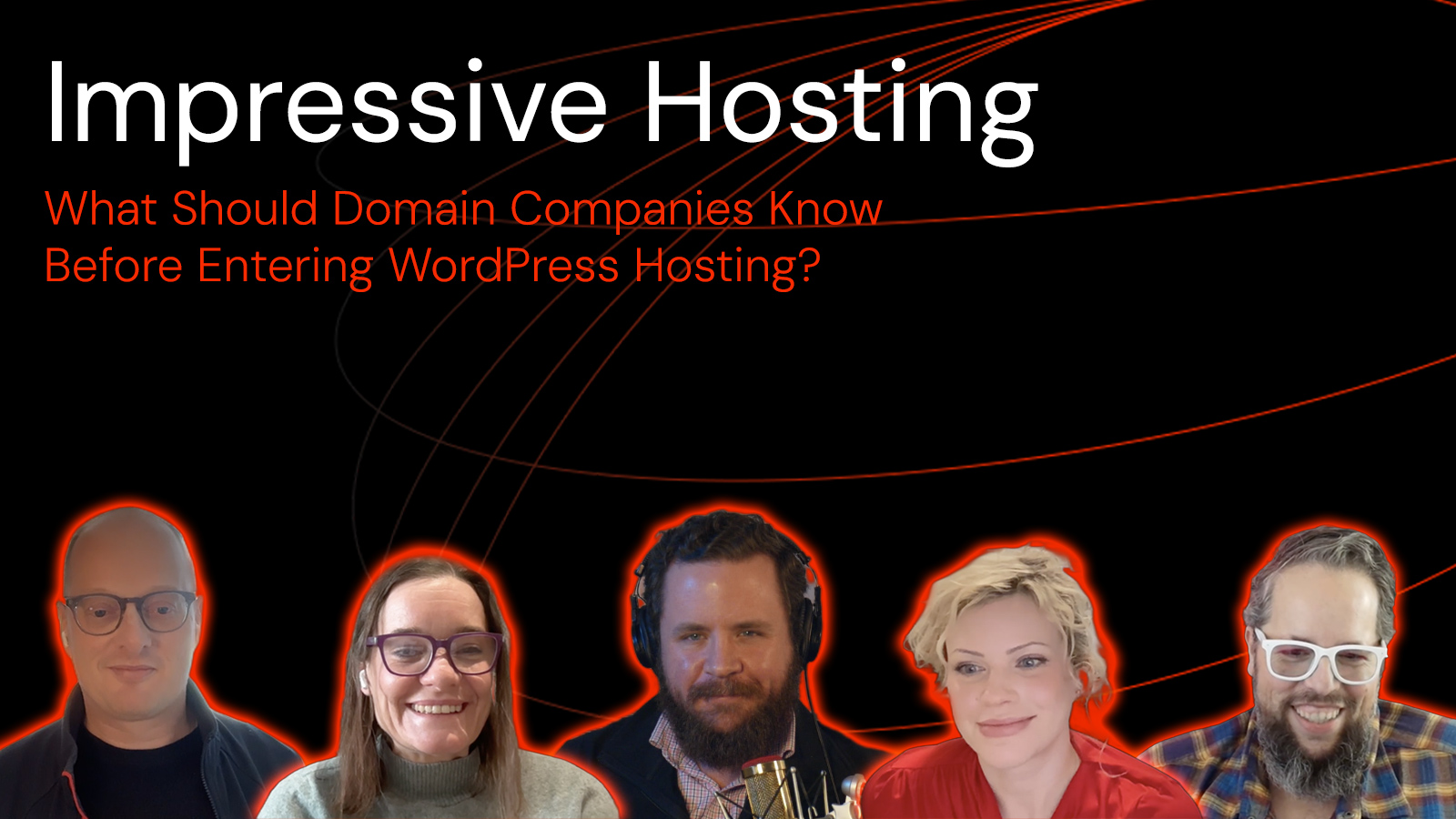
Jesse Friedman brings together domain experts from across Automattic for a unique registrar registry roundtable. Leanne Hogben from the registry team, Ronald Gijsel who leads registrar partnerships, Elise Prather from WP Cloud business development, and Joshua Goode from technical solutions share insights on how domains and hosting intersect in the WordPress ecosystem.
The conversation covers the upcoming opportunity to apply for new domain extensions starting in April 2025, the first time since 2012 that new generic top-level domains will be available. The team explores how registrars can move beyond transactional domain sales to offer complete publishing solutions, and why diversity in hosting providers strengthens the open web.
For hosting companies and registrars looking to expand their offerings, this episode provides practical insights on leveraging domains as the entry point to WordPress hosting. The discussion includes strategies for niche hosting solutions, the technical considerations for different use cases like e-commerce versus blogs, and how infrastructure-as-a-service approaches can help domain companies compete with established hosts.
Links:
Transcript
Teaser
Introduction
Jesse Friedman: Welcome to Impressive Hosting, a podcast about the role hosting plays in shaping the open web. I’m your host, Jesse Friedman. On this show, we go deeper than uptime and dashboards. We talk about hosting as infrastructure, about ownership, independence, and what it takes to build ethical, high-end WordPress hosting that actually serves creators, businesses, and the internet itself.
Before we dive in, head to impressive host, that’s where you can comment on episodes, ask follow-up questions, and help shape future conversations. You’ll also find links to follow, like, and subscribe wherever you listen. Today’s episode is unique in that we have several guests and we’re doing what we’re calling a registrar registry roundtable.
Instead of just having a conversational-style episode, we’re gonna bouncae around and ask several of our experts questions across the board because we think domains are incredibly important and a piece of the open web that everyone should be more familiar with.
We’ve brought together a group of experts from Automattic who are focused on everything from selling domains to partnering with registrars, to selling WP Cloud and maintaining it as well. Let’s jump in by introducing our first guest. Leanne, you are the head of registry at Automattic. Tell us a little bit about yourself, where you’re located, what you’re working on, and give us the lowdown.
Leanne Hogben: Sure. Well, hello and thank you for having me. My name is Leanne Hogben. I’m normally based in Melbourne, Australia, but I’m coming today from Montreal for a team meetup with Ronald and our domains team. We at Automattic have the domain .blog, and I work on all of the things related to that—marketing and operations of .blog.
Jesse Friedman: Very cool. You’ve been around the block for a while now and you’ve been working with partners, seeing a lot of different domains and stuff. What’s a TLD that makes you smile or raises an eyebrow?
Leanne Hogben: Anytime I encounter a new gTLD in the wild, that always makes me smile. My phone is full of fun domain sightings—photos of them. I love when I’m traveling. I often see restaurants that are using city TLDs. I see it at home in Melbourne. A lot of restaurants use .melbourne, and I was just in Tokyo the other week and I saw the same thing there. So when I’m choosing a restaurant and all things being equal, I’ll usually go for the one with the better TLD.
Jesse Friedman: I like that. A localization angle. That’s nice.
Leanne Hogben: Yeah.
Jesse Friedman: Very cool. All right, Ronald, you’re in Canada with Leanne. You’re at a conference. You are the head of registrars at Automattic. Tell us what that means.
Ronald Gijsel: Great. Thanks Jesse. Head of registrar. My name is Ronald. I’ve been at Automattic for a number of years, but just over a year sitting in the seat of head of registrar. I normally live in Cyprus, but yeah, as you mentioned, we are here in Montreal at a team get-together, and we’re working very hard making domains a better place. A better team at Automattic. Head of registrar means connecting a lot of dots between operations, ICANN accreditation, business development, and partnership. Sometimes my kids ask me what I’m doing because all they see me do is chatting and sending emojis and so on. But it’s really just connecting all the dots between all of that, because domains are right at the center of everything. You talk about abuse, registration, renewals, but it’s the front door to everything, and that makes it so exciting.
Jesse Friedman: Nice. You and I share something in that. We’re often traveling and meeting with partners and taking them out to dinner. What’s your go-to when you’re looking for a restaurant? What kind of food are you looking for? What’s the atmosphere you’re looking for when you’re taking a partner out to dinner?
Ronald Gijsel: I was just talking about it internally and that’s a really difficult question because I guess it depends a little bit on what you want to get out of it. The reviews of restaurants are crucial. Finding a nice place that allows you to have a good conversation. I don’t like loud places because the intimacy with people is important. I must say in the domains industry, people have been working there for a very long time. I’m a fairly new person in the industry. Leanne has been there for a very long time, which I appreciate because sometimes I have to ask for some references of who’s this, who’s that. If somebody’s been in the industry for a very long time and they refer to companies by their previous names, it means they’re old. It’s a long space with lots of folks that have been there for a long time. So building strong long-term connections is key.
One of my favorite sayings is meeting without eating is cheating. So when it comes to meeting in a restaurant, it’s absolutely crucial.
Jesse Friedman: Meeting without eating is cheating. That’s awesome. I’ll say that as much as I love Italian food, it’s not conducive to a good partnership discussion like shoveling spaghetti in your mouth. So my favorite’s always sushi because it’s easy to eat while having conversations.
Ronald Gijsel: If you’re competent with chopsticks because if not, it could be a total failure too.
Jesse Friedman: That’s true too. But it’s a nice icebreaker. You can teach someone how to use them.
Ronald Gijsel: Yeah.
Jesse Friedman: All right, all right. Elise, you’ve been on the show before and you are someone that I have the pleasure of working with all the time. You’re the VP of Partnerships and Growth at WP Cloud. Tell us a little about yourself.
Elise Prather: Yeah, so I have been with Automattic for a little over a year now, which is very exciting. Probably closer to a little under a year and a half by the time this airs. But my concentration on the team is to not just make sure I’m understanding the market when I’m meeting people and setting up new partnerships, but also understand where all of the companies that I’m talking to want their businesses to go.
There’s so much going on right now. AI roadmaps are like six-week sprints typically. So things are changing really quickly. Aside from making sure I’m spreading the knowledge of WP Cloud infrastructure, it’s also helping people get to the place that they want their roadmap to be, and understanding how we can play a part in that.
Jesse Friedman: Yeah, that’s great. So you’re at conferences all the time, and you and I have conversations about swag. What is some of the cooler, fun swag things you’ve seen lately?
Elise Prather: Okay, so I really love trinkets, so I’m very excited about this question. I have two things at my desk and then I’m gonna have to ask you if you have one of our swag items, because it’s also a favorite of mine and I don’t have one anymore. I was at Affiliate Summit West in Vegas and this business card I got looks like a poker chip.
Jesse Friedman: Oh, it looks like a poker chip.
Elise Prather: It is. It’s Dylan’s business card, the CEO of Gravity ads. So I thought this was a really neat, memorable way to give out a business card. There’s actually proper weight to it too, so I thought it was really fun. The other one is from Big Scoots. It’s like a little squishy toy. I can squeeze it on my desk, and I think it’s the cutest little squishy. This is my second favorite trinket, but hopefully you have yours. I didn’t give you a heads up that I probably want us to take a look at it, but we made iPod Nanos this year for WP Cloud. By made, I mean I sourced them and they all have engravings on the back as they’re recycled essentially. We loaded Impressive Hosting on it so that I could hand them out to people at our conferences this year. Yeah, it was really fun.
Ronald Gijsel: We’ve been talking about Slack and what works well, what we like, and maybe create our own. So that’s a good way of showing it. I think battery packs are always very welcome at conferences.
Jesse Friedman: Yeah, it’s very cool because it’s hard to tell on here, but the iPod comes preloaded with some great Impressive Hosting episodes. It’s also a really nice way for us to introduce people to what WP Cloud has to offer. It’s also a retro-style thing. We’ve been playing around with the narrative around that swag item, but I think very much that it allows us to send the message that WP Cloud is focused on the high-tech hard stuff, and you can take a break and relax and listen to some music or some Impressive Hosting podcast episodes. Very cool. Thanks, Elise.
Elise Prather: It’s been so fun to see the impact of it too, Jesse. I think the most fun thing is the conversations I’ve had with people after handing it to them. Like Andrew Palmer, a friend of yours. Ronald and I got to know him a bit more after talking to him about that. It was fun.
Ronald Gijsel: Yeah, something nostalgic definitely opens the conversation and creates deeper connections. I also know the .blog team does notebooks, really nice notebooks. I think that’s a nice thing. We probably get overwhelmed with notebooks, but you know, when you get a good notebook that’s well made, you keep that.
Jesse Friedman: Yeah, for sure. Yeah. So if you’re ever at a conference and you see Elise, you can give her a little elbow and ask for an iPod. See if she has one on her.
Ronald Gijsel: Great.
Jesse Friedman: All right. Last, but absolutely certainly not least, Joshua Goode. A friend and colleague who has been helping all of our partners find success with WP Cloud. He is our technical solutions engineer, our partner success manager, our magician, handyman, everything in between. Josh, it’s great to have you here.
Joshua Goode: Yeah. Thanks for having me back, Jesse.
Jesse Friedman: So you’re covering a lot of bases. Why don’t you tell us a little bit about something interesting that’s been on your plate lately or maybe something you’re thinking about for the roadmap. Where’s your head at these days?
Joshua Goode: Yeah, so with my background, I’ve worked on wordpress.com, I’ve worked on Pressable, and then I moved to be fully dedicated as we want to grow WP Cloud. As we look to the future of how we want to elevate WP Cloud and the entire hosting industry further and set higher standards, we’re constantly looking at different ways we can improve site performance, speed, and reliability.
You know, some core table stakes if you want great WordPress hosting. With that, we’re doing some cool things around, specifically for e-commerce. So imagine you have a WooCommerce store that’s pretty busy. Right now, a lot of hosts have a lot of requests in that space that can’t be cached. So how can we make these usually uncacheable experiences cached all the time automatically? That’s more of a technical thing that I personally get excited about. But the fact that we can turn that around and it can be a value add that companies and registrars can bring to differentiate themselves and improve their hosting capabilities. And that gets me excited.
Jesse Friedman: I love your role because you’re at the intersection of empathetic listening. You’re talking to our partners and understanding what they need. You’re talking to end customers and understanding what they need, but you’re also in an actionable role where you can actually influence the roadmap, make changes yourself, build new things, and bring that stuff to our partners. One of my favorite things is when I hear from a partner that they want some feature or something new. Josh, you just jump in there. Sometimes it’s a longer thing—it takes weeks or days—but sometimes you’re able to get something done very quickly and alter the course of that relationship. I think that’s fantastic.
Joshua Goode: Yeah.
Jesse Friedman: All right. Before we jump into the podcast, I have one quick question for you, Josh. You’re so focused on high-tech stuff all the time. What are you doing with your free time when you’re not plugged in?
Joshua Goode: Well, you can find me often. I live in southeast Tennessee, pretty rural area, and we have a bit of old farmland. So when I’m not on the computer, you can often find me out on a tractor or maybe fixing a tractor, which I guess I spend more time doing that. So I do get out about quite a bit and try to maintain the land a bit. We’re not doing too much actual farming anymore, but I’m usually outside.
Jesse Friedman: It’s awesome. I think that’s really, really awesome. Yeah.
Ronald Gijsel: Do you do anything else as well?
Joshua Goode: Oh yeah. Yeah. So that’s my other main hobby. I used to be in the professional brewing world when I took a little sabbatical from tech. So we have a pretty hefty professional brew-level brew system that a friend and I use on a regular basis. We still brew a bit. Nothing is fermenting right now. But here come the spring, we do some fundraiser events and stuff where we will brew the beer for the fundraiser. So we will be starting that back up here in the spring.
Jesse Friedman: Elise, I think we need to consider putting out a WP Cloud beer. Not only would that be an awesome swag item, but it might help get some signatures on some pages too.
Elise Prather: Have you ever seen those beer belts where it goes across your chest like a belt with cans of beer? Sign me up. I’ll do it.
Ronald Gijsel: We could do an Automattic beer fest at Joseph’s. Right?
Joshua Goode: Yeah.
Jesse Friedman: Yeah, we could run our own Oktoberfest this fall. That sounds like a great plan.
Elise Prather: As a salesperson, am I the appropriate person to recommend a shot-gunning competition?
Joshua Goode: I’ll have to brew some lighter beer if we’re going to do that.
Jesse Friedman: All right, so let’s jump in. Great round of intros. I wanted to make sure everyone at home understood why I wanted these folks from Automattic, these experts in the field, to come and talk to us. But now we want to jump in. So, Leanne, you came and visited Rhode Island last year and you visited with the WP Cloud team. You gave us such a great lowdown on the registrar registry world and helped us understand it all so much better. From your perspective, or from our perspective, it was invaluable having you there. I’m gonna ask you to give us a “Playschool” type explanation. Actually, you’re from Australia. Do you have Play School there?
Leanne Hogben: Play School. I think the kids show.
Jesse Friedman: Okay.
Leanne Hogben: Yeah.
Jesse Friedman: All right. Very cool. So from a Play School perspective—explain it like I’m five—what’s the difference between registries, registrars, and also what’s going on with the most recent thing with the auctions and new TLDs that are coming up? I know that there’s something happening soon where we’re gonna start seeing a release of new domains, right?
Leanne Hogben: Yeah, that’s a big question. Okay. I think that’s a good place to start because we’ll no doubt use the terms registry and registrar many times in this conversation. The easiest way to think about it is that a registry is like the wholesaler and the registrar is like the retailer of domain names.
So if you want to buy a domain name, you’re usually gonna go to a registrar. A registrar will sell you .com domains. They’ll sell you .blog. You’ll have options of different domains that you can buy at a registrar. A registry typically manages a single domain or a single set of domains.
So Automattic is the registry for .blog. We manage the database of .blog domain names. If a registrar wants to register a .blog domain, they need to connect to us to do that. So that’s the difference between registries and registrars.
In terms of what’s happening with new domains, yeah, this is something big. The last time it was possible to apply for a new domain or a new TLD was in 2012. So what, 14 years ago? That’s right, 14 years ago now.
Jesse Friedman: Yeah.
Leanne Hogben: Yeah, so that was when we got .blog. Before 2012, there were just the legacy TLDs like .com and .net. There weren’t as many options available. In 2012, ICANN opened it up so that anybody could apply or any business could apply for a new gTLD. We got something like 1500 or so new gTLDs out of that round, including .blog.
Jesse Friedman: 1500. That’s what you said.
Leanne Hogben: Yeah, around that. Some of those are brand TLDs, so they’re not open TLDs that anybody can register in. There’s .canon or other big brands. So they’ll be available exclusively for that brand to register domains in. And then there’s what we call geo TLDs—city TLDs. They may or may not have restrictions around having to live in that city or have some sort of connection with that city. And then there’s the generics like .blog, .online, .art, .cloud. There’s so many of them, which are open. Yeah, so that’s what came out of that round. And for the first time since 2012, beginning in April, the end of April, we’ll be able to apply for new gTLDs. That’s generic top-level domain. Yeah, so we’ll see what comes out of that round. We’re thinking now about what we’re gonna do at Automattic, as is everybody else in the industry. It’s gonna be a long process. Applications open at the end of April. And then I think we probably won’t see the actual domains that are applied for in that round go live until like towards the end of 2027. I think it’s gonna be a very long process.
Jesse Friedman: Oh, okay. So we got a little ways to prepare for it. Yeah.
Leanne Hogben: Yeah. But if you’re thinking about it now, now is the time to act. But if you wanna actually register one, you got a bit of time before that happens.
Jesse Friedman: Gotcha. And in 2012, that was when I remember seeing the expansion beyond the typical TLDs that we were so used to—the .com, the .edu and all. That’s when we got like .pizza, .agency, all those crazy ones?
Leanne Hogben: Yes.
Jesse Friedman: Yeah, right, right.
Leanne Hogben: Yep.
Jesse Friedman: Yeah. Okay.
Elise Prather: I was saying, I wonder what we’re gonna see pop up this year that hasn’t been used or created. Yeah, I know when we had our meetup, I was saying .curse word, you know, as a joke. I am curious to see what’s gonna pop up because what pops up this round will dictate a lot of the trends of what is used and marketed in the next 12 years until this happens again.
Leanne Hogben: Yeah, it’s not really defined, I think.
Elise Prather: Okay.
Leanne Hogben: Yeah, we don’t know.
Jesse Friedman: The market defines it.
Leanne Hogben: Yeah. It wasn’t intended that it was gonna take 12 years for the next round to come. But that’s how long it took. I think you know, there are things that didn’t exist back in 2012 that exist now—things related to Web3 and crypto and AI. I think that’s what the industry expects. But we’ll see. I mean, I hope we get some good surprises as well.
Jesse Friedman: Awesome.
Elise Prather: Yeah.
Jesse Friedman: Thanks for the great explanation there. Yeah, I wanna give you a chance though. Do you want to ask anything?
Leanne Hogben: I do. So now that we’ve got registry and registrar defined, I’ll ask a question about registrars to you, Jesse. So how do you think that registrars fit into the bigger perspective of preserving an open web?
Jesse Friedman: That’s a great question. I think the reason that WP Cloud in particular is interested in helping registrars right now is because they’re sitting on a ton of domains. Those domains have the opportunity—the customer can point that domain to anything. And frankly, I don’t see this more often, but if you run a social media page or something like that, you can buy a domain and point it at that. You don’t have to constantly be pointing someone to LinkedIn slash username. You could just buy, you know, jesse’s-bio.com or something like that and point it that way. Tumblr’s a great example of a social media network that allows for you to buy a domain and actually have it pointed directly at your Tumblr page.
So I think domains are incredibly important to the preservation and growth of the open web. But I think at the same time, if we’re not careful, more and more domains can end up being posted or pointed to closed networks. As we start to see the siloing of these networks and platforms consolidating your web presence onto these platforms, things get dangerous.
WordPress in particular is very good at preserving that open web and giving people ownership of their content. They get to own their audience and their influence. So I think it’s vital that we just try to aid in the development of that growth so that more and more domains can be pointed to the open web. We can make sure that we’re preserving what we care most about on the internet. That’s a great question.
Cool. Let’s move this round robin around. Ronald, how do you think we can better align domain sales with the WordPress experience so that buying a domain isn’t transactional, but it’s a first step towards publishing?
Ronald Gijsel: It is hard because not everybody knows what a domain is to begin with. Everybody has the idea like, “Oh, I wanna publish something. I wanna share something online.” And proprietary platforms, they’re very good at directing people to do exactly that. Traditionally, you would have to go to a registrar, register a domain, and do something with it and set it up. Quite often if you were to go to wordpress.com, you can do that all in one flow, within one transaction. In fact, you actually get a free domain with it, but it’s not always very obvious. And the terminology is not very clear for maybe 90 percent of the population. So I think we have some work to do.
You see some platforms where it’s all included and it’s the same flow. But you can do so much more with domains and directing users to your piece on the web—something you wanna share, an opinion, a product, or your podcast. That branding, that name that you have above the door of your shop or above the entrance of whatever you want to share, it’s such an important part of your identity. You know, earlier we talked about the different TLDs. If I said my website is ronald.com, it could be anything. But if I were to say it’s ronald.blog, it’s like, “Ah, it’s a blog.” Or ronald.art—maybe it’s an artist or museum or something like that.
So we’ve become a lot more playful with these new TLDs. I really like that trend where some of the newer TLDs are very popular and they build a community by themselves, creating identity. Registrars and registries are starting to play with that, and I really like that trend.
Jesse Friedman: I think it’s a great point and I think it’s something that people can build into their strategies as well. When you think about a company with multiple components to their web presence—a brochure-type website where they’re talking about their brand and values versus the actual e-commerce store where they sell their product versus the blog where they talk about updates and things like that. We often think it’s domain slash blog slash store, but there’s no reason not to buy additional domains and operate them as separate properties. Then build up a network of sites that interlink with each other and create a great experience for the customer. It gives you an opportunity to differentiate yourself so you know exactly where you are in that purchase flow.
For example, you know you’re on the .store, you’re about to buy something versus the .blog where it’s more of a learning opportunity. I think that provides a unique customer experience.
Ronald Gijsel: You referred earlier to some geo TLDs. If you live in a specific place, that could be an example of the TLDs. So a really good example is .org. You need to be a charity or nonprofit and share that. The same maybe for .eco. I think there are a few others like it. So to ensure that the value of those TLDs remain high and you know that when you visit a specific domain plus the TLD, that’s exactly what you can expect.
Jesse Friedman: Yeah. Great. Good answer, Ronald. Thank you.
Ronald Gijsel: I want to jump on that a little bit because I know the WP Cloud team is also keen to work with registries and sort of provide that flow. So you have a specific TLD that serves a group or community. Now we know that registry and registrar are two different things. The registry as a wholesaler is not able to sell domains direct to customers. So how do you think about providing that package service of hosting and domains that some registries would be able to utilize?
Jesse Friedman: Well, that’s really interesting. Yeah, so I mean, the opportunity that WP Cloud presents is that we have a way of offering essentially turnkey hosting. So if you are someone who’s in the domain space and you have a book of business or you’re getting into it now, maybe you’re registering for a gTLD for next year, WP Cloud can take care of the tougher parts of hosting. We can manage the infrastructure. We can manage updates. We can help provide a really superior customer experience and then let you focus on what you do best.
This is similar to the narrative that we talk with other hosting companies or other general companies interested in WP Cloud. You can either provide a subpar product, which no one wants and that’s not good for the WordPress ecosystem. A common theme on this podcast is that the first WordPress experience can be the last. So it’s your obligation to provide a really great experience.
The next step is invest heavily in both team members and infrastructure to create a competitive solution, which is an uphill battle and quite a struggle for new companies not playing in the space now. Another choice would be reselling hosting. But the problem there is you’re always working with essentially a competitor, and you’re often selling something that other people have defined.
WP Cloud plays at an API layer that allows for any company to build their marketing packages and business packages on top of that. So they can go to market any way they want to. We stay out of the business of hosting. We focus on infrastructure and allow you to figure out how it is to best serve your customers. So if you’re selling .store, for example, or some kind of e-commerce related TLD, you could spool up WP Cloud-powered e-commerce stores with pre-configured plugins so that you can offer a straight store experience and solve for a niche solution.
There’s a ton of things that we can do there. I think it’s really powerful that WP Cloud is focused on staying in our lane, which is providing the best WordPress hosting with a WordPress-first cloud platform and allowing the registry or the registrar to figure out how they want to go to market on top of that.
Yeah, thanks Ronald.
Ronald Gijsel: I think that’s a really good point. I like to see that come to fruition and see that evolve because the web is big and you can’t be a trader to the whole world. So finding your niche, finding your community, and building something specific for them is gonna be really exciting to see.
I mean, a good example is our own Automattic’s Newspack where we’ve repackaged some elements and provided a service specific for news outlets, and that seems to be working really well.
Jesse Friedman: Yeah, I think solving for niche hosting is gonna be a very important thing for the future. And actually, let’s ping pong that because you know, we’re talking about the value that WordPress plays in this space. Elise, why do you think hosting should be top of mind for registrars?
Elise Prather: Yeah, so the way that I look at it, when we talk about what’s healthy in the hosting industry in general, you were just touching on it: not every host is for everyone, which is why having more out there is important. Providing the ability for people to create an experience for the customers that they have is so helpful and important. When I think of registrars, the thing I think of is that there’s a different perspective on hosting there than there is in the rest of the market. The product by itself first is hosting and maybe they resell domains. But their main product is gonna be the up and to the right of hosting.
When I think about registrars, I think about how there are very specific registrars doing things like .art and .arts—artists. The people that are typically buying those domains are likely going to need something very different and maybe more guided or specific to what is important to them than someone who is .store. You can’t really cross paths with those two things and ignore the fact that there are specific needs for e-commerce and artists. Even if you mix the two, you have to be thoughtful about how you do that.
I think with registrars, they have the agility to not have a lot of infrastructure that has already been put in place. But even if there is, there is risk for them to explore changing things and looking into maybe a different roadmap than they had initially anticipated. Hopefully that makes sense.
You know, I wanted to ask you, Jesse, about strategy with that. You know, we’ve talked as a team about the industry as a whole and how we’re helping people with open source. I touched on that just a little bit by talking about making it easier for anyone to be a host and get different perspectives. But for you, when you think about who we’re working with and with registrars as non-traditional hosts, I’d love to hear just your thoughts about that.
Jesse Friedman: Yeah, I mean, I think it goes back to the same conversation we had before around empowering companies to take advantage of the things that they’re selling and the way they’re entering the market, allowing them to double down on what they do best, and then giving us the opportunity to take care of the infrastructure and take care of the harder parts of hosting.
I love what you said there about diversity in hosting being a good thing. The more hosts that we have out there providing a really great experience, the more likelihood that someone’s gonna stumble upon a WordPress experience that’s powerful and beneficial to them. It also helps us to be more competitive and grow our individual businesses.
I think that’s great. You know, at the same time, I think registrars have this tangentially related element where they’re selling these domains and they’re playing in this space, but they’re not necessarily always providing hosting. Sometimes, like you said, it’s the other way around where a hosting company is hosting first and they’re selling domains as the point of entry.
But a registrar has that point of entry. It’s just that a lot of times I feel like the companies we’ve talked to haven’t gotten into hosting as much because it is a big, hairy, complicated thing. It’s not the easiest thing in the world. So what we can do is step in and help provide performance and security and WordPress basically as a platform as a service. Give them the opportunity to turn that key and get things going very quickly, which actually gives us an opportunity to pivot now and ask Josh.
You know, if you’re talking to someone in the registrar space—maybe someone who hasn’t been playing in hosting very long or at all—what do you think are the most important things that should be top of mind for them to solve for, and where do you think WP Cloud can step in and help them with that?
Joshua Goode: Yeah, so just thinking about the conversations I’ve had and what they’re trying to solve for already: they want to know who’s managing the technical debt and how much are they going to be taking on in terms of hosting infrastructure to ultimately provide fast, reliable sites. Because, you know, it’s one thing—it’s great for registrars to use WordPress. It’s the fastest way to provide a very open experience for the open web. You can create anything. You can create experiences where anyone can go and create beautiful sites for projects or apps all within WordPress. So that’s a great foundation there.
They also get a business benefit of having stickiness. If you’re able to provide that good experience, you can keep them and keep that domain registered through you. So you have less risk of people transferring to another registrar or going to another host that may also act as a registrar. So the first thing coming to mind is like, “Well, we want to do that. We wanna provide something that’s gonna get people to stay with us.” But they don’t necessarily always want to have that massive investment that can go into creating a performant, reliable cloud platform. That’s where WP Cloud really comes into play. They can focus their time and energy on integrating with us, but they don’t have to worry about servers, caching, security, uptime, and reliability. They can take what we provide in those areas and use that in their marketing and packages. Build out ways that, as we’ve said time and time again, provide these great experiences and ultimately get these customers to stay with them long-term. Yeah.
Ronald Gijsel: Joshua, can I ask you a question? You mentioned packages there. So if, for example, as a registrar and you have a customer that obviously wants to start a blog because they registered their .blog, but maybe they want to start a store or a shop. The next step in hosting is to provide the right package, but also optimize it for their use case. Because I know from previous careers that building a blog site and a store site is very different. You don’t know your file sizes and optimization, caching, especially in e-commerce or WooCommerce store. It’s quite a trick. So the question really is like, do you have different packages for the same registrar? So depending on what the use case is, you have an optimized experience.
Joshua Goode: So you know, part of our kind of go-into onboarding with some of these registrars, we really look at what their goals are. We look and see if they are going for specific target audiences, what kind of packages do they want to target—agencies and e-commerce stores. You know, I’d say most people do want to take a slice of e-commerce, so we really look into what that means. We consult with them. We set everything up so we focus on the infrastructure and they get to handle the business. But we do get to bring our experience in this space and consult them on the packaging and go-to-market perspective, but also on actual technical things.
Like, okay, well you want to do e-commerce. Well now we have a big wide open realm of opportunity there where we can pre-package certain plugins, have things auto-configured, secure updates for all of those. So a user can come in, we can work with the registrar to have some AI integrations there. A user can come in quickly, spin up the design, say yes, I want this to be a store, and they can have auto-configured, pre-installed, ready-to-go plugins that are known to be performant.
This user’s able to come in and start a store within minutes and start listing products, connecting up bank accounts and all that fun stuff to really get them launched as fast as possible, and at the same time, have a pretty fast site.
Jesse Friedman: I think that’s a great summary, Josh, because I mean, basically what we’re saying here is that you can take a company who’s been focused on selling domains and hasn’t been focused on selling hosting. In a matter of weeks, you can turn them into a full-blown hosting company that is competing with some of the highest-level enterprise hosting out there because they get to take full advantage of all the components of WP Cloud.
I mean, we talk a little bit about the opportunity for someone to build this on their own. But something simple, or not simple, but something like one specific thing that WP Cloud offers to every one of our customers is automated real-time failover. This is the idea that if something catastrophic were to happen to a data center, we can reroute traffic in real time and keep your site up. This is how our partners are offering 100 percent uptime. The idea that a registrar could ever compete in that space on their own would be a monumental task and a huge investment on their part. So this is where we get into the opportunity to play into providing superior WordPress hosting, preserving that open web, and doing it in a way that we’re empowering more and more folks to spread the wealth of a great WordPress experience.
Ronald Gijsel: What if my .blog, um, goes viral? How do you handle that on the WP Cloud side?
Joshua Goode: Yes.
Jesse Friedman: That is such a great question. And you know what, let’s open the next episode with that question because we’re at about 45 minutes here. I know our producer John is in the background right now pushing buttons, trying to get us to end this episode. So this is a great opportunity for us to take a quick break. We’ll be back with part two with everybody. Thanks everybody for joining.
Joshua Goode: Thank you.
Conclusion
Jesse Friedman: Thanks for joining us on another episode of Impressive Hosting, where we uncover the core tenets of great WordPress hosting. Do you have a follow-up question for today’s guests? A thought or comment on anything we talked about? A future guest suggestion? A hosting horror story? What do you think makes great WordPress hosting? All your comments shape the show. Drop them on impressive.host. We also appreciate you following us on social media and subscribing to the podcast on your favorite platform. Finally, do check out our list of open-source projects that need support at impressive.host. Whether it’s code, community, or cash, you can make a difference.
See you next time.
Subscribe to Impressive Hosting:


Leave a Reply