'%3E%3C/path%3E%3Cpath d='M76.4782 25.7185L71.982 9.04089H74.6936L78 22.8409L81.8045 9.04089H84.5853L88.2722 22.8409L91.5787 9.04089H94.2902L89.7248 25.6977H86.7781L83.1396 12.6379L79.3835 25.6977L76.4782 25.7185Z' fill='rgba(247, 43, 0)'%3E%3C/path%3E%3Cpath d='M96.6075 9.04089H102.439C103.739 9.04089 104.818 9.26224 105.676 9.69803C106.534 10.1338 107.17 10.7287 107.592 11.4827C108.014 12.2367 108.222 13.0875 108.222 14.0421C108.222 14.9483 108.021 15.7783 107.613 16.5254C107.212 17.2794 106.575 17.8812 105.725 18.3239C104.867 18.7666 103.774 18.9879 102.439 18.9879H99.1323V25.6977H96.6075V9.04089ZM99.1323 16.9128H102.321C103.511 16.9128 104.362 16.6568 104.881 16.138C105.399 15.6192 105.655 14.9206 105.655 14.0352C105.655 13.1152 105.399 12.3958 104.881 11.8839C104.362 11.372 103.511 11.1092 102.321 11.1092H99.1323V16.9128Z' fill='rgba(247, 43, 0)'%3E%3C/path%3E%3Cpath d='M124.138 25.9744C122.492 25.9744 121.067 25.6147 119.87 24.8953C118.674 24.1759 117.747 23.166 117.097 21.8725C116.446 20.5789 116.121 19.0848 116.121 17.3901C116.121 15.6746 116.446 14.1735 117.097 12.88C117.747 11.5864 118.674 10.5765 119.87 9.84329C121.067 9.11698 122.492 8.75036 124.138 8.75036C126.089 8.75036 127.68 9.22766 128.918 10.1753C130.156 11.1299 130.938 12.458 131.277 14.1735H128.469C128.247 13.2051 127.77 12.4373 127.044 11.8631C126.317 11.289 125.342 11.0054 124.118 11.0054C122.45 11.0054 121.136 11.5726 120.168 12.707C119.199 13.8415 118.715 15.3979 118.715 17.3831C118.715 19.3476 119.199 20.8971 120.168 22.0246C121.136 23.1521 122.45 23.7124 124.118 23.7124C125.342 23.7124 126.317 23.4427 127.044 22.9031C127.77 22.3636 128.247 21.6234 128.469 20.6896H131.277C130.945 22.3428 130.156 23.6294 128.918 24.5702C127.68 25.5109 126.089 25.9744 124.138 25.9744Z' fill='rgba(247, 43, 0)'%3E%3C/path%3E%3Cpath d='M133.961 25.6908V8.5636H136.486V25.6908H133.961Z' fill='rgba(247, 43, 0)'%3E%3C/path%3E%3Cpath d='M145.195 25.9744C144.067 25.9744 143.057 25.7185 142.158 25.1997C141.259 24.6809 140.553 23.9615 140.027 23.0346C139.502 22.1076 139.246 21.0216 139.246 19.7903C139.246 18.5591 139.509 17.4731 140.041 16.5392C140.574 15.6123 141.293 14.8929 142.192 14.3741C143.099 13.8622 144.102 13.5994 145.215 13.5994C146.343 13.5994 147.353 13.8553 148.252 14.3741C149.144 14.8929 149.864 15.6123 150.396 16.5392C150.929 17.4661 151.192 18.5522 151.192 19.7903C151.192 21.0285 150.929 22.1076 150.396 23.0346C149.864 23.9615 149.144 24.6809 148.245 25.1997C147.332 25.7185 146.315 25.9744 145.195 25.9744ZM145.195 23.8093C145.796 23.8093 146.357 23.6571 146.869 23.3597C147.387 23.0553 147.802 22.6126 148.121 22.0177C148.439 21.4228 148.598 20.6827 148.598 19.7903C148.598 18.898 148.446 18.1579 148.134 17.563C147.823 16.9681 147.415 16.5185 146.896 16.221C146.377 15.9167 145.824 15.7714 145.222 15.7714C144.62 15.7714 144.06 15.9236 143.548 16.221C143.029 16.5254 142.614 16.9681 142.296 17.563C141.978 18.1579 141.819 18.898 141.819 19.7903C141.819 20.6827 141.978 21.4228 142.296 22.0177C142.614 22.6126 143.023 23.0622 143.534 23.3597C144.032 23.664 144.586 23.8093 145.195 23.8093Z' fill='rgba(247, 43, 0)'%3E%3C/path%3E%3Cpath d='M158.275 25.9744C156.85 25.9744 155.723 25.5317 154.906 24.6394C154.09 23.747 153.682 22.4258 153.682 20.6688V13.8899H156.207V20.406C156.207 22.6887 157.141 23.83 159.015 23.83C159.949 23.83 160.717 23.498 161.326 22.834C161.927 22.1699 162.232 21.2153 162.232 19.9771V13.883H164.757V25.6908H162.522L162.336 23.6225C161.969 24.3488 161.436 24.9299 160.731 25.3449C160.011 25.7669 159.195 25.9744 158.275 25.9744Z' fill='rgba(247, 43, 0)'%3E%3C/path%3E%3Cpath d='M173.341 25.9744C172.2 25.9744 171.19 25.7046 170.318 25.1651C169.447 24.6255 168.762 23.8854 168.271 22.9515C167.779 22.0177 167.53 20.9525 167.53 19.7627C167.53 18.5729 167.779 17.5146 168.271 16.5876C168.762 15.6607 169.447 14.9275 170.325 14.4018C171.204 13.8692 172.213 13.6063 173.362 13.6063C174.296 13.6063 175.119 13.7861 175.824 14.1528C176.53 14.5194 177.083 15.0313 177.478 15.7022V8.5636H180.002V25.6908H177.74L177.478 23.8577C177.097 24.4111 176.571 24.9022 175.907 25.3311C175.243 25.76 174.385 25.9744 173.341 25.9744ZM173.791 23.7885C174.87 23.7885 175.755 23.415 176.44 22.6679C177.132 21.9209 177.478 20.9663 177.478 19.7903C177.478 18.6006 177.132 17.6391 176.44 16.8989C175.748 16.1588 174.863 15.7922 173.791 15.7922C172.712 15.7922 171.826 16.1588 171.127 16.8989C170.429 17.6391 170.083 18.6006 170.083 19.7903C170.083 20.5651 170.242 21.2568 170.56 21.8586C170.878 22.4604 171.314 22.9308 171.881 23.2767C172.435 23.6156 173.078 23.7885 173.791 23.7885Z' fill='rgba(247, 43, 0)'%3E%3C/path%3E%3C/svg%3E)
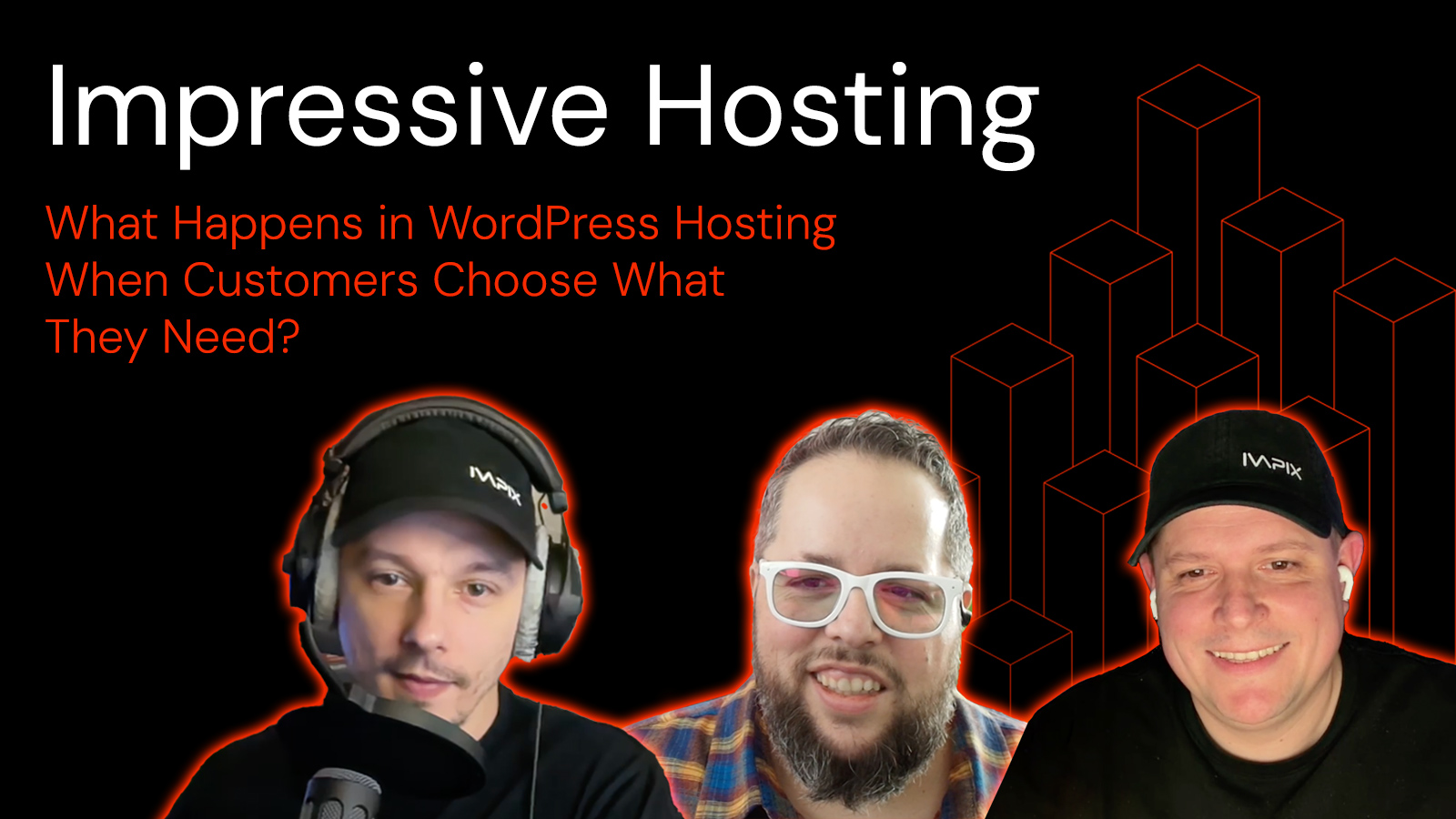
Jesse Friedman interviews Ivan Pjano and Dale Obradović from Ivapix about their custom WordPress hosting dashboard built on WP Cloud. They discuss flexible pay-per-site pricing, eliminating rigid hosting packages, and creating simplified panels focused solely on WordPress instead of bloated universal control panels that overwhelm users with unnecessary features.
Chapters:
00:00 Teaser
00:45 Introduction
03:14 The Value of Ad Hoc Partnerships
07:07 Building a WordPress-Only Dashboard
09:55 Breaking Free from Rigid Hosting Packages
15:33 Why Universal Panels Don’t Always Work for WordPress
20:10 Customer Choice Over Company Convenience
24:54 How to Scale with Customers in Mind
Show Links:
Transcript
Jesse Friedman: Welcome to Impressive Hosting, where we seek to uncover the tenets of great WordPress hosting. I am your host Jesse Friedman, and with me today is Ivan and Dale from Ivapix. I wanted to have these guys on because they are one of the earliest adopters of WP Cloud, and they’ve been doing a remarkable job of using it to bring on some great clients. So I wanted to talk to them about how they’re using it and the benefits that they see from it. Ivan and Dale, thank you for joining. Why don’t you guys take a second to introduce yourselves?
Ivan Pjano: Oh, thank you, Jesse, for having us on the show. My name is Ivan. I’m the CEO of Ivapix Corporation. So we are like pioneering now in the hosting industry with successful partnership with you guys. So hope we’ll have a great and prosperous future.
Jesse Friedman: Yeah, nice.
Dale Obradović: And also, thank you, Jesse, for having us here. And yeah, my name is Dale, or not really like the real name is Danielle, but everyone calls me Dale. So, except my mom when she’s angry at me. And yes, I’m working as a—yeah, you could say like a role is kind of CTO, lead developer with Ivan for, I don’t know, now it’s like, what, eight years or something like that. And yeah, that’s it, I guess.
Jesse Friedman: Oh, that’s great. So you guys have been working together for almost a decade.
Dale Obradović: Yeah. Something like that. Yes.
Ivan Pjano: Yeah, yeah. First time we met it was like friendship only, then we partnered together to be partners in this hosting situation. So I think it’s doing great for both of us. Yeah.
Dale Obradović: I’d agree with that.
Jesse Friedman: That’s great.
Ivan Pjano: Sometimes we argue, but you know, at the end we are like on the same line.
Dale Obradović: Yeah.
Jesse Friedman: Oh, that’s great. And we met at CloudFest, which is coming up again. CloudFest 2025 in Rust, Germany is coming up in just a few weeks. This will probably go live maybe after that conference, but it’s a wonderful opportunity to bring together people who are working in the hosting industry, the cloud infrastructure industry, registrars—all into one place. I like CloudFest because while it’s kind of a pain to get to, once you’re there, you have the lay of the land. You have this—we take over this entire amusement park for a week. CloudFest is maybe even one of the best events in Europe for the hosting industry.
Ivan Pjano: So yeah, that’s where we have a vision, like we need to go there, we need to be there to see other partners of the hosting industry, to see how the other guys are doing their business, you know, to get better. So that, I think that day when we met it was really, really good for us, you know, the break in our business operating of the hosting business. So…
The Value of Ad Hoc Partnerships
Jesse Friedman: Yeah, I think what was funny was that I had a packed schedule. I had something like 30 or 40 meetings in just three or four days. And you had seen me give a talk on WP Cloud. I think it sparked an interest in you right away. You’ll tell us about that in a second. And so you asked for some time to meet with me and I was fully booked, but I didn’t want to lose out on the chance. So you and I ended up—we all ended up having a meeting in the parking lot near a water fountain, taking a quick smoke break. That’s where everybody seemed to kind of congregate who does, you know, take a smoke break. And we had that meeting outside and we had a very, very quick catch-up. And then from there we just kicked off a partnership. It was quite organic.
Ivan Pjano: Yeah, yeah, yeah. I remember that your presentation was like on the WordPress day—I think it was even the last one. And we were like thinking about is it possible that one person from Automattic is like giving the presentation on the last, but the thing is, it was for me the best one and it was a complete revolution, especially that slide when you showed those, like, you know, the explosions in the fires of the data centers, you know, and the things what will happen if one of the data centers dies and how it’ll be instantly mitigated to the other data centers. That was the spark. When we were like, okay, this is the thing we need, you know, to expand our business, you know?
So, but at first, I thought that—I know that you are a very busy guy and I thought that it’s not possible to come to you, you know, but we wanted to try out, you know, to see is Ivapix a good partner, to see how the things will roll up. And I think your guys are also satisfied how we are with the platform and everything, you know, because it completely changed our business and everything. The satisfaction with the customers. So it—because now at the end, we can only focus on providing really good support and we can provide a really good panel for our customers and not be dependent from the other panels for the hosting companies.
So there’s, as you mentioned, yeah, the WordPress as a service which you guys provide, it gives us really, really, really good opportunity to build a great panel for us. And Dale is the guy who is building that with the rest of the boys, so yeah.
Jesse Friedman: That’s a really great segue. You touched on a couple things there. We want to come back to automated real-time failover, which is what you were referring to with that catastrophic failure slide. But yeah, so Dale, tell us a little bit about the panel that you built. One of the things that we had really sought to make happen with WP Cloud is to partner with hosting companies to empower them to really focus on providing excellent experiences to customers by letting us take care of the infrastructure and the underlying serving of websites. And I think that you guys are a great example of exemplifying that. So tell us a little bit about the panel you built.
Building a WordPress-Only Dashboard
Dale Obradović: Yep. Sure. Yeah. First we were kind of unsure where, which direction we want to go, so we had a challenge of deciding of doing something like the panels that are currently showing up, like the pretty much universal panels that you can just attach to your part of an API that WP Cloud gives actually.
So there’s like an integration, right? And we wanted, we knew that WP Cloud is kind of new. So we did consider, okay, what if we actually go and build something white-label like that and just like sell that for the future partners of WP Cloud. At the end we decided not to do that because then it’s mostly because of the business model. Like different hosting companies have different business models or different packages, different hosting packages, right? Or like subscriptions as nowadays it’s called. So we said, nah, no, let’s not do that. Like, let’s just build the thing for ourselves and have full customization of it.
We had like another challenge, which was, we want to not be limited. If we look into a bunch of other hosting providers and this was pretty big challenge for us. Actually, I wanted as a developer who like up to some years ago actually worked with WordPress and a bunch of hosting services. I was always thinking like, yeah, okay, you are making me buy, like I have six websites. Your packages as a hosting company, you—
Ivan Pjano: Yeah.
Dale Obradović: —are forcing me to buy 10. So you’re basically forcing me to pay more to buy 10 when I actually don’t need that. And I, like, we actually talked, and I, we talked a lot about that and how to actually solve this problem for the customers where we do not want to enforce these like boxes as I like to call them, but instead really be completely flexible.
Once we had that sorted out, the next thing was really the integration, which was almost painless, right? It was like, you want that? Sure. You shoot the API call. And it’s basically done. Like it was—as you probably remember, there were also some stuff we asked about which the API at that moment wouldn’t, or couldn’t support or didn’t have support for. So, but that’s like sorted out most of those things anyway. And we still have like, I would say a lot to do, but not a lot until we actually release the first version.
So the next challenge I’d like to kind of mention is that not everyone who actually uses the dashboard or the panel is a technical user.
Ivan Pjano: Yeah.
Dale Obradović: We don’t really want to cater to either of the groups where we, on one side we could have like technical users, probably developers who actually know what they’re doing. They know what DNS is or what the DNS zone is or how all of that works. We want to have them or provide to them an easy way to navigate all that. But at the same time, also support non-technical users so that they can just in the middle of a night, get to our dashboard, buy the hosting subscription for any number of sites they want, pick the resources, assign them to websites that they can just manage basically. So we don’t want to like enforce any scaling issues the user might have. And it doesn’t matter if it’s like a non-technical or a technical user. And it is tricky. And this is why we kind of, we didn’t really rush. Like we are—
Ivan Pjano: Yeah.
Dale Obradović: —now for two years, if I’m not mistaken, almost two years. Right. And we didn’t really want to rush the dashboard like, and be like, yeah, okay, just get it out there. Half the things are breaking. Maybe we got half the things wrong. No, we really actually wanted to sit, think it through and find ways—elegant ways of supporting all of these use cases.
Ivan Pjano: Yeah. What?
Dale Obradović: I think we’re very close to—
Ivan Pjano: Yeah. Yeah. What…
Breaking Free from Rigid Hosting Packages
Ivan Pjano: What Dale wants to say, like for our current customers, the thing is, we give them freedom. Now they only choose the number of the websites they want to host, and that’s it. At the end of the day, they just scale up the website. Do they need two workers, three workers, five workers, et cetera? So it’s easy for them to just click the button, you know, instantly to change the performance of each of the websites whenever they want at any part of the day. So basically we are giving them all the flexibility to change the storage, to change the resources instantly without, you know, calling the support, contacting the support, et cetera.
Jesse Friedman: Right, that provides a better experience for the customer, but it also saves you money as a hosting company as well, that you don’t have to have a support line every single time somebody wants to change something. I think it’s really smart the way in which you approach your go-to-market strategy and the pricing that you set, instead of having people have to buy a bulk package of sites that maybe they don’t necessarily need. We have other clients who are pooling resources, so it’s interesting. They’ll still say that there’s a number of sites that you can use, but you can borrow the resources from those to apply to different sites. So everybody’s kind of taking a different path. But I love the idea that you’re really thinking about the fact that the customer gets a little bit frustrated when there’s features or services or tools that they don’t necessarily need and it gets bundled—they feel like maybe they’re leaving money on the table. And it’s a complicated thing.
It’s not an easy thing to answer because when you talk to hosting companies and the way in which they go to market, you want to provide, you know, superior value, you want to bolt on services and features and things like that, that make your hosting plan stick out. But you have to find a balance there around providing the right size of tools and the right set of services. So right now, if I were to go to ivapics.cloud and sign up, I would get to use this new dashboard. And so this is not relying on like the traditional panels that we know of, the giants out there that we’ll leave unnamed at the moment. Yeah. All right. That’s great.
Ivan Pjano: Our trip basically for the CloudFest was a search for that, for the solution of that, to not be dependent from those big giants in those panels. Yeah. And also, of course, the infrastructure which you provided was a revolution basically, you know. So that was a perfect match. Everything was a perfect match for us. And now we were, as developers can build a panel. We know what the clients want because we were the developers. So for WordPress, we were building the websites, we were providing the support. We were providing WordPress maintenance for our customers. But then we evolved. We evolved to be a great hosting company. And now with this great product which we’ve built, soon as the panel for the rest of the world will be available, we can at least target this region. And because I think this will be a pioneer thing in this region, you know, because this region will finally get someone who can provide the premium WordPress hosting.
Jesse Friedman: So let me ask you a question because you aren’t, and correct me if I’m wrong, maybe you’ve been doing this a lot longer than I know of, but you’re somewhat new to the hosting world, right? It’s only been, you know, let’s say less than a decade, right? You weren’t doing this back in the early 2000s or anything. When I talk to other hosting companies out there, a lot of the veterans out there have, you know, major complaints about these large panels that kind of provided almost a monopoly on the way in which a hosting company goes into the market. But I’m curious, what made you think that right out of the gate that you wanted to use a homegrown panel? What was it that drove you to build something rather than leverage, you know, panels that have existed for a very long time?
Ivan Pjano: The start as a program, those big panels they provided you, you know. I’m sure you remember, you’re a veteran. Like whenever you log in on some of those big panels, you are instantly like blown away with the amount of the icons, amount of the features. When you are like only starting as a developer or you are just a regular user who wants to have a website, you feel complicated. You don’t know where to click, what to use. It seems like you want to just drive a car but you are sitting in an airplane, so you don’t know what button to push, et cetera.
So that’s the most important thing why we decided to go this way, to simplify things, to make performance, to provide great performance. So that’s the way it brought, that was my idea basically. And Dale aligned with that. You know, he agreed, like, I think this is the future—the hosting companies need to be more friendly and their panels need to be much more friendly. Maybe now those big panels are dominating the market now because 20 years ago it was a mix of thousands of panels, maybe all the hosting companies have their own and then all aligned with those big guys. But now, at this time, I think things need to be much more faster, much more simpler so the users, so the WordPress users can jump in right away. So they just want to build a website so we need to provide them the quickest way possible to do that.
Dale Obradović: So I’d like to add something on top of that. It’s not only, how would I call that? It’s not only like the business decision, it’s also a technical—
Jesse Friedman: Right.
Why Universal Panels Don’t Always Work for WordPress
Dale Obradović: We believe that and I will just say it like, because that’s just my opinion, those big mega dominant, like the market dominance panels, right? They hold the market dominance, right? They just have too much bloat. And this is the main reason why things are slow in the first place. Like they tend to support multiple or way too many use cases for something that could actually be very simple, like a click of a button or two fields, like form and a button.
So basically, it’s bloated and it supports a variety of use cases when we don’t want that. We are partners of WP Cloud. The WP Cloud has a limited set of capabilities or properties that we can use. And—
Jesse Friedman: We’re focused on WordPress, so you don’t need to help with static websites or Drupal websites or something like that. Yeah.
Dale Obradović: Exactly. So we don’t have that. And then we want as—we can also call our company very WordPress-oriented as well. Like all sites we build are WordPress. We never did like a Drupal website.
Jesse Friedman: Yeah.
Dale Obradović: Just no use case for that. And if there is one, we will probably just reject the offer or like request for that because we are not going to go learn Drupal now to just—
Jesse Friedman: Yeah. It allows you to hone your focus on WordPress. It makes you stronger that way.
Dale Obradović: Correct. We are WordPress-oriented and we were once in the seats of all these users that are now our customers or will be. So we also have, like, I remember when I first went into one of these super big, super popular panels, like I bought hosting for my first website. I think it was like 2010 or something like that, or around that time. And I was so confused, like I don’t know what’s going on. Like there’s just a bunch—
Ivan Pjano: Yeah.
Dale Obradović: —of icons on the homepage. I logged in into it. Right? And then there’s just a bunch of icons with a bunch of text. I don’t have the things or more than half, I didn’t know what they actually meant, what, how should I use them and what are they supposed to be used for? So this is what I mean with this bloat and with our dashboard. We aim to change that—like we aimed, at least for the WordPress users, which are our main focus. We want to actually provide a very simple way to achieve things which should be achievable in these modern days of WordPress in general.
Customer Choice Over Company Convenience
Jesse Friedman: Yeah, I think that’s a great point. I mean, one of the things that I think is complicated about these large panels as you’re mentioning is that they don’t—they’re following this rule of universality. They have to make it work for everything in every single use case, but it’s kind of contradictory to the WordPress ethos, right? WordPress got started with the 80/20 rule. The idea there being that 80% of the users should have—or every single function should work and be helpful to 80% of the users that exist out there. And then that’s why you extend it with plugins and themes, and we’ve grown this very large extensible database of plugins and themes because of that the community has contributed to that. But when you have one tool to kind of serve all use cases and you have to make that user interface visible in that way, you end up with exactly that. A lot of bloat, a lot of options, a lot of different things that you can be getting into and getting yourself into trouble with too, because there isn’t a whole—there isn’t very much of a, let me decide how much skill you have and then show you these tools. Everyone gets a full set of these, or full suite of these tools, and then all of a sudden you’re getting yourself into trouble. I love the idea that your panel being WordPress-focused and WP Cloud-focused allows for you to really narrow the use case of all the features that you have to offer to customers. And so now, instead of giving them an array of options that can be endless, you’re giving them decisions that they need to make about those specific websites that they can make those decisions and then they can keep going.
And you touched on, Dale, or maybe it was Ivan you mentioned that, you know, people just want to build a website. Right. And I think this is a recurring theme that we see on this podcast is that many people who come to WordPress, whether it’s word of mouth or they find it in advertising, whatever it might be, they were told probably that WordPress is a great experience for them and it’s what they want to build on. But when a hosting company isn’t providing a superior experience and they’re letting that customer just kind of like fade and not be successful on WordPress, they’re probably not going to go and say, “Hey, let me try WordPress somewhere else,” because they don’t necessarily have the knowledge or the experience to understand that WordPress may be different when they go from this host to that host.
So what do they end up doing? They go to something completely different. And that’s a detriment, that’s a loss for the entire ecosystem. So, you know, you had mentioned earlier that we—you know, you were excited that we wanted to partner with you, but the thing that we were really looking for and we are still looking for, are any kind of hosting company that will honor that experience for end customers to make sure that they can really focus on being successful. And it seems like that’s where you were really leveraging WP Cloud right now, which is that you don’t have to worry about how to keep the website up. You don’t have to worry about the performance of it. We’re going to take care of that. That really allows you to focus your efforts and put your resources into making sure that customer has a good experience.
And one of the things that, you know, we talked about earlier too, is that you get those customers who come in, they just buy a single website plan from you, and then they can alter it how they need to, they can add additional workers, things like that. I feel like that is eventually going to get to a place where you’re going to be able to start offering specific solutions as well to end customers. I saw that you also are offering e-commerce specific plans too. Is that right? With WooCommerce?
How to Scale with Customers in Mind
Ivan Pjano: Yeah, for now, yes. We were like—for now we have those type of plans, or only for e-commerce or such. Later, they will only choose like the number of the websites and then they will provide the resources how much they want. But we will educate them. Like for the WooCommerce websites, they can push the—if they, for example, one of the thing, one of the best things in the WP Cloud is that burst mode, especially for the e-commerce websites, you know, they can prepare it. For example, the shop e-commerce website is having some traction, but they, of course, on the Black Friday, they have high amount of traffic. Yeah. So they can prepare for that incident with our panel. It’s not—it’s not need to call the developer to call some DevOps guy. Okay? Scale the infrastructure. It’s easy. Just push the course, enable burst mode, and you are ready—
Jesse Friedman: Yeah.
Ivan Pjano: —you are completely ready for the Black Friday. And that’s about it. No need to change anything. It’s five minutes deal for you to do. And that’s it. You focus only on your business selling your products over the e-commerce or whatever they’re selling, so—
Jesse Friedman: Well, you touched on—
Ivan Pjano: —the most important—
Jesse Friedman: —you touched on something that’s near and dear to my heart. You know, I came up from building startup companies in marketing and advertising, and then later in security. And one of the things that I really noticed that customers struggle with is that, you know, you put all this time into building a website and whether it’s a blog or an e-commerce website or whatever, the points where it can go down, the points where you can get hacked or someone can log in and do something malicious. These are the areas that are the most stressful for those customers, and it leads to a lot of resentment towards the hosting company, towards WordPress, whatever it may be. But you know, with the auto-scaling that you mentioned, the bursting mode, WP Cloud set out really to create an opportunity for us to do vertical scaling in real time for customers, and it helps those e-commerce customers because they don’t know when is the right time to add additional resources? And when you’re getting started with an e-commerce shop, you want to grow as fast as you can. Obviously, there are other nuances to that, right? You don’t want to grow and exceed your product line and not have, you know, the actual products to sell, things like that.
But assuming that, you know, all of that is settled, you can waste a lot of money adding additional resources that you don’t need. But then what happens if you get featured on the Wirecutter or you have an Oprah moment or someone you know shares your—an influencer shares your product on social media? Are you ready for that? And if your resources aren’t aligned with what’s about to happen, which may not even be in your control, you may not have knowledge of, all of a sudden you have this pinnacle moment for you to be able to grow your business substantially and if your website’s going down because of an influx of traffic, that’s not good for anyone. But what you’re doing by using WP Cloud is aligning yourself and your success with your client’s success because then they’ll have the bursting, which just for everybody at home, what it means is that you could set the number of PHP workers and CPUs you want to power your website, but if WP Cloud detects that you are getting an influx of traffic, or if something’s happening with your website and you need additional resources, it will unlock reserved power behind the scenes. That doesn’t require horizontal scaling, it doesn’t require replication that is just ready and waiting, kind of like dormant resources. And we just turn those on for that website and that’s what we call bursting. And so in that moment, that customer then is able to—the website will just take on whatever level of traffic is thrown at it, and they will feel much better about being able to grow quickly. Yeah, that’s great.
Ivan Pjano: Imagine that you’re—imagine that you are some, just a simple guy selling t-shirts and the power you can do like instantly on—you only like on the push of the button you have a bracelet and you are ready, you can have a million of the orders hopefully.
Jesse Friedman: Exactly. Yeah.
Ivan Pjano: Yeah, that’s the real, real, real power and that I think that it was not possible before the WP Cloud showed the WordPress—that’s my opinion. The easiest thing about that is it’s great. That’s—
Jesse Friedman: Well, that’s actually a really great place for us to take a quick break talking about how great WP Cloud is. Thank you for saying that. There’s still a bunch of stuff that I want to talk to you about. We didn’t get to talk about automated real-time failover. There’s also a fun story I want to talk about from CloudFest last year and one of your customers who are running an e-commerce website. But I think what we need to do is just take a quick break and we’ll be back at our next episode to continue that conversation. So, thank you guys very much. Everybody at home, don’t forget to like and subscribe and we’ll be back shortly.
Ivan Pjano: Thank you.
Dale Obradović: Thank you.
Subscribe to Impressive Hosting:


Leave a Reply