'%3E%3C/path%3E%3Cpath d='M76.4782 25.7185L71.982 9.04089H74.6936L78 22.8409L81.8045 9.04089H84.5853L88.2722 22.8409L91.5787 9.04089H94.2902L89.7248 25.6977H86.7781L83.1396 12.6379L79.3835 25.6977L76.4782 25.7185Z' fill='rgba(247, 43, 0)'%3E%3C/path%3E%3Cpath d='M96.6075 9.04089H102.439C103.739 9.04089 104.818 9.26224 105.676 9.69803C106.534 10.1338 107.17 10.7287 107.592 11.4827C108.014 12.2367 108.222 13.0875 108.222 14.0421C108.222 14.9483 108.021 15.7783 107.613 16.5254C107.212 17.2794 106.575 17.8812 105.725 18.3239C104.867 18.7666 103.774 18.9879 102.439 18.9879H99.1323V25.6977H96.6075V9.04089ZM99.1323 16.9128H102.321C103.511 16.9128 104.362 16.6568 104.881 16.138C105.399 15.6192 105.655 14.9206 105.655 14.0352C105.655 13.1152 105.399 12.3958 104.881 11.8839C104.362 11.372 103.511 11.1092 102.321 11.1092H99.1323V16.9128Z' fill='rgba(247, 43, 0)'%3E%3C/path%3E%3Cpath d='M124.138 25.9744C122.492 25.9744 121.067 25.6147 119.87 24.8953C118.674 24.1759 117.747 23.166 117.097 21.8725C116.446 20.5789 116.121 19.0848 116.121 17.3901C116.121 15.6746 116.446 14.1735 117.097 12.88C117.747 11.5864 118.674 10.5765 119.87 9.84329C121.067 9.11698 122.492 8.75036 124.138 8.75036C126.089 8.75036 127.68 9.22766 128.918 10.1753C130.156 11.1299 130.938 12.458 131.277 14.1735H128.469C128.247 13.2051 127.77 12.4373 127.044 11.8631C126.317 11.289 125.342 11.0054 124.118 11.0054C122.45 11.0054 121.136 11.5726 120.168 12.707C119.199 13.8415 118.715 15.3979 118.715 17.3831C118.715 19.3476 119.199 20.8971 120.168 22.0246C121.136 23.1521 122.45 23.7124 124.118 23.7124C125.342 23.7124 126.317 23.4427 127.044 22.9031C127.77 22.3636 128.247 21.6234 128.469 20.6896H131.277C130.945 22.3428 130.156 23.6294 128.918 24.5702C127.68 25.5109 126.089 25.9744 124.138 25.9744Z' fill='rgba(247, 43, 0)'%3E%3C/path%3E%3Cpath d='M133.961 25.6908V8.5636H136.486V25.6908H133.961Z' fill='rgba(247, 43, 0)'%3E%3C/path%3E%3Cpath d='M145.195 25.9744C144.067 25.9744 143.057 25.7185 142.158 25.1997C141.259 24.6809 140.553 23.9615 140.027 23.0346C139.502 22.1076 139.246 21.0216 139.246 19.7903C139.246 18.5591 139.509 17.4731 140.041 16.5392C140.574 15.6123 141.293 14.8929 142.192 14.3741C143.099 13.8622 144.102 13.5994 145.215 13.5994C146.343 13.5994 147.353 13.8553 148.252 14.3741C149.144 14.8929 149.864 15.6123 150.396 16.5392C150.929 17.4661 151.192 18.5522 151.192 19.7903C151.192 21.0285 150.929 22.1076 150.396 23.0346C149.864 23.9615 149.144 24.6809 148.245 25.1997C147.332 25.7185 146.315 25.9744 145.195 25.9744ZM145.195 23.8093C145.796 23.8093 146.357 23.6571 146.869 23.3597C147.387 23.0553 147.802 22.6126 148.121 22.0177C148.439 21.4228 148.598 20.6827 148.598 19.7903C148.598 18.898 148.446 18.1579 148.134 17.563C147.823 16.9681 147.415 16.5185 146.896 16.221C146.377 15.9167 145.824 15.7714 145.222 15.7714C144.62 15.7714 144.06 15.9236 143.548 16.221C143.029 16.5254 142.614 16.9681 142.296 17.563C141.978 18.1579 141.819 18.898 141.819 19.7903C141.819 20.6827 141.978 21.4228 142.296 22.0177C142.614 22.6126 143.023 23.0622 143.534 23.3597C144.032 23.664 144.586 23.8093 145.195 23.8093Z' fill='rgba(247, 43, 0)'%3E%3C/path%3E%3Cpath d='M158.275 25.9744C156.85 25.9744 155.723 25.5317 154.906 24.6394C154.09 23.747 153.682 22.4258 153.682 20.6688V13.8899H156.207V20.406C156.207 22.6887 157.141 23.83 159.015 23.83C159.949 23.83 160.717 23.498 161.326 22.834C161.927 22.1699 162.232 21.2153 162.232 19.9771V13.883H164.757V25.6908H162.522L162.336 23.6225C161.969 24.3488 161.436 24.9299 160.731 25.3449C160.011 25.7669 159.195 25.9744 158.275 25.9744Z' fill='rgba(247, 43, 0)'%3E%3C/path%3E%3Cpath d='M173.341 25.9744C172.2 25.9744 171.19 25.7046 170.318 25.1651C169.447 24.6255 168.762 23.8854 168.271 22.9515C167.779 22.0177 167.53 20.9525 167.53 19.7627C167.53 18.5729 167.779 17.5146 168.271 16.5876C168.762 15.6607 169.447 14.9275 170.325 14.4018C171.204 13.8692 172.213 13.6063 173.362 13.6063C174.296 13.6063 175.119 13.7861 175.824 14.1528C176.53 14.5194 177.083 15.0313 177.478 15.7022V8.5636H180.002V25.6908H177.74L177.478 23.8577C177.097 24.4111 176.571 24.9022 175.907 25.3311C175.243 25.76 174.385 25.9744 173.341 25.9744ZM173.791 23.7885C174.87 23.7885 175.755 23.415 176.44 22.6679C177.132 21.9209 177.478 20.9663 177.478 19.7903C177.478 18.6006 177.132 17.6391 176.44 16.8989C175.748 16.1588 174.863 15.7922 173.791 15.7922C172.712 15.7922 171.826 16.1588 171.127 16.8989C170.429 17.6391 170.083 18.6006 170.083 19.7903C170.083 20.5651 170.242 21.2568 170.56 21.8586C170.878 22.4604 171.314 22.9308 171.881 23.2767C172.435 23.6156 173.078 23.7885 173.791 23.7885Z' fill='rgba(247, 43, 0)'%3E%3C/path%3E%3C/svg%3E)
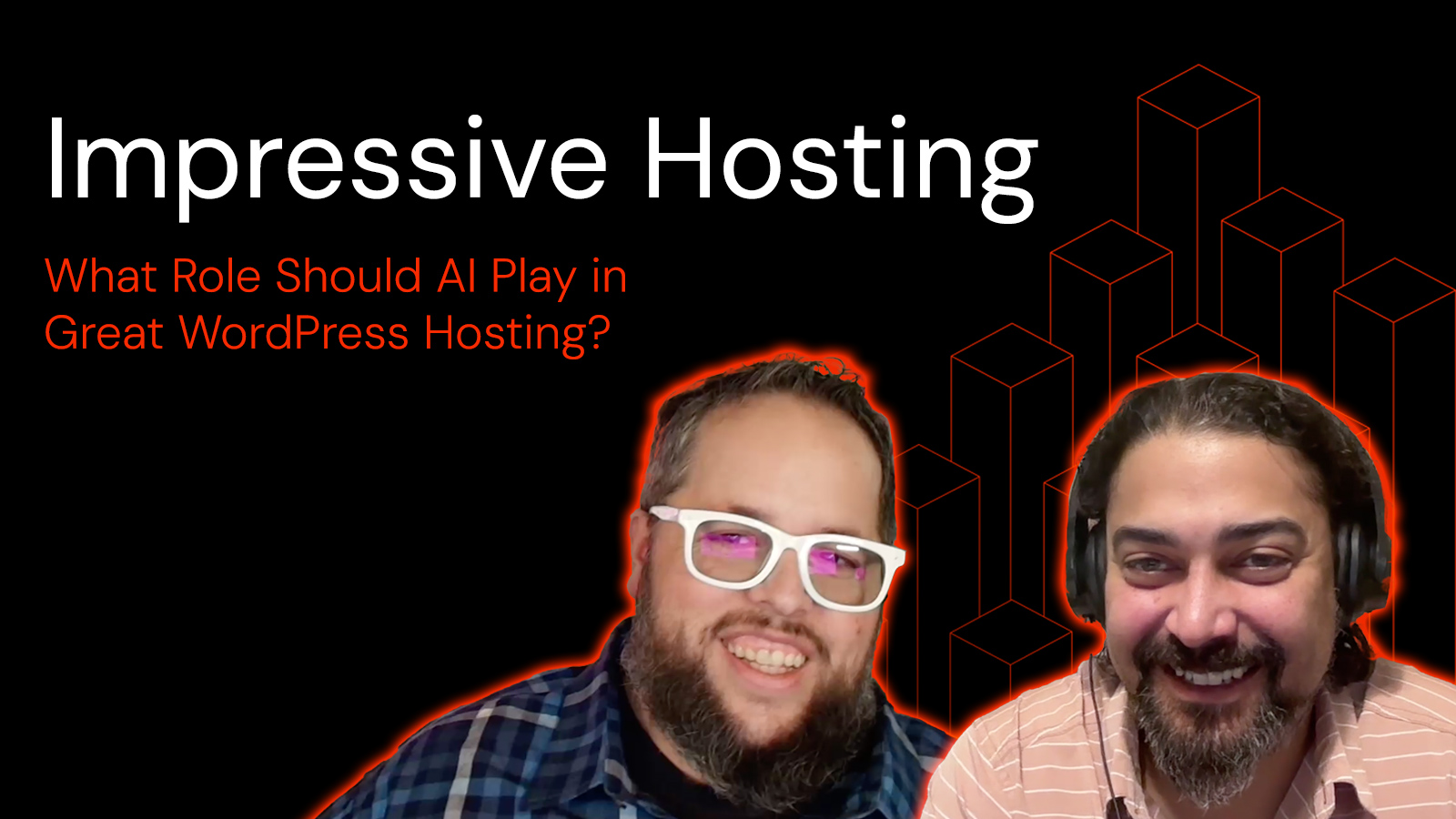
Jesse Friedman continues his conversation with Krys Lambiase, Senior Director of Product Marketing at Bluehost. They explore AI’s role in WordPress hosting, solving the “blank canvas problem,” balancing automation with creativity, and product marketing challenges. Krys shares insights on what features should be free versus premium, and both reminisce about the “weird internet” – and how to bring that spirit back.
Chapters:
00:33 Introduction
02:00 What role does AI play in great WordPress Hosting?
05:11 Balancing AI and Human Creativity
10:00 How Do We Get Back to the Weird Internet?
13:58 Best in Class Product Marketing for WordPress Hosting
17:14 The Future of Customer Interaction
22:58 The Role of AI in Product Marketing
28:16 What is Table Stakes and What to Charge For in WordPress Hosting
32:09 Conclusion
Show Links:
Transcript
What Role Should AI Play in Great WordPress Hosting?
Jesse Friedman: Help me do a better job of describing my business, my services, my product to end customers. Help me think through what it is that they’re gonna ask questions about so that I can write better content.
Krys Lambiase: If I see the word empower three times in a row, I’m like, all right, this was definitely written by an AI.
Jesse Friedman: What needs to happen, and this is something that I’ve been saying for a very long time, is that you’re gonna be asking for information anyway, you should be doing it in a way that’s giving back to that customer.
Krys Lambiase: When I first dabbled with WordPress I experienced the same thing that a lot of people experience, which is like that blinking cursor, right? The blank page.
Introduction
Jesse Friedman: Hey everyone. We’re back with Krys Lambiase, the Senior Director of Product Marketing at Bluehost. This is Impressive Hosting where we seek to uncover the core tenets of what makes great WordPress hosting. I am Jesse Friedman, and we’re gonna pick up where we left off with Krys. Sorry for the break there and leaving you with part two, but this was such a great conversation that I didn’t wanna leave it.
We had been talking about a lot of different things, including support and in-product marketing and helping customers and the differentiation between entrepreneurs and agencies and how, in fact, while they have very different paths to accomplish their goals, they actually have a lot of things in parallel in regards to how you market to them or provide services to them. We were talking about a variety of things, but one of the things that we touched on that we didn’t get to go into in depth was AI.
Krys Lambiase: Mm-hmm.
Jesse Friedman: A lot of different ways in which we can start to think about incorporating AI into our workflows, the ways in which we communicate with customers. But I’m curious, what is exciting you both from a perspective of what is happening inside of helping people to be successful inside of WordPress, but what else are you also doing outside of WordPress inside of the Bluehost platform? The way in which you communicate with customers through support and anything really driving your excitement right now.
What Role Does AI Play In Great WordPress Hosting?
Krys Lambiase: Yeah. First of all, I will start with the content generation that I’m seeing coming out of AI engines right now is leaps and bounds what it was two years ago. I remember when it first sort of launched, I was like, oh, this is a cute little tool. It makes mistakes. It misspells words and like, sometimes the images are a little funny. All that kind of good stuff. What I’ve seen last year, the end of last year alone, but I’ve seen the beginning of this year, I’m like, holy moly, this is really, really good. The streamlining of those workflows is impressive.
And so for me, inside of WordPress, what I’m most excited about is like, let’s take Bluehost for a second. Bluehost Cloud, Bluehost Shared hosting. There’s this AI layer that we’ve put on top of it as you go through the onboarding flow. You’re answering a few questions, right? And then also this prompt comes up and it just says tell us about your website. What are you trying to build? And if I come in there, I was like, Hey, I’m Krys Lambiase. I’m trying to build a website. I’m a dog walking business, right? I would also like to sell t-shirts or I’d also like to sell leashes, things along those lines. And I am based out of Jacksonville, Florida, I enter all of this information. It asks me, what’s your color vibe? Like what kind of color scheme are you looking for? Next thing I know, boom, here are three pages of a website that is already built for me, and the content is filled in.
The content is filled in with very relevant dog walker in Jacksonville, Florida content, right? I’m like, oh, this is awesome. The reason why I love that just out the gate is because when I first dabbled with WordPress, I think I experienced the same thing that a lot of people experience, which is like that blinking cursor, right? The blank page. And I’m sitting there, I’m like, oh no, this is college all over again. I do not know how to begin this paper.
Jesse Friedman: It’s the blank canvas problem.
Krys Lambiase: Exactly the blank canvas problem. And so what I love right now is we’ve solved for that to an extent, right? We’ve at least gotten you a starting point. But what is even cooler is the fact that the designs of your website, the segments or the components or what we call them internally of your website, powered by block editing in Gutenberg and what we also call Wonder Blocks internally, that is all completely smart to the answer you gave several steps ago. Once again, these components are now completely curated. The colors, the imagery, the text inside of those components. Completely curated to what you told us. Now, naturally, you can always go in and customize. It’s still WordPress, right? But the bottom line is that is light years ahead of where we were just four years ago. Right. Just that alone is amazing. The – oh, go ahead.
Jesse Friedman: In the last episode we talked heavily about the need to give time back to your end customers, right? Because again, if you’re talking about a blogger or someone who’s super passionate about something that they’re doing, and it’s their hobby, they’re gonna want to write their own content.
Krys Lambiase: Right.
Jesse Friedman: But these entrepreneurs, these clients, these agencies want to really focus on running their business and making their business successful, this is a great opportunity for AI to give back to them.
Krys Lambiase: That’s right.
Jesse Friedman: Make them more profitable, make them more capable of focusing on what is their passion.
How Do We Get Back To The Weird Internet?
Jesse Friedman: Yeah, that’s absolutely right. Because I envision a future where the internet might actually return to some of its beauty of the weirdness that was the internet in the nineties and the early two thousands.
Because what we need to do is convey so much information so that Google can crawl it, and then we can answer questions for users. And I almost think that there might be a future where AI may interview you and teach and learn everything there is to know about your business and your voice and everything else. And the AI that’s asking these questions because you say to yourself like, when is this business open? Or something like that’ll become less prominent and important to a real human who’s visiting the website.
Krys Lambiase: Right.
Jesse Friedman: And maybe there’s a connection between those interfaces where they’re communicating and there’s this backend and front end of content that would allow us to get out of the standard framework that we’ve seen the internet take and shape into and go back into like letting me express myself. Let me be more artistic.
Krys Lambiase: That’s exactly right. Do you think AI would’ve ever created Hamsterdance.com? I don’t think so. That came from somebody’s brain, man. I was like, let’s get back to that world.
Jesse Friedman: Yeah, exactly. I think I get very nostalgic when I think about the old internet in which the learning of HTML and CSS and things like that were actually pretty straightforward.
Krys Lambiase: Oh, yeah.
Jesse Friedman: It was tough back then, but then as the internet has evolved and devices have been created and we had to consider things like accessibility and the different ways in which people consume the internet, we had to build a framework that was templatized.
Krys Lambiase: Yeah.
Jesse Friedman: And so I think what we need to do is find a way to balance the two, to not be afraid of using fireworks or changing the colors of our websites, and not to be afraid to express ourselves on the internet in that way.
Krys Lambiase: Yeah, I 110% agree with that. We joke internally whenever we’re trying to run a new promotion or we’re trying to think of a new campaign, we joke, it’s like, well, you know what, just have a big flashing banner that’s just kinda like in all the different colors and everyone always laughs. And I’m like, yeah, I know. It’s silly. Nobody actually enjoyed that in 2005. But it always brings a sense of people laughing because that is when things were just weird and people just expressed their way they thought you could draw attention or really convey an idea back then because there were no guidelines. There was the Wild West, we just went for it.
Jesse Friedman: Right. I mean, I remember how scrolling marquees became overplayed because I remember discovering it and being like, oh my gosh, I can have a banner go across the screen.
Krys Lambiase: And everybody started doing it. Yeah.
Jesse Friedman: And then all of a sudden it became the thing, and of course it gets overplayed and you get tired of seeing it. But it was always fun to kind of discover those new abilities and then apply them. But now the internet is, I mean, there’s so much that you can do that it’s, you know, you almost need these guardrails because otherwise, like it is the Wild West and you’ll never get anything done.
Krys Lambiase: Yeah, yeah.
Jesse Friedman: You can apply everything. Anyways, that was a great diversion, but I love that you’re trying to solve the blank canvas problem because that’s a great way in which we incorporate and think about the diversity in hosting and layering it on top of a great platform like WP Cloud. Bluehost Cloud is leveraging an infrastructure that they know that they can rely on, but then they’re applying the things on top of it that allow these customers to go far beyond just hosting. And so it makes me think, like when you think about marketing…
Best In Class Product Marketing For WordPress Hosting
Jesse Friedman: Do you call it hosting or are you calling it something else? And is the spirit of it still hosting or is it an experience platform? Like how do you convey that to a customer?
Krys Lambiase: This is one of many problems that I try to solve on a daily basis. You touched on this in part one, and we didn’t get into it, so I’d like to get into it now. Depending on who you are talking to, right? Let’s look at those personas again. Entrepreneur, agency, enterprise, or you can call it mid-market or whatever you wanna do, but just that level of the market.
When they come to a website, when they’ve decided they’re gonna build a website, they’re gonna migrate a website, anything along those lines, they’re gonna do some cross comparisons. They’re gonna look at your merchandising, really. They’re gonna look at your plan tables. I have the hard job of teaching you two things right off the bat as quickly as I possibly can.
One, I must assure you that this has the speeds and feeds resources that you need, right? When you go buy a computer. Back in the day when people were like literally buying physical games, they’re like, well, make sure that you have enough RAM on your computer to do this, right? The speeds and feeds still matter, and so I must still convey that that’s so important, but then I must also confirm or reassure that the job that you have to be done will be done by this product, right?
And so what you’re looking at here is speeds and feeds versus feature or versus benefits or speeds and feeds versus the solution at the end of the day, right? And that’s difficult because some customers come in like, Hey man, I just need to know the speeds and feet. Do you have the right RAM? Do you got the right speed? All right, let’s go. And some people are like, I’m sorry, I’m sure it’s fine. I’m sure all those things are fine. But can it do image compression? Can it do lazy loading? Can it do, does it have a gallery mode? Right? And they start asking much more design oriented questions or job to be done questions, or have you ever built a restaurant website? Can I do bookings and appointments? And the answer is yes. Yes, yes, yes, yes. But I only have so much real estate on a product page to convey all of that.
When we get to the cloud, what I will say is we took a bet. We took a bet because we knew that we were gonna be attracting a more tech savvy customer. And we’re like, let’s lean towards speeds and feeds right now. Let’s go ahead and lean towards what that looks like. And so far it’s working out pretty well. But the thing is, we’re beginning to see more and more customers come to us. We’re like, actually, I have a job to be done. I’m sure your cloud is fast. You already said it’s a hundred percent uptime. And we’re like, oh yeah, that’s reliability, but also it is fast. And now they’re asking, can it do X? Can it do Y, can it do this? Is it good for this kind of website? Is it good for that kind?
We’re gonna start to pivot. You’ll see that pendulum begin to swing because it has to. Marketing must be flexible and fluid in that regard. And so what I will say is there is no one answer. It is always trying to find the balance between that pendulum swing depending on who you are talking to. And the best way that I have found right now that most web hosting companies tackle this problem is with a ton of content, right? You have content that is geared towards the more benefit oriented customers, then you have content that is geared more towards the speeds and feeds, despite the fact that it really is the same platform that would solve your problem.
The Future Of Customer Interactions In Hosting
Jesse Friedman: Yeah, so you talked about how you’re using AI and onboarding in this perpetual tip type solution to encourage the customer to continue building and be successful. But I wonder if it should be pulled out even a step further and into the pre-sales process where you can take some opportunities to learn about that customer in real time, then apply that marketing so that you can tell them that we’re checking these boxes that we know are gonna be important to you.
Krys Lambiase: So I love that because one of the things that we’ve seen competitors do this and we’ve dabbled with it as well, what we referred to as a decision engine, right? Front of site decision engine. You land on bluehost.com and there’s something that pops and says, Hey, what are you trying to do right now?
If you spoke to a sales agent, you’re gonna get that exact same experience. They’re gonna hear everything that you’re trying to do, and they’re gonna guide you through a very personalized and curated solution. But not everybody wants to talk to a sales agent, which is fair.
So the thing is, if you had something on front of site that did in fact take you through like a short onboarding, you could reach that same end result. The challenge that we have seen is not many consumers or not many people who crawl the website or just websites in general across hosts really wanna interact with a decision engine because they don’t know when it ends. Right. It’s like taking a survey online. They’re like, okay, how many questions do I have to answer?
Jesse Friedman: How much personal information are they gonna ask for?
Krys Lambiase: Exactly. What’s the rub? Exactly. So if you were to build something like this, it must be transparent, it must be accessible, and it must be non-invasive in a lot of ways. It’s like open-ended chat, GPT open-ended, show up. Hey, let’s have a conversation, and that’s it. Don’t pull anything away from your customer or from your prospect so that they want to keep on giving this information and finally coming to a solution that they originally were hoping that you had.
Jesse Friedman: So I’ll go back to something, and this is for anybody who’s listening who wants to try and experiment with something. But years ago I worked on a product that would help people who were trying to discover what type of insurance they needed to buy, and how that could save them money by bundling. That’s the co like we always heard that, right? Like, in the biggest insurance industries is always saying, bundle and save, but the small mom and pops who are running their insurance websites needed to try and find a way to compete with these big conglomerates.
And so what we ended up doing was trying to take the time to build content on the front end of the website that would allow for us to see interactions with it, telling us in real time what it is that’s interesting to them. Use some other personalization efforts to apply to that and say, and make recommendations. Things that we were able to glean from that was, is that like if you lived, oddly enough in Chicago, you have a higher likelihood that you own a boat because everybody out there is on that lake. And so you might need boat insurance in addition to car insurance, right?
And so people at home might be like, oh my God, that’s you’re getting into that creepy mode of personalization. But the reality of the situation is that I think people have become much more familiar with the idea that the Internet’s always constantly taking information from you. But I think what needs to happen, and this is something that I’ve been saying for a very long time, is that you’re gonna be asking for information anyway, you should be doing it in a way that’s giving back to that customer.
Krys Lambiase: Give back first. Yeah, it’s right, like this idea of fair trade marketing.
Jesse Friedman: Yeah, I’m gonna trade the information that you’re giving to me in exchange for making you more successful.
Krys Lambiase: Right.
Jesse Friedman: So instead of trying to upsell you globally on something that you may not need, I can actually pinpoint the exact pieces of the puzzle that you need to apply to your project and make those recommendations for you. Because again, it always returns back to how can I make you as successful as possible in the smallest amount of time.
Krys Lambiase: That’s right.
Jesse Friedman: So you can go back to applying that work to your business. So I might ask, what type of business are you running? Click. Or do you care about marketing? Click and then you can say like, Hey, so it sounds like you’re gonna need an SEO tool. You’re gonna need email marketing. These are all the components that you’re gonna need to run your business and be successful. Well, guess what? You can get all of that with Bluehost.
Krys Lambiase: That’s right.
Jesse Friedman: You don’t have to go and find third party solutions and bolt it on and not know how much it’s gonna cost you. Here’s one price, one fee. It’s all right here for you. And now you can run your business online.
Krys Lambiase: That’s right. No, I agree. The funny thing is, for a while there was a term called Trusted Advisor. Right? The term trusted advisor was pervasive through the market for a while. It’s like, Hey, you know, so-and-so’s a trusted advisor, does it, but it always required you to give something first, right? The very first word in that term is trusted. Advisor, give me a reason to trust you. And I don’t think that anyone had ever really mastered that, but what you just described to me, I don’t know if you’re on Pinterest or Instagram or anything along those lines, but what you just described to me is like when you first start your profile on any of those social media platforms, this could be a hot take.
I’m not trying to say anything too crazy, but that’s the first thing that they walk you through. That’s the first thing they walk you through is like, what are you interested in? And the moment you’re done with that, you are shown a feed of your interests and you’re like, ah, there’s the value.
The Role Of AI In Product Marketing
Krys Lambiase: I was looking for something that is interesting. Now I can doom scroll to the end of the day. Right? But the bottom line is, what AI could help us do from a WordPress host out into the market is say, look, we are trying to solve your problem. We’re not trying to take your money.
We are trying to solve your problem or help you achieve your goal. And so if we can get back to a place where we really do bring the trusted back in trusted advisor with a tool like that, I do think you’d see this market shift a little bit because it’s less about, Hey, you give to us and now we will do for you. It’s more so, Hey, we want to help you get there. Let’s just start in a nice, open, honest communication and just say, what are you looking to achieve and this is how we can do that for you. Would you like to continue this conversation? And that is, I think, where most marketing should start.
Jesse Friedman: Yeah. No, that’s great. You know, you mentioned social media and stuff and as time has gone on, I’ve been using less and less of it. But that’s a design pattern that people are used to, and I think that we need to make sure that we’re leveraging the things that are familiar because then it becomes an easier step.
Krys Lambiase: Yeah.
Jesse Friedman: Asking what your interests are, that same exact environment can be replicated. But just ask a slightly different question, which is around what are the goals of your project? What do you need to succeed?
Krys Lambiase: That’s right.
Jesse Friedman: And I think AI is gonna play a really interesting part in it. We talked a little bit about how AI is helping with content generation and now with marketing, but I think that there’s also other components like support, there’s configuring sites as well.
Krys Lambiase: Performance.
Jesse Friedman: Performance as well. Yeah. So I think there’s a lot more to explore there, but one of the things that we need to also consider is this around whether or not we should be charging for something. You know, hosting companies tend to bundle a bunch of things.
Krys Lambiase: Mm-hmm.
Jesse Friedman: And so then we get into a problem where you’re bundling things and maybe some of it’s not gonna be used by a customer. And they perceive that as a problem that they’re paying for.
Krys Lambiase: That’s correct.
Jesse Friedman: May say I don’t use that. I don’t know what it is. It seems expensive, so like, am I wasting my money on that? But then we get into a different problem where if you strip it all the way down.
Krys Lambiase: It looks…
Jesse Friedman: Then it’s like, oh I’m paying $5 for this and $4 for that. So how do you strike a balance there? Where are you looking to try and land in that?
Krys Lambiase: This goes back to what we talked about a little bit earlier, like the table stakes, detractors, and delighters. Right? Those detractors. When I say a detractor, what I’m not saying is like we purposely put something in there that’s gonna be like, just absolutely ruin your website. That’s not what I mean. It’s exactly what you just said. Wait, why is this in here? Why should I pay extra for that? And that’s different for everybody, right?
The one thing that I will say is that what I can’t stand when hosts do is they charge for things that they know for a fact should be free. And I will die on this hill, and if any of my bosses watch this, fine. That’s okay. SSLs, I’m sorry. SSLs they’re free. They’re free. Right? Now, there are premium SSL that offer other services for other circumstances, right? You have EVs and OVs and all that kind of good stuff. But come on, at the end of the day, like an SSL, it can be free.
Jesse Friedman: So we talk about table stakes, right? Like an SSL, a very basic SSL, like a Let’s Encrypt or similar should be a core component of every single hosting plan.
Krys Lambiase: Bingo.
Jesse Friedman: Does that mean that the most complex or complicated SSLs should always be free? No, but like at a base level, we should say, that should come with every plan.
Krys Lambiase: That’s exactly right, and so that’s what I’m saying is like when we try to strike the balance, what do you charge for versus what do you don’t charge for? What can be bundled in? What I will always say is this is if something is bundled in, or at least how I build packaging, if I’ve bundled something in, I am absolutely okay one with it being free, and then two, I believe very deeply that it is of a benefit to the customer.
And if the customer does not use it, that is okay. They’re paying nothing extra for it. I’m not doing a one year free, I’m not doing a, Hey, by the way, this is gonna renew. I will do a free trial for those reasons. Right? But if I’m bundling it into a plan, I’m like, okay. It’s here. This is why you would buy this plan. I will have other plans that don’t have it in. So now you have a choice to say, nah, you know what, I really didn’t need that. I will go with the lower plan.
But my approach to packaging has always been very closely tied to if it’s here, I assume it’s a delighter, and if you’re not gonna use it, that’s okay. You will never, at no point in time should you feel like you’re paying for this or it’s weighing you down. Now, I can’t guarantee that everyone’s always gonna feel that way, and that’s okay. We are always calibrating our packaging due to like customer responses and things along those lines, but.
For me, there are some very key features in WordPress, key features in website hosting that I’m like, absolutely do not charge for those. And then some that I’m like, you must charge for these things. Not just ’cause it’s a cost to us, but because the value is so niche or so unique to that type of website that if it were to go wrong, you will lose much more money than what you are paying us. And that’s the difference. If this goes wrong, you lose a lot more money. You should pay for this value because of the value that it is providing to your business. Right.
Jesse Friedman: Yeah. Yeah.
Krys Lambiase: That’s how I separate that.
What And What Not To Charge For In WordPress Hosting
Jesse Friedman: A lot of WordPress’s early development was based on that 80/20 rule.
Krys Lambiase: Yeah.
Jesse Friedman: The idea that everything that goes into core should apply to 80% of those customers. I think that it’s not too dissimilar than we can apply that to this whole problem around what we should charge for and what we shouldn’t. I think one of the things that we struggle with as an ecosystem is that WordPress itself is free. And something that we go back to, right, is that hosting companies have a responsibility to WordPress because it is free.
Krys Lambiase: Correct.
Jesse Friedman: There’s another component to this, which is that because it’s free and because there’s thousands of plugins that help you to extend your site and thousands of themes that help you to design your site, and there’s so many of them that are free, you get to a place as a marketer where you make this assumption that people don’t want to pay for anything. This feeling that WordPress is free. I don’t want to pay for hosting. I don’t want to pay for a more robust form building tool or something like that.
What I’ve actually found in interviewing agencies and entrepreneurs is that if it’s an extraordinary amount of money, it’s a different case. But if we’re talking a few bucks a month and it unlocks something for them that is hugely valuable to them.
Krys Lambiase: And that’s just it.
Jesse Friedman: And if you talk to them and you interview them, like, and this is for hosting companies, but also for plugin developers and agencies too. Like when you’re thinking about the products that you’re building for WordPress and the value that you’re giving or the code that you’re writing or whatever it might be, don’t be afraid to solve those problems with a price tag.
Krys Lambiase: That’s exactly right.
Jesse Friedman: An entrepreneur who’s running their business, and we keep going back to this over and over again in this episode, right, is that you’re saving them time, which means you’re saving them money, which means you’re helping them be more successful. If they’re going to have the choice between becoming a web designer and having to learn how to create a dropdown menu for their menu, or they could pay three bucks and it just comes built and it does everything it needs to do like a big mega menu or something like that. They’re gonna pay that three bucks all day long. I’m gonna be happy that I spent that money as long as it delights me and it’s not wasting my time.
Krys Lambiase: Saved me time, right?
Jesse Friedman: Exactly. Yeah. I think we just need to be able to feel more comfortable with that.
Krys Lambiase: There is a difference between getting something that’s good enough and if it’s free and it’s like, Hey, it just, it’s up there on the wall versus paying for what you want versus paying for it being easier to do. Right? I can go ahead and grab some scrap wood and I can make a frame for a painting, right? Does it look good? Is it really what I wanted? Not really. Or I will pay for someone to gimme exactly something that looks good, it’s what I wanted, and I’m like, Hey, you know what? Honestly, I’m happy with it. I paid a little extra, but it’s exactly what I wanted. It was worth the payment.
Jesse Friedman: Because it’ll delight you in a different way, right? Like the way in which you settle for something sometimes is not as exciting. It doesn’t get you, and you just walk away from it being like, yeah, it works. I guess I needed it at that moment, but I just wanted it to be so much better, you know? And sometimes it’s something so simple. If you’re going to create something that’s niche, if you’re gonna support it, then you shouldn’t be afraid to charge for it because it actually improves the likelihood that you’ll be able to continue providing that service.
Krys Lambiase: That is true.
Jesse Friedman: We talked in the last episode about how developers of plugins maybe a single developer all by themselves, and they can’t provide the support that they want or to expand on that product. The reason they can’t is because they can’t hire somebody else.
Krys Lambiase: That’s right.
Jesse Friedman: But if they could unlock that by charging for something a modest amount, then all of a sudden you get the opportunity to actually expand on that product and delight more customers, make them more successful, which is frankly, all this is about.
Krys Lambiase: Yeah, a hundred percent agree.
Conclusion
Jesse Friedman: Yeah. Alright, well, we’re at the end of part two here. This is another fantastic episode. Krys, thank you so much for joining. I would love to have you back to talk about some new things in the future. Keep me in mind if you have anything worth sharing with the folks at home.
Krys Lambiase: Absolutely. Hey, thanks for having me. This is great.
Jesse Friedman: All right. Take care.
Thanks for joining us on another episode of Impressive Hosting, where we uncover the core tenets of great WordPress hosting. Do you have a follow-up question for today’s guest, thought or comment on anything we talked about, a future guest suggestion, a hosting horror story? What do you think makes WordPress hosting? All your comments shape the show. Drop them on impressive.host. We also appreciate you following us on social media and subscribing to the podcast on your favorite platform. Finally, do check out our list of open source projects that need support at impressive.host. Whether it’s code, community, or cash, you can make a difference. See you next time.
Subscribe to Impressive Hosting:


Leave a Reply