'%3E%3C/path%3E%3Cpath d='M76.4782 25.7185L71.982 9.04089H74.6936L78 22.8409L81.8045 9.04089H84.5853L88.2722 22.8409L91.5787 9.04089H94.2902L89.7248 25.6977H86.7781L83.1396 12.6379L79.3835 25.6977L76.4782 25.7185Z' fill='rgba(247, 43, 0)'%3E%3C/path%3E%3Cpath d='M96.6075 9.04089H102.439C103.739 9.04089 104.818 9.26224 105.676 9.69803C106.534 10.1338 107.17 10.7287 107.592 11.4827C108.014 12.2367 108.222 13.0875 108.222 14.0421C108.222 14.9483 108.021 15.7783 107.613 16.5254C107.212 17.2794 106.575 17.8812 105.725 18.3239C104.867 18.7666 103.774 18.9879 102.439 18.9879H99.1323V25.6977H96.6075V9.04089ZM99.1323 16.9128H102.321C103.511 16.9128 104.362 16.6568 104.881 16.138C105.399 15.6192 105.655 14.9206 105.655 14.0352C105.655 13.1152 105.399 12.3958 104.881 11.8839C104.362 11.372 103.511 11.1092 102.321 11.1092H99.1323V16.9128Z' fill='rgba(247, 43, 0)'%3E%3C/path%3E%3Cpath d='M124.138 25.9744C122.492 25.9744 121.067 25.6147 119.87 24.8953C118.674 24.1759 117.747 23.166 117.097 21.8725C116.446 20.5789 116.121 19.0848 116.121 17.3901C116.121 15.6746 116.446 14.1735 117.097 12.88C117.747 11.5864 118.674 10.5765 119.87 9.84329C121.067 9.11698 122.492 8.75036 124.138 8.75036C126.089 8.75036 127.68 9.22766 128.918 10.1753C130.156 11.1299 130.938 12.458 131.277 14.1735H128.469C128.247 13.2051 127.77 12.4373 127.044 11.8631C126.317 11.289 125.342 11.0054 124.118 11.0054C122.45 11.0054 121.136 11.5726 120.168 12.707C119.199 13.8415 118.715 15.3979 118.715 17.3831C118.715 19.3476 119.199 20.8971 120.168 22.0246C121.136 23.1521 122.45 23.7124 124.118 23.7124C125.342 23.7124 126.317 23.4427 127.044 22.9031C127.77 22.3636 128.247 21.6234 128.469 20.6896H131.277C130.945 22.3428 130.156 23.6294 128.918 24.5702C127.68 25.5109 126.089 25.9744 124.138 25.9744Z' fill='rgba(247, 43, 0)'%3E%3C/path%3E%3Cpath d='M133.961 25.6908V8.5636H136.486V25.6908H133.961Z' fill='rgba(247, 43, 0)'%3E%3C/path%3E%3Cpath d='M145.195 25.9744C144.067 25.9744 143.057 25.7185 142.158 25.1997C141.259 24.6809 140.553 23.9615 140.027 23.0346C139.502 22.1076 139.246 21.0216 139.246 19.7903C139.246 18.5591 139.509 17.4731 140.041 16.5392C140.574 15.6123 141.293 14.8929 142.192 14.3741C143.099 13.8622 144.102 13.5994 145.215 13.5994C146.343 13.5994 147.353 13.8553 148.252 14.3741C149.144 14.8929 149.864 15.6123 150.396 16.5392C150.929 17.4661 151.192 18.5522 151.192 19.7903C151.192 21.0285 150.929 22.1076 150.396 23.0346C149.864 23.9615 149.144 24.6809 148.245 25.1997C147.332 25.7185 146.315 25.9744 145.195 25.9744ZM145.195 23.8093C145.796 23.8093 146.357 23.6571 146.869 23.3597C147.387 23.0553 147.802 22.6126 148.121 22.0177C148.439 21.4228 148.598 20.6827 148.598 19.7903C148.598 18.898 148.446 18.1579 148.134 17.563C147.823 16.9681 147.415 16.5185 146.896 16.221C146.377 15.9167 145.824 15.7714 145.222 15.7714C144.62 15.7714 144.06 15.9236 143.548 16.221C143.029 16.5254 142.614 16.9681 142.296 17.563C141.978 18.1579 141.819 18.898 141.819 19.7903C141.819 20.6827 141.978 21.4228 142.296 22.0177C142.614 22.6126 143.023 23.0622 143.534 23.3597C144.032 23.664 144.586 23.8093 145.195 23.8093Z' fill='rgba(247, 43, 0)'%3E%3C/path%3E%3Cpath d='M158.275 25.9744C156.85 25.9744 155.723 25.5317 154.906 24.6394C154.09 23.747 153.682 22.4258 153.682 20.6688V13.8899H156.207V20.406C156.207 22.6887 157.141 23.83 159.015 23.83C159.949 23.83 160.717 23.498 161.326 22.834C161.927 22.1699 162.232 21.2153 162.232 19.9771V13.883H164.757V25.6908H162.522L162.336 23.6225C161.969 24.3488 161.436 24.9299 160.731 25.3449C160.011 25.7669 159.195 25.9744 158.275 25.9744Z' fill='rgba(247, 43, 0)'%3E%3C/path%3E%3Cpath d='M173.341 25.9744C172.2 25.9744 171.19 25.7046 170.318 25.1651C169.447 24.6255 168.762 23.8854 168.271 22.9515C167.779 22.0177 167.53 20.9525 167.53 19.7627C167.53 18.5729 167.779 17.5146 168.271 16.5876C168.762 15.6607 169.447 14.9275 170.325 14.4018C171.204 13.8692 172.213 13.6063 173.362 13.6063C174.296 13.6063 175.119 13.7861 175.824 14.1528C176.53 14.5194 177.083 15.0313 177.478 15.7022V8.5636H180.002V25.6908H177.74L177.478 23.8577C177.097 24.4111 176.571 24.9022 175.907 25.3311C175.243 25.76 174.385 25.9744 173.341 25.9744ZM173.791 23.7885C174.87 23.7885 175.755 23.415 176.44 22.6679C177.132 21.9209 177.478 20.9663 177.478 19.7903C177.478 18.6006 177.132 17.6391 176.44 16.8989C175.748 16.1588 174.863 15.7922 173.791 15.7922C172.712 15.7922 171.826 16.1588 171.127 16.8989C170.429 17.6391 170.083 18.6006 170.083 19.7903C170.083 20.5651 170.242 21.2568 170.56 21.8586C170.878 22.4604 171.314 22.9308 171.881 23.2767C172.435 23.6156 173.078 23.7885 173.791 23.7885Z' fill='rgba(247, 43, 0)'%3E%3C/path%3E%3C/svg%3E)
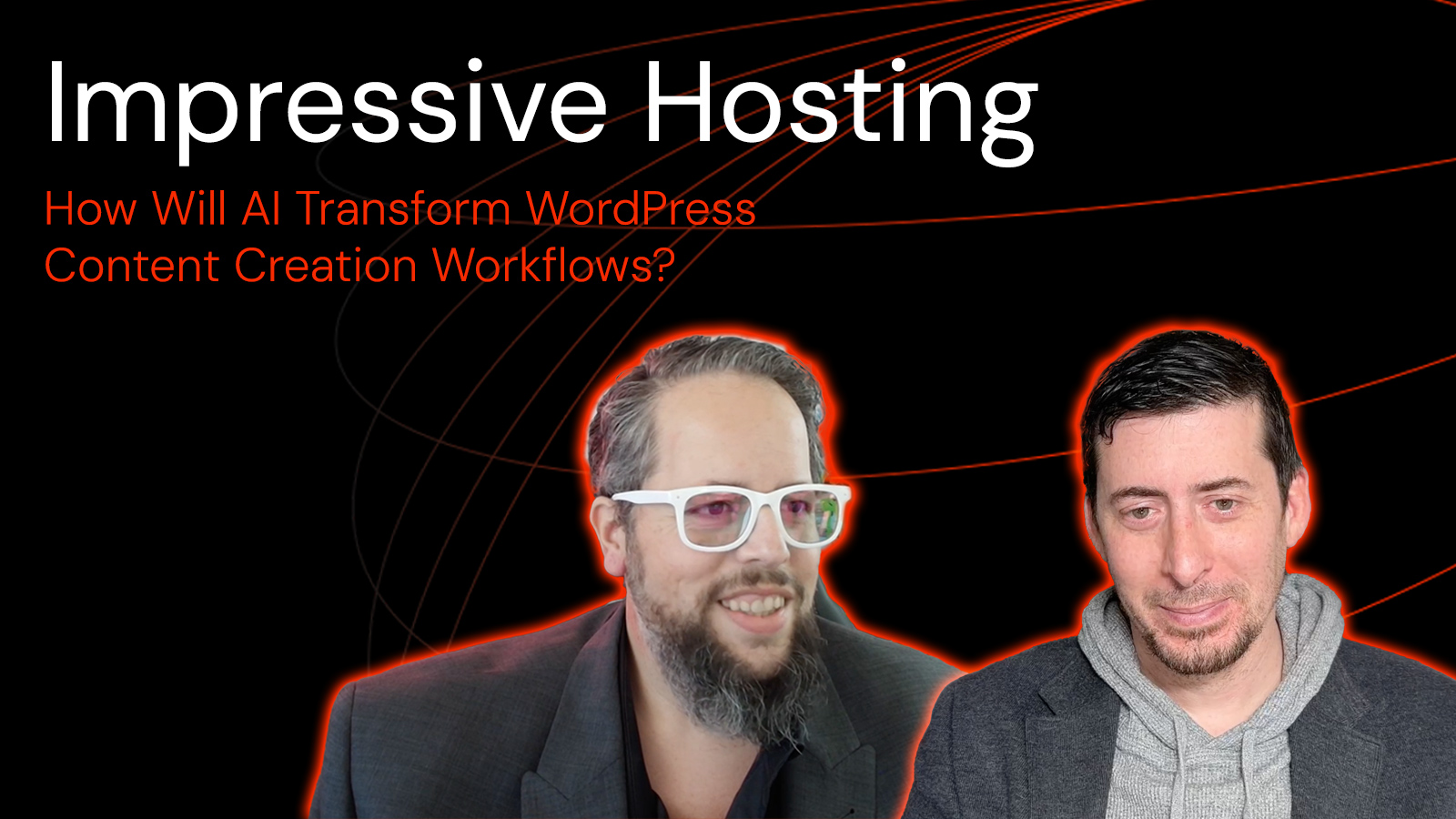
What does it take to build a successful WordPress business while staying true to open source values? Jake Goldman shares lessons from growing 10up into a leading WordPress agency and how those principles apply to hosting companies today.
The discussion covers Goldman’s transition from 10up to Fueled, exploring how WordPress fits into broader digital experience strategies. They examine why managed hosting specialization matters for enterprise clients and how hosting companies can build trust through focused expertise rather than generic solutions.
This episode provides actionable insights for hosting professionals and agency owners. Goldman’s experience building and scaling WordPress-focused businesses offers a proven framework for success, while his thoughts on AI and collaboration point toward exciting opportunities ahead.
Links:
Transcript
#### Introduction
Jesse Friedman: Welcome to Impressive Hosting, a podcast about the role hosting plays in shaping the Open web. I’m your host, Jesse Friedman. On this show, we go deeper than uptime and dashboards. We talk about hosting as infrastructure. About ownership, independence, and what it takes to build ethical, high-end WordPress hosting that actually serves creators, businesses, and the internet itself. Before we dive in, head to impressive host, that’s where you can comment on episodes, ask follow-up questions, and help shape future conversations. You also find links to follow, like, and subscribe wherever you listen. I am so happy to be presenting an interview with Jake Goldman and a friend and someone who’s been, you know, a prolific, super important element in the WordPress hosting an agency space for more than a decade. And he is the first guest that we have on season two of this show. Jake, thank you so much for joining us. Tell us a little bit about where you’re from, what you’re working on, what’s going on with you.
Jake Goldman: Sure, I’m delighted. And it does feel special. It’s like, I don’t know how we’ve avoided being on a podcast together before. I think Jesse, you and I have been working together for, since 2010, 2011. It’s a little frightening to think that that was over 15 years ago now. And an honor to be your second season first guest. So, I like to say I’ve been developing on a web since there’s been a web to develop on going back to the nineties, doing things for high school clubs and in college, projects. I then went into the like sort of, I guess we’d call the contracting or the consulting or the agency spaces, which is to say most of my career actually been going back to that like sort of late nineties little freelance projects here and there. I’ve been in the business, the services business, helping people build the best solutions on whatever the best technology is for making things, making experiences on the web, making experiences with modern connected technology. And then in 2011, back when I was living near in your neck of the woods, in Providence, Rhode Island area. I started a company called 10up. I thought at the time that I started the business that WordPress was really going places. I’d already, I had sort of in my previous role helping diversify into other CMSs and platforms, gotten a chance to travel around and go to different WordCamps. Saw so much energy bubbling up in this community, so much talent that was just freelancing, doing a project here and there. Would’ve loved to, you know, really dedicate their more focus to building professional sites, but just didn’t have yet the sort of the economics or the, you know, enough intake for business or, you know, enough demand to turn into full-time jobs. So, incredible talent, potential on one side and the other side working, you know, from the earliest days with what’s called the WordPress VIP program now really starting to see some larger businesses, enterprises at that time, particularly in media, get really more interested in WordPress and even small and medium business I was working with at that time. That was just a, it was a, it was a level ahead in terms of both the effort that it would take to produce a really high quality site, but maybe more uniquely the sort of the joy that somebody actually having to edit and maintain, manage that website, would experience compared to so many of the other platforms at the time. Not to mention how many sites were still just doing it all custom every time that there was a request. So I started 10up believing at that time that there was a real space for someone, for an agency to come in, to really supplant cement themselves early as a leader in the space, as a contributor to the project, as a thought leader and how to create great editorial experiences and admin experiences and serving the enterprises in that space. But inspired by companies like Red Hat and Linux, or at that time, Lullabot in the Drupal world, agencies that had really come to be associate or technology companies had really become to be associated with more open technologies as a leading provider. And that’s the model I wanted to build with 10up. And, you know, thought I was gonna be taking a break for a year from payroll, but they ended up year one. We had seven or eight employees and history continues on from there. Built that company to about 300 people. I would say very, centered in WordPress as our preferred platform, but starting work with other technologies, starting work with things that were completely CMS agnostic and design and user experience, design thinking, and all the rest. And then in 2023, I made the decision to merge the business into a company called Fueled, which was, I would say what 10up was to WordPress is probably what fueled was to mobile, you know, mobile apps and well-funded startups and app experiences. So it was a great combination of like really strong product design thinking, app development on their side. Strong CMS web on our side with some overlap. That was a couple years ago. So after running 10up and building it for a good 12 and a half years before integrating into Fueled, I helped for the next year, year and a half. Some of that really figured out how do we get the company to act as one, combined together as one at a wild time when AI was flying onto the scene. And there was, I would say, a major shift from overheated to probably under heated in the economy in the market of web and digital. So that was a, you know, wild year and a half. And then at the beginning of 2025, I sort of stepped back into a role that we, I think call, we call partner. I’m not sure that we’ve quite found the right title for it, but effectively I work in a part-time, at least part-time by my standards. In the business, really focusing on, you know, regularly talking to the executive team, the CEO of advising strategic support, some special projects, or, you know, unique development opportunities that I can sink my teeth into. And actually doing a lot of work in storytelling and content marketing for the company and still doing a fair amount of networking and getting to chat with people like you still. So, that was long-winded. Maybe that gives a.
Jesse Friedman: That’s great. No, I mean, it is so fantastic because, you know, you and I have known each other for a long time and it’s awesome to hear from your perspective all the things that you’ve been working on. And in fact you just, you know, you went through all that and I realized that like two seconds into it that I hadn’t actually said for the guests at home what your title is, what you’re working on. We had, you know, we had just said that you’re a partner and advisor at Fueled, and I failed to say that, and I think that’s because of the fact that like, in my head, everyone knows who Jake is, right? Like it’s just, you’re, you’re one of those guys that’s so well known within the industry. I’m so glad you dove into your past a little bit there and you gave us a little bit of a preview of what you’re working on. You know, I think it’s funny.
Jake Goldman: Probably some people in your audience have different titles in their head that come to mind when they think of me, but yes, fair to community that we sit inside of.
Jesse Friedman: Well,
Jake Goldman: Yeah, so I mean, you, well, I, you founded, 10up obviously. Are you still working with 10up at all in any way? In any capacity?
Jesse Friedman: Yeah, that’s that partner role. So 10up the brand today is the, is, we call it the, the name of our WordPress practice. So the combined brand, and I probably should have been clear about that as well. The combined brand ended up, you know, post merger about a year in, we rallied around settling on the name fueled as the combined company brand. One of the big reasons we did that was because as much as we love WordPress, it’s still our primary CMS, the one that we do the most work with. There was a larger vision to expand out and be a bigger business, work with more technologies, work with more solutions. I think the, the flip side of being so positively associated with WordPress is it was almost, it almost sometimes felt, I know my marketing team hate when I say this, but it almost sometimes felt typecasted where it was, even for current customers, hard to have a conversation where things, oh, 10up the WordPress agency. Oh, you have the WordPress people, right? And which
Jake Goldman: Hmm.
Jesse Friedman: to really break through and say, well no, we wanna work with other parts of your organization. There’s other things we do. So keeping that 10up name associated with WordPress by sort of branding it as like the part of the business that’s focused on WordPress solutioning and R&D
Jake Goldman: Gotcha.
Jesse Friedman: can still find. But I think the pivot to the fueled name makes it much more clear that what this larger
Jake Goldman: Gotcha.
Jesse Friedman: I think you did a great job there because I kind of saw it as more of a offshoot rather than like an umbrella over it. So that’s a good bit of clarity there. Okay. So that’s great. When you’re working on fueled and you’re, you said that it’s a little bit more like, you know, 10up was to WordPress, fueled is to apps. Are you building these apps on WordPress a little bit all the time. Never. Like, what’s going on there?
Jake Goldman: Yeah. So to be, yeah, I mean, I would say, you know, the funny thing about or rebrand where you sort of go with one of the previous company’s names and you that the vocabulary becomes a little hard. I’d say today we think of as fueled as a company that has general digital experience with a concentration in both mobile product design and digital product design and in CMS and content solutions platforms like WordPress and, you know, the things that attach onto it, like WooCommerce. So the company today is really about both of those heritages for both
Jesse Friedman: Right.
Jake Goldman: where the company builds apps. It’s interesting because, you know, WordPress is so almost like integrate, or, sorry, 10up was almost so integrator-like and being very spoke focused on specific technologies and platforms, or Fueled traditionally was, and its legacy, was much more agnostic in terms of what was right for the project, what was right for the client. Not agnostic in the sense, you know, they’re building iOS and Android apps, but what the technology was the layer below that. So the, you
Jesse Friedman: Yeah.
Jake Goldman: company does did everything from, for those more familiar with vocabulary in the mobile space. Everything from like Java to, you know, objective C, and that was the platform for iOS. They’ve done Swift applications on the web technologies front. There’s platforms like frameworks, like Flutter or react Native, some of those tech, and it’s really all over the map in terms of the technologies that they’ve worked with under the hood. Many of those projects, especially ones we’ve done the last couple of years since integrated together, use WordPress as a content store, use it as the sort of, you know, the back end of the CMS where the content and data and information, is stored, very frequently. In fact, I think we have a blog post, actually I think it went out last week so I could talk about it, about Good Housekeeping. We just did like a recipes app for the famous UK magazine brand under Hearst as a project, there on WordPress in the UK, part of Hearst. And, you know, it was a great example that we have on the site now of a blog post and a case study about it that really shows off like how our experience with WordPress, with CMSs, with knowing how to organize and structure that content and pull it out of a CMS combines with like the product design thinking and like the very native mobile application kind of experience. what we think of as traditionally pre-merger fueled was. So it’s a good example of, yeah, sometimes we are using WordPress. We don’t use it, we don’t really use it as like the, like, WordPress isn’t the, we’re not, I wouldn’t say we build the apps with WordPress. It’s not a framework for how you build mobile applications. There are some cases and some tools out there where there’s, you know, that can make sense. But the reality is, I think where WordPress plays well and has a lot to offer in the mobile and application experience space is the content store, right? And the
Jesse Friedman: Right.
Jake Goldman: API that is called out to, for content and information and data, it’s not the like native front end, you know, locally run experience on the application.
Jesse Friedman: And do you think that the WordPress CMS still provides a pretty good experience for the your client to go in and make those changes to the content themselves.
Jake Goldman: Yeah, absolutely. We generalize a little bit at our hazard, right? Different customers have different problems. For some customers, they, know, not every single customer, for, you know. WordPress does not make sense for every single customer. There are some customers that are doing things that have to do with like, like menu displays in, like we did a lot of work like Six Flags where you’re dealing with like menus in the park and everything that are needing much more structured. Kind of CMS a little bit. It’s a little bit more or less about like publishing and editorial experience. A little bit more about like highly structured data types. But for, yeah, for all the customers that are just trying to get content pushed out in the web layout pages, have articles, have things like recipes for that recipe app. I still think WordPress is, you know, WordPress is the way to go.
Jesse Friedman: Right. Yeah. Well, I think we agree on that one for sure. You know, so first season of this podcast, we talked about the core tenets of managed WordPress hosting. I’m curious what you think that should mean to your clients if you tell them you are, you know, you’re gonna be putting their website on, you know, a hosting product that offers managed WordPress hosting. If you were not to dive in any deeper than that, what would you hope they are taking away from that definition?
Jake Goldman: The definition of what they’re looking for in managed.
Jesse Friedman: What is managed WordPress hosting? What do you want them to think that that means? What do you think is, the general population should assume you’re getting when you’re buying managed hosting?
Jake Goldman: I think the expectation that I should always caution in these conversations, I can speak a little bit to the whole like entire universe, but our focus is largely like on the enterprise and the larger buyers. Not everyone, not
Jesse Friedman: Sure. Yeah. It’s a good perspective though, to look at it through that lens, you know?
Jake Goldman: For sure, but I also just feel like I need to qualify a little, because I think it might be different for like a small or medium business. I think at the enterprise level, what their expectation is that they have trust, that there’s specialization in how to make this platform work well, that they don’t have to worry that WordPress 7.0 is gonna come out and there’s gonna be a preferred PHP, and they have to start getting technical about getting my low level metal generic host, even paying attention to what requirements are changing in WordPress. It connotes a focus. It’s kind of like. You know, you take in the industry, right? If I’m working with a law firm I wanna work with, I want, when I’m dealing with employment matters and difficulty, I wanna work with an employment firm. So I know that they understand specifically the challenges that are unique to that space. They’re prepared to deal with things that might be cutting edge or changing. I really believe in the power of focus. It’s why, you know, back in the day, focused on WordPress as a platform. On version one. So I think it’s the same thing for our clients. They don’t want to have to worry about low level sort of configuration. The underlying Apache or Nginx or Mongo or MySQL, they don’t wanna worry about that. They wanna know that, they can trust that through specialization. If there’s one thing that this, that managing, that managed hosting platform does is worry about making sure it works really well with WordPress. It’s optimized for WordPress. It’s not gonna break when new versions come out, that if there is a problem with how their site is running on WordPress, if they get some, they have specialization on unpacking those problems and diagnosing those problems. So it’s the trust that comes with specialization and expertise.
Jesse Friedman: That’s, that’s a great way to put it. And you know what’s funny is, is that the way you framed it, I could literally just put like, and this is gonna be a little bit of a shameless plug, but I could literally just put like description of WP Cloud because it’s not just the, the things that we’re working on is not, it’s not just about the way in which we’re describing it to the end customer. To the hosting companies that we’re working with. It is an opportunity for them to actually offload some of the work that you just described in managing WordPress updates, knowing what’s happening in core, what’s coming in the future, managing updates, you know, rolling back problems if they exist. These are all things that we’re taking off the shoulders of our hosting partners and putting back onto WP Cloud. So it’s a, it’s an interesting parallel there. I love that you brought that up, or rather that you answered in that way. Awesome. So you mentioned 7.0. Are you excited for real-time collaboration? Is that something that your clients need? They want
Jake Goldman: Yeah, absolutely. We have a bunch of customers on WordPress VIP in the enterprise space. So they’ve had
Jesse Friedman: some of them been able to experiment with the early access into that. You know, it’s, it’s in some ways it feels hard to understate how significant of a shift a like unleashing of new workflows. I mean, anybody, I think that works in a newsroom with multiple people, frankly, even just our small, two, three person content team at Fueled, you know, if I never have to see a, if I ever have to DM somebody on Slack again, hit to say, Hey, did you finish that change? Can I take over? Right.
Jake Goldman: Oh yeah.
Jesse Friedman: Somebody
Jake Goldman: Right.
Jesse Friedman: have to see the takeover screen again. I’ll be delighted.
Jake Goldman: it really is a powerful shift in being able to collaborate asynchronously. I think I’m a little bit braced maybe having some of the earlier experiments. I love that we’re taking risks. I don’t say breaking things, but taking some bigger risks platforms. I do think there’s some work that, you know, agencies like us will have to do to make sure it works well with all these customized implementations. And there some education that’s gonna have to come with that. But I mean, we need to, we need to keep these changes pushed forward. I also think, and we’ve written about this on some other, some of our recent content, looking at trends for next year. We have a white paper we’re publishing that gets into this a little bit in the media and editorial space and collaborative, and I think, I think that should be published in like a week and a half or so. But the other, it’s not just important because I think it’s sort of modernizes a WordPress to be more like what people have come to expect from the Figma and Google Docs the world, to really unleash like. Human to human collaboration. But there’s another interesting angle here, I think, which it’s a little bit cerebral, which is like. I think as AI becomes more prominent in things like laying out content, doing first drafts of content, you know, it being more integrated with human beings into the editorial process, I actually think it’s critical, these kind of collaboration tools are more and more the most critical features that will differentiate management systems like WordPress. If you don’t mind my rambling I’ll tell you a little bit more about why. I think there’s two big reasons. One is. I think AI is going to increasingly to the extent it hasn’t already, among early adopters like us and technologists like us already there, it’s increasingly always the first draft. So the power of the CMS in a world where AI goes in, it’s like, okay, here, you gave me some information, you prompted me. Here’s my first cut. The power of the CMS I think is less and less going to be about like, I want to go in and write and lay out my content. The first time, you’re probably at some point gonna tell some bot or agentic thing, like, here’s what I wanna write about, here’s my inputs. Ask me some questions, look at my other pages, and take a stab of laying out this new product description. So like how good the tools are to do your first cut at laying out, your first cut. At laying things out quickly becomes less and less important with time. What becomes more and more important is when you get that first cut, how easy it is for people in teams to go in and quickly clean that up and refine it and polish it. And with high velocity in this era, getting out the door quickly. So like I think I’ll be spending less time in my CMS doing things in the future, let me add this block. I think this picture will look nice doing all of that the first time and more time going in and cleaning up and refining. That’s with other humans on my team. I can, you know, sending an engineer in to read some technical copy or something like that, that I have to send them to some Google Doc. I also think, and there’s gonna be a lot of, there should be a lot of collaboration in the CMS with AI, picture these notes and the collaboration going—it gives me a little bit, more excitement—even more interesting than now with my editorial team, we can work on, Hey, how does this look? How does that look You can do a doc or a slideshow. That’s cool, and that’s important, that’s an important differentiation. But I’m also imagining the world where there’s an agent that comes in and I’m like Hey, can you try moving this thing down there? Try inserting a different picture and in real-time mode, the little cursor moving on the screen isn’t necessarily another human that I’m working with. Might be an AI. That I’m working with, that’s going alongside me. Or even in the notes collaboration features that actually fueled helped shift in 6.9. Like I might be writing back and forth, not to another human, but wanting to put editorial notes and comments going back and forth with an agent. Or a bot or an experience. So this is a very long-winded way of saying like, I’m not just excited about collaboration features because it feels like catch up. It feels like new. It’s better human collaboration, it’s modernization. I actually think these features may be the most important features to ship to enable this AI future that we’re heading toward
Jesse Friedman: I think that’s so smart. Yeah. I mean, you know, the way I was thinking about it as you were talking about it, is getting AI involved. It immediately helps with the blank canvas problem. Something that we all know that a lot of customers experience is that they just don’t know where to begin. Now, that could actually be just purely text, right? Just writing alone can be daunting, intimidating, but the actual layout of a page can be incredibly hard too. And having, you know, some kind of agentic service or an agent inside of that editor view, just to get the ball rolling can be probably so powerful in that, you’re gonna actually produce more content, you’re gonna get things going faster. Time to live will decrease. Those things will be really, really great. But now you’re talking about is, is that in this real-time collaborative mode, we would probably have views where it’s very similar to Google Docs. You have users who are helping to collaborate on things. You got their avatar, their name, they’re leaving comments, they’re writing content in real time. But you’re right. Like it would be so cool if you had the ability to have like the Jetpack AI assistant actually act as a user rather than a block as it exists today where you go in and you ask it to do something, it could actually act as a user and, and maybe you can even get to the place where you’re gonna. Assign it an actual user with role permissions inside of WordPress, given an avatar, and then that way, you know, it’s the AI and it’s not a human being. You can differentiate a little bit better, but then it can operate within WordPress as if it is a user that would, that would be quite brilliant.
Jake Goldman: That’s maybe not only a more exciting and interesting future in terms of AI integration. I almost kind of, I almost feel like it’s inevitable.
Jesse Friedman: Yeah. Yeah.
Jake Goldman: Like what? To be clear and then we have classifying everything else. Like there absolutely should be like AI smart tools just embedded that are not like another a bot coming in or like things like what categories are intelligently crop this or things that are AI, that almost lower level AI that I think it should be almost invisible as this is an AI thing as opposed to just just how the platform works. But when I think about like, what it means to have an intelligent person creating, crafting, editing, refining content with me, like we do, like probably everyone does now and they’re like writing an email or a paper or whatever, or a brief or something. What gets me the most excited is to think that I have, I’m, I’m not, I’m pretty far from trusting it to do its own thing, aside from very trivial tasks, but to have a collaborator that comes in that kind of shows up in WordPress, more like another human being, but it’s an AI to be able to say, again, to be in the window and be like, okay, I don’t really know how to write this next section. Here’s what I’m thinking. And then like, like a, you know, synchronous editor today with another human in 7.0. You see that? Sort of write the paragraph for you. I can choose whatever AI, it’s not whatever. Isn’t necessarily built into WordPress. I can choose whatever AI bot or agent I want that can come in, connect to it as a user, and then be through MCP and then through the, and through collaborative editing, be like write, I’m trying the, I don’t know, the new, say new, a new Claude agent or something like that. Right? Write this paragraph for me. Then I tweak a few live collaborative editing. Then I change a few things. Writing WordPress. I’m like, reread that again. Or Can you give me a take a shot at creating an image that expresses this idea? And then I’m like, eh, I don’t like that. I’m gonna get rid of this. I’m gonna upload this image that I found that I think is better. Like that kind of like almost that kind of collaborative process that is. Leveraging these collaboration features coming into WordPress with things baking in tandem, like an MCP, so there’s an official way to connect to it, me is very exciting. Exciting,
Jesse Friedman: Very cool.
Jake Goldman: Whole thing for me. Yes. And that will happen more interesting, exciting work beside me. I don’t wanna have to keep copying from WordPress and be like, I’m, go back to ChatGPT, paste it in and be like, I don’t really like these paragraphs. Can you select something and strip out the formatting and try to plain text, paste it, acting WordPress? Oh no. It should just be inside WordPress with me on
Jesse Friedman: Yeah. Well, you know, it changes the idea of what it means to be native within WordPress, because, you know, when we think about plugin development, for example, you know, a lot of times, and we’ve seen this with the evolution of plugins like, like Jetpack and others, where you’ve, you’ve at times, you’ve existed in the editor or in the setting screen or in the media library. And that’s because it, it’s a much more natural feel. But then, you know, as time went on, we’ve seen that more and more plugins have built their own dashboard. You kind of visit that as a separate area within the WP admin. I think this is a brilliant way to kind of like rethink the way in which. WordPress native kind of would be described. And I think what you’re getting to is actually really interesting when you start to think about the fact that these individual agents might have different responsibilities. So if you’re on Bluehost Cloud, for example, you might have an agent that’s focused on the site editor process. They have a new AI site building tool. So maybe that guy, that agent is focused on the actual layout of the page. Whereas, maybe you have an SEO agent whose job is only purely to just when you’re done with the content, go in and revise it and add meta descriptions and things like that. You could have a different agent that’s focused on the actual content, things that make it a lot more user friendly, I think, for you to be able to interact with those folks. And then in that real-time collaboration, that becomes the scaffolding essentially, to be able to interact with all these different agents in different ways across, you know, this, I guess, you know, get back to the idea of WordPress operating is like a, an operating system on the web, and now you’ve got this collaborative efforts from different AI agents helping in different ways.
Jake Goldman: I wanna, I want to be able to build a team agents and AIs that are good. To your point, maybe multiple ones that are good at solving different kind of problems. I don’t wanna necessarily have to work, wait for WordPress to figure out, eh, which, or the, the plugin ecosystem to figure out exactly which agent that makes callbacks to come back. No, I just wanna be like, I’m working with the, I’ve hired these three or four different agents to, one’s gonna work with me on visuals and images. One’s gonna first copies and layouts. One I think is really good at doing final review of copy and refinement. I, as the human being, still wanna have creative control and judgment that I don’t think, I think we’re still some ways off from like AI having, but I wanna be able to just plug them in and just, just like I would hire a person to go in, your job is to go work on The way that I see us getting there is not through a plugin that does images in WordPress per se, although that’s fine too. That’s another good avenue, especially right now, but is ultimately. What you need is an interface for them to connect and understand how to use WordPress that is friendly to an AI. That’s the MCP stuff that we’re developing and the APIs that we’re developing. And you need a human interface to be able to collaborate with these AI tools as if they’re your collaborators working on content And the key to doing that is these new collaborative tools coming into
Jesse Friedman: Yeah.
Jake Goldman: That’s, you put those together. You don’t need to build a custom plugin for interface for doing that. You put those two things together and you can work side by side. No different than hiring someone to come in and co-edit something with you and work on a piece of content with you or a layout with you. But again, the simple way of saying it is like, I want those other cursors in the collaborative editing view, moving up and down my screen and interacting with me. I want those to be, at least some of them to be AI. Not just other people that I’ve hired to.
Jesse Friedman: Yeah. That’s, yeah, I’m, I’m loving this. This is so, such a smart way to think about it. And I think that that real-time collaboration for me just got even more exciting than, than I was already with it. There’s a really interesting book called Range by David Epstein that talks about how the human mind is still so much better at creative imaginative strategy than computers are. And one of the things he goes into is this idea that with chess you have, I’m gonna forget the name of it. But we had, you know, we had AIs trying to beat chess masters and then they actually did this thing called centaurs where the AIs would focus on the tactics, the parts of the brain that, humans have, you know, memory recall. And having the expansive understanding of all these intricate ways in which chess can be played, was handled by AI. But the human was handling strategy, so it was like a hybrid approach where, and, and it brought chess to a whole new level. And was wiping the floor with all these like purely AI tools that were then beating chess masters. And it makes me think like. For folks at home who are maybe a little bit nervous about AI, who feel like it’s gonna replace them or replace their job, I mean, I think it would be ignorant to say that like AI is not gonna have a, you know, any result reduce zero workforce. But I think if you are smart about it, you can get ahead of it and you can be in a place where you’re operating as a multiplier effect, you get used to these AIs and they can actually help you to do so much more. And what you’re talking about here is, is that like you’d essentially be able to build a team within your WordPress ecosystem to accelerate your work and to actually help you bring on even more clients and make more money.
Jake Goldman: Yeah, for sure. I mean, I think, I feel like somebody else, I’m sure has said this before, but to me it’s like if the computer was the bicycle for the mind in terms of like AI is the motorcycle.
Jesse Friedman: Yeah. Yeah. Right.
Jake Goldman: In terms of its effect, right? Like at least, I
Jesse Friedman: Yeah,
Jake Goldman: who knows? We live in a wild world now, but like, at least right now, like what computers are really good at are pattern matching and they’re, they’re really good at vast memory and storage and they are really good at rapidly doing those two things.
Jesse Friedman: Yeah. Right, right.
Jake Goldman: They
Jesse Friedman: Yep.
Jake Goldman: really, I mean, again, it’s wild world, your words, but they’re not really great agents of creativity.
Jesse Friedman: Yeah,
Jake Goldman: Something ineffable about human creativity. Now you can, I know we can get into a long philosophical of creativity is derivative and we are all just pattern matchers. We’re all just simple LMS ourself. But there, there is something ineffable about human originality, right?
Jesse Friedman: Of course. Right.
Jake Goldman: At least as far as I’ve seen, there is a sort of, there’s a, a lack of vocabulary, like a judgment or something or, or a common sense almost that a human, that human beings still have that AI still quite haven’t an ability to immediately go, no, no, no. That’s not quite right. Or advanced
Jesse Friedman: Right.
Jake Goldman: Right?
Jesse Friedman: Yeah.
Jake Goldman: have, but there are unquestionably things that are really just about what humans traditionally were also the best at before computers, pattern matching and memory and retrieval, that they’re much better. And so being able to like the two of those, saying the, you know, the obvious here, having those two things be able to work together but, and bring, again, bring that back to like the CMS and WordPress. Like it’s, you know, I think about like, WordPress’s ability to continue thriving and succeeding, like, I try to think about like, know, as much as one can today in technology, a year, two years, three years from now, what do I, what do we imagine based on current trends, the experience is going to be, that’s gonna be the most compelling to people doing digital marketing. Right, or digital content right on the web. It’s very hard for me to close my eyes and not imagine on the current cycle that we are on that. It’s the one ChatGPT is blown away. Anything else as an exam or Gemini or whatever, right? You know that class of tools for things like the creative crafting and writing or even coding now, right? Kind of. It’s hard for me not to imagine that the CMS that’s gonna be like the one that blows it away and is, is ready for the next generation, is one that it feels like you’re working side by side in partnership and collaboration with these tools, I can’t imagine that in like timescales are so screwed up right now, but like I can’t imagine that in two years the winning CMS is not one where I can go in with my favorite LLM and GenAI tool and be like, work with, work with me.
Jesse Friedman: Right.
Jake Goldman: This page created or work with
Jesse Friedman: Yeah.
Jake Goldman: This post created in the way that feels very natural to a human right in Claude
Jesse Friedman: Yeah. I.
Jake Goldman: One for me, based on listening to me and then work with me side by side and making it, just like we do with, like people do, with like Claude code or whatever the, you know, newest one people are using, nobody’s going, you know, it’s not go in, go out, right? It took the go in, go out of like ChatGPT and brought it into one interface to collaborate on coding. That’s the CMS
Jesse Friedman: Right.
Jake Goldman: One place where we’re going in and working together. You’re gonna do what you’re good at. AI, which is rapidly doing things, refining things, you know, generating things very quickly. I’m gonna do what I’m good at, which is like having judgment to say, no, that was terrible. That’s not a good idea. Having some creativity to make it a little bit, feel a little less,
Jesse Friedman: Yeah.
Jake Goldman: To, you know.
Jesse Friedman: Well, I think it, I think it brings back the analogy of like being a conductor in an orchestra, right? Like, you know what’s right and wrong, you know whether to speed up the tempo or not. You know how to apply that artistic element to all of these things. But at the same time, you need to manage all of these different things happening at a different time and they don’t work well unless they work well together. And so that would be your job in that role. This is such a great conversation and I hate to end it, but we are at the end of our first episode. We’re gonna have to break this up into a second part. Before we go though, I wanna say one quick thing, Jake. I wore a suit jacket because you brought suit jackets and, and that business professional look to WordCamps so long ago. I remember, you know, being at WordCamps, wearing jeans and a t-shirt we’re all like, you know. Nerdy developers or whatever, and, and there was Jake Goldman wearing, you know, you didn’t wear like a suit suit, but you wore a suit jacket and you kind of, you brought a level of business professionalism and, and it changed the, you know, the way in which we thought about WordPress a little bit. And I think one thing that, you know, you have this long resume, you’ve done so much work, but I think one thing that I can take away from just having been able to work alongside you in various times. Just see how you operate is that you made it feel okay to make money. Like you made it feel like, all right, like to, to like be in WordPress to provide, you know, a service to go back and give back to open source, but do it in a way that’s, you know, profitable that helps to grow your business, helps you to hire more people to expand. Like, and, and I found it funny when I was thinking about what to wear today. Is that like, this kind of represents that, you know, so it’s, it’s a little bit of an homage to you.
Jake Goldman: You look, all I’ll say is you look great in the sports jacket.
Jesse Friedman: Thanks. I appreciate it. All right. We’ll be back with another episode with Jake Goldman.
Subscribe to Impressive Hosting:


Leave a Reply